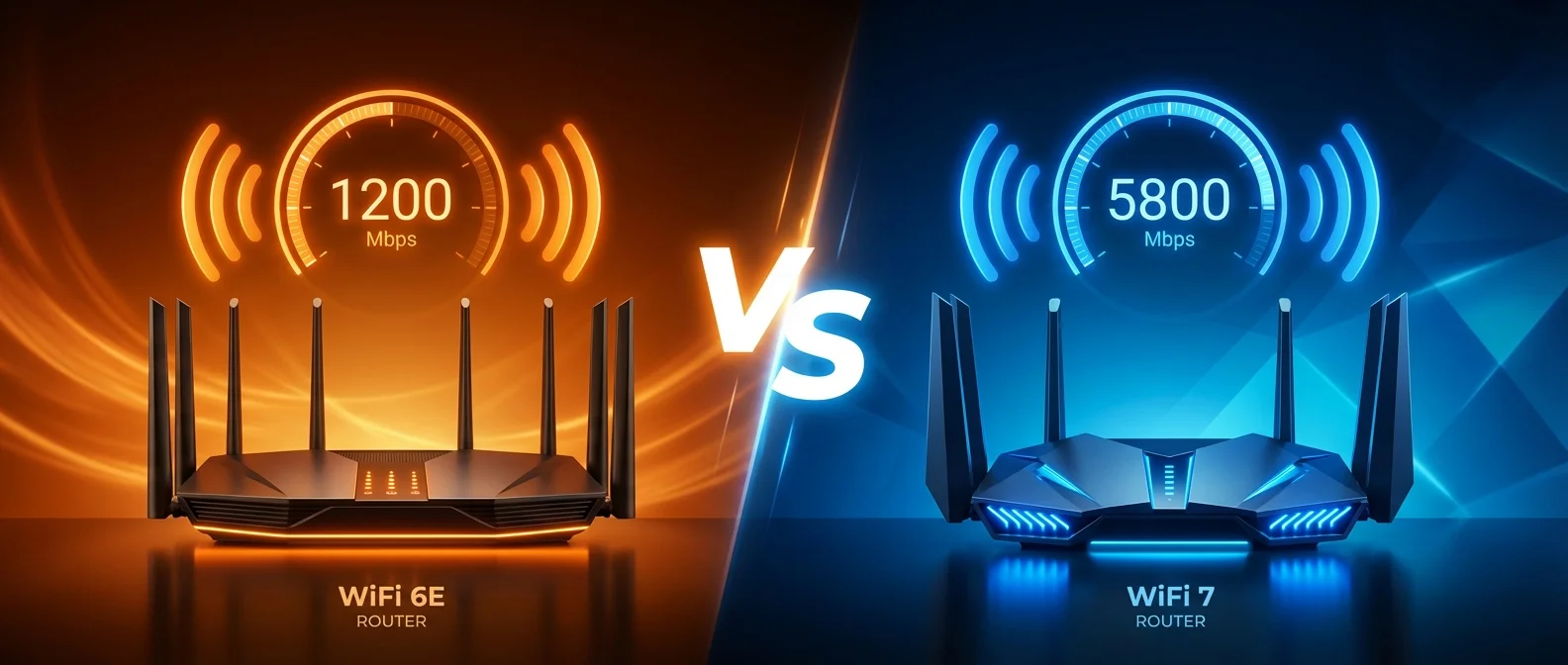
WiFi 7 routers are already on store shelves, but the price tags give you pause. Is upgrading from WiFi 6E actually worth it? Or does WiFi 6E remain the smart choice for 2026? In this article, we put both standards side by side, break down the real differences — and help you decide without the marketing fluff.
📖 Read more: WiFi 6 GHz: The Band That Changes Everything
What Are WiFi 7 & WiFi 6E?
WiFi 6E (802.11ax — Extended)
WiFi 6E isn't a new standard — it's an extension of WiFi 6 (802.11ax) into the 6 GHz band. It was approved in September 2020, after the FCC opened up the 6 GHz spectrum in April 2020. In practice, this means ~1,200 MHz of additional bandwidth on a “clean” band with minimal interference — 14 channels at 80 MHz or 7 channels at 160 MHz.
On paper, WiFi 6E tops out at ~9.6 Gbps (with 8 streams), supports OFDMA, MU-MIMO uplink/downlink, Target Wake Time for power saving, BSS Coloring for interference mitigation, and 1024-QAM modulation. The improvement over WiFi 5 (802.11ac) is impressive: 4x throughput and 75% lower latency.
WiFi 7 (802.11be — Extremely High Throughput)
WiFi 7 is a full next-generation standard — officially IEEE 802.11be. It operates on the same three bands (2.4, 5, 6 GHz) but introduces technologies that fundamentally change how data is transmitted. Theoretical maximum: ~23 Gbps — more than double WiFi 6E. How? Three key upgrades: 4096-QAM instead of 1024-QAM, 320 MHz channels instead of 160 MHz, and Multi-Link Operation (MLO) — the most significant innovation of all.
Head-to-Head Comparison
📊 WiFi 7 vs WiFi 6E — Technical Specifications
| Feature | WiFi 6E | WiFi 7 |
|---|---|---|
| IEEE Standard | 802.11ax (extended) | 802.11be |
| Year Approved | 2020 | 2024 |
| Frequency Bands | 2.4 / 5 / 6 GHz | 2.4 / 5 / 6 GHz |
| Max Theoretical Speed | ~9.6 Gbps | ~23 Gbps |
| Modulation | 1024-QAM (10 bits/symbol) | 4096-QAM (12 bits/symbol) |
| Max Channel Width | 160 MHz | 320 MHz |
| Multi-Link Operation | No | Yes |
| Preamble Puncturing | No | Mandatory |
| Resource Units per User | 1 RU | Multiple RUs |
| Real-World Speed | 0.5 – 2 Gbps | 1 – 4 Gbps |
| Router Price (2026) | €80 – €150 | €150 – €800 |
On paper, WiFi 7's advantage looks crushing. In the real world, the gap narrows: WiFi 7 is typically 1.5 to 2 times faster than WiFi 6E — meaningful, but not quite as dramatic as the theoretical figures suggest.
MLO — The Biggest Game-Changer
If there's one feature that single-handedly justifies the excitement around WiFi 7, it's Multi-Link Operation (MLO). Instead of your device connecting to one band at a time (say, only 5 GHz), MLO lets it send and receive data across multiple bands simultaneously — for example, 5 GHz + 6 GHz at the same time.
💡 What Does MLO Actually Do?
- Aggregation: Data is transmitted on two or three bands at once → combined throughput
- Redundancy: The same packets are sent on multiple links → lower latency, higher reliability
- Seamless failover: If one link hits interference, traffic shifts instantly — no disconnection
- Lower latency: Critical for gaming, video calls, and AR/VR applications
WiFi 6E can use the 6 GHz band, but the connection happens on one link at a time. If the 6 GHz band runs into trouble, the device has to perform band-steering — a process that works in theory but often causes brief hiccups in practice. With MLO, that problem disappears entirely.
Another key WiFi 7 feature is Preamble Puncturing: if a portion of a wide channel (e.g., 320 MHz) is occupied by radar or a neighboring network, WiFi 7 “punches out” just that segment and uses the rest. With WiFi 6E, the entire channel must be abandoned if there's a DFS conflict.
Where You'll Actually Notice the Difference
🎮 Gaming
This is where MLO makes the biggest impact. In online multiplayer games, latency consistency matters more than raw speed. With WiFi 7 MLO, jitter spikes drop dramatically because even if one band experiences interference, packets aren't lost. Typical latency — WiFi 7: 2–5 ms vs WiFi 6E: 5–15 ms. If you play casual games, you won't notice. If you're into competitive shooters or cloud gaming, you will.
📺 4K/8K Streaming
For streaming, even WiFi 6E is more than enough. A 4K HDR stream requires ~25 Mbps — well below what either standard delivers. The difference only shows up when you're running multiple 8K streams simultaneously across different rooms or doing live streaming at high bitrates.
💻 Remote Work / Video Calls
Zoom and Teams calls depend mainly on stable upload bandwidth. Here, WiFi 7 with MLO provides a more consistent connection, especially when someone else on the network is downloading large files at the same time. That said, a solid WiFi 6E router with proper QoS already handles this well.
🏠 Many Devices (Smart Home)
With 30+ IoT devices, robot vacuums, security cameras, smart thermostats, and tablets, WiFi 7 performs better thanks to multiple Resource Units per user and wider channels. However, most smart home devices use the 2.4 GHz band — which is unchanged between both standards.
When Is the Upgrade Worth It?
Upgrade If: You're a Gamer
Competitive online gaming, cloud gaming (GeForce NOW, Xbox Cloud), VR multiplayer — the low, stable latency from MLO justifies the price premium.
Upgrade If: Busy Household
Family of 4+ with simultaneous streaming, gaming, video calls, and IoT. The 320 MHz channels and MLO keep everything stable even at peak usage.
Wait If: No Rush
WiFi 7 prices are dropping every quarter. If there's no urgent need, you'll find WiFi 7 routers at €80–120 within 12–18 months. Until then, WiFi 6E is plenty fast.
Wait If: Budget-Conscious
A reliable WiFi 6E router costs €80–150 — half or a third of what you'd pay for WiFi 7. For the average user, the performance gap doesn't yet justify the premium.
The Greek Market Reality
In Greece, the transition to WiFi 6E was essentially completed during 2025. The three major ISPs (COSMOTE, Vodafone, Nova) now ship WiFi 6E routers as standard equipment with new fiber connections. If you have a recent FTTH/VDSL subscription, there's a good chance you're already on WiFi 6E without even realizing it.
The 6 GHz band is fully approved for WiFi in Greece (per European CEPT regulations) and — perhaps most importantly — remains nearly empty. Very few devices in Greek neighborhoods are using 6 GHz, which means minimal interference and outstanding performance even with WiFi 6E equipment.
On the retail side, WiFi 7 routers are already available in Greek electronics stores. Models like the TP-Link Archer BE800, ASUS ROG Rapture GT-BE98, and Netgear Nighthawk RS700 are on the shelves, but expect prices starting at €250 up to €800. More affordable WiFi 7 routers (under €200) are expected to become widely available in the second half of 2026.
🇬🇷 Tip for Greek Consumers
Before buying a WiFi 7 router, make sure your Internet connection can actually take advantage of it. If you're on a 100 Mbps VDSL line, neither WiFi 6E nor WiFi 7 will make your Internet any faster — you're bottlenecked by the line itself. The upgrade mainly pays off with FTTH 1 Gbps+ connections or for improving local network performance (LAN transfers, NAS streaming).
It's also worth noting that the vast majority of smartphones, laptops, and tablets used in Greece support WiFi 6 or WiFi 6E. WiFi 7 client devices are only just starting to appear: flagship smartphones (Samsung Galaxy S25 Ultra, iPhone 16 Pro) and premium laptops from the second half of 2025 onward. Mass adoption of WiFi 7 clients is expected around 2027.
"WiFi 7 is undeniably the future of wireless networking. But WiFi 6E is the present — and it's already impressively fast. If you don't have a specific reason to upgrade today, wait. Prices are falling, compatible devices are multiplying, and within a year, WiFi 7's value proposition will be unbeatable."