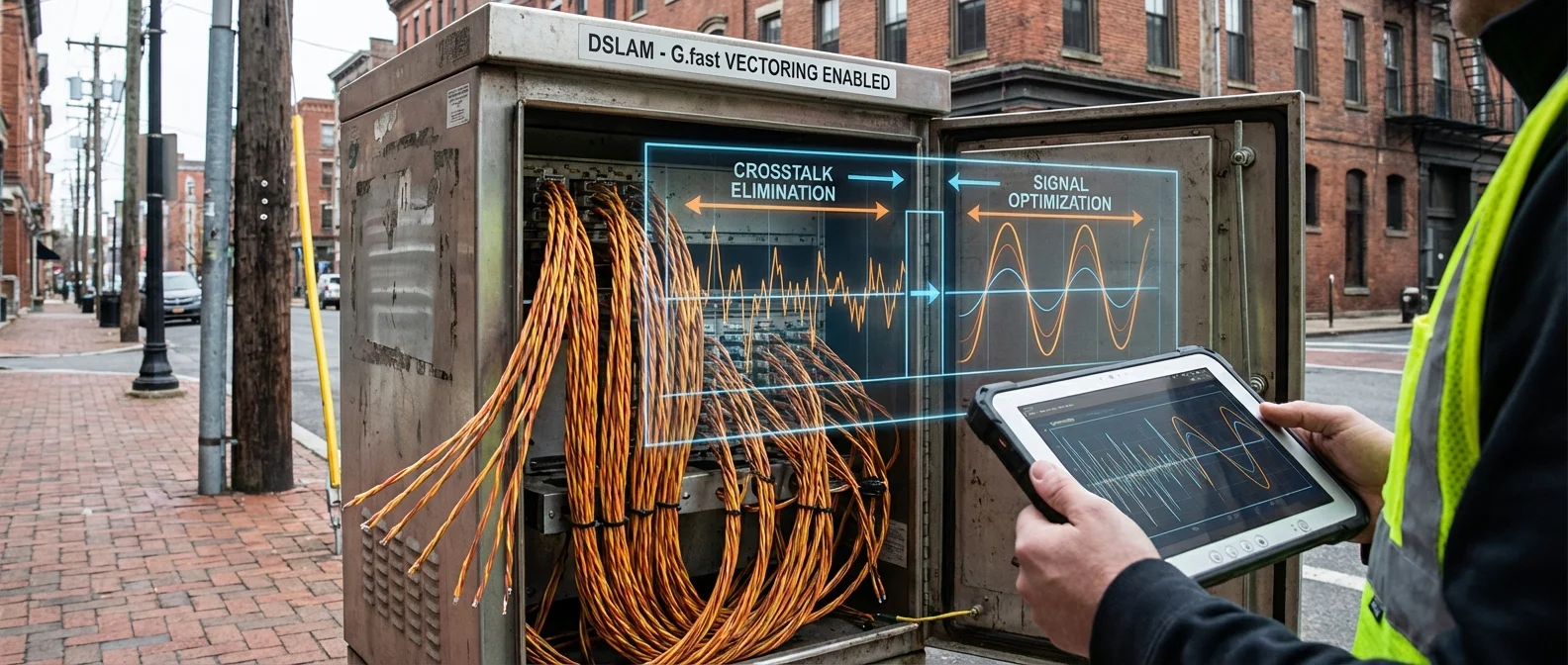
Copper has been the backbone of telecommunications for well over a century. While fiber optics steadily gains ground, millions of connections worldwide — and especially in Greece — still rely on copper pairs. Technologies like Vectoring, G.fast, and MGfast aim to squeeze every last drop of bandwidth from these aging cables, reaching speeds that once seemed impossible.
📖 Read more: Broadband Greece: Why We're Falling Behind
📡 The Evolution of DSL: From ADSL to VDSL2
The story begins with classic ADSL, which brought broadband to millions of homes at speeds of 8-24 Mbps. It was the first taste of “fast internet” for most users, but it quickly proved inadequate. The answer came with VDSL (Very-high-bit-rate Digital Subscriber Line), first published in 2001, promising speeds up to 52 Mbps downstream and 16 Mbps upstream.
The real game-changer arrived with VDSL2, standardized as G.993.2 in February 2006. VDSL2 uses frequencies up to 17.664 MHz (profile 17a) or 35 MHz (profile 30a/35b), achieving speeds up to 200 Mbps aggregate — and with the Vplus profile 35b, it reaches 300 Mbps. This was a massive leap forward, but there was a critical problem lurking beneath the surface: crosstalk.
🔇 Vectoring: The Noise Cancellation That Changed Everything
Inside a typical street cabinet, dozens or even hundreds of copper pairs run together in bundles. Each pair emits an electromagnetic signal, and these signals interfere with one another — a phenomenon known as crosstalk. The more VDSL2 lines are active in a cabinet, the worse the crosstalk becomes, and the more real-world speeds drop.
Vectoring, standardized as G.993.5 in 2010, tackles exactly this problem. The technology employs noise cancellation — essentially, the equipment at the cabinet (DSLAM) simultaneously analyzes signals across all lines, precisely calculates the crosstalk interaction between them, and sends inverse cancellation signals. The result is dramatic: each line behaves as if it were the only one in the cable, free from interference.
💡 How Vectoring Works in Practice
- Crosstalk analysis: The DSLAM measures interference between every copper pair in real time
- Anti-signal generation: Mathematically computes the exact inverse cancellation signal (precoding)
- Simultaneous application: Applied to all lines in the cabinet in parallel
- Result: Stable speeds close to the theoretical maximum, regardless of line load
In practice, Vectoring boosts real-world VDSL2 speeds by 50-100%, particularly in cabinets with many active lines. A typical VDSL2 line that would achieve 35-40 Mbps without vectoring can reach 70-100 Mbps with vectoring enabled — provided the distance from the cabinet is short enough.
Supervectoring: The German Approach
Deutsche Telekom took things a step further with Supervectoring — essentially VDSL2 Vectoring using the 35b profile. By utilizing 35 MHz of bandwidth instead of 17 MHz, combined with improved vectoring algorithms, Deutsche Telekom managed to offer speeds up to 250 Mbps downstream and 100 Mbps upstream. These are the highest speeds copper can achieve via VDSL2, representing the ultimate evolution before moving on to G.fast.
📖 Read more: Family Mobile Plans Greece 2026: Cosmote vs Vodafone vs Nova
⚡ G.fast: Gigabit Speeds Over Copper
In December 2014, the ITU-T approved G.9701 — known as G.fast. This technology represents a fundamental leap: it uses frequencies up to 106 MHz or 212 MHz, many times higher than VDSL2, and mandates vectoring by default. The result? Speeds ranging from 100 Mbps to 1 Gbps, depending on the distance.
The distance-speed relationship is critical with G.fast. At distances under 100 meters, the technology reaches 900 Mbps — nearly gigabit. At 200 meters it drops to 600 Mbps, at 300 meters to 300 Mbps, and at 500 meters just 100 Mbps. This means G.fast cannot operate from a central office — it requires equipment installed very close to the end user.
📊 G.fast: Speed by Distance
| Distance | Download | Rating |
|---|---|---|
| < 100 meters | 900 Mbps | Excellent |
| 200 meters | 600 Mbps | Very good |
| 300 meters | 300 Mbps | Good |
| 500 meters | 100 Mbps | Acceptable |
| > 500 meters | < 100 Mbps | Impractical |
DPU: Bringing G.fast to Your Doorstep
The solution to the distance problem is the DPU (Distribution Point Unit). It is a small, compact piece of equipment installed extremely close to the end user — in building basements, on utility poles, or even on boundary walls. Fiber reaches the DPU (an architecture known as FTTdp — Fiber to the Distribution Point), and from there the G.fast signal travels the final few meters over copper.
This architecture is exceptionally practical: it avoids the costly process of running fiber through building interiors — a procedure that in Greece can be technically impossible in older apartment blocks with narrow conduits or no suitable ducting infrastructure.
Apartment Buildings
A DPU in the basement or lobby delivers G.fast to every unit without internal fiber. Perfect for older buildings.
Rural Areas
A nearby DPU replaces a distant DSLAM. Dramatic speed improvement without any new in-home wiring.
Commercial Properties
Quick upgrade to near-gigabit speeds without street excavation — ideal for small and medium businesses.
📖 Read more: Fiber in Hotels: A New Era of Connectivity
🌍 Who Uses G.fast Today
G.fast is not a theoretical technology — it is already commercially deployed in several countries. Swisscom was the pioneer, launching commercial G.fast services in 2016 in Switzerland. AT&T followed in 2017 in the United States, primarily targeting apartment buildings (MDU — Multi-Dwelling Units) where internal fiber installation would be prohibitively expensive.
In the United Kingdom, Openreach (BT's infrastructure arm) deploys G.fast to millions of homes as an interim solution while the full FTTP rollout progresses. CenturyLink (now Lumen Technologies) in the US also uses G.fast to deliver gigabit-class speeds over existing copper. In every case, G.fast serves as a bridge — a transitional technology that enables gigabit speeds without fully replacing the copper last-mile.
🏆 Commercial G.fast Deployments Worldwide
- Swisscom (Switzerland, 2016): World's first commercial G.fast deployment
- AT&T (USA, 2017): Focused on apartment buildings (MDU) with 500+ Mbps speeds
- Openreach (United Kingdom): Mass deployment as an interim FTTP bridge
- CenturyLink/Lumen (USA): Gigabit-class services over existing copper
🚀 MGfast: The Future of Copper
In April 2021, the ITU-T approved G.9711 — known as MGfast (Multi-Gigabit fast access). It is the successor to G.fast, and its specifications are impressive: 424 MHz bandwidth (with plans for 848 MHz), speeds up to 8 Gbps in Full Duplex mode or 4 Gbps in TDD (Time Division Duplex). The target deployment window is 2021-2031, and the technology is primarily aimed at FTTdp scenarios where fiber reaches very close to the building.
At the research level, there is even the concept of Terabit DSL — a vision promising 1 Tbps at distances up to 100 meters, leveraging multiple copper pairs in parallel with extremely high frequencies. While still firmly in the research stage, it demonstrates that copper has not yet spoken its last word.
📊 Copper Technology Comparison
| Technology | Standard | Max Speed | Bandwidth | Status |
|---|---|---|---|---|
| VDSL | G.993.1 | 52 Mbps | 12 MHz | Legacy |
| VDSL2 | G.993.2 | 200 Mbps | 17/35 MHz | Active |
| VDSL2 Vectoring | G.993.5 | 100+ Mbps | 17 MHz | Widely deployed |
| Supervectoring | G.993.2 35b | 250 Mbps | 35 MHz | Active |
| G.fast | G.9701 | 1 Gbps | 106/212 MHz | Active |
| MGfast | G.9711 | 8 Gbps | 424/848 MHz | New standard |
| Terabit DSL | — | 1 Tbps | — | Research |
🇬🇷 Copper and FTTC in Greece
In Greece, the dominant broadband architecture remains FTTC (Fiber-to-the-Cabinet). Fiber reaches the street cabinets (known locally as KV), and from there the signal travels over copper to homes. OTE/Cosmote extensively uses VDSL2 Vectoring in these cabinets, offering speeds up to 100 Mbps for subscribers within a short distance.
The problem is that the actual distance from many homes to their nearest KV exceeds 300-500 meters, causing real-world speeds to fall well below the advertised 100 Mbps. In many areas — particularly suburbs and semi-urban zones — users see 30-50 Mbps even with VDSL2 Vectoring, simply because the copper pairs cannot carry more at those distances.
📖 Read more: Holographic Calls: 3D Video Calls of the Future
Whether G.fast will be deployed in Greece remains an open question. It could be an effective solution for densely populated urban areas in Athens and Thessaloniki, especially in older apartment buildings where internal FTTH wiring is difficult or impossible. However, Greek operators' strategy appears to lean more toward direct FTTH (Fiber-to-the-Home) — a logical choice, since fiber offers superior long-term value.
⚖️ Copper vs Fiber: When Copper Still Makes Sense
Fiber optics is undoubtedly the superior technology in the long run. It delivers 10+ Gbps, minimal latency, immunity to electromagnetic interference, and practically unlimited upgrade potential. However, there are clear scenarios where copper technologies still make sense:
Speed of Deployment
Upgrading to G.fast via DPU can be done in weeks — FTTH installation requires months to years, plus excavation and permits.
Cost
A G.fast upgrade costs 50-80% less per connection compared to new FTTH deployment, especially in densely populated areas.
Legacy Buildings
In buildings without fiber ducting, G.fast leverages existing copper pairs without renovation or interior construction work.
🔮 The Road Ahead
The evolution of copper technologies does not mean fiber is unnecessary — quite the opposite. Each new generation of DSL (Vectoring → G.fast → MGfast) brings fiber closer to the end user. Vectoring requires fiber to the cabinet (FTTC), G.fast requires fiber to the distribution point (FTTdp), and MGfast essentially brings it just meters from the home. It is a gradual approach toward the ultimate goal: FTTH everywhere.
For Greece, the realistic picture is a mixed landscape. In new developments and areas with available fiber infrastructure, FTTH will become the norm. In older apartment buildings, historic city centers, and remote areas, technologies like G.fast can bridge the gap until the full transition to fiber is complete.
The numbers speak for themselves: from 52 Mbps (VDSL) to 250 Mbps (Supervectoring), to 1 Gbps (G.fast), to 8 Gbps (MGfast), and ultimately — theoretically — to 1 Tbps (Terabit DSL). Copper is not dying; it is transforming. But to truly enjoy these speeds, we first need the fiber infrastructure to reach our neighborhoods — and that is where Greece still has a long way to go.