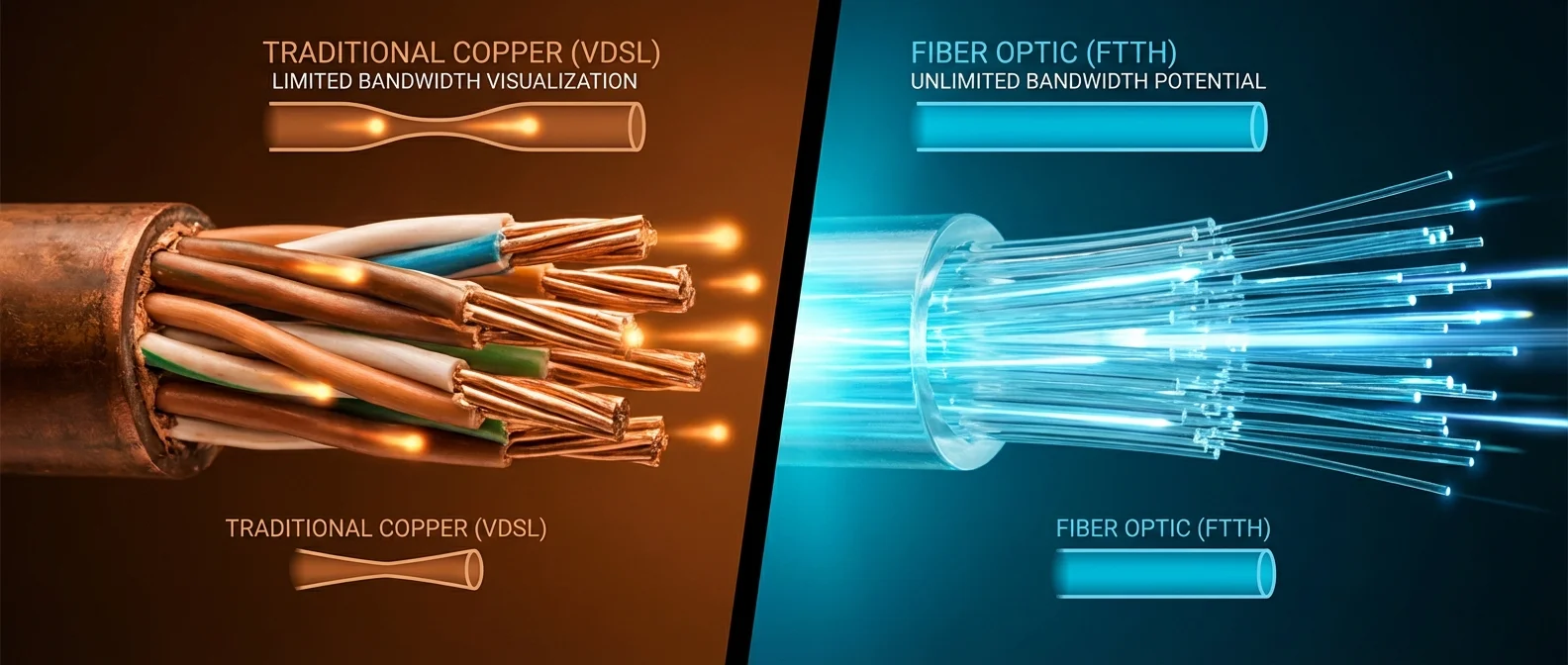
VDSL or fiber? It's the question millions of internet subscribers face — especially now that providers are pricing fiber plans almost identically to VDSL. But the truth goes far beyond marketing slogans. The difference between these two technologies is fundamental: one relies on copper wires designed for telephone calls, while the other transmits data as pulses of light through glass strands thinner than a human hair. In this in-depth guide, we put the real numbers side by side — examining speed, latency, upload, stability, and cost — to help you decide which connection truly deserves your money in 2026.
📖 Read more: Speedtest 2026: How to Measure Your Speed Correctly
⚡ What Is VDSL and How Does It Work
VDSL (Very-high-bit-rate Digital Subscriber Line) is an evolution of the familiar ADSL technology. It uses the same copper telephone wires (twisted pairs) but operates at much higher frequency bands — up to 12 MHz for VDSL1 and up to 30 MHz for VDSL2. The first version, standardized as ITU-T G.993.1 in 2001, promises up to 52 Mbit/s downstream and 16 Mbit/s upstream.
The most widely deployed version today is VDSL2 (G.993.2, February 2006), with a theoretical aggregate rate of up to 200 Mbit/s. In practice, however, speed depends dramatically on the distance between your home and the DSLAM (Digital Subscriber Line Access Multiplexer) — the provider's equipment box at the street cabinet. At the source, VDSL2 theoretically delivers 350 Mbit/s. At 500 meters, it drops to 100 Mbit/s. At 1,000 meters, just 50 Mbit/s. And at 1,600 meters? Performance falls to the same level as ADSL2+.
📍 Why Distance Matters with VDSL
Unlike fiber, copper attenuates the signal proportionally with distance. Most deployments — especially in Greece — use an FTTC (Fiber to the Cabinet) architecture: fiber reaches the street cabinet, but the “last mile” to your home remains copper. If you live 200 meters from the cabinet, you enjoy excellent speeds. If you live a kilometer away, the experience feels like the old ADSL days.
Significant improvements have been made in recent years through vectoring techniques. VDSL2 Vectoring (G.993.5) cancels crosstalk interference between adjacent copper lines, achieving a stable 100 Mbit/s at distances up to 500 meters. The more recent VDSL2+ (Vplus/35b, 2015) pushes the bar to 300 Mbit/s down and 100 Mbit/s up — but only on loops shorter than 250 meters. Deutsche Telekom deployed Supervectoring with stable 250 Mbit/s down and 100 Mbit/s up, while G.fast (G.9701, December 2014) reaches ~1 Gbps aggregate — but only within 100 meters. The even more experimental XG-FAST theoretically hits 10 Gbps, but with a usable range of just 30 meters — utterly impractical.
The bottom line is straightforward: VDSL relies on infrastructure originally designed for voice, and no matter how much it's optimized, the physics of copper impose hard limits. On top of that, loading coils present in older lines can completely block DSL signals and must be removed — yet another technical hurdle that simply doesn't exist with fiber.
🔬 What Is Fiber Optic (FTTH)
FTTH (Fiber to the Home) replaces copper entirely: optical fiber runs all the way to the wall of your home. Data travels as pulses of light through glass strands just a few micrometers thick — hence the term “fiber optic.” Typical speeds range from 1 to 10 Gbps, but what really matters is that the fiber itself isn't the bottleneck: single-mode fiber has virtually unlimited bandwidth capacity, and the only limiting factor is the terminal equipment on each end.
The most common architecture is PON (Passive Optical Network), where a single fiber from the provider is split through passive optical splitters to serve up to 128 customers. The word “passive” means no electrical power is needed at intermediate points — only at the endpoints. This drastically reduces maintenance costs and increases reliability, since there are no active electronic components in the middle that can fail.
✅ Fiber Optic Advantages at a Glance
- Speeds of 1-10 Gbps — up to 50x faster than VDSL
- Symmetrical speeds: identical upload and download
- Low latency (~5 ms vs 10-30 ms on DSL)
- No significant signal loss over tens of kilometers
- Future-proof: upgrades without rewiring
- Immune to electromagnetic interference
A critical difference often overlooked: fiber natively supports symmetrical speeds — identical download and upload. This is game-changing for remote work, video calls, cloud backup, live streaming, and gaming. With VDSL, upload is always a fraction of download (typically 5-16 Mbit/s), while fiber can deliver 500 Mbps upload if your plan supports it. Glass fiber is also immune to electromagnetic interference, humidity, and temperature fluctuations — factors that significantly affect copper performance.
📖 Read more: Vodafone Fiber: Complete Guide 2026
📊 Speed Comparison: Numbers That Speak
Let's look at the numbers in a table. Keep in mind that with VDSL, “real” speed always depends on your distance from the street cabinet, while fiber remains consistent regardless of distance.
🔄 VDSL vs Fiber — Full Feature Comparison
| Feature | VDSL2 | FTTH (Fiber) |
|---|---|---|
| Max Download | 200 Mbps (theor.) | 1-10 Gbps |
| Real-World Download (Greece) | 24-50 Mbps | 300-1000 Mbps |
| Upload | 5-16 Mbps | Symmetrical (matches download) |
| Latency | 10-30 ms | ~5 ms |
| Distance Impact | Dramatic (50% loss at 1km) | Negligible (tens of km) |
| Transmission Medium | Copper wire (twisted pair) | Glass fiber (single-mode) |
| Symmetrical Speeds | No | Yes |
| Future-proof | Limited | Virtually unlimited |
| Price (Greece 2026) | €25-35/month | €30-40/month |
| Availability (Greece) | Widespread (~80%) | Limited (~28% FTTP) |
The numbers speak for themselves. Fiber's theoretical advantage is overwhelming — but what really matters is the everyday experience. A typical VDSL user in Greece sees 24-50 Mbps, while a fiber user starts at 300 Mbps. For a 10 GB file download, that translates to ~27 minutes of waiting on VDSL versus ~2.5 minutes on fiber. That's the difference between “I'll grab a coffee while it downloads” and “it's done before I stand up.”
📶 Latency, Stability, and Upload
Download speed isn't the only metric — and in many cases, it's not even the most important one. Three additional factors make an enormous difference in daily use:
Latency (Delay)
Fiber delivers latency of ~5 ms, while VDSL typically sits at 10-30 ms. The difference shows up most in online gaming, video conferences, and real-time applications. For gamers, those milliseconds can mean the difference between victory and defeat. Copper introduces greater delay due to the nature of electrical signal propagation.
Upload Speed
VDSL upload tops out at 5-16 Mbps — insufficient for remote work, cloud backups, or streaming. Fiber offers symmetrical speeds: if you have 500 Mbps download, you can have 500 Mbps upload too. Perfect for content creators, streamers, and anyone working with large files.
Connection Stability
Copper is susceptible to electromagnetic interference, humidity, and temperature fluctuations. Glass fiber is immune to all of these, delivering consistent speeds 24/7 without the typical slowdowns during peak hours that plague DSL connections.
The upload asymmetry is arguably VDSL's greatest weakness in the modern era. With remote work, Zoom/Teams calls, cloud storage, and live streaming dominating daily use, a 10 Mbps upload creates a visible bottleneck. DSL was designed in an age when data flow was one-directional (download), and that legacy is still baked into its architecture. The DSL family started with ADSL at 8 Mbit/s, moved to ADSL2+ (24 Mbit/s), and evolved into VDSL/VDSL2 — but at every generation, copper remained the weak link.
📖 Read more: Internet Speeds in Greece vs Europe 2026: Where Do We Stand?
💰 Cost in Greece 2026
Perhaps the most pleasant surprise: the price gap between VDSL and fiber in Greece has all but disappeared. Basic VDSL plans cost roughly €25-35 per month, while equivalent fiber (FTTH) plans run €30-40 per month. For just €5-10 more each month, you get speeds that are many times faster.
All three major providers — Cosmote, Vodafone, and Nova — now offer both VDSL and FTTH packages. Cosmote (OTE) launched VDSL in Greece back in 2012, expanding the base to 1.3 million households by 2014. Today, all providers are actively pushing customers toward fiber plans, since the construction cost difference barely trickles down to the end user.
The real “catch” isn't the price — it's availability. Even if you want fiber, you might not be able to get it: FTTP coverage in Greece sits at just 28%, well below the EU average of 56%. So the first question before switching providers isn't “what do I want” but “what's available in my neighborhood.” Check availability on provider websites or through the Greek telecom regulator (EETT) before making any decisions.
🇬🇷 The Situation in Greece
Greece is in a transitional phase. The majority of households still rely on FTTC/FTTN — fiber to the cabinet with copper for the last mile — which in practice means VDSL2 with real-world speeds of 24-50 Mbps depending on distance. The country's average fixed broadband speed is 44.60 Mbit/s (February 2023), ranking 92nd worldwide — a position that reflects neither the country's economic level nor the demands of an increasingly digital society.
The technological history of Greek broadband began with consumer ADSL packages — ranging from 256 kbit/s to 25 Mbit/s — using frequencies above the 3.4 kHz voice band up to 35 MHz for VDSL2. With each upgrade, the underlying copper infrastructure remained the same, and that's reflected in today's average speeds. The Ultra-Fast Broadband (UFB) projects are underway in several regions, and the National Broadband Plan 2021-2027 targets gigabit connectivity across the entire country.
The reality, however, is that until rollout is complete, millions of households will remain stuck on VDSL. The gap between urban centers (where fiber is already deployed) and semi-urban or rural areas (still relying exclusively on copper) represents a serious digital divide that demands political will and accelerated investment.
📈 Key Numbers for Greece
- FTTP coverage: just 28% (EU average: 56%)
- Average broadband speed: 44.60 Mbit/s (92nd worldwide)
- Dominant technology: FTTC/VDSL2 (fiber to cabinet, copper to home)
- Major providers: Cosmote, Vodafone, Nova
- National Plan: gigabit connectivity by 2027
🏆 Which One Is Actually Worth It?
The answer is clear, with one caveat: fiber (FTTH) is unquestionably the superior technology — in speed, latency, upload, stability, and future-proofing. If it's available in your area, switching is a no-brainer. The price difference is minimal (€5-10/month), while the improvement in user experience is dramatic.
If FTTH isn't available yet, don't despair. A VDSL2 plan — especially if you live close to the street cabinet (within 300-500 meters) — still delivers a perfectly decent experience for most everyday needs: 4K streaming, remote work, browsing. Problems mainly surface with large uploads, latency-sensitive gaming, and households with many simultaneous devices.
Choose Fiber If...
- It's available in your area
- You work from home (remote work)
- You need high upload (streaming, cloud)
- You're a gamer or use real-time apps
- You have many devices at home
Stick with VDSL If...
- Fiber isn't available in your area
- You live close to the cabinet (<500m)
- Your needs are basic (browsing, streaming)
- You want the lowest possible price
- Upload speed isn't a priority for you
Ultimately, moving from VDSL to fiber isn't just an upgrade — it's a technology shift. It's like going from a horse cart to a car: yes, both get you from point A to point B, but the experience is on a completely different level. Check availability in your area, request a quote, and if fiber is there — don't hesitate. The speed of light waits for no one.