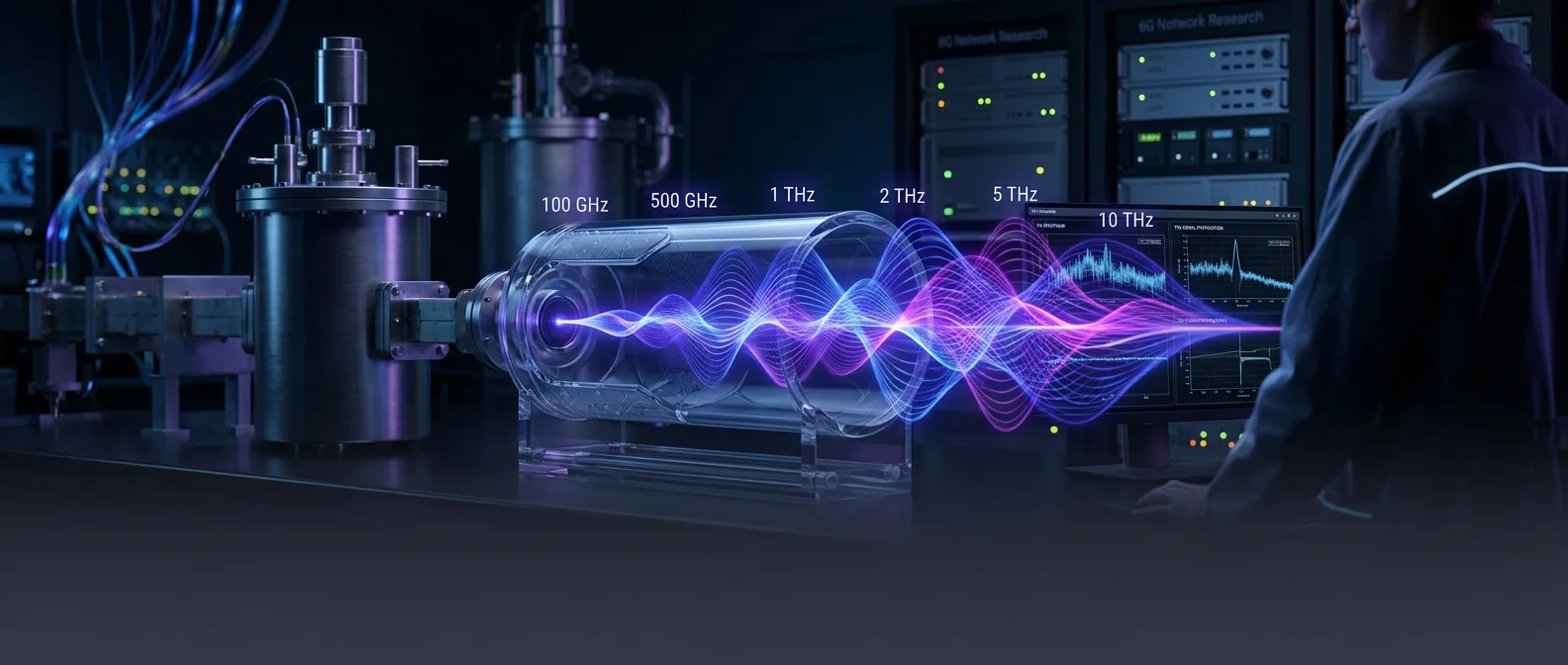
Early 2024 brought something the telecom world will debate for months. ETSI dropped two reports that reveal how 6G networks will harness terahertz technology — from remote surgery to cable-free data centers. We're talking frequencies that deliver data speeds making 5G look sluggish.
The European Telecommunications Standards Institute (ETSI) proved it's done with theory. Their new terahertz working group, launched December 2022, announced concrete use cases for 6G networks expected around 2030. What's stunning? These applications blow past every expectation.
📡 Terahertz Technology: The Future of Wireless Communications
Terahertz frequencies span 100 GHz to 10 THz. Within this range, the spectrum offers something no other technology can: massive bandwidth.
Terahertz magic doesn't stop at speed. THz signals have unique properties enabling precise detection and imaging. This means a 6G network won't just be faster — it'll be intelligent.
High-Frequency Challenges
There's a flip side. Higher frequencies mean shorter range and greater dependence on line-of-sight connections. Enter Reconfigurable Intelligent Surfaces (RIS), acting like smart mirrors for signals.
🏥 Remote Surgery: When Technology Saves Lives
Remote surgery stands as perhaps the most impressive application. According to ETSI GR THz 001, doctors will operate from anywhere globally using robotic systems.
"The idea of remote surgery with THz communications support promises to enable people to receive treatment anywhere and anytime"
ETSI GR THz 001 Report
The critical element here is ultra-low latency. One wrong move due to lag could have catastrophic consequences. Terahertz 6G networks promise sub-1ms latency — fast enough for surgeons to feel like they're in the same room as their patients.
Practical Medical Applications
Beyond surgery, the technology opens paths to remote diagnostic testing. THz frequency precision enables real-time imaging that could replace many traditional methods.
✈️ In-Flight and Train Entertainment: The End of Boredom
One of the most practical use cases involves entertainment during travel. Terahertz networks will enable 4K or 8K content streaming even on flights.
Picture this: instead of ancient airplane screens, passengers get real-time content with the same quality they have at home. Same goes for trains, where high speeds create connectivity challenges.
🤖 Smart Data Centers Without Cables
Wireless data centers represent perhaps the most revolutionary application from a technical standpoint. Imagine a data center where servers communicate via terahertz connections instead of fiber optic cables.
Speed
Extremely high data transfer speeds without physical constraints
Flexibility
Easy data center reconfiguration without rewiring
Cost
Reduced maintenance and infrastructure upgrade expenses
Benefits are obvious, but so are challenges. Line-of-sight requirements mean data center design must change radically. Plus, THz signals are sensitive to interference from humidity and other factors.
Cooperative Mobile Robots
In industrial settings, cooperative mobile robots will benefit from terahertz network precision. Robots working in hazardous environments can communicate with exceptional accuracy and coordinate movements in real-time.
🎮 Virtual and Augmented Reality: The New XR Chapter
Interactive immersive XR represents a primary 6G technology target. Today's VR headsets are limited by connection speed — a problem terahertz networks eliminate.
With speeds reaching and exceeding 100 Gbps, users will experience VR environments indistinguishable from reality. Sub-1ms latency means no motion sickness caused by current systems.
Mission Critical XR for Professionals
In industry, mission critical XR will let technicians see digital overlays on real installations with such precision they can perform complex interventions. Picture a technician repairing a jet engine while seeing internal components in AR projection.
🏭 Real-Time Industrial Control
Real-time industrial control is an application that will transform manufacturing. Factories operating with microsecond precision, where every movement synchronizes perfectly.
ETSI identified specific use cases including commissioning of industrial plants — the process of testing and optimizing new installations. With THz networks, this process can happen remotely with precision exceeding human limitations.
Fascinating detail: Terahertz networks will combine communication and sensing (ISAC - Integrated Sensing and Communications). This means the same signal carrying data can simultaneously map environments with centimeter accuracy.
🌐 Technical Challenges and Solutions
Implementing terahertz networks isn't simple. Frequencies 100 GHz and above have unique properties creating challenges.
Molecular Absorption and Atmospheric Effects
THz signals are affected by humidity and other atmospheric molecules. ETSI notes specialized channel models are needed to account for these factors.
Also, micro-mobility — small device movements — can significantly impact signal quality. This makes advanced beam tracking algorithms essential.
Advanced MIMO and AI Integration
The report states terahertz networks will rely on advanced MIMO systems and artificial intelligence for performance optimization. AI will predict user movements and adjust beams accordingly.
💡 Applications We Didn't Expect
Among the most surprising use cases are some we never imagined. Simultaneous imaging, mapping, and localization will let devices create 3D environment maps in real-time.
Grand events with ultra-high throughput will change the nature of large gatherings. Picture a stadium with 100,000 spectators where everyone has access to multi-angle streaming, AR experiences, and real-time statistics.
Intra-device Communications
Even within devices themselves, THz signals will change how components communicate. Instead of copper connections, we'll have wireless communication between processors, memory, and other parts.
🔮 Timeline and Prospects
ETSI predicts the first terahertz 6G networks will begin deployment around 2030. But some believe core 6G networks will operate at lower frequencies, between 7-20 GHz.
Companies like Ericsson and Nokia have stated 6G will primarily rely on these "centimetric" bands. Terahertz will be used for specialized applications requiring exceptional speed and precision.
Greek Research Participation
Greek universities and research centers actively participate in 6G network research through European programs. The expertise developed in coming years will be critical for Greek technological competitiveness.
⚡ A Technology That Will Change Everything
Terahertz 6G networks aren't just the next generation of mobile telephony. They're a technology that will reshape industries, create new professional categories, and enable applications that today seem like science fiction.
ETSI's research proves we're not talking about distant future. Companies are already preparing for implementation challenges. But questions remain: How quickly can we overcome technical limitations? And crucially, what will the transition to this new era cost?