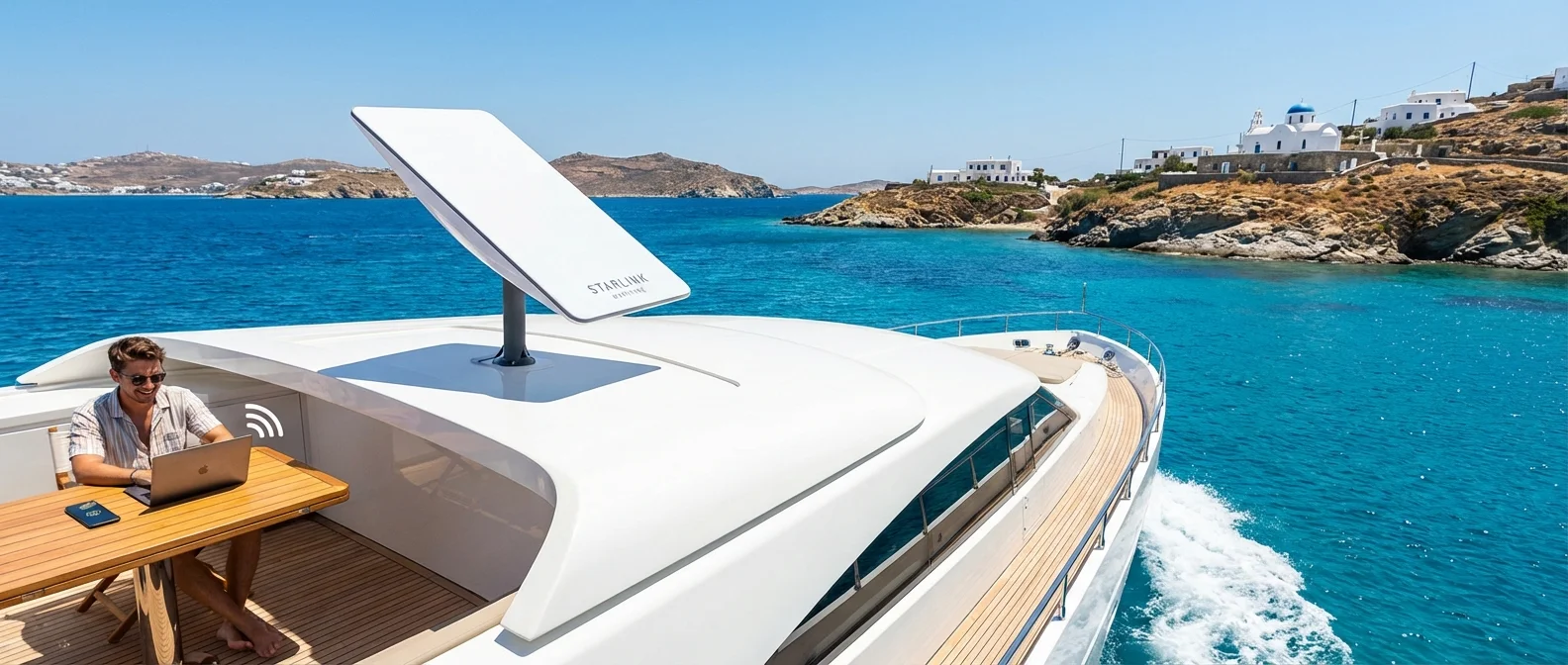
The open sea has always been the internet's last gray zone. For decades, crews and passengers endured slow, expensive, and unreliable satellite connectivity through legacy VSAT systems. SpaceX's Starlink Maritime has upended that reality, delivering speeds up to 350 Mbps in the middle of the ocean. For Greece — the world's largest shipping nation by fleet tonnage — this isn't merely a tech headline. It's a revolution in how thousands of vessels operate.
📖 Read more: Starlink Greece 2026: Prices & Experience
🚢 What Is Starlink Maritime — The Technology
Starlink Maritime is a specialized SpaceX service designed exclusively for use on ocean vessels — from massive container ships to private yachts. It uses the same LEO satellite constellation (9,422+ active as of January 2026) but with a purpose-built terminal engineered to withstand salt air, seawater spray, waves, and constant vibration.
The core technology remains the same: satellites in low orbit (550 km) deliver low latency (25-50ms at sea) and high throughput up to 350 Mbps. Coverage spans nearly the entire ocean surface, excluding only polar regions. For Greek waters — the Mediterranean and the Aegean — coverage is complete.
💰 Starlink Maritime Pricing — What It Costs
Starlink Maritime pricing isn't for the faint of heart — it's a professional-grade solution aimed at commercial shipping, cruise lines, and mega-yachts. That said, compared to legacy VSAT systems, the price-to-performance ratio is revolutionary.
Starlink Maritime Pricing Tiers
| Plan | Terminal | Monthly Fee | Speed |
|---|---|---|---|
| Maritime (Enterprise) | ~€9,200 | ~€4,600/month (50GB priority) | Up to 350 Mbps |
| Business (smaller vessels) | ~€2,300 | ~€460/month | Up to 220 Mbps |
For smaller vessels (sailboats, fishing boats, small yachts), the Starlink Business option is more realistic: ~€2,300 for the terminal and ~€460/month. Even that represents a massive improvement over the ~€3,000-15,000/month that legacy VSAT systems charge for speeds of just 2-10 Mbps.
📖 Read more: OneWeb vs Starlink vs Amazon Kuiper — Who Wins
📡 Before Starlink — The VSAT Era
To fully appreciate the scale of change Starlink Maritime represents, it helps to understand what maritime internet looked like before. VSAT (Very Small Aperture Terminal) systems relied on geostationary satellites orbiting at 36,000 km. The result? Latency of 600ms+ (video calls were impossible), speeds of 2-10 Mbps (on a good day), and costs of €3,000-15,000 per month.
Starlink Maritime vs Legacy VSAT
| Feature | VSAT (GEO) | Starlink Maritime |
|---|---|---|
| Download speed | 2-10 Mbps | Up to 350 Mbps |
| Latency | 600+ ms | 25-50 ms |
| Monthly cost | €3,000-15,000 | ~€4,600 (enterprise) |
| Hardware cost | €15,000-50,000 | ~€9,200 |
| Installation | Professional, takes days | Simpler, takes hours |
| Video calls | Impossible (600ms+) | Excellent quality |
The difference is staggering. With VSAT, even sending an email could feel like an ordeal. With Starlink Maritime, crews can make video calls to their families, stream content, and work with cloud applications — as if they were on land.
🇬🇷 Greek Shipping — Why This Matters Enormously
Greece isn't just a maritime country — it's the world's top shipping power. The Greek-owned fleet numbers approximately 5,500 vessels, controlling roughly 21% of the global fleet by tonnage. This means that every advancement in maritime internet disproportionately affects the Greek shipping industry.
For Greek shipowners, Starlink Maritime delivers multiple advantages: enhanced navigation safety through real-time data, more efficient fleet management from headquarters, better working conditions for crews (critical for recruitment and retention of seafarers), digitalization of operations (e-logs, remote diagnostics, IoT sensors), and reduced connectivity costs compared to legacy VSAT systems.
Greek Ferries & Coastal Shipping
Beyond the merchant fleet, Greek ferries represent an exceptional use case. Millions of passengers travel to the islands each year, and demand for onboard WiFi is enormous. Until now, ferry WiFi was slow (if it existed at all) and overpriced. With Starlink, ferries can offer genuine high-speed internet — streaming, social media, remote work — throughout the entire voyage.
Fishing Vessels
For Greek fishers, connectivity at sea isn't just about entertainment. Real-time weather data, maritime charts, port communications, and GPS tracking improve both safety and efficiency. The Starlink Business option (~€460/month) is affordable even for small fishing boats — especially when it replaces costlier legacy systems.
Yachting & Recreational Vessels
Greece ranks as a top yachting destination in the Mediterranean. Mega-yachts and leisure craft in the Aegean cater to clients who expect seamless connectivity. Starlink Maritime enables 4K streaming, remote work, video conferencing, and even online gaming — right in the middle of the Aegean, far from any cell tower.
📖 Read more: Starlink vs Fixed Internet: 2026 Comparison
✈️ Starlink Aviation — Extending to the Skies
It's worth noting that SpaceX didn't stop at the sea. Starlink Aviation provides in-flight internet, with airlines like Hawaiian Airlines, United Airlines, Qatar Airways, and Air France already adopting the technology. The same LEO architecture powering maritime connectivity works at 35,000 feet.
🏢 Cruise Ships — The New Passenger Experience
Major cruise lines have embraced Starlink wholeheartedly. Royal Caribbean, Carnival Cruise, Norwegian Cruise Line, and MSC Cruises are installing Starlink terminals across their fleets. An SES partnership delivers even greater bandwidth: up to 3 Gbps per ship through a corporate collaboration.
For passengers, this spells the end of slow and expensive cruise WiFi. They can now share Instagram photos in real time, make video calls, watch Netflix, or even work remotely — without the feeling of “losing” their connection the moment they step aboard.
Likewise, major shipping companies such as Maersk and Hapag-Lloyd use Starlink on their container vessels. Reliable connectivity improves supply chain management, enables remote machinery diagnostics, and significantly enhances crew living conditions.
📖 Read more: Satellite Internet for Greek Islands: Complete Guide 2026
⚠️ Limitations & Challenges at Sea
Despite the impressive advantages, several limitations merit attention:
Key Considerations
- High cost: €4,600/month for enterprise plans — not suitable for every vessel
- Severe weather: Heavy seas and intense rain can degrade the connection
- Coverage gaps: No service in polar regions (above 60° latitude)
- Antenna placement: Requires unobstructed mounting (clear of masts, antennas)
- Priority data: After 50GB priority data, speeds may be throttled
🔮 The Future of Maritime Internet
Starlink Maritime technology is evolving rapidly. SpaceX launches new satellites on an almost weekly basis, continually improving coverage and bandwidth. Expected price reductions as scale increases will make the technology accessible to an ever-growing number of vessels.
Direct-to-Cell technology will bring an even greater shift: within a few years, crews may not need specialized equipment at all — their personal smartphones will connect directly to Starlink satellites. This would completely eliminate the isolation experienced at sea.
For the shipping industry, permanent connectivity enables entirely new business models: real-time route optimization (fuel savings), automated emissions reporting (critical for ESG compliance), predictive maintenance through IoT sensors, and digitalized port procedures. The sea is gradually becoming as connected as the land.
📝 Conclusion
Starlink Maritime is arguably the biggest revolution in maritime telecommunications in decades. Speeds up to 350 Mbps, 25-50ms latency, and costs far below traditional VSAT — on oceans that were previously all but offline. For Greece, the world's top shipping power with 5,500 vessels, this technology isn't a luxury — it's a competitive necessity. From cargo ships on oceanic routes to ferries in the Aegean and superyachts off Mykonos, Starlink Maritime is fundamentally reshaping the maritime experience in the digital age.