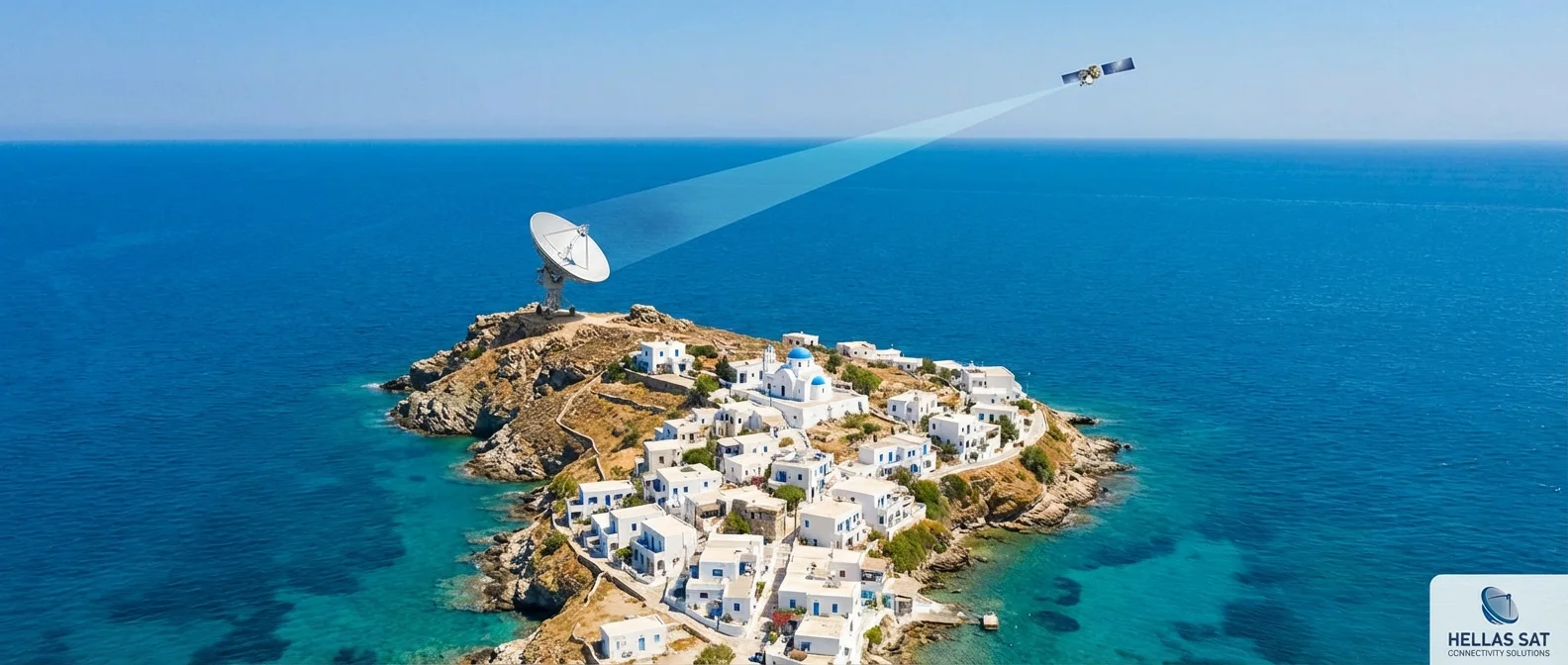
The Greek islands face unique connectivity challenges unlike anywhere else in Europe. With over 6,000 islands — roughly 227 of them permanently inhabited — Greece has one of the most geographically fragmented nations on the continent. While the mainland gradually rolls out fiber infrastructure, many islands remain stuck with sluggish DSL connections or unreliable 4G. The low Earth orbit (LEO) satellite revolution — led by Starlink — is fundamentally changing this picture. In this comprehensive guide, we explore how satellite internet can deliver reliable broadband to every corner of the Aegean and Ionian seas.
📖 Read more: Direct-to-Cell: Satellite Internet on Your Regular Phone
🏝️ The Problem: Internet on the Greek Islands
Greece holds a unique distinction in Europe: the country is made up of more than 6,000 islands and islets, scattered across the Aegean, Ionian, Cretan, and Libyan seas. Of these, only around 227 are permanently inhabited — but even that number represents a massive telecommunications challenge.
Connecting an island to the mainland internet backbone typically happens in two ways: submarine cables or radio links (microwave bridges). Submarine fiber optic cables deliver high speeds, but installation costs millions of euros per connection — especially in deep waters or areas with strong sea currents. Radio links are cheaper but offer limited bandwidth and are weather-dependent.
The result? On many small islands in the Cyclades, the Northeastern Aegean, or the Dodecanese, internet speeds rarely exceed 10-20 Mbps, and frequently drop below 5 Mbps during summer months — precisely when demand skyrockets due to tourism. An island with 500 permanent residents may host 10,000+ visitors in summer, and existing infrastructure simply cannot handle that capacity spike.
Meanwhile, the Greek government launched the "Ultrafast Broadband" (UFBB) program, targeting fiber deployment across the country. However, priority was understandably given to densely populated mainland areas. Small islands sit at the bottom of the list, and full fiber coverage could still take many years.
Even the major telecom providers — Cosmote/OTE, Vodafone, and Wind — offer mobile internet (4G/5G), but coverage varies dramatically. On popular tourist islands like Mykonos or Santorini, there is decent 5G. On a small Aegean island, there may be just a single 4G tower with limited capacity — or no stable signal at all in settlements behind mountainous terrain.
🛰️ Satellite Internet: What Changed After 2022
Until recently, “satellite internet” essentially meant one thing: geostationary orbit (GEO) satellites positioned at 36,000 kilometers above Earth. Providers like HughesNet and Viasat have used this technology for decades. The problem? Distance. Signals travel 72,000 kilometers round-trip, resulting in latency of 600ms or more. That makes real-time video calls, gaming, and even basic web browsing noticeably sluggish.
In April 2022, SpaceX launched Starlink in Greece, marking a seismic shift in the sector. Starlink uses satellites in Low Earth Orbit (LEO), at just 550 kilometers altitude — that is 65 times closer to Earth compared to geostationary satellites. This proximity translates to latency of just 25-35ms — nearly equivalent to a fixed broadband connection.
As of January 2026, Starlink has over 9,422 LEO satellites in orbit — the largest constellation in space history. It serves 10+ million active subscribers across 125+ countries worldwide. These numbers grow every month as SpaceX launches new satellites at a pace no competitor can match.
A telling precedent comes from the Fiji Islands: in May 2024, Starlink became available across 300+ islands in the Pacific, bringing reliable connectivity to communities that had never had broadband internet access. While Greece's geography is quite different, it presents analogous challenges of island fragmentation. What worked in Fiji can work in the Aegean.
📡 Starlink on the Greek Islands
How does Starlink work in practice? The user places a small satellite dish (informally called "Dishy") at their home — typically on the roof or in an open area with a clear view of the sky. The dish automatically communicates with LEO satellites passing overhead and provides connectivity through a built-in WiFi router included in the package.
Speeds for residential users typically range between 50 and 150 Mbps, depending on network congestion in the area. For the vast majority of use cases — 4K streaming, video calls, remote work, online gaming — these speeds are more than adequate. The Business tier offers speeds up to 500 Mbps with priority data and no data cap.
It is worth noting that there is a 1 TB monthly data cap for non-business users. After exceeding it, speeds are throttled during peak hours — but the connection is not cut off entirely. For a typical island household, 1 TB is generally sufficient, though heavy simultaneous 4K streaming from multiple family members could hit the limit.
📊 Starlink Plan Comparison (Europe, Feb. 2026)
| Plan | Equipment | Monthly Cost | Speeds | Data |
|---|---|---|---|---|
| Residential (Standard) | ~€549 (Gen 3) | €50-70 | 50-150 Mbps | 1 TB / month |
| Starlink Mini | ~€549 | €50-70 | Up to 100 Mbps | 1 TB / month |
| Business | ~€2,300 | ~€460 | Up to 500 Mbps | Unlimited |
The Starlink Mini is particularly appealing for the Greek islands: it is a backpack-sized portable terminal, ideal for travelers, seasonal homes, or boat owners. It delivers speeds up to 100 Mbps and can even operate while in motion. For someone who wants internet at their holiday home on an island without a permanent connection, or for a fisherman on their boat, this is a game-changer.
Island-specific considerations worth highlighting: strong sunlight does not negatively affect the satellite signal, but heat can cause thermal throttling on the terminal if there is no shade or adequate ventilation. Additionally, the powerful Meltemi winds of the Aegean can shift a dish without proper mounting, causing signal drops. Correct installation on a stable base is absolutely essential.
🔄 Alternative Solutions
Starlink is not the only option — though it is by far the most mature and accessible consumer solution available today. Let us examine the alternatives:
Eutelsat OneWeb (following the 2023 merger) operates 648 LEO satellites in a 1,200-kilometer orbit. However, the service is exclusively B2B (business-to-business): it targets telecom operators, governments, maritime companies, and airlines. There is no residential package, so it is not a direct solution for island families. It could, however, serve as a backbone connection for small local ISPs on remote islands.
Traditional GEO satellite internet (HughesNet, Viasat): Geostationary satellite internet services still exist, but their value has plummeted since Starlink arrived. With 600ms+ latency, strict data caps, and high prices, virtually no one chooses them in a market where a LEO alternative exists. The only remaining use case is highly specialized B2B applications.
4G/5G mobile routers: A common workaround is using a SIM card in a 4G/5G router. Cosmote, Vodafone, and Wind offer data packages, but coverage on small islands can be unstable — especially on mountainous terrain or in homes far from cell towers. Data caps (typically 100-200 GB/month) fall short for heavy usage, and speeds depend entirely on how many users share the same tower.
Submarine cables & Fiber: The ideal long-term solution, but installation costs millions per island and requires years of planning, permitting, and construction. Larger islands (Crete, Rhodes, Lesbos, Corfu) already have adequate infrastructure. Dozens of smaller islands will wait far longer — if they ever get fiber at all.
⚡ Practical Installation Guide
If you have decided that satellite internet is the right solution — whether on an island or in a mountainous mainland area — here is what you need to know:
First, check availability through the official Starlink website. Greece has full coverage, but there may be a waitlist in certain densely populated zones. On small islands, waitlists are rare. Ordering is done entirely online — no store visit needed — and equipment ships directly to your address. No contract commitment is required; you can cancel at any time.
Equipment
- Satellite dish (Dishy) Gen 3
- Built-in WiFi 6 router
- Power supply & 15m cable
- Mounting base (roof mount extra)
- Ethernet adapter (optional)
Installation
- Place in a spot with a clear sky view
- Starlink app scans for obstructions
- Auto-setup completes in 5-15 minutes
- No technician needed (fully DIY)
- Secure mount to withstand Meltemi winds
Troubleshooting
- Initial setup: allow 20-30 minutes
- Thermal shutdown: provide shade for dish
- Disconnections: check for obstructions
- Slow speeds: firmware updates are automatic
- Ethernet: requires Starlink adapter accessory
A critical factor on the Greek islands is proper mounting. Aegean Meltemi winds can sustain 7-8 Beaufort for days at a time. The standard tripod mount is not always sufficient — a bolt-down wall or roof mount is recommended. Some island residents position the dish behind a low wall for wind protection, as long as sky visibility remains unobstructed. Third-party heavy-duty mounts and counterweights are popular accessories.
For thermal management during summer, avoid placing the dish on dark surfaces (black rooftops) that radiate heat upward. If you experience thermal shutdowns, a small shade structure that blocks direct sun without obstructing the sky — a metal frame with stretched fabric — almost always resolves the issue.
🔮 The Future: Direct-to-Cell and Emerging Technologies
Starlink's ambitions extend well beyond home internet. The Direct-to-Cell technology — satellite connectivity delivered directly to ordinary smartphones, without any special equipment — is already being deployed. Since July 2025, satellite-based SMS service has been operational in the US through partnerships with T-Mobile, AT&T, and Verizon. Voice and data capabilities are expected in subsequent phases.
What does this mean for the Greek islands? Within 2-3 years, even on islands with no cell towers whatsoever, a regular smartphone will be able to send texts and eventually access data directly via satellite. This is transformative for fishermen at sea, sailors, hikers on remote peaks, and residents of islands beyond mobile coverage.
Meanwhile, Amazon's Project Kuiper is building its own LEO satellite constellation, with initial commercial services expected in 2026. Competition between Starlink and Kuiper is anticipated to drive lower prices and better service quality — a development particularly beneficial for island communities that until recently had no competitive options in the sector.
EETT (the Greek National Telecommunications Commission) is closely monitoring these developments. Satellite connectivity may soon be included in subsidy programs targeting island regions — similar to the broadband vouchers issued in the past. If this materializes, affordable satellite internet access will become even more attainable for island residents.
Consider the scenarios now possible: a doctor on a small island conducts telemedicine consultations over Starlink with 30ms latency; a hotel owner provides reliable 100+ Mbps WiFi to guests without depending on a shaky DSL line; a student attends remote classes without buffering; a restaurant processes POS card payments even when mobile signal drops. These are not science fiction — they are the reality of 2026, enabled by technology that already exists.
The Greek islands no longer need to be digitally isolated. The combination of LEO satellite internet, gradual expansion of submarine cable infrastructure, upgraded 4G/5G networks, and future Direct-to-Cell capabilities means that every island — from Gavdos in the south to Samothrace in the north — can achieve reliable connectivity. Digital inclusion is not a luxury; it is a fundamental need for healthcare, education, the economy, and quality of life. And low Earth orbit satellites are making it achievable for the first time in history.