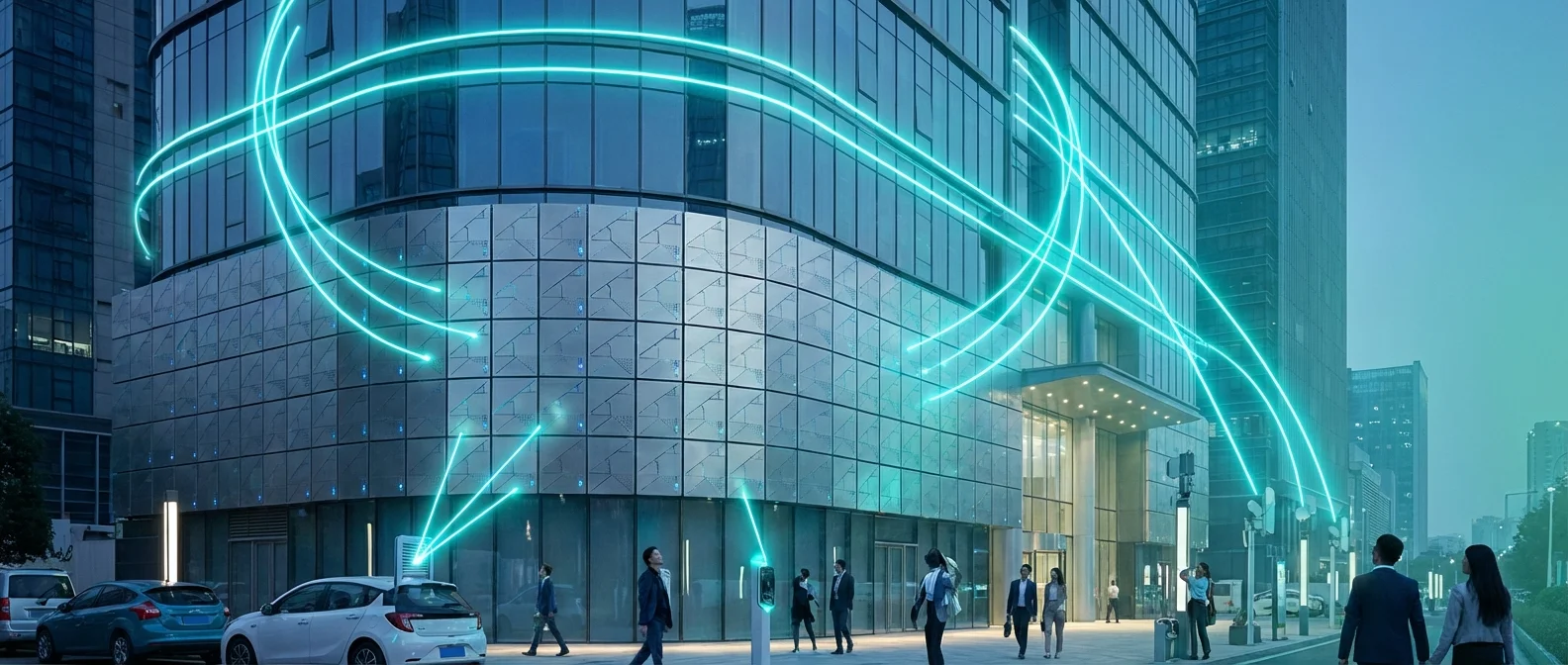
Imagine building walls, windows, and billboards not as passive obstacles for wireless signals, but as intelligent surfaces that steer, focus, and enhance connectivity in real time. That is the promise of Reconfigurable Intelligent Surfaces (RIS) — a key enabling technology for 6G networks that transforms the wireless propagation environment from uncontrollable to fully programmable.
📖 Read more: Terahertz Technology: The Foundation of 6G
What Are RIS?
Reconfigurable Intelligent Surfaces — also known as Intelligent Reflecting Surfaces (IRS) or smart metasurfaces — are large planar panels composed of thousands of programmable sub-wavelength elements. Each element is a metamaterial unit cell with a tunable electromagnetic response.
Using PIN diodes or varactors in each cell, the surface dynamically adjusts the phase and amplitude of reflected signals under software control in real time. The result: reflection, refraction, absorption, or focusing of signals precisely where they are needed.
The core operating principle is straightforward in concept: each element on the surface acts like a microscopic mirror that can change its reflection angle electronically. When thousands of these elements coordinate through a central controller, they create a programmable beam (beamforming) that follows users or simultaneously serves multiple devices. The crucial difference from traditional antennas: RIS do not transmit — they simply redirect existing signals. This means zero RF power consumption, zero noise addition, and zero need for backhaul connectivity.
A typical RIS panel can contain 1,000 to 10,000+ elements in a 1×1 meter form factor, depending on operating frequency. In mmWave bands (24-40 GHz), elements are smaller and denser, while sub-6 GHz surfaces are larger. Aesthetic flexibility is a major advantage: RIS can be integrated into building facades, windows, billboards, and even interior walls without altering the architectural character of the space.
"RIS turn every surface into an intelligent radio mirror — no active amplification, no noise, with minimal power consumption."
RIS vs Relay vs Small Cell
Today, operators use two main solutions to improve coverage in problematic areas: relays and small cells. Both require active equipment, power connections, and often backhaul links. RIS offer a radically different approach — leveraging existing transmissions without any active components. Here is the detailed comparison:
Coverage Technology Comparison
| Feature | RIS | Relay | Small Cell |
|---|---|---|---|
| Cost | €5K-€20K | €10K-€30K | €30K-€80K |
| Power Consumption | Minimal (passive) | Moderate | High |
| Noise Addition | None | Yes (amplification) | Minimal |
| Installation | Wall / Window | Pole / Mast | Infrastructure + Power |
| Backhaul | Not needed | Wireless | Fiber / Ethernet |
| mmWave Coverage | Excellent | Good | Excellent |
Use Cases
RIS unlock a wide spectrum of applications in next-generation networks:
mmWave Extension
Overcome blockage caused by buildings and human bodies in millimeter-wave bands, ensuring seamless 5G/6G coverage.
Indoor Coverage
Replace small cells indoors. Mount on walls and ceilings without power connections or backhaul infrastructure.
Physical Layer Security
Beam nulling toward eavesdroppers — signals are directed exclusively to legitimate receivers, dramatically enhancing communication security.
📖 Read more: 6G: What the Next Generation of Networks Brings
V2X Communications
Enhanced Vehicle-to-Everything signaling in urban canyons and intersections with limited line-of-sight.
Precision Positioning
Enhanced indoor positioning accuracy by leveraging controlled signal reflections for centimeter-level location services.
Energy Efficiency
Networks without active amplification — reducing the energy footprint of telecommunications by up to 40% in urban areas.
Types of RIS
The technology is evolving along three main directions:
Three Generations of RIS
- Reflective RIS: The first and most widespread form — reflects signals in a controlled direction, ideal for outdoor deployments and building facades.
- STAR-RIS (Simultaneous Transmitting & Reflecting): Simultaneous transmission and reflection — serving users on both sides of the surface, e.g., inside and outside a building through the same panel.
- Active RIS: Small signal amplification at each element — overcomes double path loss at long distances, at the cost of slightly higher power consumption.
Key Research Programs
The global research community and industry have already made significant strides toward commercial RIS deployment. From university laboratories to R&D centers of major manufacturers, RIS represent one of the hottest topics in wireless network research:
NTT DOCOMO + AGC
Transparent RIS for windows — demonstrated beam control at 28 GHz. Windows become antennas.
Samsung & Huawei
RIS-aided 6G prototypes (Samsung Research) and intelligent metasurface antenna technology (Huawei).
ETSI ISG RIS & 3GPP
Industry Specification Group established in 2021. 3GPP studying RIS integration for Release 19+.
EU RISE-6G & MIT
European Horizon 2020 multi-partner project. MIT developing self-configuring RIS with artificial intelligence.
📖 Read more: AI-Native Networks: Intelligence in 6G Antennas
RIS by the Numbers
Key Figures
- €1-€5 per element: Panels of thousands of elements cost €5,000-€20,000 — a fraction of a small cell deployment.
- ~0 Watts active consumption: Passive RIS require no RF chains, no ADC/DAC, and no power connection.
- +200% coverage: Estimates show a RIS-equipped network can more than double mmWave coverage in dense urban environments.
- 0 dB noise: Unlike relays and repeaters, RIS add zero noise to the signal.
Challenges & Obstacles
Despite the enormous potential, the technology faces significant hurdles that must be overcome before mass adoption becomes viable. The academic community is working intensively on these issues, but the transition from laboratory to market remains a substantial challenge:
Critical Challenges
- Channel State Information (CSI): Channel estimation for surfaces with thousands of elements is computationally extremely demanding.
- Standardization: Standards are still immature — ETSI ISG RIS and 3GPP Release 19+ are in early stages.
- Control latency: Real-time control of thousands of elements requires ultra-low latency at the controller level.
- Deployment planning: Optimal RIS placement in complex urban environments requires new network planning tools.
RIS in Greece
Greek geography and architecture create ideal conditions for RIS deployment. Narrow alleys, dense urban areas, islands with seasonal demand, and protected heritage buildings present scenarios where RIS can solve coverage problems that traditional solutions cannot effectively address. Greek universities including NKUA and AUTH are already researching RIS applications in urban and island environments:
Narrow Old Town Streets
Plaka, Thessaloniki's Upper Town, medieval cities — RIS can “bend” the signal around tight passages without the cost of small cells.
Islands & Tourism
Instead of expensive base stations on remote islands, RIS enhance coverage with minimal infrastructure — ideal for seasonal demand surges.
Heritage Buildings
At archaeological sites and neoclassical buildings, transparent RIS mount on windows without aesthetic disruption.
The Road to 2030
RIS are expected to become a fundamental building block of 6G networks. By 2028-2030, standardization will mature through 3GPP Release 19 and beyond, while mass production will further reduce costs. AI integration in RIS controllers will enable autonomous optimization without human intervention. Researchers estimate that by 2032, the global RIS market will exceed $5 billion, with telecommunications representing the largest application sector.
The “smart buildings” of the future will not merely be energy-efficient — they will be telecom-active, turning every wall, window, and facade into an ally of the wireless network. For countries like Greece, with intense seasonal demand fluctuations and complex urban environments, RIS promise a more flexible, economical, and sustainable connectivity solution.
"In the age of RIS, the built environment stops being the enemy of wireless connectivity and becomes its most important ally."