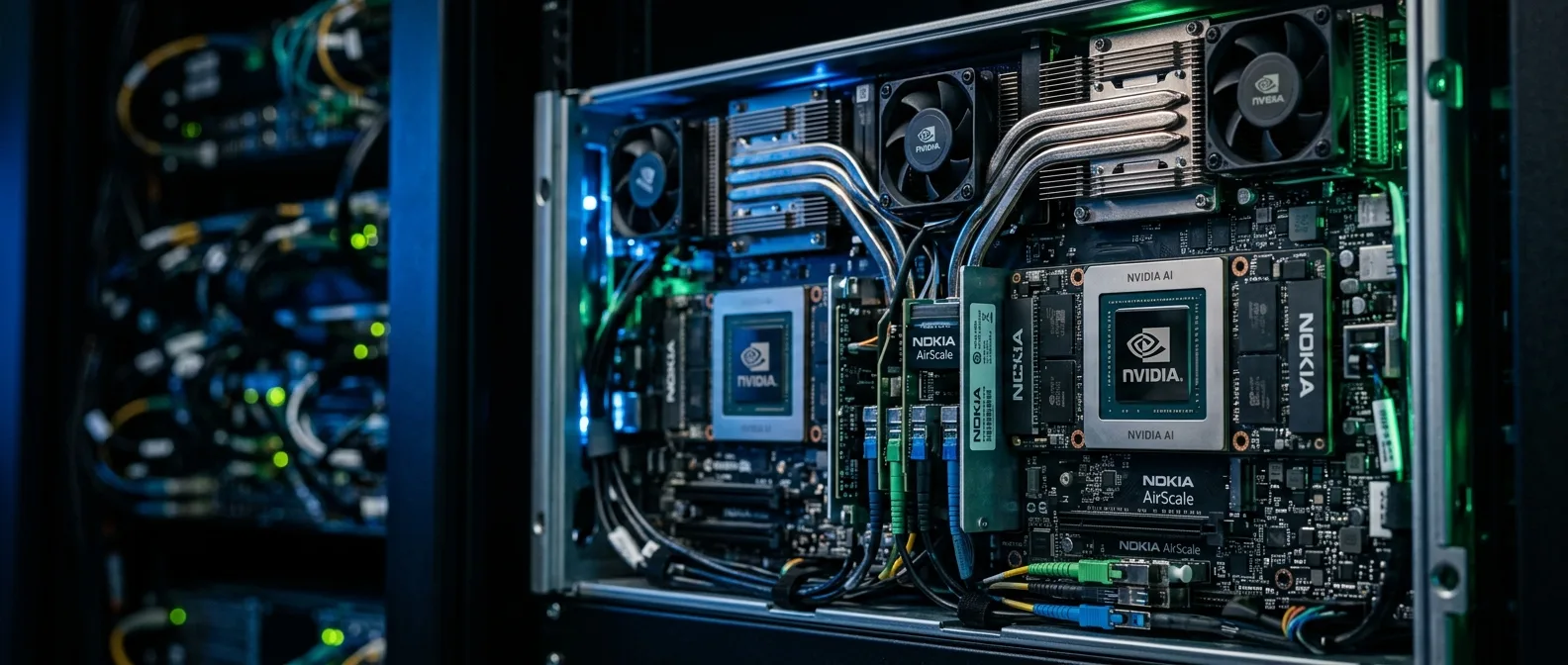
T-Mobile's CEO just dropped an ultimatum. If Nokia's AI RAN doesn't hit field trials within 12 months, he'll "get frustrated." We're talking about base stations packed with NVIDIA GPUs that could reshape 5G — and maybe 6G. The clock is ticking, and T-Mobile isn't waiting around.
T-Mobile wants to dominate AI-powered networks before anyone else. CEO Srini Gopalan made it clear: the company already has the foundation — America's first nationwide 5G Standalone network. Now it wants something more. It wants AI running directly on base stations.
The Nokia-NVIDIA-T-Mobile partnership isn't just a tech demo. It's a strategic bet on the future of telecom. And T-Mobile clearly doesn't want to wait any longer.
⚡ GPUs in Base Stations — The Revolution Begins
What exactly do we mean by AI RAN? Traditional base stations run dedicated hardware for RAN processing. Nokia's AI RAN moves these functions to NVIDIA GPUs. The result? A system that can simultaneously manage network traffic and run AI applications.
NVIDIA's ARC-Pro platform combines RAN processing with AI inferencing in a single unit. This means "idle" GPU cycles can be used for other tasks — from computer vision to traffic optimization.
T-Mobile already tested this at its AI-RAN Innovation Center in Seattle. Nokia AirScale Massive MIMO radios at 3.7 GHz served devices running video streaming, generative AI queries, and AI-based video captioning. All simultaneously, on a single NVIDIA Grace Hopper 200 server.
Sounds impressive? It is. But what about the cost?
📊 The Economics of AI Networks
Here's the tough part. GPU-based base stations cost more than traditional ones. NVIDIA knows this — that's why it invested $1 billion in Nokia, acquiring a 2.9% stake.
But T-Mobile sees the bigger picture. With NVIDIA Metropolis platform and physical AI applications, the network becomes more than a carrier. It becomes a distributed computing platform for smart cities, autonomous vehicles, and industrial automation.
Examples already being tested?
Smart City Operations with San Jose
LinkerVision, Inchor, and Voxelmaps are working with T-Mobile on "City Operations Agents." The AI monitors traffic in real time, optimizes traffic lights, and responds to incidents. Goal: 5x faster response to emergencies.
Automated Utility Inspection
Levatas and Skydio are automating inspection of hundreds of thousands of miles of power lines. Drones run AI algorithms that detect leaning poles, corrosion, and thermal hotspots. The goal? Moving from reactive to predictive maintenance.
🚀 Next Generation: From 5G Advanced to AI-Native 6G
Nokia is clear: AI RAN is the stepping stone to AI-native 6G. Instead of hardware upgrades every few years, we're building fully software-driven systems that evolve through updates.
"AI is the new workload reshaping networks. That shift requires architectural change across every layer — including the radio."
Justin Hotard, CEO Nokia
T-Mobile already has the advantage of its 5G Standalone network. Now it wants to leverage that for something no one else in the US has done: fully integrated AI infrastructure.
But it's not alone in this game. BT, Elisa, NTT DOCOMO, and Vodafone Group are also participating in AI-RAN trials. Nokia is also working with Indosat in Southeast Asia, where the first AI RAN-powered Layer 3 5G call was made.
🎯 Edge AI — When Networks Become Computers
The real breakthrough isn't the AI algorithms. It's the architecture. Traditional networks send data to the cloud for processing. AI RAN networks process data at the edge — right at the base stations.
Computer Vision
Real-time object detection and behavior analysis for security and traffic management.
Industrial Automation
Safety monitoring at construction sites and offshore facilities with instant alerts for hazardous events.
Video Analytics
Search and summarization of security footage with natural language queries — results in under 5 seconds.
Fogsphere, for example, works with SAIPEM on safety AI agents. The system detects workers under suspended loads or hydrocarbon leaks and automatically activates safety protocols. It does this 24/7, without Wi-Fi, using only 5G connectivity.
The NVIDIA Metropolis VSS Blueprint
The third version of the Video Search and Summarization blueprint brings something that sounds like science fiction: AI agents that search for specific events within hours of video footage. You give a natural language query — "find all red BMWs that passed the intersection after 3 PM" — and get an answer in seconds.
The statistic is striking: of the 1.5 billion cameras worldwide, less than 1% of recordings are ever reviewed by humans. AI changes this equation.
⚠️ The Questions That Remain
The demos look impressive. But real deployment faces problems that marketing can't solve.
First, energy consumption. GPUs are power hungry — how sustainable is it to have them in every cell tower? Second, latency. Yes, edge processing is faster than cloud, but what happens when the AI model needs massive datasets that don't fit in local storage?
Third — and perhaps most important — the business model. How exactly will a carrier monetize spare GPU cycles? Who will pay for these AI services, and how much?
T-Mobile clearly believes it can find the answers. And with its experience in 5G Standalone, it might be right. But "might" is a big word for billion-dollar investments.
🎯 Frequently Asked Questions
What's the difference between AI RAN and traditional networks?
Traditional networks use dedicated hardware for each function. AI RAN runs all workloads — RAN processing and AI applications — on shared GPU infrastructure. This allows greater flexibility and better resource utilization.
When will we see commercial deployments globally?
Major vendors are targeting Q4 2026 for commercial deployment launch. Different regions will likely follow with some delay, as carriers wait to see results from international trials.
Will this change mobile plan pricing?
Initially, probably yes — GPU-based base stations cost more. Long-term, carriers hope to monetize AI services and reduce operational costs through automation. The balance will depend on demand for edge AI applications.
T-Mobile has gone all-in to become the world's first with fully operational AI RAN. If it succeeds, it will have a years-long advantage over competitors. If not, it will have wasted millions on technology that isn't ready for mass deployment. We'll see the answer within the next 12 months — exactly as the CEO wants.
Sources: