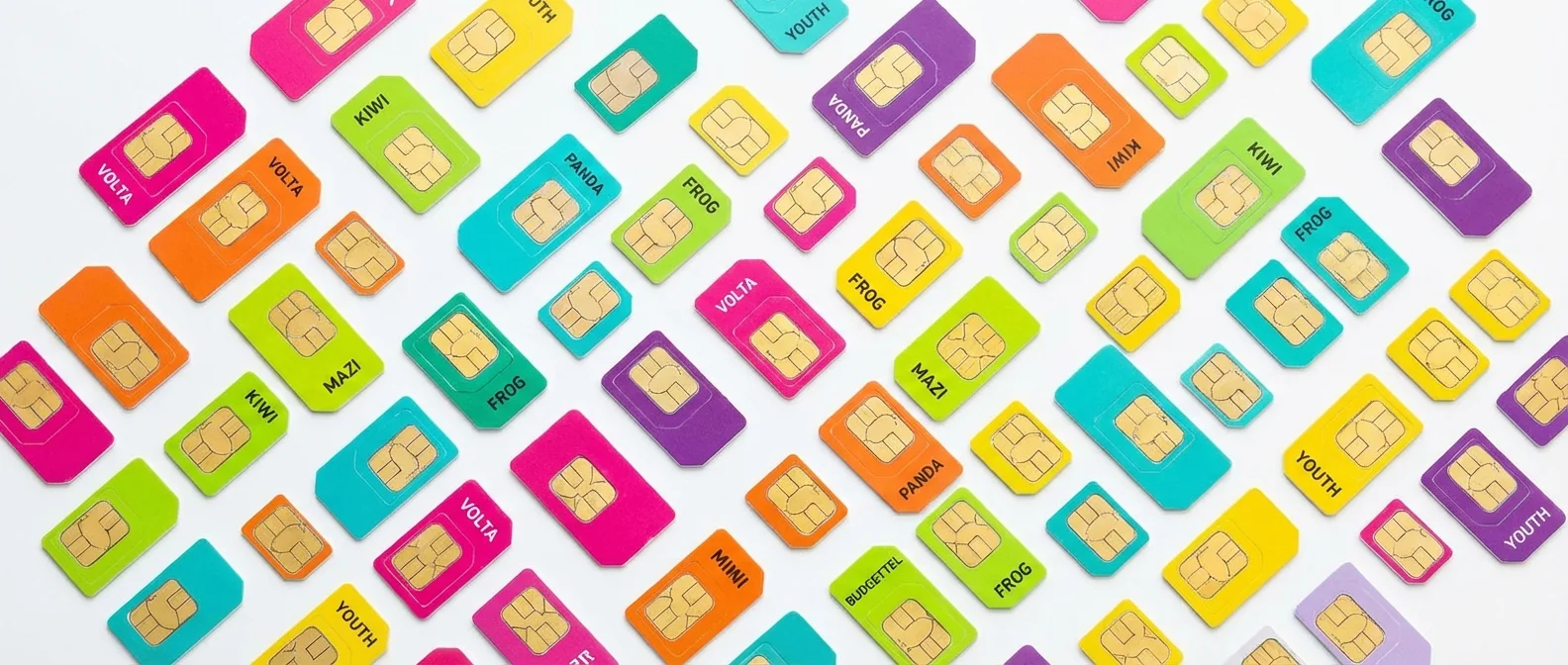
Greece remains one of the very few European Union countries with no active alternative mobile operators — known as MVNOs (Mobile Virtual Network Operators). While countries like Denmark, Germany, and the UK enjoy dozens of virtual operators that drive down prices and offer specialized plans, the Greek market is controlled exclusively by three major players: Cosmote Telekom, Vodafone, and Nova. What exactly are MVNOs, why they don't operate in Greece, and what would consumers gain if that changed?
📖 Read more: COSMOTE 5G: Setup & Configuration Guide
📱 What Are MVNOs?
An MVNO (Mobile Virtual Network Operator) is a telecommunications company that provides mobile services without owning its own radio spectrum or cell tower network. Instead, it leases network capacity from an existing operator (MNO — Mobile Network Operator), such as Cosmote or Vodafone, and sells services under its own brand with its own pricing and customer support.
The concept dates back to the late 1990s. The first MVNO agreement in Europe was Sense Communications in Scandinavia in 1997. Since then, the market has grown enormously — today there are 2,138 active MVNOs worldwide (as of August 2025), with Europe leading the charge at 1,056 operators.
Not all MVNOs are created equal. There are four main categories, depending on how independently they operate from the host MNO:
Branded Reseller
The simplest type. Resells the MNO's services under its own brand and pricing, but relies entirely on the MNO's infrastructure for billing, SIM management, and customer service.
Light / Thin MVNO
Manages its own billing and customer service, but relies on the MNO's network for switching, SIM management, and technical infrastructure.
Medium MVNO
Owns part of the infrastructure — typically a billing platform, VAS (Value-Added Services) platform, and possibly its own HLR/HSS. Greater independence in pricing and service design.
Full MVNO
The most independent type. Owns its own switching/transmission infrastructure, manages numbering, SIM cards, roaming agreements, and VAS. Only uses the MNO's radio spectrum.
The most well-known international MVNOs — such as Lycamobile, Lebara, Virgin Mobile, Tesco Mobile, and Aldi Talk — operate across multiple countries simultaneously, leveraging economies of scale. Lycamobile, for example, is active in over 20 countries, specializing in international calls — ideal for immigrant and diaspora communities.
🌍 MVNOs in Europe & Worldwide
Europe is the most mature MVNO market on the planet. With 1,056 active MVNOs, the continent accounts for nearly half of the 2,138 worldwide — reflecting both regulatory maturity and consumer demand for competition. The European Commission played a pivotal role: its 2003 recommendation urging national regulators to examine mobile competition led countries like Ireland and France to mandate wholesale network access for virtual operators.
The results of these policies are striking. In countries with mature MVNO markets, virtual operators hold significant market share:
📊 MVNO Market Share Across European Countries
| Country | Number of MVNOs | Market Share | Status |
|---|---|---|---|
| 🇩🇰 Denmark | Multiple | 34.6% | Mature market |
| 🇩🇪 Germany | 136 | 19.5% | Very mature |
| 🇬🇧 United Kingdom | 110 | 15.9% | Mature market |
| 🇫🇷 France | Multiple | 11.2% | Growing |
| 🇪🇸 Spain | Multiple | 11.5% | Growing |
| 🇬🇷 Greece | 0 | 0% | Non-existent |
Globally, the top MVNO markets are the United States (179 MVNOs), Germany (136), the United Kingdom (110), Japan (100), and Mexico (95). The worldwide average stands at 2.38 MVNOs per MNO — a figure that highlights just how unusual Greece's situation is, where three MNOs host zero virtual operators.
"Denmark, with an MVNO market share of 34.6%, proves that competition from virtual operators doesn't destroy MNOs — on the contrary, it increases overall mobile service usage and drives innovation."
📖 Read more: Unlimited Data Greece: Who Really Delivers
🇬🇷 The Greek Mobile Market
Greece's mobile market is characterized by high penetration but limited competition. With 11.326 million mobile subscriptions for a population of roughly 10.4 million, penetration reaches 109% — meaning many users maintain a second SIM card. Yet this entire market is split among just three network operators.
Cosmote Telekom (formerly Cosmote, rebranded April 2025) dominates with 7.373 million subscribers (Q2 2023) — nearly two-thirds of the market. It's owned by OTE, in which Deutsche Telekom holds a 55.6% stake. Vodafone Greece follows with 4.040 million (Q3 2026), while Nova (United Group, formerly WindHellas + Q-Telecom) rounds out the trio with 3.200 million subscribers (Q3 2023). Vodafone strengthened its position after acquiring Cyta Hellas in April 2019, gaining roughly 300,000 customers plus fiber infrastructure.
📋 Greek Network Operators (MNOs)
| Operator | Ownership | Subscribers | Market Share |
|---|---|---|---|
| Cosmote Telekom | OTE / Deutsche Telekom (55.6%) | 7.373M | ~50% |
| Vodafone Greece | Vodafone Group | 4.040M | ~28% |
| Nova | United Group | 3.200M | ~22% |
The market regulator is EETT (Hellenic Telecommunications and Post Commission), which oversees competition, pricing, spectrum allocation, and consumer rights. Despite its mandate, EETT has not yet imposed mandatory network access for MVNOs — a critical gap compared to other European countries.
❌ Why Greece Lacks MVNOs
The absence of MVNOs in Greece is no accident. It results from a combination of regulatory gaps, structural barriers, and commercial pressure from the incumbent operators. Here are the key reasons:
The Key Barriers
- Regulatory gap: EETT has not mandated wholesale access to mobile networks, unlike regulators in Ireland and France that introduced such rules following the EU's 2003 recommendation.
- Oligopolistic structure: Three operators backed by major international groups (Deutsche Telekom, Vodafone Group, United Group) have no incentive to open their networks to competitors.
- Small market: With 11.3 million connections, Greece doesn't offer the economies of scale that make MVNO investments attractive compared to markets of 50-80 million.
- Aggressive MNO pricing: The three operators maintain fairly competitive pricing among themselves, leaving little room for an MVNO to offer significantly cheaper plans.
- The Frog Mobile precedent: The failure of Greece's only MVNO has discouraged new entrants from investing.
The case of Frog Mobile deserves special attention. Frog Mobile was a Greek MVNO that launched around 2013, operating on Cosmote's network. Despite efforts to offer budget plans, it faced serious obstacles: limited scale, difficulty securing competitive wholesale rates, and simultaneous pricing pressure from MNOs who drop prices whenever a competitor appears. Ultimately, Frog Mobile ceased operations, leaving Greece without any active MVNO.
"In a market dominated by three large groups with massive financial backing, an MVNO without regulatory access guarantees is like playing football on your opponent's pitch — under their rules."
💰 What Consumers Would Gain
Introducing MVNOs to the Greek market could deliver significant benefits for consumers. The European experience clearly shows that virtual operators push prices down by 10-30% and broaden the range of choices available.
Lower Prices
In countries with MVNOs, mobile prices are 10-30% lower. A Greek MVNO could offer 15 GB plans from €8-10/month instead of the €15-18 charged by MNOs.
Specialized Plans
MVNOs like Lycamobile specialize in diaspora communities with cheap international calls. In Greece, plans for students, tourists, remote workers, or IoT would fill market gaps.
Pricing Innovation
Pay-as-you-go without monthly fees, data-only plans, eSIM-first services, shared family plans — models that MNOs are slow to adopt due to low incentive.
Pressure on MNOs
Even the mere presence of MVNOs forces MNOs to improve their services and lower prices — benefiting even those who stay with Cosmote, Vodafone, or Nova.
A telling example: in Germany, MVNOs like Aldi Talk (on O2/Telefónica's network) offer 12 GB plans with unlimited calls from just €7.99/month — prices unimaginable in the Greek market. In the United Kingdom, Tesco Mobile (O2 network) and Giffgaff (also O2) are budget heroes, while in France, MVNOs forced even the fourth operator Free Mobile to lower prices further.
For Greek consumers, an MVNO would mean in practice: cheaper prepaid plans, specialized solutions for tourists (short-term SIM/eSIM), data-only packages for tablets and laptops, and genuine freedom of choice beyond the three familiar brands.
📖 Read more: 5G on Greek Islands: Holiday Internet 2026
🔮 MVNO Prospects in Greece
Despite the current absence, there are strong reasons to believe the situation could change in the near future. Three key forces are pushing in that direction:
First, eSIM technology dramatically lowers barriers to entry. An MVNO no longer needs a physical SIM card distribution network — users download an eSIM profile digitally, activate their connection in minutes, and can switch operators without visiting a store. This means an MVNO can operate almost entirely online, slashing operational costs.
Second, the EU's Digital Markets Act (DMA) establishes new competition rules for digital sectors. While it doesn't directly target MVNOs, it sets a precedent for mandatory access regulations — something that could extend to telecommunications. The European Commission is already monitoring markets with low competition, and Greece is on the radar.
Third, the growing demand for IoT/M2M (Machine-to-Machine) connections creates a new arena for specialized MVNOs. Companies needing thousands of SIM cards for sensors, trackers, smart meters, and connected devices have very different needs from typical consumers — and an IoT-focused MVNO could fill this gap effectively.
Drivers of Change
- eSIM technology: Lowers entry costs — digital-first MVNOs can operate without physical stores
- EU Digital Markets Act: Creates a regulatory framework for mandatory access in markets with low competition
- IoT/M2M demand: Specialized MVNOs for connected devices, smart agriculture, logistics
- Tourism: 30+ million tourists annually in Greece — a massive market for short-term eSIM plans
- European pressure: Greece stands out negatively as one of the few countries without MVNOs
🛡️ What Needs to Change
For MVNOs to operate in Greece, technological readiness alone isn't enough — specific regulatory intervention is required. The necessary steps are clear:
1. Mandatory wholesale access: EETT must require at least one operator — ideally the dominant Cosmote Telekom — to provide wholesale access to its network. This means regulated wholesale rates for voice, data, and SMS, set to allow a reasonable margin for the MVNO.
2. MVNO regulatory framework: A clear legal framework defining MVNO rights and obligations is needed — numbering, number portability, quality of service, consumer protection. Greece can adopt best practices from Ireland, France, and Germany.
3. Strengthening EETT: The regulator needs a clear mandate and resources to monitor wholesale agreements, resolve disputes, and impose penalties for anti-competitive practices.
4. Entry incentives: Tax incentives or reduced licensing fees for the first MVNOs could attract international players like Lycamobile or Lebara, which already operate across multiple European markets.
Regulatory Measures
Mandatory wholesale access, regulated wholesale rates, MVNO licensing framework, quality of service oversight by EETT.
Commercial Incentives
Tax incentives for new entrants, reduced licensing fees, support for startup MVNOs through innovation hubs.
Technological Readiness
Leveraging eSIM technology, cloud-native MVNO platforms (MVNx), API-based provisioning for rapid launch.
The reality is that Greece, as an EU member state, cannot remain the “last bastion” of a mobile telephony oligopoly. The European trend toward greater competition is undeniable, and sooner or later regulatory pressure will reach the Greek market too. The question isn't whether MVNOs will come — it's when.
Until then, Greek consumers can only compare offers from the three existing operators, leverage number portability to negotiate better deals, and hope that European developments will finally bring real variety to the Greek mobile market.