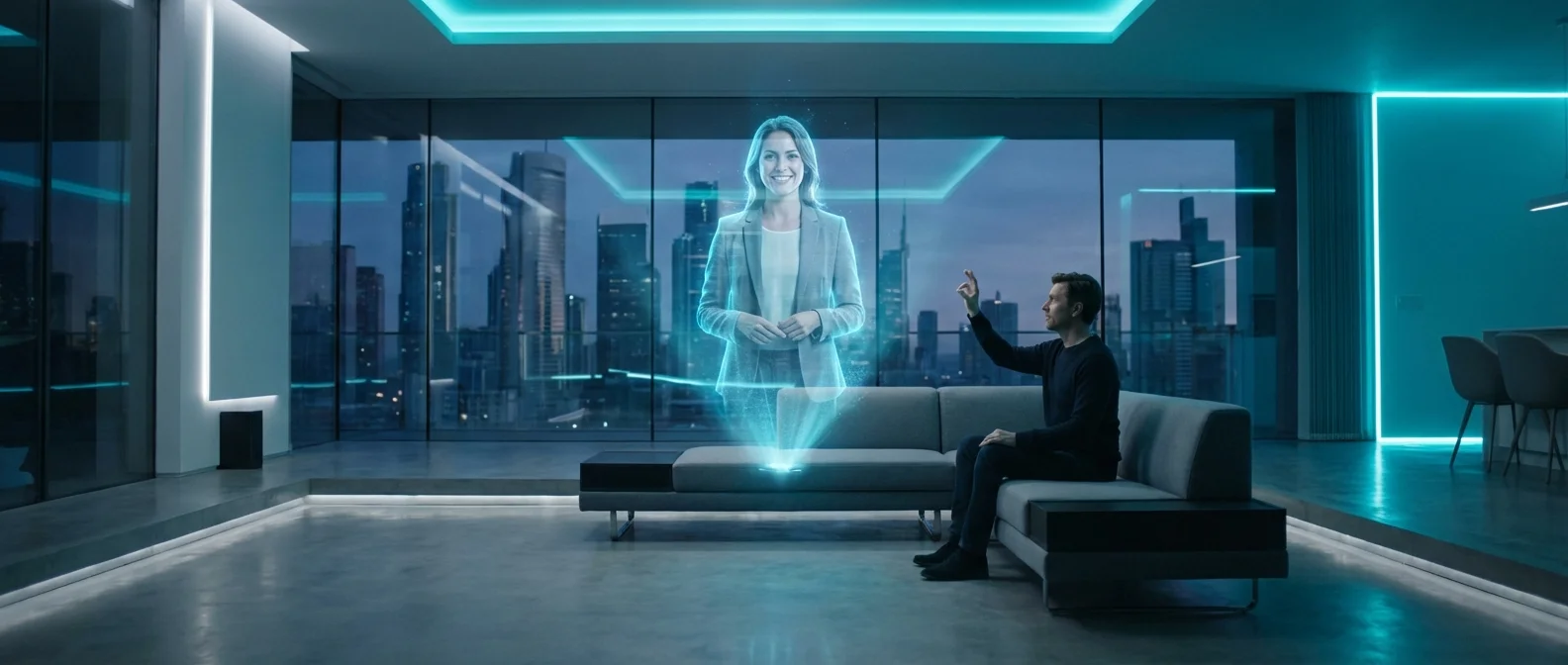
Picture a phone call where the person you're talking to appears right in front of you — in three dimensions, at full size. No glasses, no headset, nothing to hold. You're simply speaking to a hologram. This isn't a Star Wars script — it's the promise of 6G, the next generation of networks being designed right now by the world's largest telecom companies. Ericsson, Samsung, Nokia, and dozens of research institutions are actively working on technologies that will transform the video call into a full three-dimensional telepresence experience — where digital and physical reality merge into one.
📖 Read more: Open RAN: The Revolution in Mobile Networks
What Is Holographic Communication?
Holography — the technique of creating three-dimensional images through light diffraction — was born in 1947 when Dennis Gabor conceived the concept, work that later earned him the Nobel Prize in Physics in 1971. Practical holography arrived after the invention of the laser (1960) and Denisyuk's white-light reflection technique (1962), which enabled holograms viewable under ordinary light. In 1989, MIT pioneered electroholography, opening the door to digital holograms — the foundation of today's holographic communication research.
Today, holographic communication means transmitting a three-dimensional representation of a person in real time — without special glasses. The image is formed through light diffraction, making the other person look as if they're physically sitting across from you. Unlike today's flat 2D video call on a screen, a holographic call delivers a figure with depth, movement, and spatial presence.
The main technological directions include: holographic television (MIT Media Lab, researcher Michael Bove), touchable holograms (Japan and Intel — ultrasonic feedback with no physical contact needed), aerial holographic displays (Mitsubishi), and micromagnetic piston displays (IMEC, Belgium). Each approach targets the same outcome: a 3D image visible without specialized equipment.
The difference from today's video calls is fundamental. On a Zoom or FaceTime call, you see a flat two-dimensional image on a screen — a representation without depth. In a holographic call, the other person appears in full three-dimensional form: you see them from the front, from the side, even if you move around them. It's not an image — it's a presence. The technology is far from fictional: in 2011, DARPA unveiled the Urban Photonic Sand Table — a holographic 3D tactical display. In 2012, the first holographic display in a car appeared in the Lykan HyperSport. Michael Bove at MIT predicted in 2013 that mass-market holographic displays would arrive “within ten years.” Year after year, the technology gets smaller, cheaper, and more realistic.
Why Do We Need 6G for Holograms?
A true holographic call demands massive network resources — far beyond what 5G can deliver. Even the most advanced 5G deployments (peaking at ~10 Gbps with 1–5 ms latency) fall dramatically short of what a real-time hologram requires. Samsung's 6G white papers explicitly list holographic communication as a primary use case — it's literally one of the applications the next-generation network is being designed for.
6G networks target speeds of several hundred Gbps and sub-millisecond latency, according to Ericsson. Sub-THz spectrum (300 GHz – 3 THz) can deliver enormous bandwidth at local scale — enough for professional high-resolution holographic communication and advanced machine-to-machine interaction. 6G use cases also include “wide-area mass-market mixed reality” and “massive digital twinning” — both directly linked to holographic applications.
In plain terms: 5G isn't enough. A real-time hologram needs 100 times more data than a standard HD video call, and any noticeable delay shatters the illusion of physical presence. Only 6G is being designed from the ground up to handle this level of communication.
Network Comparison: What Does Holography Need?
| Feature | 5G (today) | 6G (target) | Holographic Need |
|---|---|---|---|
| Peak Bandwidth | ~20 Gbps | >1 Tbps | 100+ Gbps per user |
| Latency | 1–5 ms | <0.1 ms | <1 ms end-to-end |
| Spectrum | mmWave (24–47 GHz) | Sub-THz (300+ GHz) | Wide high-frequency bands |
| Holographic call | ✗ Insufficient | ✓ By design | Full real-time 3D |
📖 Read more: Topological Antennas: A New Era of Wireless
How Will a Holographic Call Work?
A holographic call is unlike anything we use today. Instead of a camera and microphone, it requires an entire capture, transmission, and display pipeline operating simultaneously:
The 4 Stages of a Holographic Call
- 1. Capture: Depth cameras — evolved descendants of Kinect — combined with LiDAR, create a real-time 3D model (volumetric capture) of the speaker
- 2. Compress: Raw 3D data (point cloud) is compressed into a transmittable format — from Tbps down to hundreds of Gbps
- 3. Transmit: The compressed 3D stream travels over 6G with latency <1 ms — every frame must arrive without delay
- 4. Display: Light field displays or holographic projectors render the figure in 3D — no glasses, no headset required
An additional stage under active research: haptic feedback. Japanese labs and Intel are developing ultrasonic technology that creates the sensation of touch without physical contact — you literally “feel” a hologram. Ericsson refers to this as part of the “All-Senses Meeting,” a multi-sensory communication concept that represents a core 6G research goal.
In practice, early holographic calling systems will likely use light field displays — screens that project different images from different angles, creating a sense of depth without glasses. Google's Project Starline is already the most advanced example of this approach: a specialized screen — a “magic window” — that combines 3D imaging, custom compression, and real-time rendering to show the other person in full 3D without any headset. Pilot trials are already running with T-Mobile and Salesforce, with users reporting the experience feels “like being in the same room.” The display evolution follows a clear trajectory: 2D screens → 3D screens → AR glasses → light field displays → volumetric displays — each step bringing natural presence closer to reality.
Applications Beyond Calls
Holographic technology won't be limited to personal calls. According to Ericsson, 6G bridges "physical things, people and activities into a fully cyber-physical world" — and holography is a key enabler of that merger. The concept of “massive digital twinning” means that every physical space, object, or person could have a real-time digital counterpart — and holographic displays bring those digital twins to life in three dimensions.
Telemedicine
Remote holographic medical consultations. A surgeon in another city appears in full three-dimensional form beside the patient, viewing holographic anatomical data overlays. Every hand movement is transmitted in 3D with latency under 1 ms — remote surgery gains spatial precision unimaginable today.
Education
Holographic classrooms. A professor at MIT appears in full three dimensions at a university in Athens. Students can rotate three-dimensional models of the human body, zoom in on mechanisms, interact with content — distance learning becomes an experience, not just a broadcast.
Industry
Remote maintenance using holographic experts and factory digital twins. A technician sees the specialist “standing” next to the machine, pointing exactly at which component needs replacing — dramatically cutting downtime.
Entertainment
Real-time holographic concerts and sporting events. An artist in Tokyo appears live on a stage in Thessaloniki. Immersive gaming, theater, and virtual experiences without geographical barriers — the audience feels like “being there.”
📖 Read more: 5G mmWave: What It Is & Why It Matters
Who's Working on This?
Holographic communication isn't theoretical — dozens of organizations are actively investing in making it real. The scale of commitment signals that this is not a fringe research topic but a core industrial objective for the next decade:
MIT Media Lab remains a pioneer, with researcher Michael Bove predicting mass-market holographic displays. Samsung lists holographic calling as a primary use case in its 6G white papers. Ericsson is researching multi-sensory communication through its “All-Senses Meeting” concept. Nokia is developing 6G technologies for immersive media.
In defense, DARPA developed the Urban Photonic Sand Table project (2011) — holographic 3D battlefield representations. Mitsubishi is building aerial holographic displays. In Belgium, IMEC is researching micromagnetic piston displays for 3D projection.
On the consumer front, Apple is already introducing spatial video through Vision Pro — three-dimensional memories and videos that serve as direct precursors to holographic calling. Meta is developing similar capabilities for Quest headsets. Microsoft's Mesh platform already offers mixed reality telepresence via HoloLens — holographic collaboration with 3D avatars. And in South Korea, Korea Telecom (KT) achieved one of the first live holographic calls over 5G in 2020. Low resolution, but a fully functional proof-of-concept — a clear signal of where the technology is headed.
When Will It Become Reality?
The path to holographic calling follows specific milestones. Each step builds on the previous one, with network capabilities, display technology, and compression standards all advancing in parallel:
Development Timeline
- 2024–2026 (Now): Early spatial video (Apple Vision Pro, Meta Quest). Light field display prototypes. Basic volumetric communication over 5G Advanced
- 2028: 3GPP Release 21 — the first 6G technical specifications. Defines the framework for holographic services
- ~2030: First commercial 6G networks. Pilot holographic calls in specialized environments (hospitals, enterprises)
- 2032–2035: Realistic timeline for broad consumer availability of holographic calling. Lightweight AR glasses or light field screens at home — 2D video calls start feeling “outdated”
The early signs of this transition are already visible. The 5G Advanced era (3GPP Releases 18–19) brings improvements to AR/VR streaming, extended reality, and low latency — steps that prepare both networks and the equipment industry for 6G's demands. The holographic display market is projected to reach $5.5 billion by 2030 according to Grand View Research — a clear signal that the industry takes this technology's future seriously.
The remaining challenges are far from trivial: display technology is still in its early stages, power consumption runs high, and consumer equipment costs remain prohibitive. Then again, video calling faced the exact same dynamics in the late 1990s — expensive, slow, experimental. Two decades later, it's an everyday activity.
Holographic calling is to the video call what the video call was to the landline phone — an entirely new level of human connection. It doesn't just change how we communicate; it changes how we feel present. And thanks to 6G, this shift isn't a question of “if” — it's a question of “when.” The small face on your phone screen will someday feel as quaint as a telegram does today.