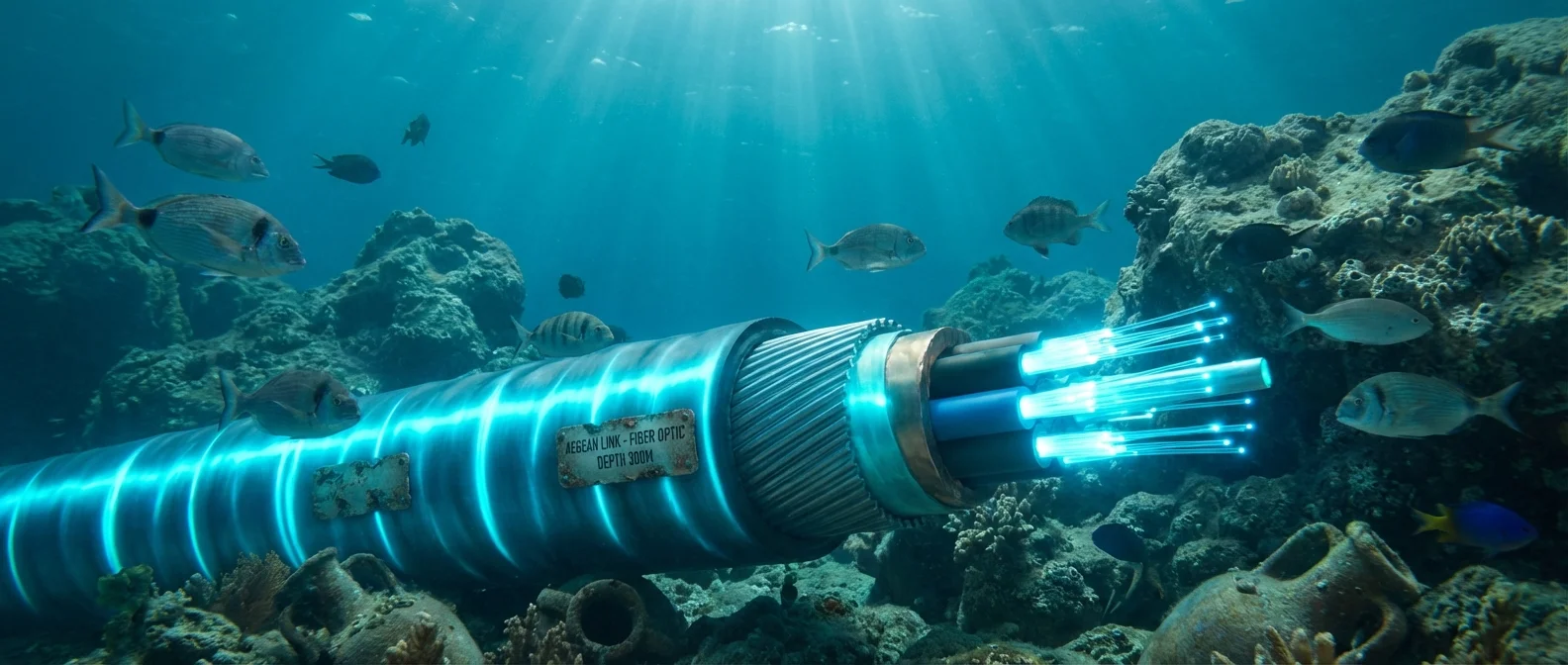
Greece has over 6,000 islands, roughly 230 of which are permanently inhabited. How do all these islands stay connected to the rest of the world? The answer lies on the seabed — in thousands of kilometers of submarine fiber optic cables that carry 99% of the planet's intercontinental data. In this guide, we explore the “invisible” digital web beneath the Mediterranean, the major international cables passing through Greece, the domestic island infrastructure, and the massive investments by Big Tech.
📖 Read more: Broadband Greece: Why We're Falling Behind
Why Submarine Cables Are Critical
In an era where satellite constellations like Starlink dominate the headlines, it's easy to forget that the backbone of the global internet sits on the ocean floor. Submarine fiber optic cables carry terabits of data per second — by comparison, even the most advanced satellite manages roughly ~1 Gbps. The difference is staggering: thousands of times more capacity.
Historically, the first transatlantic fiber optic cable was TAT-8, laid in 1988, marking the transition from older coaxial cables. Since then, technology has evolved dramatically: today a single fiber pair can carry multiple terabits thanks to WDM/DWDM (Wavelength Division Multiplexing) technology, which uses 30+ different wavelengths of light within the same fiber.
Next-generation cables now use SDM (Spatial Division Multiplexing), packing 12 to 24 fiber pairs per cable — multiplying capacity to unprecedented levels. Their diameter remains just about 25 millimeters (roughly the size of a garden hose), while repeaters are placed every ~100 kilometers to amplify the optical signal.
Greece as a Mediterranean Hub
Greece's geographical position — at the crossroads of Europe, Asia, and Africa — makes it a natural hub for submarine cables. The Eastern Mediterranean hosts dozens of cables connecting three continents, and Greece sits right at the heart of this dense network.
Here are the most significant international cables that touch Greek territory or pass through Greek waters:
Major International Submarine Cables via Greece
| Cable | Route | Notes |
|---|---|---|
| AAE-1 | Asia – Africa – Europe | Passes through Greece, ~25,000 km |
| SEA-ME-WE 3/4/5 | SE Asia – Middle East – W. Europe | Core backbone, 30+ countries |
| EMOS-1 | Greece – Israel – Turkey – Italy | Eastern Mediterranean Optical System |
| MedNautilus | Italy – Greece – Turkey – Israel – Cyprus | Key Eastern Med backbone |
| MENA | Italy – Greece – Egypt – Saudi Arabia – Oman | Middle East North Africa |
| Blue-Raman | France – Italy – Greece – Israel – Saudi Arabia – Oman | Google investment |
| 2Africa | Europe – Africa – Middle East (Mediterranean) | Meta/Facebook, 45,000 km |
| PEACE Cable | Pakistan – Africa – Europe (via Cyprus) | Pakistan & East Africa – Europe |
| APHRODITE-2 | Greece – Cyprus | Dedicated GR-CY link |
| ARIANE-2 | France – Greece | Direct Western Europe link |
| GWEN | Greece – Italy (Western Europe) | Greece to Western Europe Network |
| NAFSIKA | Italy – Greece | New high-capacity cable |
| ADRIA-1 | Croatia – Albania – Greece | Adriatic connection |
| LSP | Libya – Crete (Greece) | Libya Submarine Cable |
| Otranto–Corfù | Italy – Greece (Corfu) | Ionian entry point |
This density of cables is no coincidence. Greece serves as a “gateway” between Western Europe's transoceanic internet backbone and the Eastern Mediterranean, Middle East, and Africa. Every time you send an email to Asia or stream video from Mykonos, your data likely traverses Greek waters.
Anatomy of a Submarine Cable
What does a submarine cable actually look like? Despite the massive volume of data it carries, a modern cable is just ~25mm in diameter — roughly the size of a garden hose. Let's look at what's inside:
Protection Layers
Polyethylene, steel wire armor, copper, and aluminum. In shallow waters (<2,000m), cables are buried in the seabed using specialized equipment. In deep waters, they rest freely on the ocean floor.
Repeaters
Signal amplifiers are placed every ~100 km, powered by electrical current running through copper conductors within the cable itself. Critical for distances exceeding 300 km.
Optical Fibers
Modern SDM cables contain 12-24 fiber pairs. Each fiber uses DWDM with 30+ wavelength channels, achieving terabits/sec per pair.
Length & Cost
A typical multi-terabit transoceanic cable costs hundreds of millions of euros. Meta's 2Africa spans 45,000 km — one of the longest ever built.
WDM (Wavelength Division Multiplexing) technology is what makes the magic happen: it exploits different “colors” of light within the same fiber, creating multiple independent channels. Its evolution, DWDM (Dense WDM), allows 30+ channels — each carrying tens of Gbps.
Domestic Island Cables: Connecting Greek Islands
Beyond the major international cables, Greece maintains an extensive network of domestic submarine cables connecting inhabited islands to the mainland. These cables are the digital lifeline for Greek islands — without them, hundreds of thousands of residents would rely solely on satellite internet.
📖 Read more: COSMOTE 5G: Setup & Configuration Guide
OTE (parent company of Cosmote, Greece's incumbent telco) is the primary operator building and maintaining domestic submarine cables. These systems connect major hub islands to the mainland, while smaller islands are often linked in a “daisy chain” pattern through neighboring larger islands.
How Island Connectivity Works
- Primary landing points: Crete, Rhodes, Syros, Lesbos, and Corfu serve as major hubs for their respective island clusters.
- Daisy chain topology: Smaller islands connect through larger ones — e.g., Mykonos → Syros → Mainland Greece.
- Redundancy: Critical islands like Crete and Rhodes have multiple cable paths to prevent total disconnection if one cable fails.
- Fiber on islands: FTTH is gradually being deployed on larger islands (Crete, Rhodes, Corfu), while smaller islands rely on VDSL/xDSL or satellite as backup.
- Submarine map: OTE manages dozens of submarine cable segments linking island groups — Cyclades, Dodecanese, North Aegean, and Ionian.
The challenge is immense: Greece has a longer coastline than France due to its thousands of islands, and dozens of islands are separated by deep sea channels. Laying a new submarine cable across a cluster of Cycladic islands can require weeks of specialized cable ship work costing millions of euros.
Google, Meta & The Big Players
In recent years, major tech companies haven't just been building software — they've been constructing the very physical infrastructure of the internet. Google and Meta (Facebook) are investing billions in building privately-owned submarine cables, and the Mediterranean is at the center of this strategy.
Google — Blue-Raman
Blue-Raman is a two-segment system passing through Greece: France → Italy → Greece → Israel → Jordan → Saudi Arabia → Djibouti → Oman → India. It's part of Google Cloud's strategy for decentralized global infrastructure.
Meta — 2Africa
2Africa spans 45,000 km around Africa and the Mediterranean, connecting 33 countries across 3 continents. It's one of the largest submarine cables ever constructed — Greece sits on its northern Mediterranean segment.
Why Build Their Own?
Big Tech needs massive bandwidth for cloud computing, AI training, video streaming, and CDN. Privately-owned cables provide lower latency, greater control, and long-term cost savings compared to leasing capacity from telecom carriers.
The Mediterranean region is becoming increasingly vital for these investments as bandwidth demand grows exponentially from cloud and AI workloads. Greece, thanks to its geographic position, benefits as a landing point — attracting data centers, tech jobs, and new digital opportunities to the country.
Did You Know?
Google owns or co-owns more than 20 submarine cables worldwide. Meta follows closely with its own projects. Together, the four tech giants (Google, Meta, Amazon, Microsoft) now control a significant share of the global submarine cable infrastructure — a dramatic shift from a decade ago, when the market was dominated by traditional telecom carriers.
Vulnerabilities & Risks
Despite their critical importance, submarine cables face numerous threats — both natural and man-made. A severed cable can cut off entire countries or islands from the internet for days.
Fishing Vessels
The leading cause of damage worldwide. Trawlers and fishing boats drag nets or anchors across the seabed, cutting or crushing cables. In the Mediterranean, this happens quite frequently, especially in shallow coastal waters.
Ship Anchoring
Large cargo ships and tankers dropping anchor in the wrong spot can destroy entire cable sections — leaving a whole region without internet connectivity for days.
Earthquakes & Landslides
Greece is one of Europe's most seismically active countries. Underwater landslides triggered by earthquakes can sever cables — particularly in deep waters where they aren't buried.
Geopolitical Threats
Submarine cables are targets for espionage or sabotage. Multiple incidents in the Baltic Sea and Mediterranean in recent years have raised serious concerns about deliberate damage to critical infrastructure.
How Cable Repairs Work
Repairing a submarine cable is far from simple. It requires specialized cable ships equipped with ROVs (remotely operated vehicles) and fiber splicing equipment. The process involves locating the fault, recovering the damaged segment, splicing in a new section, and relaying it on the seabed.
Repairs can take days to weeks depending on the location, depth, and weather conditions. There are only about 60 specialized cable ships worldwide — meaning wait times can be considerable if multiple cables need attention simultaneously.
In shallow waters (under ~2,000 meters depth), cables are buried in the seabed for protection, significantly reducing the risk of anchor and net damage. In deeper waters, they rest freely on the ocean floor — making them more vulnerable to natural disasters but less exposed to human activity.
📖 Read more: MVNOs in Greece: Why Alternative Mobile Operators Don't Exist
Cables vs Satellites: A Detailed Comparison
Why can't we just replace cables with satellites? Many assume that Starlink and similar systems could make submarine cables obsolete. The comparison clearly shows why that's not the case:
Submarine Cables vs LEO Satellites
| Feature | Submarine Cables | LEO Satellites |
|---|---|---|
| Capacity | Terabits/sec per cable | ~1 Gbps per satellite |
| Latency | 5-30 ms (Europe–Asia) | 25-60 ms (LEO orbit) |
| Cost per bit | Extremely low | Very high |
| Reliability | 99.99%+ uptime | Weather/position dependent |
| Remote coverage | Adjacent landmasses only | Global coverage |
| Deployment | Months/years, high cost | Rapid activation |
| Capacity scaling | Virtually unlimited | Limited spectrum |
In practice, the two systems are complementary — not competing. Satellites are ideal for remote locations, ships at sea, aircraft, and areas where cables don't reach. But they can't come close to replacing cables for moving massive amounts of data between continents.
Economic Impact for Greece
Greece's position as a submarine cable hub isn't just a technical advantage — it's a significant economic opportunity. Every cable landing point creates demand for infrastructure and services:
- Data centers: Data flowing through Greece needs storage, processing, and rerouting — this drives data center construction near landing points.
- Tech jobs: Operating this infrastructure requires specialized technical personnel, creating high-tech employment.
- Digital tourism: Fast internet on islands boosts tourism (digital nomads, remote work, villa rental connectivity) — critical for a tourism-dependent economy.
- Geopolitical value: Hub countries gain strategic importance on the digital map, attracting investment and diplomatic relevance.
- Transit revenue: Greece can earn from data “transit” passing through its landing points, providing IP transit services to international carriers.
Greece on the Digital Map
With over 15 international submarine cables touching Greek territory, the country holds a central position on the Mediterranean's digital “railways.” Recent data center investments (Google, Microsoft) in the Attica region are directly linked to this geostrategic position — Greece is becoming a data hub, not just a tourist destination.
The Future: 5G, AI & Exponential Demand
Bandwidth demand is growing exponentially, driven by three major factors that will dominate the coming years:
5G networks — and soon 6G — require massive backhaul bandwidth. Every 5G antenna needs a fiber connection to the backbone network. For islands, this means an even greater need for high-capacity submarine cables — if you want 5G on Santorini, you first need a reliable undersea cable.
Artificial intelligence is multiplying demand: AI data centers exchange petabytes of data with extremely strict latency requirements. The Mediterranean, as a corridor between Europe and Asia, is becoming a critical link in AI infrastructure — and Greece a key node in that chain.
The Internet of Things (IoT) — billions of devices, from temperature sensors to autonomous vehicles — will dramatically increase data volumes. Even on Greek islands, smart agriculture, smart tourism, and environmental monitoring depend on stable internet delivered via submarine cables.
What to Expect in Coming Years
- New higher-capacity cables: GWEN, NAFSIKA, Blue-Raman, ARIANE-2, and projects still in planning will significantly increase capacity through Greece.
- Island connection upgrades: Cosmote/OTE is gradually upgrading domestic island cables to higher-speed fiber.
- More data centers: Google is investing in data centers in Greece, leveraging its position as a submarine cable hub.
- EU protection policies: The EU is considering new regulations to protect critical submarine infrastructure following recent incidents in the Baltic Sea.
- Next-gen SDM cables: Spatial Division Multiplexing technology with 20+ fiber pairs per cable, increasing capacity by orders of magnitude.
Conclusion
Submarine cables are the “invisible web” keeping Greece — and the entire planet — digitally connected. Without them, there would be no streaming, no cloud computing, no remote work. Greece, thanks to its unique geographic position at the crossroads of three continents, plays a central role in this global network.
From the 15+ international cables passing through Greek waters (AAE-1, SEA-ME-WE, Blue-Raman, 2Africa, EMOS-1, MedNautilus, and more) to the hundreds of kilometers of domestic island cables maintained by OTE, the country's submarine digital web is a cornerstone for tourism, the economy, and the daily lives of millions.
With bandwidth demand growing exponentially due to 5G, AI, and IoT, the importance of this infrastructure will only increase — and Greece is uniquely positioned to capitalize on this new reality. Next time you're streaming on Mykonos or video-calling from Santorini, remember: your data is traveling through thin optical fibers inside a 25-millimeter cable, on the floor of the Mediterranean Sea.