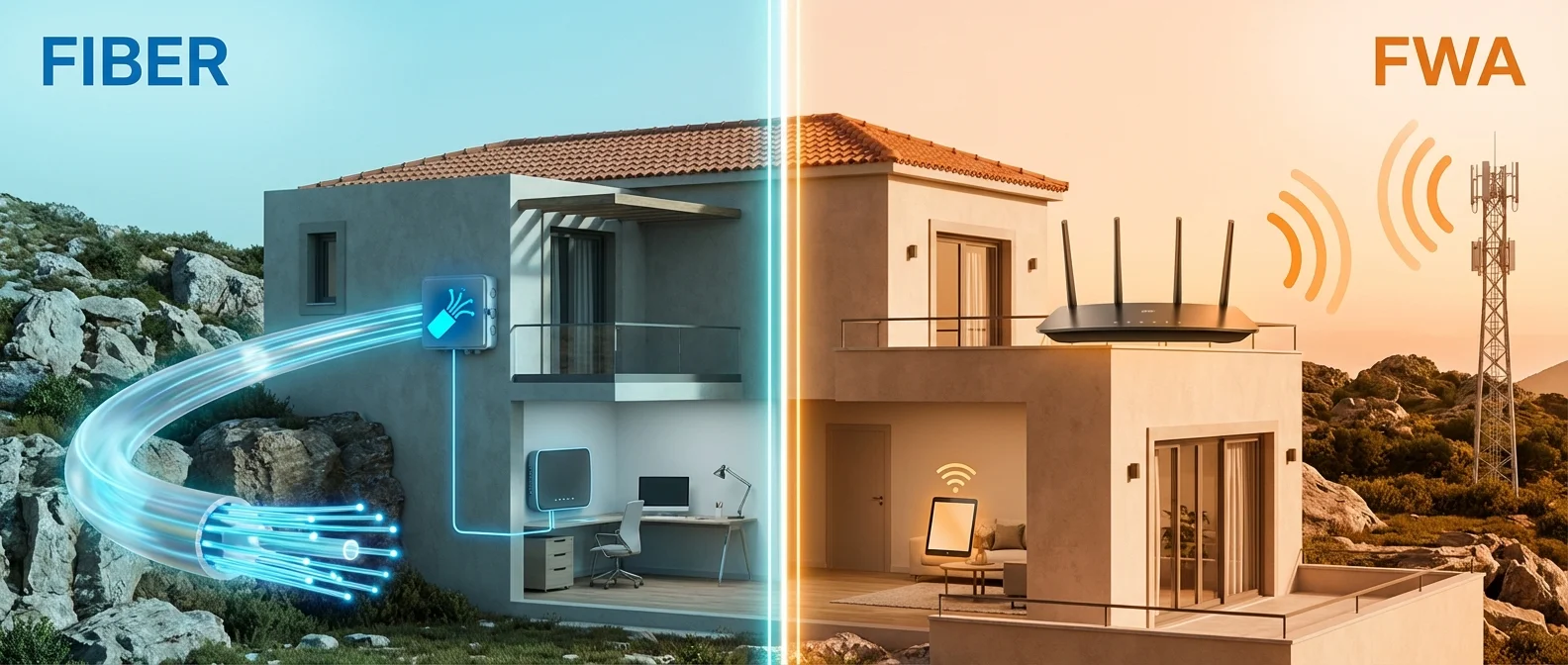
Fiber or FWA? That is the question facing thousands of households across Greece as the home internet landscape shifts rapidly. Fiber optic (FTTH/FTTP) promises symmetrical gigabit speeds, while Fixed Wireless Access (FWA) offers quick deployment with no digging required. Which connection truly deserves a place in your home? In this in-depth guide, we put both technologies under the microscope.
What Is Fiber (FTTH/FTTP)?
Fiber to the Home (FTTH) or Fiber to the Premises (FTTP) means a physical optical fiber cable runs all the way to your home or office. Unlike legacy xDSL connections that relied on copper telephone lines, fiber optic carries data via pulses of light — delivering theoretically unlimited bandwidth.
Fiber networks in Greece primarily use two architectures:
- GPON (Gigabit Passive Optical Network): The most widespread technology, offering 2.5 Gbps download / 1.25 Gbps upload shared among users on the same splitter.
- XGS-PON: The next generation, delivering 10 Gbps symmetrical — meaning identical download and upload speeds.
- Point-to-Point Ethernet: A dedicated fiber per connection, mainly used in commercial deployments.
The most compelling advantage of fiber? The glass strand itself is not the speed bottleneck — the equipment at either end determines maximum throughput. This means your connection is genuinely "future-proof": when equipment upgrades, your speeds rise without any new cabling.
Fiber Advantages
Massive Speeds
Symmetrical speeds of 1-10 Gbps. Download a 10 GB file in under 80 seconds. Ideal for multiple devices running simultaneously.
Ultra-Low Latency
Just 1-5 ms latency. Critical for online gaming, video conferencing, and real-time applications. Zero perceptible lag.
Reliability & Stability
Unaffected by weather conditions, electromagnetic interference, or distance. Consistent connection quality around the clock.
Symmetrical Upload
Perfect for remote workers, content creators, and cloud backups. Upload matches download — a unique fiber advantage.
What Is FWA (Fixed Wireless Access)?
FWA (Fixed Wireless Access) replaces the physical last-mile cable with a wireless radio link. A CPE (Customer Premises Equipment) unit — either an indoor or outdoor antenna — is installed at your home and communicates wirelessly with the nearest mobile base station.
In practice, there are two main flavours of FWA:
- 4G LTE FWA: Typical speeds of 30-100 Mbps, latency of 30-60 ms. Adequate for everyday use, but noticeably slower during peak hours.
- 5G FWA: Theoretical maximum of 1 Gbps download, real-world speeds of 100-300 Mbps, latency of 10-30 ms. A significant upgrade, yet still dependent on location and congestion.
The greatest advantage of FWA is speed of deployment: no digging, no cabling, no lengthy permit applications. A technician installs the CPE unit, configures the connection, and you are online within minutes.
FWA: Pros & Cons
Advantages
- Quick and easy installation — no excavation needed
- Ideal for rural and island areas without fiber coverage
- Competitive pricing (~€30-50/month)
- Portable — well suited for temporary living arrangements
Drawbacks
- Shared bandwidth — speeds drop during peak hours
- Higher latency compared to fiber
- Weather-sensitive (rain, snow can degrade signal)
- Speed depends on distance from the base station
- Line-of-sight issues — obstacles between antenna and tower matter
- Asymmetrical upload (significantly lower than download)
Head-to-Head: Fiber vs FWA Compared
Let us stack the two technologies side by side across every critical criterion:
Fiber vs FWA Comparison Table
| Criterion | Fiber (FTTH/FTTP) | 5G FWA | 4G FWA |
|---|---|---|---|
| Max Download | 1-10 Gbps | ~1 Gbps (theoretical) | ~100 Mbps |
| Typical Speed | 300 Mbps - 1 Gbps | 100 - 300 Mbps | 30 - 100 Mbps |
| Upload Speed | Symmetrical (= download) | 20 - 50 Mbps | 5 - 20 Mbps |
| Latency | 1 - 5 ms | 10 - 30 ms | 30 - 60 ms |
| Reliability | Excellent (99.9%+) | Good (variable) | Moderate |
| Weather Impact | None | Moderate | Noticeable |
| Installation | 1-4 weeks, excavation | 1-2 days | Same day |
| Monthly Cost | €30-50 | €30-45 | €25-40 |
| Availability (GR) | ~28% (growing) | Urban centres | Widespread |
| Gaming | Excellent | Acceptable | Problematic |
| Remote Work | Ideal | Good | Adequate |
| 4K Streaming | Effortless | Good | Depends |
The Greek Market: Providers & Availability
The Greek home internet market is in a period of transition. Fiber penetration is growing steadily but remains below the EU average, while FWA is gaining ground as a viable alternative.
Fiber Providers in Greece
- Cosmote Fiber (OTE): The largest provider, offering speeds up to 1 Gbps via GPON. Operates the most extensive FTTH network in the country.
- Vodafone FTTH: Speeds up to 1 Gbps in selected areas, with competitive fiber + mobile bundles.
- Nova Fiber: Leveraging the former Wind Hellas network, with expanding coverage across urban centres.
Government-funded programmes play a pivotal role: SFBB (Super-Fast Broadband) and UFBB (Ultra-Fast Broadband) are financing fiber rollout across Greece, targeting a dramatic increase in FTTH coverage by 2028.
FWA Providers in Greece
- Cosmote 5G Home: Speeds up to 200 Mbps in areas with 5G coverage. Priced at ~€35-45/month.
- Nova 5G Home: Same-day installation, ideal for areas without FTTH. Speeds up to 300 Mbps.
- Vodafone FWA: Both 4G LTE and 5G options, flexible plans, solid coverage in urban and many semi-urban locations.
When to Choose Fiber vs FWA
The right choice hinges on your personal needs, geographic location, and what is actually available at your address. Here are the key scenarios:
Choose Fiber if...
- It is available at your address — when fiber is an option, it should always be your first choice.
- You are a gamer — the 1-5 ms latency makes a massive difference in competitive titles.
- You work from home — symmetrical upload is essential for video calls, large file transfers, and cloud sync.
- You have many devices online simultaneously (smart TVs, tablets, laptops, IoT).
- You stream or create content — 4K/8K streaming, YouTube uploads, live streaming.
- You need maximum reliability — no fluctuations, no weather dependency.
Choose FWA if...
- Fiber is not available in your area — rural, island, or mountainous locations.
- You need to get online fast — new flat, temporary residence, quick setup.
- Your usage is fairly basic — browsing, social media, SD/FHD streaming.
- You want to avoid lengthy installation processes and excavation.
- You need a bridge solution until fiber reaches your neighbourhood.
Specific Use Cases: Gaming, Streaming & Remote Work
Online Gaming
For gamers, latency is the decisive factor. In competitive multiplayer games, the difference between 3 ms (fiber) and 25 ms (5G FWA) can determine whether you win or lose. Moreover, fiber does not suffer from jitter (latency variability), something that on FWA can cause sudden lag spikes during peak hours.
If you play casual or single-player games, 5G FWA will serve you perfectly well. But if you are serious about FPS, MOBA, or fighting games, fiber is the only sensible choice.
4K Streaming & Content Creation
4K streaming requires a stable 25+ Mbps — something both technologies can theoretically deliver. The practical difference emerges when you are streaming on multiple screens simultaneously or uploading large files. That is where fiber dominates, thanks to its symmetrical bandwidth.
For content creators uploading video to YouTube or live-streaming on Twitch, fiber's upload speed (100+ Mbps) is incomparably superior to the 20-50 Mbps of a typical 5G FWA connection.
Remote Work
Remote work demands a stable connection above all else. A dropout during a video call or sluggish cloud file synchronisation can cost you real productivity. Fiber delivers:
- Consistent upload for HD/4K video conferencing
- Low latency for real-time collaboration tools (Google Docs, Figma, etc.)
- Unchanging quality regardless of time of day or weather
5G FWA can handle remote work, but you may encounter occasional hiccups during peak hours — especially if other household members are sharing the connection.
Cost & Value
A welcome development in the Greek market: fiber and FWA cost roughly the same. Monthly plans range between €30 and €50 for both fiber and 5G FWA. This means the value per Mbps of fiber is clearly better — you pay the same yet receive significantly more.
Of course, if fiber is not available where you live, a cost comparison is moot — FWA gives you something rather than nothing, which alone fully justifies the expense.
What the Future Holds
The Greek internet market is undergoing a transformation. Here is what lies ahead:
- Fiber Expansion: The SFBB/UFBB programmes aim to dramatically increase FTTH coverage. Greece is expected to surpass 50% FTTP penetration by 2028.
- 5G Advanced & FWA: With 3GPP Release 18, 5G FWA will deliver higher speeds and lower latency, narrowing (but not eliminating) the gap with fiber.
- XGS-PON Rollout: Symmetrical 10 Gbps speeds will gradually become the new norm for fiber connections.
- Convergence: Providers will increasingly offer bundled packages — fiber + mobile, FWA as a backup line, and more.
Practical Recommendation
If fiber is available at your address, choose it without a second thought. It outperforms FWA on every metric — speed, latency, reliability, upload — at a comparable or identical price. If fiber has not yet reached your area, 5G FWA is an excellent bridge solution — far superior to legacy xDSL. For gamers and remote workers, fiber is the only real option. Check fiber availability at your address using your provider's coverage tool before making a decision.
Conclusion
The “battle” between Fiber and FWA is not really a battle at all — they are complementary technologies serving different needs. Fiber remains the gold standard of home internet: unmatched in speed, latency, and reliability. FWA, however, plays a vital role as a bridging technology, bringing decent internet to areas where fiber has not arrived yet.
For most users in Greece, the answer is straightforward: fiber if available, FWA if not. And with government programmes aggressively funding fiber expansion, availability will only continue to grow in the years ahead.