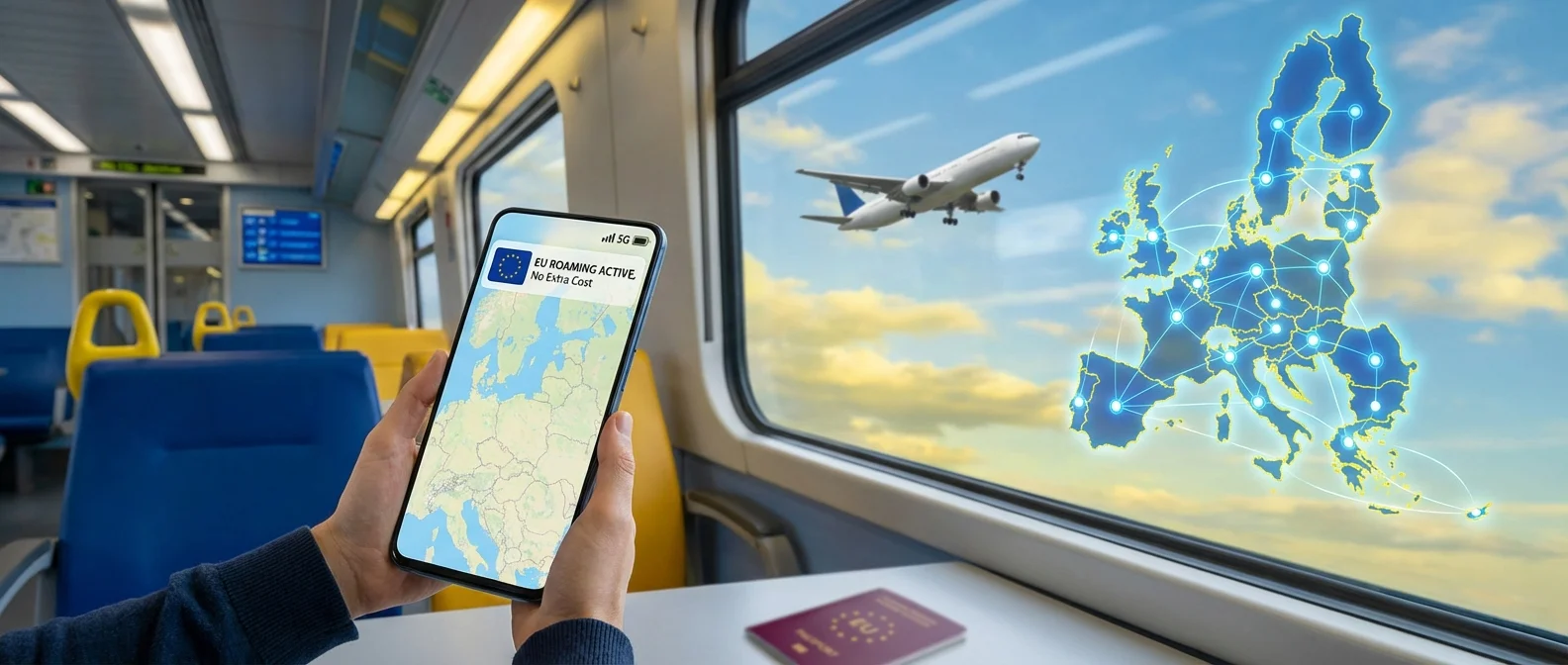
Travelling across Europe and worried about roaming charges? You don't need to be — not anymore. Since June 15, 2017, the European Union has abolished retail roaming surcharges for calls, SMS, and data within the EU/EEA, and by 2026 the rules are stronger than ever. Regulation (EU) 2022/612 guarantees free roaming until at least 2032, while this year the list of participating countries expands to include Moldova, Ukraine, and soon the Western Balkans. This is the complete guide to everything you need to know.
🌍 Roam Like at Home: The Revolution
Roam Like at Home (RLAH) stands as one of the European Union's most tangible achievements in the daily lives of its citizens. Before June 2017, a simple phone call from Rome to Athens could cost several times the domestic rate — and using mobile data while roaming was practically prohibitive. Countless travellers returned home to find bills of hundreds of euros because they forgot to disable mobile data abroad.
The EU began gradually reducing roaming fees from 2007, but full abolition came a decade later. The RLAH principle establishes something simple yet fundamental: when you travel to another EU or EEA country, you use your domestic mobile plan as if you were at home. You pay nothing extra for calls, SMS, or data — you consume them from the same bundle, under the same terms.
The impact was immediate and striking. In the first six months alone, the European Commission estimates that consumers saved €2 billion. Data roaming usage surged 17-fold compared to 2015, while voice roaming calls tripled. These numbers reveal just how much roaming charges had functioned as an artificial barrier to communication — once removed, people began using their phones abroad exactly as they did at home.
Today, the current Regulation (EU) 2022/612 secures the continuation of RLAH until 2032, mandates gradual wholesale cap reductions, requires the same quality of service during roaming as domestically — where technically feasible — and guarantees access to 112 emergency calls. The regulation's premise is clear: the EU's internal market should know no telecommunications borders.
📱 What EU Roaming 2026 Covers
Let's clarify exactly what free EU roaming covers, as misconceptions are common. The coverage applies to three core services: voice calls, SMS messages, and mobile data. When you're in an EEA member country, you can call any number (domestic or European), send texts, and use the internet exactly as you would in your home country — at no additional charge.
This applies regardless of your SIM type. The rules work identically for contract plans, prepaid SIMs, and eSIMs. If your plan includes 10 GB of data at home, those same 10 GB are available to you in Berlin, Paris, or Lisbon — with one important caveat called the Fair Use Policy, which we'll explore below.
One point many overlook concerns quality of service. The 2022 regulation introduced an explicit obligation: your operator must provide the same network speeds during roaming as it does domestically, insofar as the visited network technically supports it. In other words, if you use 5G at home, you should have access to 5G abroad — provided the local partner network offers it. This quality clause was a significant addition, as some operators had previously downgraded roaming speeds to 3G or even 2G.
Finally, access to the European emergency number 112 is guaranteed in every roaming situation, free of charge, even if you have no credit or active plan.
🗺️ Participating Countries
The RLAH country list in 2026 is the most extensive it has ever been. It encompasses 32 countries: the 27 EU member states (Austria, Belgium, Bulgaria, Croatia, Cyprus, Czech Republic, Denmark, Estonia, Finland, France, Germany, Greece, Hungary, Ireland, Italy, Latvia, Lithuania, Luxembourg, Malta, Netherlands, Poland, Portugal, Romania, Slovakia, Slovenia, Spain, Sweden) plus three EFTA/EEA nations (Iceland, Liechtenstein, Norway) and, as of January 2026, Moldova and Ukraine.
This represents a significant expansion. The inclusion of Moldova and Ukraine within the RLAH framework is part of a broader political convergence with the EU and signals the gradual telecommunications integration of Eastern Europe. For Greek citizens visiting these countries — whether for work, studies, or humanitarian missions — this translates to meaningful savings.
Equally significant is the anticipated inclusion of the Western Balkans during 2026. Albania, Bosnia & Herzegovina, Kosovo, Montenegro, North Macedonia, and Serbia are in advanced negotiations to join the RLAH zone. If realized, the free roaming zone would effectively span the entirety of continental Europe — a particularly important development for Greeks who frequently travel to neighbouring Balkan countries for tourism or business.
⚖️ Fair Use Policy: The Rules
Free roaming does not mean unlimited usage without any caps. The European Commission established the Fair Use Policy (FUP) to prevent cases of permanent roaming — that is, someone purchasing a cheap plan in one country and using it permanently in another, exploiting price differences. Such behaviour would jeopardize the sustainability of the entire model.
The FUP operates on clear rules. For voice calls and SMS, the situation is straightforward: if your plan includes unlimited calls and texts domestically, the same applies while roaming — no FUP ceiling at all. The fair use policy primarily applies to mobile data, where a mathematical formula determines the roaming data volume you're entitled to: (retail price excluding VAT ÷ wholesale data cap) × 2.
How FUP Data Is Calculated
The Fair Use Policy applies only to mobile data. The calculation formula:
- Formula: FUP Data = (retail price excl. VAT ÷ wholesale data cap) × 2
- Example (2025): €20/month plan → €16.13 excl. VAT → (16.13 ÷ 1.55) × 2 = 20.8 GB roaming data
- Exceeding FUP: If you go over, the surcharge equals the wholesale cap + VAT (max ~€1.55/GB + VAT in 2025)
- Voice & SMS: No FUP — if unlimited domestically, unlimited in roaming too
- Notification: Your operator must alert you when you reach 80% of your FUP limit
In practice, the FUP is a non-issue for most travellers. If you're on holiday or a business trip lasting a few weeks, you'll use your data normally without approaching the limit. The FUP targets exclusively those cases where someone effectively lives in another country while maintaining a connection in a country with cheaper plans. Even then, the operator must first send a warning and provide a 14-day grace period before applying any surcharge.
There is also a permanent roaming monitoring mechanism. Operators can track, over a four-month period, whether a customer spends more time roaming than on their domestic network. If this occurs systematically, they may reach out and ultimately apply charges — but always after written notification, an explanation of consumer rights, and a reasonable response deadline.
💶 Wholesale Caps & Price Evolution
Behind the free roaming experience lies a complex system of wholesale caps — the fees that the visited operator charges your home operator every time you use a network abroad. These caps are regulated by the EU and have been declining steadily — a critical dynamic, because the lower the wholesale cost falls, the more roaming data your operator can offer you through the FUP formula.
The reduction has been dramatic. When RLAH launched in June 2017, the wholesale data cap stood at €7.70 per GB — a cost that operators struggled to absorb. Today, in 2025, it sits at €1.55/GB, and by 2027 it will drop to €1.00/GB. This 87% decline over a decade reflects both network economies of scale and sustained EU regulatory pressure.
Wholesale Data Cap Evolution (€/GB)
| Year | Wholesale Cap (€/GB) | Change |
|---|---|---|
| 2017 | €7.70 | Initial (RLAH launch) |
| 2018 | €6.00 | -22% |
| 2019 | €4.50 | -25% |
| 2020 | €3.50 | -22% |
| 2021 | €3.00 | -14% |
| 2022 | €2.50 | -17% |
| 2023 | €2.00 | -20% |
| 2025 | €1.55 | -22.5% |
| 2027 | €1.00 | -35.5% (proj.) |
Beyond data, voice and SMS wholesale caps have stabilized at very low levels: €0.022 per minute for voice calls and €0.004 per SMS — prices so low that absorbing them costs operators almost nothing. In practice, this means even budget plans can offer free roaming calls and SMS without meaningful financial impact.
This gradual decline explains why, in RLAH's early years, many operators offered very low FUP data volumes — they simply couldn't absorb the wholesale cost. Today, with a cap of €1.55/GB, a €20 plan can comfortably offer 20+ GB of roaming data. By 2027, with the cap at €1.00/GB, the same €20 will correspond to over 32 GB — meaning the FUP will become increasingly irrelevant for the average user.
⚠️ What Roaming Does NOT Cover
The enthusiasm around free EU roaming often leads to a critical misconception: that it applies everywhere in Europe. It does not. There are important exceptions that every traveller should be aware of before setting out.
Switzerland is the most common trap. Despite sitting geographically at the heart of Europe, Switzerland does not participate in EU roaming — it is neither an EU nor EEA member. Roaming charges in Switzerland can be extremely high, especially for data. Some Greek operators offer special Swiss packages or bilateral agreements, but you cannot assume free usage. If you're travelling to Austria or Italy via Switzerland, even transit may trigger roaming on a Swiss network — be sure to disable data connectivity during the crossing.
The United Kingdom is now an exception following Brexit. Since January 2021, Britain has been excluded from RLAH. However, several operators — both British and Greek — voluntarily maintain free or low-cost roaming for the UK through commercial arrangements. Cosmote, Vodafone, and Nova each offer different terms for the UK — check before you travel.
Turkey is also not covered — and given its geographic proximity (particularly to the eastern Aegean islands), this creates practical problems. On islands like Lesvos, Chios, and Samos, mobile phones may unintentionally connect to Turkish networks — especially near the coast. Always set manual network selection in these areas, choosing exclusively a Greek network.
In general, any country outside the EU/EEA is subject to separate roaming charges — including non-European destinations that many Greeks visit: Egypt, the United Arab Emirates, the United States, Canada. For these destinations, the solution remains purchasing a local SIM/eSIM or buying dedicated international roaming packages from your operator.
🇬🇷 Tips for Greek Travellers
Greece's three mobile operators — Cosmote Telekom, Vodafone Greece, and Nova — fully comply with RLAH rules. However, the experience isn't always identical across carriers, and there are practical details worth knowing.
If you're on a prepaid (pay-as-you-go) plan, make sure roaming is activated on your account before you travel. On some prepaid plans, roaming capability must be manually enabled — via the operator's app, by phone, or at a retail store. If you arrive in Milan and can't connect, it's likely not a network issue but an inactive roaming setting on your account.
For eSIM users, the situation is more straightforward: RLAH rules apply regardless of SIM type. If you have an eSIM from Cosmote, Vodafone, or Nova, it will work normally while roaming. The only exception involves eSIMs from foreign providers (e.g., travel eSIM apps) — these fall under their own terms, not Greek RLAH regulations.
Before you leave, take these steps: check your phone's roaming settings (Settings → Mobile Data → Data Roaming → enabled), ensure you have sufficient credit or an active plan, download your operator's app to monitor consumption in real time, and remember — if you're heading to a non-EU country, set manual network selection or disable data entirely.
Those who travel frequently within Europe — Erasmus students, remote workers, frequent flyers — should pay particular attention to the FUP. If you spend more than four months per year roaming, your operator may legitimately contact you and request an explanation. The solution is simple: explain that you're travelling temporarily — if your primary residence is in Greece, there's no issue. If you live permanently in another country, you might want to consider a local carrier.
Finally, an important detail for Greek islanders and their tourists: millions of Europeans visit the Greek islands every summer, and thanks to RLAH they use their phones freely — driving tourism engagement, reviews, social media shares, and a more connected tourism ecosystem overall. The abolition of roaming charges doesn't just benefit Greeks who travel — it benefits Greek tourism as a whole.