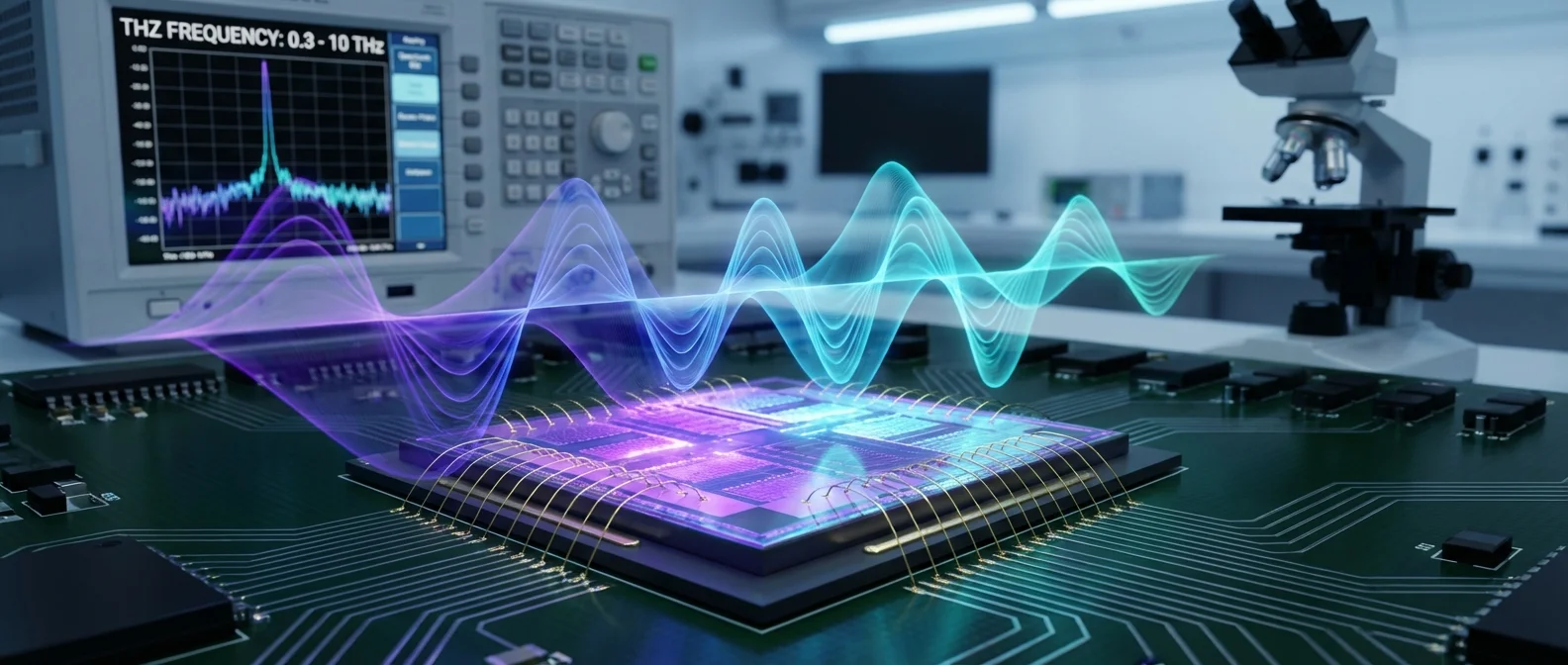
5G is only just rolling out across Greece and the rest of the world — yet in the research labs of Samsung, Nokia, Huawei, and dozens of universities, the next generation of wireless networks is already taking shape. 6G is no longer science fiction. It is a multi-billion-dollar technology program with record-breaking pilot experiments and a target arrival date: early 2030s. Terabit speeds, AI managing every aspect of the network, holographic communication — these are not exaggerations but the official goals set by the ITU for the post-5G era. Here is what is coming.
What Is 6G
6G (6th Generation) is the proposed sixth generation of mobile communications, successor to 5G (IMT-2020). Its development is coordinated by the ITU-R under the IMT-2030 framework, in accordance with Recommendation ITU-R M.2160-0. The 3GPP standards body, which specified 4G and 5G, is already finalizing Release 18 (known as 5G Advanced) and preparing Release 19 — the foundation for early 6G research.
Unlike previous generational leaps, 6G does not merely aim for faster speeds. Its pillars include AI-native architecture (artificial intelligence embedded at the network core), human-centric design, and exceptionally high security and privacy. Commercial deployment is expected in the early 2030s, with South Korea planning a pilot service as early as 2028.
5G vs 6G: The Big Comparison
How does the current generation stack up against what is being planned? The table below lays out the key specifications — and why the gap is enormous.
📊 5G (IMT-2020) vs 6G (IMT-2030)
| Feature | 5G | 6G (target) |
|---|---|---|
| Peak speed | 20 Gbps | 1 Tbps |
| Latency | 1 ms | <0.1 ms |
| Spectrum | Sub-6 GHz, mmWave | Sub-THz, 100 GHz–3 THz |
| Device density | 1M /km² | 10M+ /km² |
| Energy efficiency | Baseline | 100× better |
| AI integration | Partial | Native / core |
| Coverage | Terrestrial | Terrestrial + satellite |
A peak speed of 1 Tbps may sound outlandish, but lab demonstrations are already underway: Purple Mountain Labs in China achieved 206.25 Gbps under laboratory conditions using the THz band (2022). Samsung recorded 6 Gbps in indoor sub-THz tests at 15 meters (2021) and 12 Gbps at 30 meters (2022), while LG hit 6 Gbps at 500 meters outdoors in September 2023.
Key 6G Technologies
Four technology pillars are considered critical for making 6G a reality.
Terahertz (THz) Bands
Spectrum between 100 GHz and 3 THz, offering massive bandwidth. The challenge: very short range and sensitivity to obstacles. The solution: ultra-dense small-cell networks and next-generation beamforming.
AI-Native Networks
AI/ML will not be an add-on but the core of the network. Real-time spectrum allocation, automatic service optimization, predictive maintenance, dynamic security — all governed by artificial intelligence.
Reconfigurable Intelligent Surfaces (RIS)
Large “smart” surfaces on walls and buildings that reflect and steer THz signals exactly where they are needed. A quiet revolution in wireless physics.
Holographic MIMO
An evolution of Massive MIMO, using dense antenna arrays to create holographic beams. The result: hyper-targeted signal transmission, enormous capacity, and minimal interference.
"6G will not simply be a faster 5G. It will be a network that thinks, adapts, and learns — autonomously."
Applications That Change Everything
If 5G unlocked IoT and industrial automation, 6G promises to bring technologies that today belong in the realm of science fiction.
Holographic Communication
Real-time 3D hologram video calls. This demands Tbps throughput and sub-ms latency — exactly what 6G targets. Remote work takes on an entirely new dimension.
City-Scale Digital Twins
Digital replicas of entire cities, industrial facilities, or energy grids. A live, faithful mirror of the physical world in real time, powered by millions of IoT sensors.
Fully Autonomous Vehicles
Self-driving cars, drones, and robots need ultra-reliable, zero-latency networks. With satellite coverage everywhere, 6G makes autonomy feasible even in rural areas.
Extended Reality (XR)
Lag-free AR/VR/MR applications: haptic feedback, immersive gaming, remote surgery. Ambient IoT with backscatter communication for billions of tiny, battery-free sensors.
Who Is Leading the 6G Race
The 6G race is as much geopolitical as it is technological. Major powers are investing billions because whoever sets the 6G standards will control the digital infrastructure of the next decade.
China: Leading in research. The 14th Five-Year Plan explicitly includes 6G. Purple Mountain Labs holds the THz speed record (206 Gbps). Huawei is at the forefront of patent filings.
US & the West: The Next G Alliance (under ATIS) includes AT&T, Ericsson, Verizon, T-Mobile, Microsoft, and Samsung. The goal: an open, global standard. In February 2024, 10 countries signed a joint statement for open, secure, interoperable 6G. The EU is funding research through Horizon Europe and the Smart Networks and Services Joint Undertaking.
South Korea: An ambitious national-level program — planning 6G service as early as 2028, two years ahead of most. Samsung and LG are pioneering THz demos.
Japan: NTT Docomo is researching 6G intensively, with strong government-industry synergies. The target: a pilot network before the 2032 Olympics.
The central risk is a potential standards split. If China and the West pursue separate paths, the world could end up with two incompatible 6G networks — a nightmare scenario for the industry. That is why the 10-country joint statement champions the Open RAN model and open international standards.
When Is 6G Coming
The road to 6G is mapped out, but it is long. Here are the key milestones:
🗓️ 6G Timeline
- 2024-2025: 3GPP Release 18 (5G Advanced) — a stepping stone toward 6G. Extensive academic research, first lab demos.
- 2025-2027: Release 19 — early 6G standardization. Pilot THz experiments in real-world conditions.
- 2028: South Korea targets a pilot 6G service — potentially the world's first.
- 2029-2030: ITU-R finalizes IMT-2030 specifications. First commercial networks in pilot cities.
- 2030-2035: Wide-scale commercial deployment. Telstra (Australia) expects 6G in the 2030s, with an $800M infrastructure investment.
It is worth noting that Ericsson, Nokia, Apple, and many other tech giants are already actively involved in 6G research. Companies from India — Airtel and Jio — are also entering the arena, signaling that 6G will not be the exclusive domain of the Western world.
What It Means for Greece
Greece may not be leading 6G research, but it will not be left out. Under the Horizon Europe framework and the Smart Networks and Services Joint Undertaking, Greek universities and research centers (NKUA, AUTH, GRNET) are already participating in European 6G projects.
OTE (Cosmote), as part of the Deutsche Telekom group, will closely follow its parent company's 6G strategy — and Deutsche Telekom is active in the Next G Alliance and European consortia. The 5G infrastructure being built today forms the foundation on which 6G will be constructed.
Opportunities for Greece include:
🇬🇷 6G Opportunities for Greece
- Tourism: Holographic tours, digital twins of archaeological sites, XR museum experiences
- Shipping: Fully autonomous vessels with satellite 6G coverage on the open sea
- Agriculture: Ambient IoT sensors on crops requiring no charging — next-generation precision farming
- Islands: Satellite 6G coverage = end of the digital divide even for the most remote islands
- Startups: AI-native applications built on 6G platforms — an opportunity for Greek companies in edge computing
The transition to 6G will take years, but preparation starts now. Every 5G tower erected today, every fiber optic cable laid, every network slice created brings the country one step closer to the next networking revolution. 6G is not a question of “if” — it is a question of “how ready will we be.”