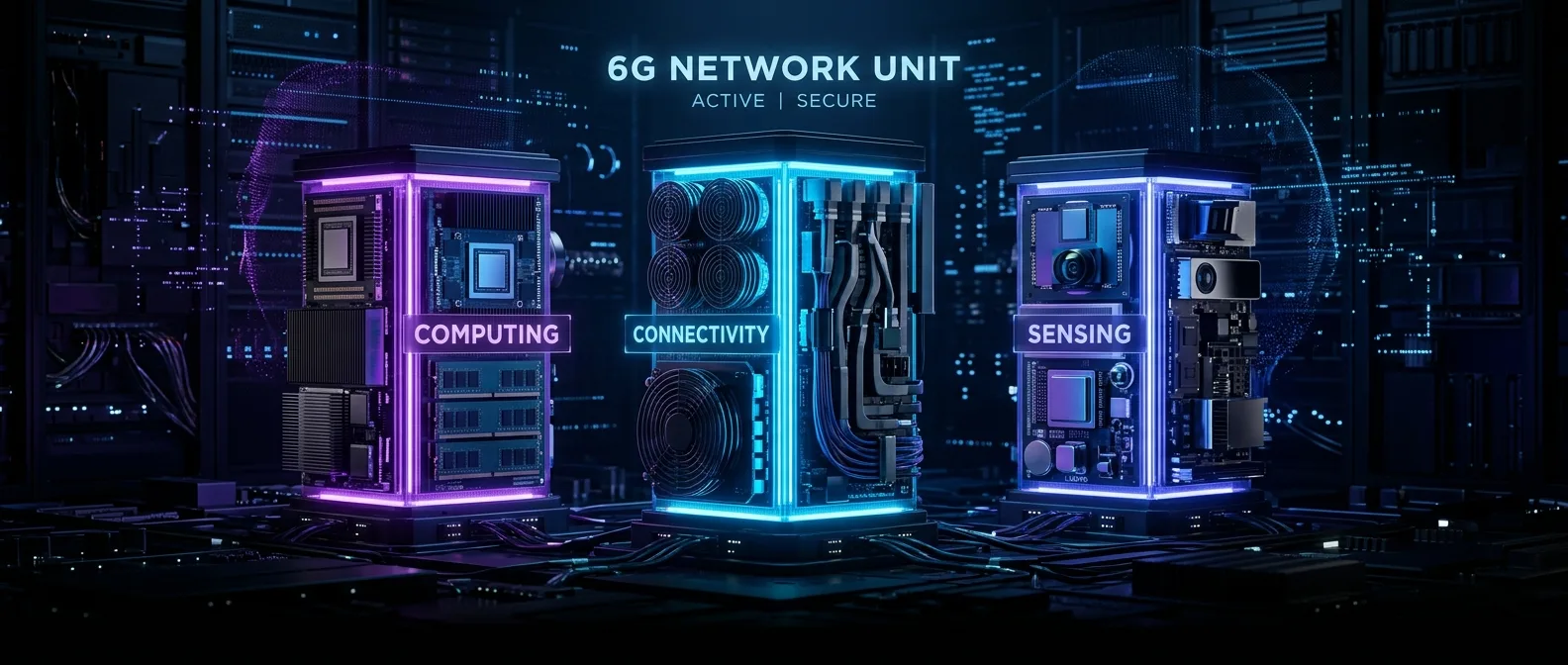
At MWC 2026 in Barcelona, while most attendees debated 5G commercialization, Qualcomm dropped a blueprint that could make them forget this generation entirely. Three pillars for 6G: connectivity, computing, and sensing. Sounds like marketing buzzwords, but the technical details suggest a fundamental shift in network architecture.
When Enrico Salvatori, Qualcomm Europe's senior vice-president, talked about AI-native networks at the conference, he wasn't describing some distant future. He outlined a plan already in motion, targeting commercial 6G deployment by 2029. The big difference? This time artificial intelligence won't be bolted on afterward — it's baked into the core from day one.
🧠 AI-Native Networks: When Infrastructure Learns to Think
Qualcomm's AI-native network concept sounds familiar at first — every major company talks about AI integration these days. But their approach targets the network foundation itself.
Instead of adding AI algorithms to existing RAN (Radio Access Network) infrastructure, Qualcomm proposes networks designed from scratch with artificial intelligence as a fundamental principle. The result? Networks that predict user needs, self-configure for optimization, and make autonomous decisions in real-time.
Agentic RAN: Qualcomm introduced the new Agentic RAN Management Service, a system that creates an "intelligence layer" from specialized AI agents. These agents continuously monitor network performance, diagnose problems, and apply corrective actions without human intervention.
From Reactive to Proactive Management
Today's 5G networks react when congestion or performance issues emerge. Qualcomm's AI-native 6G networks predict. Using machine learning models, networks analyze usage patterns, weather conditions, and even events that might affect traffic.
The difference isn't just technical — it's economic. According to data the company presented, autonomous optimization could reduce telecom operators' operational expenses by 30-40%.
📡 Connectivity, Computing, Sensing: The 6G Trinity
Qualcomm's 6G strategy rests on three pillars that work collaboratively, not independently. Each pillar works with the other two — connectivity feeds data to computing, which enables sensing.
Connectivity: Beyond the Gbps Race
The first pillar, connectivity, transcends traditional bandwidth metrics. Qualcomm focuses on intelligent connectivity — networks that dynamically adapt to application needs.
The new X105 5G Modem-RF system, the company's first Release 19-ready modem, delivers peak download speeds up to 14.8 Gbps. More significant is its integrated sixth-generation AI processor that optimizes network traffic in real-time.
Computing: Edge AI at Every Node
The second pillar focuses on distributed computational power. Instead of relying exclusively on cloud datacenters, 6G networks will embed AI processing at every level — from devices to radio access points.
This isn't just theory. The Siemens partnership shows practical results: using Qualcomm Cloud AI 100 Accelerator Cards in Siemens Industrial PCs, factories can process AI workloads locally, improving security and reducing latency.
Sensing: When Networks See
The third pillar changes the network's basic function. 6G networks won't just provide connectivity — they'll function as distributed sensor networks. Using techniques like integrated wide-area sensing, radio signals will detect movement, measure distances, and provide environmental data.
We're not just building faster networks. We're building networks that understand the world around them.
Marie Hogan, Head of 6G Portfolio Strategy, Ericsson
⚡ Wi-Fi 8: The AI-Native Wireless Ecosystem
Alongside 6G, Qualcomm unveiled its AI-native Wi-Fi 8 portfolio, with the FastConnect 8800 promising speeds over 10 Gbps. But the real breakthrough isn't speed — it's dynamic bandwidth expansion.
In enterprise environments where multiple access points operate in close proximity, the system can dynamically redistribute bandwidth where needed. Instead of each AP competing for the same slice, the system's AI identifies hotspots and reallocates resources automatically.
Bluetooth 7.0: The Silent Revolution
Something that flew under the radar in the announcements is the Bluetooth upgrade. From 2 Mbps maximum transmission speed, the new Bluetooth 7.0 reaches 7.5 Mbps. Might sound like a modest improvement, but for IoT applications and wearables, this change opens entirely new possibilities.
🏭 Industrial AI: The Real Test Case
The Qualcomm-Siemens partnership offers a first taste of how AI-native networks will function in practice. In factory environments where autonomous guided vehicles, robotics, and machine vision systems must collaborate in real-time, local AI data processing becomes critical.
The numbers: latency below 5ms for critical applications, 90% reduction in cloud datacenter traffic, and 60% improvement in energy efficiency. If these numbers scale, they'll completely change Industry 4.0 economics.
Edge Processing
AI workloads processed locally, reducing dependence on cloud infrastructure.
Enhanced Security
Critical data remains within the factory, improving security posture.
Real-time Decisions
Sub-5ms latency enables instant decisions in critical applications.
🎯 Wearables: AI on Your Wrist
The Snapdragon Wear Elite platform represents an intriguing wearables approach. Instead of relying on cloud AI services, new wearables will process AI workloads locally. This means more accurate health monitoring, contextual awareness, and personalized AI assistants that function even without internet connectivity.
The technology remains in early stages, but the potential applications are specific. Imagine a smartwatch that can detect cardiac arrhythmia and suggest immediate actions without needing server connectivity.
🌐 Ecosystem and Partnerships: The Big Picture
Qualcomm's strategy depends on its breadth of partnerships. From telecommunications giants like T-Mobile and Airtel to tech companies like Microsoft and Google, the company appears to have built a comprehensive ecosystem.
The T-Mobile collaboration is particularly significant, as it will enable testing 6G technologies in live network environments. The goal is ensuring measurable improvements in efficiency, latency, and user experience before full 6G transition.
But there's a deeper strategy at play. Qualcomm isn't just trying to sell chipsets — it's positioning itself as the platform upon which the next generation of connectivity solutions will be built.
💭 The Other Side of the Coin
Despite impressive technology, questions remain. AI-native networks require massive computational resources and sophisticated AI models. This translates to higher infrastructure costs, at least initially.
System complexity also increases exponentially. When AI agents make autonomous decisions for network management, troubleshooting becomes far more complex. What happens when an AI agent makes a wrong decision affecting millions of users?
There's also the energy consumption issue. Qualcomm promises energy efficiency improvements, but AI workloads are inherently energy-intensive. We'll see if optimizations suffice to offset increased computational load.
🔮 Timing and Realism
Qualcomm's timeline appears ambitious but not unrealistic. Pre-commercial trials in 2028 (coincidentally during the Los Angeles Olympics) and commercial deployment in 2029 provides adequate time for fine-tuning.
The fact that the company focuses on continuity with existing 5G networks, rather than complete replacement, shows a more realistic approach. 6G networks will develop gradually, starting with specific use cases like industrial environments.
What is uncertain is whether telecom companies will invest in new infrastructure as quickly as Qualcomm predicts. With 5G not yet delivering all promised economic benefits, there's some market skepticism.
If the factory trials deliver their promised cost savings, telecom companies may accelerate adoption. A 30-40% reduction in operational expenses would force every carrier to recalculate their infrastructure budgets.
Sources: