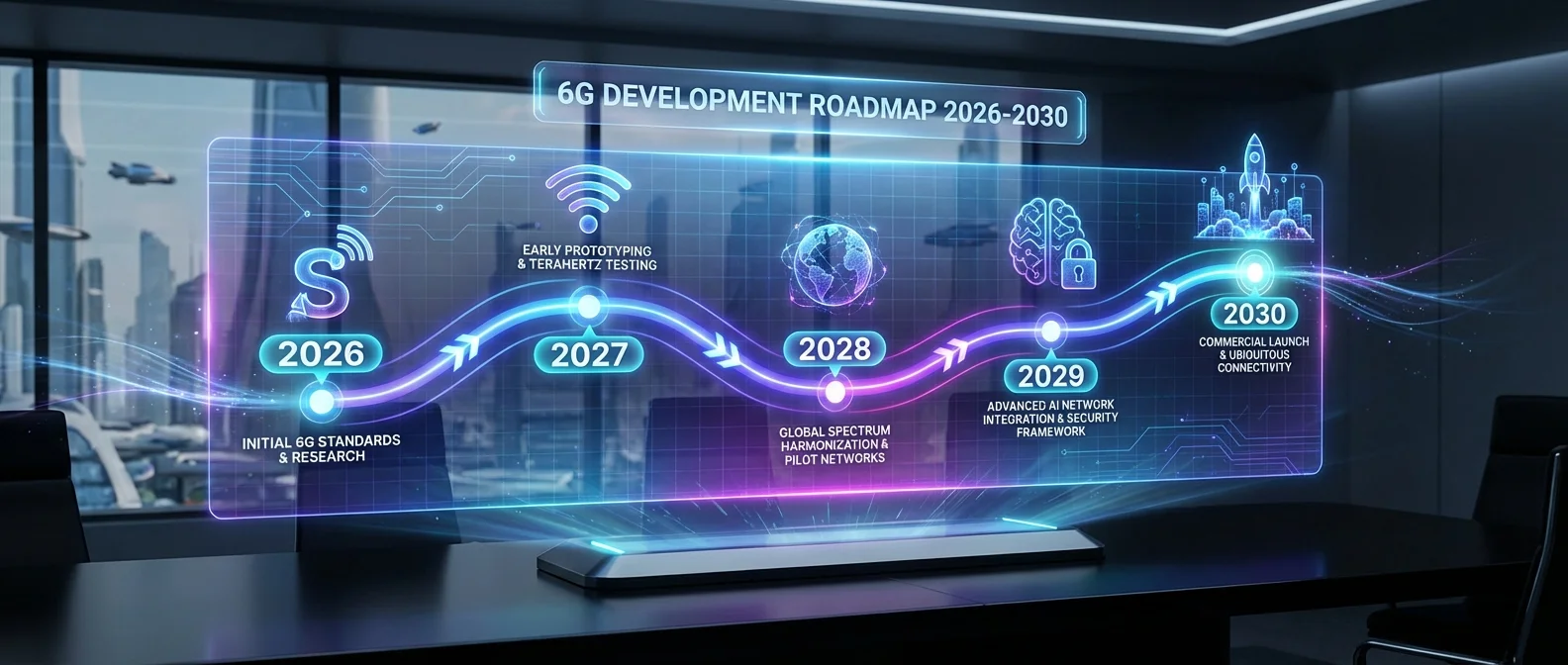
6G is no longer a distant dream — it's a concrete timeline with milestones, deadlines, and global competition. The ITU has already published the IMT-2030 framework, 3GPP is working on initial releases, and countries like South Korea are planning pilot networks as early as 2028. In this article, we break down the full roadmap: when standards will be finalized, when trials will begin, and when 6G will reach consumers.
The Path from 5G to 6G: The 3GPP Roadmap
Every generation of mobile communications follows a steady evolutionary path through 3GPP (3rd Generation Partnership Project), the body that defines global telecom standards. The transition from 5G to 6G is already underway:
3GPP Release Timeline
| Release | Description | Timeline | Status |
|---|---|---|---|
| Rel-18 | 5G-Advanced (Phase 1) | 2024 | Completed |
| Rel-19 | 5G-Advanced (Phase 2) | 2025-2026 | In Progress |
| Rel-20 | Early 6G Specifications | 2027-2028 | Planned |
| Rel-21 | Full 6G Standard | 2029-2030 | Future |
Release 18, known as 5G-Advanced, serves as the bridge to 6G. It introduces critical technologies such as AI/ML for network optimization, Extended Reality (XR) support, RedCap low-power devices, non-terrestrial networks (NTN) via satellites, and ambient IoT. These technologies will mature within 5G-Advanced and form the foundation of 6G.
The ITU and the IMT-2030 Framework
The International Telecommunication Union (ITU-R) has published Recommendation M.2160-0, known as IMT-2030, which defines the framework for the next generation of mobile communications. This document sets the performance targets and technological directions the industry must follow.
6G Performance Targets (IMT-2030)
- Peak speed: 1 Tbps (Terabit per second) — 50× faster than 5G
- Latency: below 0.1 ms — truly instantaneous response
- Device density: 10 million devices per km² — full IoT coverage
- Energy efficiency: 100× better compared to 5G
- Reliability: 99.99999% — critical for remote surgery and autonomous vehicles
These targets may seem ambitious, but they reflect the demands of applications that will dominate the 2030-2040 decade: holographic communications, city-scale digital twins, autonomous transportation systems, and the haptic internet (the internet of touch).
The Global Race for 6G
No country wants to fall behind in next-generation telecommunications. The competition is already fierce:
🇰🇷 South Korea
Leading on timelines, South Korea plans a 6G pilot network as early as 2028. Companies like Samsung have published 6G white papers since 2020 and are conducting indoor demos at 6-12 Gbps on sub-THz frequencies.
🇨🇳 China
6G is included in the 14th Five-Year Plan. China launched a 6G test satellite in 2020. Purple Mountain Labs achieved 206 Gbps in THz testing — a world record. Massive government funding is in play.
🇺🇸 United States
The Next G Alliance (under ATIS) unites AT&T, Ericsson, T-Mobile, Microsoft, Samsung, and others. The focus is on open standards and Open RAN architecture. Strategic goal: prevent Chinese dominance in standards.
🇪🇺 European Union
The Hexa-X research project (led by Nokia) defines Europe's 6G vision. €900 million in 6G research funding. 10 countries signed shared 6G principles (Feb. 2024): open, interoperable, secure, resilient.
🇯🇵 Japan
The Beyond 5G Promotion Consortium and NTT IOWN initiative target commercial 6G by 2030. Japan is investing in photonic networks and AI integration into core infrastructure.
"6G won't simply be faster 5G. It will be a unified physical-digital platform with integrated artificial intelligence, sensing, and computing at every point in the network." — Nokia Bell Labs, 6G Vision 2030
The Key Technologies Behind 6G
Beyond speed and low latency, 6G introduces fundamentally new technological concepts:
AI-Native Networks
Artificial intelligence won't be an add-on — it will be embedded in the core. Automatic optimization, load prediction, and real-time resource allocation.
THz Communications
Sub-THz (100-300 GHz) and THz (>300 GHz) spectrum, including D-band (130-175 GHz) and W-band (75-110 GHz). Enormous bandwidth, but limited range.
Non-Terrestrial Networks (NTN)
Integration of LEO satellites, HAPS (high-altitude platform stations), and drones into the network. Truly global coverage with no gaps.
RIS (Reconfigurable Intelligent Surfaces)
Smart surfaces that direct signals exactly where they're needed — improved indoor coverage without additional antennas.
Holographic MIMO
Evolution of massive MIMO with ultra-dense antenna arrays creating holographic signal beams — extreme capacity.
Semantic Communication
Instead of transmitting raw bits, the network transmits meaning. Dramatic data reduction through AI content understanding — ideal for bandwidth-hungry applications.
The Realistic Timeline: 2024-2035
Based on current data, here's when each milestone is expected:
6G Milestones — Detailed Timeline
| Period | Milestone | Details |
|---|---|---|
| 2024-2025 | 5G-Advanced rollout | Release 18-19, AI/ML integration, RedCap, NTN |
| 2025-2026 | Research results | Hexa-X II, Next G Alliance reports, ITU-R framework |
| 2027-2028 | First 6G standards | 3GPP Release 20 with initial 6G specifications |
| 2028-2029 | Pilot networks | South Korea, China, Japan — first trial deployments |
| 2029-2030 | Full standards | 3GPP Release 21, complete 6G standard |
| 2030-2032 | First commercial deployments | Asia first, US and EU follow |
| 2032-2035 | Wide adoption | Coverage in major urban centers worldwide |
Most analysts agree that commercial launch will happen between 2030 and 2035. South Korea may lead with pilot networks in 2028, but widespread coverage in Europe will likely take until the mid-2030s.
Geopolitics and Standards: The Fragmentation Risk
A major concern for the industry is the potential geopolitical fragmentation of 6G standards. Tensions between the West and China in the technology sector create the risk of two competing standards systems — which would mean higher costs, reduced interoperability, and slower adoption.
Shared 6G Principles (February 2024)
10 countries signed a declaration of shared principles for 6G, committing to:
- Open and global standards through international bodies
- Interoperability between different manufacturers
- Security built in from the start (security by design)
- Resilience against cyberattacks and natural disasters
Open RAN is supported as a foundational architecture model, ensuring no single vendor dominates the supply chain.
The outcome of this geopolitical struggle will determine whether we get a single global 6G — as largely happened with 4G/5G — or two incompatible ecosystems.
What This Means for Europe
European countries follow EU telecommunications standards. The major providers — including Greece's Cosmote/OTE, Vodafone, and Nova — will adopt 6G based on European timelines and regulatory frameworks set by national regulators like Greece's EETT.
What to Expect in Europe
- Research phase (2025-2028): European universities and research centers participate in EU 6G consortia
- First trials (2029-2031): Pilot networks in major urban centers across Europe
- Commercial launch (2032-2035): Gradual rollout, starting with metropolitan areas
- Regulatory framework: National regulators will announce 6G spectrum auctions per the EU framework
It's worth noting that the transition to 6G doesn't mean abandoning 5G. 5G will continue to serve as the network backbone for many years, while 6G will initially function as a complementary high-performance layer.
The Big Picture: Internet of Senses
Ericsson describes 6G as the "Internet of Senses" — a network that doesn't just carry data but reproduces sensory experiences. Imagine: holographic video calls, remote touch, real-time digital twins of entire cities.
"Between the 5G we have today and the 6G of the 2030s, there's a bridge: 5G-Advanced. This intermediate phase introduces AI, satellites, and ambient IoT — paving the way for the big transformation."
Digital twins — virtual replicas of cities, factories, even entire ecosystems — will require massive bandwidth and latency lower than what 5G can currently deliver. That's precisely where 6G's value will shine: in applications that today simply cannot run reliably.
Conclusion: A Timeline Grounded in Reality
6G is coming, but in measured steps. The first standards will be finalized around 2028-2030, pilot networks will emerge in South Korea, China, and Japan, and commercial deployments are expected in the early 2030s. For Europe, the realistic estimate places the first commercial services around 2032-2035.
Until then, 5G-Advanced will continue evolving, gradually introducing the technologies that will make 6G a reality. The era of Terahertz communications, AI-native networking, and holographic communications is approaching — and the world is getting ready.