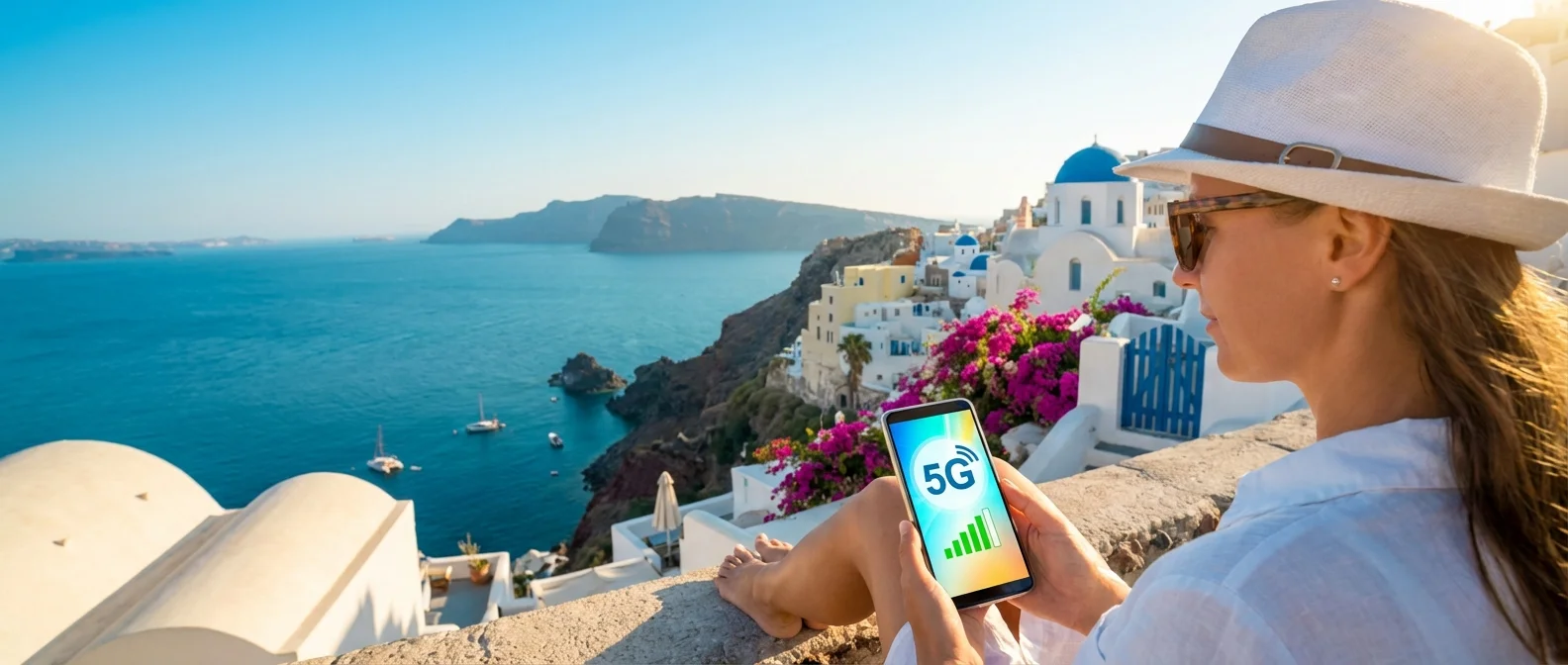
Summer 2026 marks a watershed moment for digital connectivity on the Greek islands: 5G networks now extend to the most popular vacation destinations, fundamentally changing the holiday internet experience. Cosmote boasts over 99% national population coverage, Vodafone covers 95% of the population across 71 islands, and Nova continues its steady expansion. Whether you want to share sunset photos in real time or need reliable connectivity for remote work, this guide covers everything you need to know about staying connected on Greek islands this summer.
📖 Read more: MVNOs in Greece: Why Alternative Mobile Operators Don't Exist
🌊 5G Coverage on the Islands in 2026
The rollout of 5G across the Greek islands has accelerated dramatically over the past two years. All three major providers have invested heavily in infrastructure, targeting both year-round residents and the millions of tourists who flock to the islands every summer.
📖 Read more: Vectoring & G.fast: Copper Technologies
Cosmote leads the pack with national population coverage exceeding 99% and speeds surpassing 1 Gbps in select areas. This dominance is backed by consecutive awards: the Ookla Speedtest Award for fastest network for the 9th year running, and umlaut Best in Test for the 11th year with a score of 928/1000. Notably, 5G access comes at no extra charge for all subscribers.
Vodafone follows with an aggressive expansion strategy, covering 95% of the population across 249 cities and 71 islands — with a target of 96% by March 2026. A standout feature is 5G availability at 20 Greek airports and 5G roaming capability abroad.
Nova is expanding steadily, focusing on major urban centers and key tourist destinations. While its island presence is smaller, it offers solid 5G coverage at popular hotspots like Mykonos and Heraklion.
Important Note
Coverage figures refer to population coverage, not geographic area. This means coverage exists where most people live and travel. Remote beaches, mountainous areas, and tiny villages may still have only 4G or weaker signal.
📊 Provider Comparison for Island Coverage
How do the three providers stack up when it comes to what matters most for vacationers? Here's a clear breakdown:
5G Provider Comparison on Islands
| Provider | Island Coverage | Speeds | Airports | Price/month |
|---|---|---|---|---|
| Cosmote | Widest — >99% population | >1 Gbps | Yes | from €15 |
| Vodafone | 71 islands confirmed | Very good | 20 airports | from €12 |
| Nova | Growing — major islands | Decent | Fewer | from €10 |
Cosmote is the safest bet if you want guaranteed coverage on any island. Vodafone is an excellent choice for popular tourist islands, especially if you travel frequently abroad (5G roaming). Nova offers the most budget-friendly prices for those sticking to major destinations.
📖 Read more: Telecom Phishing: How to Spot and Avoid Scams
🏝️ 5G at Popular Destinations
Each island group has a different level of coverage. Here's what to expect in each region:
Cyclades
Santorini, Mykonos, Paros, Naxos — excellent 5G coverage from Cosmote and Vodafone in main towns. The most popular Cycladic islands offer speeds of 200-500 Mbps in central areas. Smaller villages have reliable 4G+ connections.
Crete
Heraklion, Chania, Rethymno, Agios Nikolaos — very strong coverage along the north coast. Full 5G in urban zones, ports, and airports. The south coast relies more on 4G, though coverage is continuously improving.
Dodecanese
Rhodes, Kos — strong 5G coverage in main towns and tourist areas. Rhodes has 5G in the Old Town, Faliraki, and the airport. Kos is covered in town and at popular beaches.
Ionian Islands
Corfu, Zakynthos, Kefalonia — coverage is expanding steadily. 5G is available in city centers and major resorts. Corfu and Zakynthos lead, with Cosmote and Vodafone covering the most popular spots.
Saronic Gulf
Aegina, Hydra, Spetses — close proximity to Athens gives these islands an advantage. Good 5G coverage thanks to nearby Attica base stations. Ideal for day trips without worrying about connectivity.
NE Aegean
Lesvos, Chios, Samos — coverage in main towns (Mytilene, Chios town, Vathy). 5G at central locations, 4G elsewhere. Great for relaxed vacations, less suited for intensive remote work outside of towns.
📱 Tips for Better Internet on Vacation
Even with excellent 5G coverage, a few practical tips can make all the difference in your experience:
Practical Tips
- Check coverage maps before traveling: Cosmote, Vodafone, and Nova all offer online coverage maps — verify your exact destination before booking
- eSIM for dual-SIM capability: If your phone supports eSIM, you can have two providers simultaneously — ideal for switching to whichever has better signal
- Portable hotspot / mobile router: A portable router can share a single connection across multiple devices in your rental or villa
- Download offline content: Google Maps, Spotify playlists, Netflix movies — download everything before departure for peace of mind
- Starlink for very remote areas: Ask your accommodation if they offer satellite internet — it's becoming increasingly common at boutique hotels
- Make sure your phone supports 5G: You need a smartphone with Band n78. Most models from 2022 onwards support it
- Prepaid tourist SIM cards: If visiting from abroad, a prepaid data package (from €10) avoids expensive roaming charges
📖 Read more: Unlimited Data Greece: Who Really Delivers
🚢 Internet on Ferries
A topic rarely discussed but relevant to millions of travelers: what about connectivity during ferry travel?
Vodafone has begun expanding maritime coverage on high-traffic routes. For islands close to the mainland (Saronic Gulf, northern Cyclades), mobile signal during the crossing is relatively stable. On longer routes, signal can be spotty or nonexistent.
The big game changer in 2026 is the installation of Starlink on Greek ferries. Several companies (ANEK, Blue Star) are testing or have already installed satellite internet, offering onboard WiFi. Speeds aren't 5G-level, but they're sufficient for email, messaging, and light browsing.
Ferry Tip
Download everything you need before departure. Maps, movies, music, e-books. Even if the ferry has WiFi, speeds won't be enough for streaming or large downloads.
🔮 What to Expect This Summer
Beyond the current state of things, what changes are coming before summer?
Vodafone is targeting 96% population coverage by March 2026, with a further goal of 97% by March 2028. This means several new islands will be added to their coverage map in the coming months.
More islands are expected to get 5G SA (Standalone) — meaning a fully independent 5G network not reliant on a 4G core. This brings lower latency and more stable connections, ideal for video calls and remote work.
Maritime connectivity is set to improve significantly, with more ferries adopting satellite WiFi. Additionally, eSIM tourism packages are expected from all providers — specifically designed for visitors, with digital activation in minutes and no need to visit a store.
"The era when working remotely from a Greek island was a luxury is over. With 5G now reaching the Cyclades, Crete, and the Dodecanese, any beach can become your office — as long as the view doesn't distract you."