The Wow! Signal
On August 15, 1977, a radio telescope in Ohio recorded 72 seconds that were never explained — and forever changed the way we search for life in the universe
📖 Read more: Rana Plaza: The Truth Behind Cheap Clothes
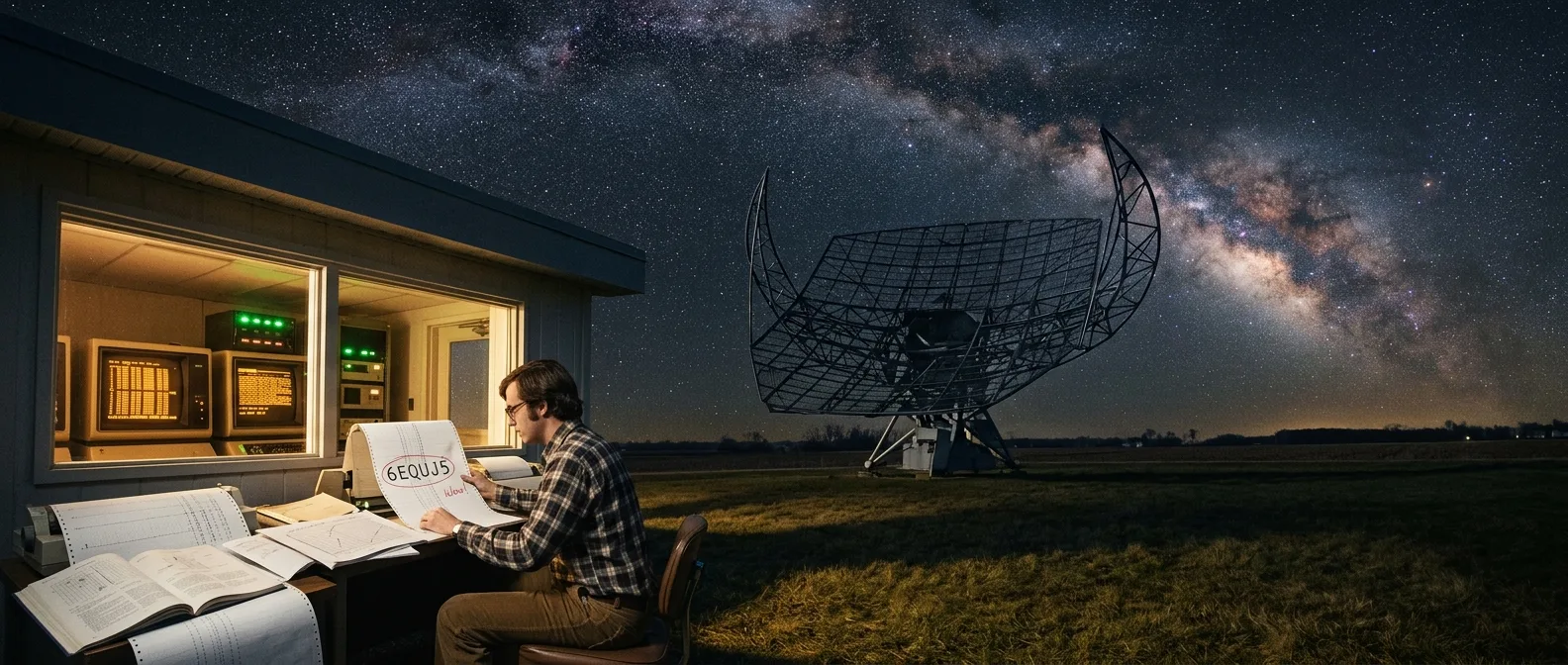
Jerry Ehman wasn't expecting anything unusual that evening. It was August 15, 1977, a warm summer night in Ohio, and the Ohio State University astronomer was scanning pages of numbers — printouts from the Big Ear radio telescope, a massive metal structure that swept the sky automatically, day and night, searching for signals from the depths of space.
Big Ear was no ordinary telescope. It belonged to the SETI program — Search for Extra-Terrestrial Intelligence — an ambitious effort to detect signals from alien civilizations. For years, data analysis was done by hand, with Ehman and his colleagues studying pages of numbers, looking for anything that stood out from the background noise of the cosmos.
That summer evening, Ehman sat at his kitchen table, picked up the data sheets, and began scanning them column by column. Numbers. Noise. Nothing. And then, suddenly, his eyes froze on a sequence of characters unlike anything he had ever seen on any data sheet.
— 1 —The sequence was: 6EQUJ5. In Big Ear's recording system, each character represented the intensity of a radio signal. Numbers 1 through 9 corresponded to low intensities. After 9, the system switched to letters — A, B, C, and so on. The letter U meant an intensity 30 times above the background noise. Something extraordinarily powerful. Something that had never been recorded before.
Ehman grabbed a red pen. He circled the characters. And in the margin, he wrote a single word: “Wow!”
He didn't know that small note would become one of the most recognizable symbols in the history of astronomy. The signal he had recorded lasted exactly 72 seconds — precisely the time it took the telescope's beam to sweep across a fixed point in the sky as the Earth rotated. This meant something critical: the signal came from a fixed point in space, not from something on Earth or in the atmosphere.
"I was at home, looking at the data on my table. When I saw that string of characters, I felt a chill. It was as if something was screaming through the noise."
— Jerry EhmanThe signal's frequency was exactly 1420.4556 MHz — the so-called “hydrogen line.” Hydrogen is the most abundant element in the universe. Its emission frequency has been considered for decades the most likely frequency at which an intelligent extraterrestrial civilization would choose to transmit — precisely because any sufficiently advanced civilization in the universe would know its significance. A kind of cosmic common ground.
— 2 —To understand why those 72 seconds were so significant, you first need to understand how Big Ear worked. It wasn't like the telescopes you see in movies — enormous dishes swiveling across the sky. It was a fixed telescope, built on the ground like an aluminum football field. It couldn't move. Instead, it relied on the Earth's rotation to sweep sections of the sky.
As the Earth turned, the telescope's beam scanned a strip of sky. Each point in the sky remained within the beam for exactly 72 seconds. If a signal came from a fixed point in the universe, its intensity would gradually increase as it entered the beam, peak at the center, and decrease as it exited. That is exactly what the Wow signal did — it formed a perfect gain curve, like a bell. This ruled out terrestrial interference sources, low-orbit satellites, and atmospheric phenomena.
The signal was extremely narrowband — meaning it was transmitted on a very specific frequency without spreading across a wide spectrum. Natural cosmic phenomena — pulsars, quasars, stars, nebulae — emit across a broad spectrum. A narrowband signal suggests intentionality. Someone — or something — chose that frequency.
📖 Read more: Shackleton: 2 Years Trapped in Antarctica
Its direction? The constellation Sagittarius, near the star group Chi Sagittarii. A distance of hundreds of light-years.
— 3 —As soon as Ehman alerted his colleagues, an intensive effort to relocate the signal began. Big Ear was aimed again (via the Earth's rotation) at the same spot in the sky. Nothing. Another sweep. Nothing. Again and again, day after day, for weeks. Silence.
And that was the most chilling characteristic of the signal: it appeared once and vanished. If it were a natural phenomenon — a pulsar, a star, a nebula — it should have emitted continuously, or at least periodically. If it were interference from a terrestrial source, it would have appeared from multiple directions. Instead, it came from a single point, one time only, on a single frequency.
Over the following years, dozens of radio telescopes around the world targeted the same region in Sagittarius. The Very Large Array in New Mexico, the Arecibo telescope in Puerto Rico, facilities in Australia, Germany, Japan. No one ever recorded anything similar.
Robert Gray, an amateur astronomer who later rose through the academic community, spent decades on this search. He used a private telescope, then persuaded the administrators of the Very Large Array to grant observation time. The result? Nothing. The signal never reappeared.
"I don't know if what I recorded was of extraterrestrial origin. I know I have never found a satisfactory explanation. And that, in itself, keeps me awake at night."
— Jerry Ehman, decades laterAlmost immediately, the scientific community split into camps. Some believed the signal was the first genuine evidence of extraterrestrial intelligence. Others searched for more mundane explanations. No one could prove their case.
The first and most obvious theory: an alien signal. The frequency was ideal — right on the hydrogen line. The shape was ideal — narrowband, like a deliberate transmission. The intensity was enormous. If a civilization wanted to send a message to the universe, this is exactly how it would be done. But there was a problem: without repetition, it is impossible to confirm. In science, a single event proves nothing.
The second theory: a reflected terrestrial signal bouncing off something in space. Perhaps a terrestrial transmitter — a radio station, a military installation — broadcast on that frequency, and the signal bounced off some object in space back to Earth. But the 1420 MHz frequency is a protected band — terrestrial transmission is forbidden on it, precisely to avoid such confusion.
The third theory: a classified military satellite. During the Cold War, both the United States and the Soviet Union operated satellites transmitting on secret frequencies. Could such a satellite have passed through Big Ear's beam during those 72 seconds? Theoretically, yes. Practically, no satellite would have lingered in the beam for that long, nor would it have produced such a perfect gain curve.
— 5 —Forty years later, in 2017, astronomer Antonio Paris proposed a new explanation that caused a sensation. His theory: two comets — 266P/Christensen and P/2008 Y2 (Gibbs) — passed through that region of the sky in August 1977. Comets are surrounded by enormous hydrogen clouds. These clouds could, in theory, emit at 1420 MHz — exactly where the Wow signal was recorded.
📖 Read more: The $100 Million Diamond Heist in Antwerp
The theory swept through the media like a tsunami. Headlines on every corner of the planet: “Mystery of the Wow Signal Solved.” Paris even published observations in which he claimed to have recorded a similar signal at 1420 MHz while observing comet 266P.
The scientific community pushed back almost immediately. Alan Fitzsimmons, an astrophysicist at Queen's University Belfast, pointed out that comets emit across a broad spectrum — not in a narrow band. Ehman himself expressed serious doubts: a comet's hydrogen cloud could never produce a signal of such intensity. Other astronomers noted that Paris's methodology was inadequate — the telescope he used was far too small, his data insufficient, and his results non-reproducible.
"The comet theory was attractive to the media, but it does not hold up under realistic analysis. A comet's hydrogen cloud is extremely diffuse and cold — it cannot produce a signal of that intensity in such a narrow band."
— Alan Fitzsimmons, astrophysicistTo this day, the comet theory is considered inadequate by the vast majority of the astronomical community. However, it continues to appear in news articles as the “probable explanation,” giving the false impression that the mystery has been solved.
— 6 —The hydrogen line at 1420 MHz is no random frequency. It holds a unique position in astronomy, and perhaps in the entire universe. Hydrogen is the most common element in existence — it makes up roughly 75% of all matter. Every neutral hydrogen atom naturally emits at 1420 MHz when its electron flips spin. This frequency is the same everywhere in the universe.
As early as the 1950s, astronomers Giuseppe Cocconi and Philip Morrison proposed that if an extraterrestrial civilization wanted to send a message, it would use this exact frequency. The logic was simple: any civilization advanced enough to build a radio telescope would know about the hydrogen line. It is a kind of “cosmic common language” — physics makes it inevitable.
That was why SETI had focused on this frequency for decades. And that was why, when something finally appeared right there, the reaction was so intense. It wasn't merely a strong signal. It was a strong signal on the one frequency that had been expected.
There is one more detail rarely mentioned: the hydrogen line sits in a zone of relative quiet in the radio spectrum — between the noise of galactic radiation and the noise of the cosmic microwave background. Astronomers call this zone the “water hole” — a natural silence within the noise of the universe. If you were an alien and wanted to be heard, you would shout there.
— 7 —Before examining what it could have been, let us consider what it definitely was not. It was not an airplane — the 1420 MHz frequency is not used by aircraft. It was not a telecommunications satellite — no known satellite transmits on that band. It was not a terrestrial signal bouncing off space debris — the intensity was far too great.
It was not an equipment malfunction — Big Ear had two feed horns, and the signal was recorded by only one. If it had been a technical glitch, it would have appeared in both. It was not interference from a nearby transmitter — the direction was fixed and the gain curve perfect.
Ehman himself examined dozens of possible explanations over the course of decades. Each time he reached the same conclusion: nothing known can convincingly explain the signal. That does not mean it was extraterrestrial — it means we do not know what it was.
📖 Read more: The 4 Children Who Survived 40 Days in the Jungle
And perhaps that is the most frightening thing of all.
— 8 —The Big Ear radio telescope was demolished in 1998. A golf course was built in its place. The decision was administrative — Ohio State University had sold the land to a developer. John Kraus, the astronomer who designed and built the telescope in 1963, watched his creation reduced to rubble.
There is no longer any way to replicate the exact observation. Modern telescopes are more sensitive, but none share Big Ear's precise beam characteristics. If the signal returns, a different instrument will have to catch it.
Ehman, until the end of his life, insisted that he did not know what that signal was. He refused to declare it extraterrestrial in origin — but he equally refused to accept any natural explanation. It was, in his words, “the most important question mark of my career.”
"We never found an explanation. And perhaps we never will. But something was there, for those 72 seconds. Nobody can deny that."
— Jerry Ehman72 seconds that won't fade
Nearly half a century has passed since that August night in 1977. In that time, our technology has advanced dramatically. We have launched space telescopes, mapped billions of galaxies, discovered thousands of exoplanets in habitable zones. And yet, those 72 seconds remain unexplained.
The Wow signal was not merely the strongest candidate for extraterrestrial communication in the history of SETI. It was something deeper — a reminder that the universe can still surprise us. That we do not have all the answers. That 72 seconds can pose questions that entire decades cannot answer.
If it was an alien message, who sent it? Why only once? Was it directed at us, or simply a broadcast that happened to pass through Big Ear's beam? If it was a natural phenomenon, why has it never been detected again? And if it was neither one nor the other — what was it?
The constellation Sagittarius still shines on every summer night. Somewhere there, near the stars of Chi Sagittarii, something spoke for 72 seconds. No human ear heard it in real time. Only a printer recorded the numbers, and an astronomer, days later, circled them with a red pen.
"Wow!" he wrote.
We have been waiting to learn why, ever since.