Wojtek
The bear that carried ammunition at Monte Cassino
and earned the rank of corporal
📖 Read more: Nicholas Winton: Saved 669 Children in Secret
Picture a military camp in the Middle East, 1942. Polish soldiers, freshly released from Soviet gulags, surround you. Next to you, a brown bear is drinking beer, chewing on cigarettes, and play-wrestling with his companions. A few months later, that same bear will carry crates of mortar shells during the Battle of Monte Cassino — and earn the rank of corporal.
This isn't a fairy tale. This is the story of Wojtek (pronounced “voy-tek”), an orphaned bear cub adopted by Polish troops who became the most unlikely mascot in military history. The name derives from the old Slavic “Wojciech,” meaning “joyous warrior” — a name that would prove remarkably fitting.
— 1 —The story begins with catastrophe. In September 1939, Poland was invaded simultaneously by Nazi Germany and the Soviet Union. The country was torn apart. Hundreds of thousands of Poles were deported to Soviet labor camps. Among them, thousands of soldiers.
In June 1941, Hitler broke the non-aggression pact and invaded the USSR. Stalin, needing every possible ally, signed the Sikorski-Mayski Agreement, which allowed Polish prisoners to form their own army. The Polish II Corps was born under Lieutenant General Władysław Anders.
In the spring of 1942, tens of thousands of Polish soldiers and civilians left the Soviet Union, heading toward Iran. The journey was brutal. Hunger, disease, exhaustion. Many never arrived.
📖 Read more: The Man Who Survived Two Atomic Bombs
On April 8, 1942, on the road from Pahlavi to Tehran near the Iranian town of Hamadan, Polish soldiers encountered a boy with an orphaned bear cub. The mother had been killed by hunters. Irena Bokiewicz, an 18-year-old refugee and the great-niece of General Bolesław Wieniawa-Długoszowski, was captivated instantly. She persuaded Lieutenant Anatol Tarnowiecki to buy the cub in exchange for a few tins of food. For the first three months, Irena cared for the little bear in a refugee camp near Tehran, before handing him over to the 2nd Transport Company.
Wojtek grew up inside the army. Literally. At first, the cub had trouble swallowing, so they fed him condensed milk from an old vodka bottle. Later, his diet expanded: fruit, marmalade, honey, syrup — and of course beer, which quickly became his favorite drink. In the mornings, he drank coffee alongside the soldiers. He smoked — or rather, ate — cigarettes. On cold nights, he slept among them for warmth.
With the 22nd Company, Wojtek traveled from Iran to Iraq, then through Syria, Palestine, and Egypt. At every stop he became a spectacle — soldiers from other units came just to see him. He was assigned two dedicated caretakers, Henryk Zacharewicz and Lew Worzowski, though in practice the entire unit looked after him. He loved riding in the cab of the supply trucks, staring at the road like a co-driver.
As he grew, Wojtek developed into a striking Syrian brown bear. By the time of the Battle of Monte Cassino, he weighed around 200 pounds — still relatively young. Despite his increasing size, his behavior was remarkably gentle. He play-wrestled with soldiers, saluted when they saluted him, and at night slept among them or in a specially built wooden crate that was transported by truck.
On one occasion, Wojtek caught an intruder in the supply showers. The bear walked into the washroom and came face-to-face with an Arab spy — who surrendered immediately, terrified. Wojtek was rewarded with extra beers.
📖 Read more: The Soldier Who Hid in the Jungle 30 Years After the War
— 3 —In 1943, the unit prepared to board a ship from Alexandria, Egypt, to join the Allied campaign in Italy. One problem: port officials refused to let a bear on board. He wasn't “officially” a member of the army.
The solution was as Polish as it was brilliant. The soldiers enlisted Wojtek as a private in the Polish II Corps. He was given a serial number (253), a rank, a pay book, and even a salary. Wojtek was now a legal member of the armed forces — and the ship couldn't turn him away.
"Wojtek was one of us. We didn't see him as an animal. He was a companion, a friend, a soldier. He walked beside us, ate beside us, fought beside us."
— Testimony from a Polish veteranThe Battle of Monte Cassino (January–May 1944) was one of the bloodiest engagements in the European theater of World War II. Allied forces attempted to break through the German Gustav Line in central Italy. The Monte Cassino monastery, perched on a hilltop, was a natural fortress. Four brutal assaults were needed to dislodge the defenders. In the fourth and final assault, May 1944, the Poles took a central role — and with them, Wojtek.
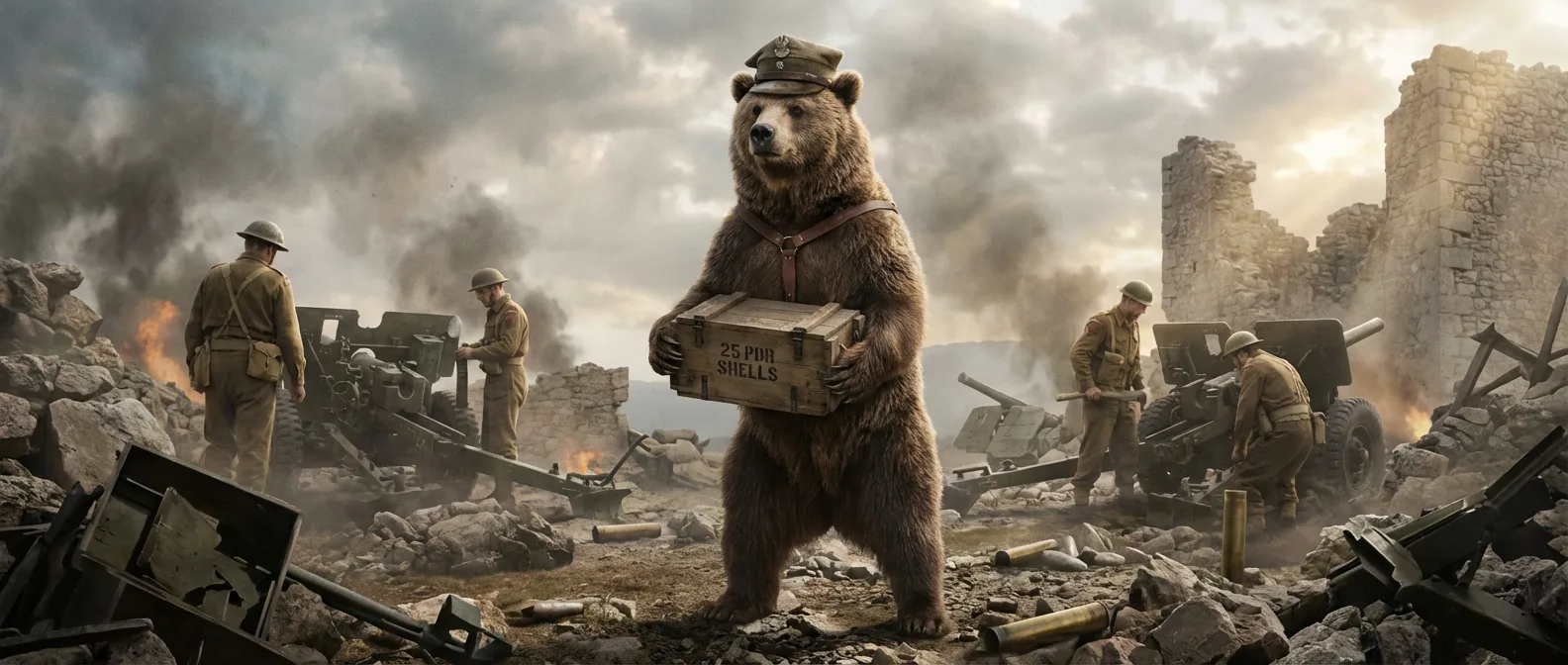
The 22nd Artillery Supply Company — Wojtek’s unit — was on the front line of resupply, supporting the famous British Eighth Army, renowned from the battles of North Africa. The crates of 25-pounder artillery shells were heavy — often over 100 pounds each, with four shells per crate. And here Wojtek did something that seems impossible: watching the soldiers, he learned to carry crates of mortar rounds with his front paws, standing on two legs, transporting them from the trucks to the artillery positions. He stacked them on top of other crates or onto trucks, exactly as he saw the men do.
📖 Read more: Dashrath Manjhi: Carved a Mountain Alone for 22 Years
Reports say he never dropped a single crate — crates that normally required four men to lift. At least one British soldier recorded seeing a bear carrying ammunition boxes on the battlefield. Wojtek wasn’t just carrying ammunition — he was carrying morale. His presence electrified the troops. In a battle that cost tens of thousands of lives, he was living proof that something lighthearted, something human, could still exist amid the horror.
After the Polish victory at Monte Cassino, Wojtek became a celebrity — visiting Allied generals and statesmen requested to meet him. His service earned him promotion to the rank of corporal. Polish high command made an unprecedented decision: Wojtek became the official emblem of the 22nd Artillery Supply Company. A bear holding a shell — that was the unit’s insignia from that point forward.
— 5 —The Zoo
When the war ended in 1945, Poland was under Soviet occupation. Most soldiers of the II Corps couldn’t go home — they refused to live under the regime that had sent them to the gulags. Many settled in Scotland, at Winfield Camp near the village of Hutton in Berwickshire. And Wojtek went with them.
For a few years, the bear lived at the camp with his companions, drawing attention from local press and civilians alike. The Polish-Scottish Association made him an honorary member. But as the soldiers were demobilized on November 15, 1947 and the world returned to normalcy, caring for a massive bear became impossible. Wojtek was transferred to Edinburgh Zoo.
📖 Read more: Deaf Beethoven: Masterpieces Without Sound
He spent his remaining years there. Veterans came to visit him — some tossed cigarettes for him to eat, just like in the war years — and according to the zookeepers, Wojtek would perk up every time he heard someone speaking Polish. He’d stand up, look around, as if he remembered. As if he recognized the language of his companions.
Wojtek died on December 2, 1963, at the age of 21. At the time of his death, he weighed nearly 500 kilograms and stood over 1.8 meters tall. During his years at the zoo, he appeared frequently on the BBC children’s program Blue Peter — becoming famous to a new generation of children who had never lived through the war.
Today, a bronze statue in Edinburgh’s Princes Street Gardens shows him walking alongside a Polish soldier — unveiled in 2015. Statues also stand in Kraków (2014), in Cassino, Italy (2019), and in cities across Poland. In Poznań, a street bears his name: Corporal Wojtek Street. In 2023, the animated short film “A Bear Named Wojtek” was nominated for an Academy Award for Best Animated Short Film.
An orphaned bear in an Iranian village, raised among soldiers, fought in Italy, retired in Scotland, and became a symbol of friendship between species that supposedly can't communicate. If that's not a story worth telling, what is?