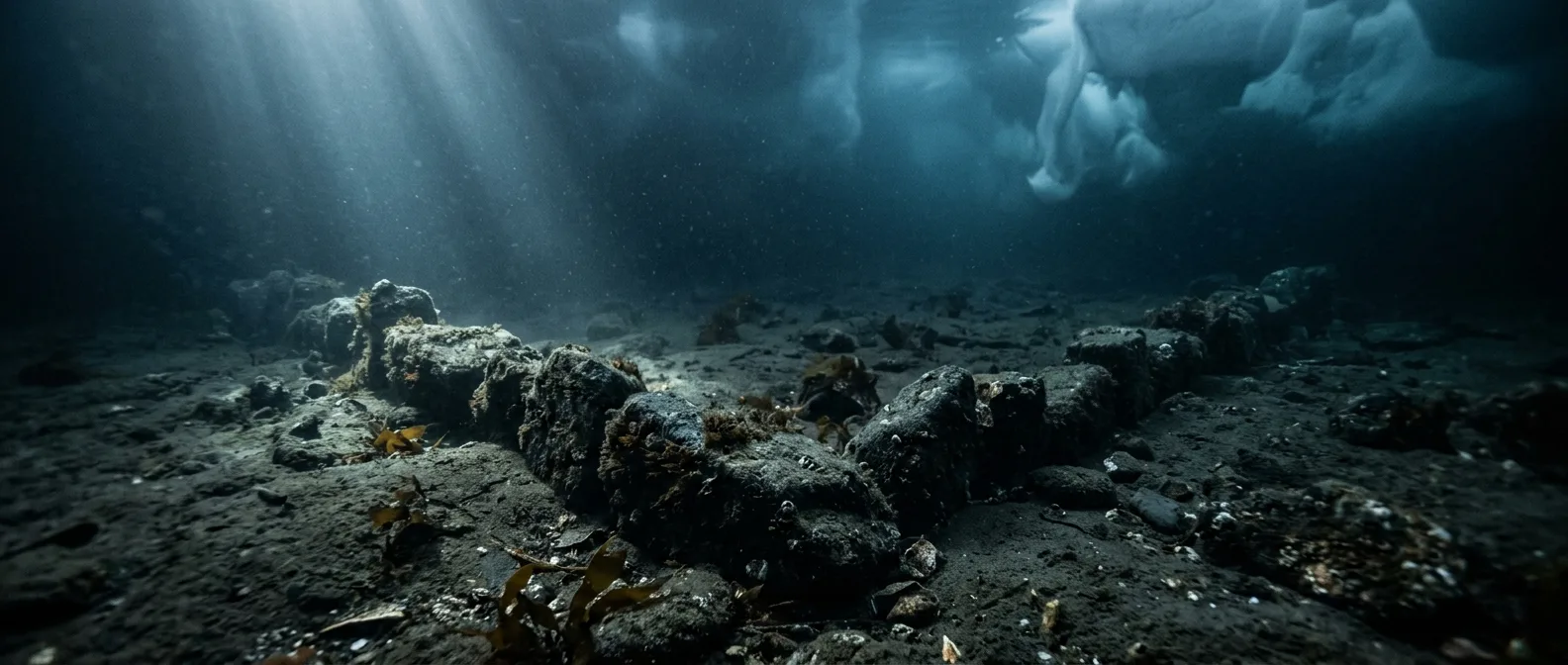
Two kilometers off Norway's western coast, beneath the icy waters of Grindafjord, lies proof of an extraordinary story. A 25-meter line of stones stretches across the seafloor — the first physical evidence of medieval Norway's legendary whale traps. If archaeologists are right about what they found, something we knew only from 1,100-year-old texts just became real.
📖 Read more: 7,000-Year-Old Stone Wall Found Deep Underwater Off France
🏺 The Discovery That Rewrote History Books
In January 2026, a team of marine archaeologists descended into the frigid waters near Bergen with scuba gear and a mission. They were hunting for something described in Norway's oldest law — the Gulating Law of 900 AD. A mysterious reference to "cetacean trapping systems" that had never been confirmed archaeologically. The search began with sonar that revealed something unexpected. Instead of the smooth sandy bottom that characterizes the area, researchers detected a continuous line of stones. Elling Utvik Wammer from the Norwegian Maritime Museum described the moment: "We saw a distinct zone of stones crossing the strait. It was exactly what we'd hoped for." But the real surprise waited on the seafloor. Beyond the linear construction, divers spotted a circular mound of rocks 15 meters across and 4 meters high. The evidence pointed to one conclusion: this wasn't natural.The construction required hauling tons of stone by boat and placing them strategically on the seafloor — an undertaking that suggests serious community planning and coordination.
📖 Read more: Pharaoh Thutmose II Tomb Found After 100-Year Search
⚔️ How Medieval Whale Traps Actually Worked
Historical sources describe a system that resembled a military operation. When whales were spotted entering a bay, someone alerted the village. The first move was to quickly seal the strait to prevent the animals from escaping. The whale trap system included barriers of wood and rope, weighted with stones. The underwater stone line archaeologists discovered likely formed the foundation of this trapping system. At the bay's far end, nets closed off the alternative exit.The Brutal Reality of Survival
What followed was violent. Hunters attacked the whales with crossbows and arrows, some dipped in bacteria from rotting meat to weaken the animals. After exhaustion, whales were speared and dragged to shore by multiple rowing boats. The process could last days. 19th-century accounts describe wounded whales swimming around the bay for extended periods before finally being killed. While barbaric by today's standards, these whale hunting methods were once essential for coastal community survival. Whale meat and bones provided precious food and materials shared among villagers.25m Stone line length
900 AD First historical references
20,000 kg Minke whale weight
🔬 Modern Technology Reveals the Past
To map the underwater structures, divers used a photogrammetry technique involving GoPro cameras mounted on poles. The system captured photos every second as divers swam slowly over the formations. Thousands of overlapping images were then processed to create detailed 3D models of the site. This technology has become increasingly important in underwater archaeology, where dive times are limited and conditions can change rapidly. Winter conditions actually helped the research team. Cold water contains very little algae, making the sea unusually clear and improving visibility for divers.The Mystery of the Large Mound
The large circular mound discovered near the stone line may connect to later attempts to modify the strait. According to records from the 1700s, a local priest named Andreas Kristi wrote that villagers tried to replace the original wooden barrier with a permanent stone wall. However, the effort was eventually abandoned because the project required massive amounts of rock.📖 Read more: Thutmose II Tomb Found: Egypt's Lost Pharaoh After 100 Years
🌊 A Community Dependent on the Sea
The discovery reveals something significant about medieval Norwegian communities. The fact that they invested such resources in this system shows how critical whale hunting was to their survival. Minke whales, which can reach 7-10 meters and weigh up to 20,000 kg, were tremendous prey for communities with simple tools. But these Scandinavian coastal communities had developed sophisticated systems. They're documented as extensively exploiting marine mammals well into the Viking and Medieval periods. Stone-lined pits believed to be early blubber processing facilities have been documented in northern Norway.The system had a ritual dimension too. According to historical descriptions, when a whale was killed, its eyes were thrown back into the water to ensure future generations would continue returning — almost like a way to appease the gods or acknowledge the violent nature of what survival meant.The newly discovered underwater archaeological site is very unusual. Such constructions have rarely been preserved or documented beneath the sea.
Elling Utvik Wammer, Norwegian Maritime Museum
📖 Read more: Thutmose II Tomb Found After 100-Year Hunt in Valley of Kings
🎯 What the Sources Reveal
The research is led by the Inter-Regional Maritime Archaeological Cooperation (IRMAS), with Anders Skou from Bergen Maritime Museum and Svein Vatsvåg Nielsen from Stavanger Maritime Museum collaborating with Wammer. Written sources from 900 AD describe whales and other large marine animals being driven into narrow bays and trapped for processing and survival. As time passed, constructions of wood and rope weighted with stones were used to direct mammals into enclosed areas, and the practice continued through the centuries. Further fieldwork is planned for June, when archaeologists will return to Øygarden to study nearby fishing sites where stone walls and nets were used to trap large numbers of fish.Strategic Location
The Grindafjord strait provided perfect conditions for whale trapping — a natural funnel with controlled exits.
3D Technology
GoPro camera photogrammetry allowed detailed modeling without destroying the site.