UVB-76: Russian Radio Buzzing for Decades
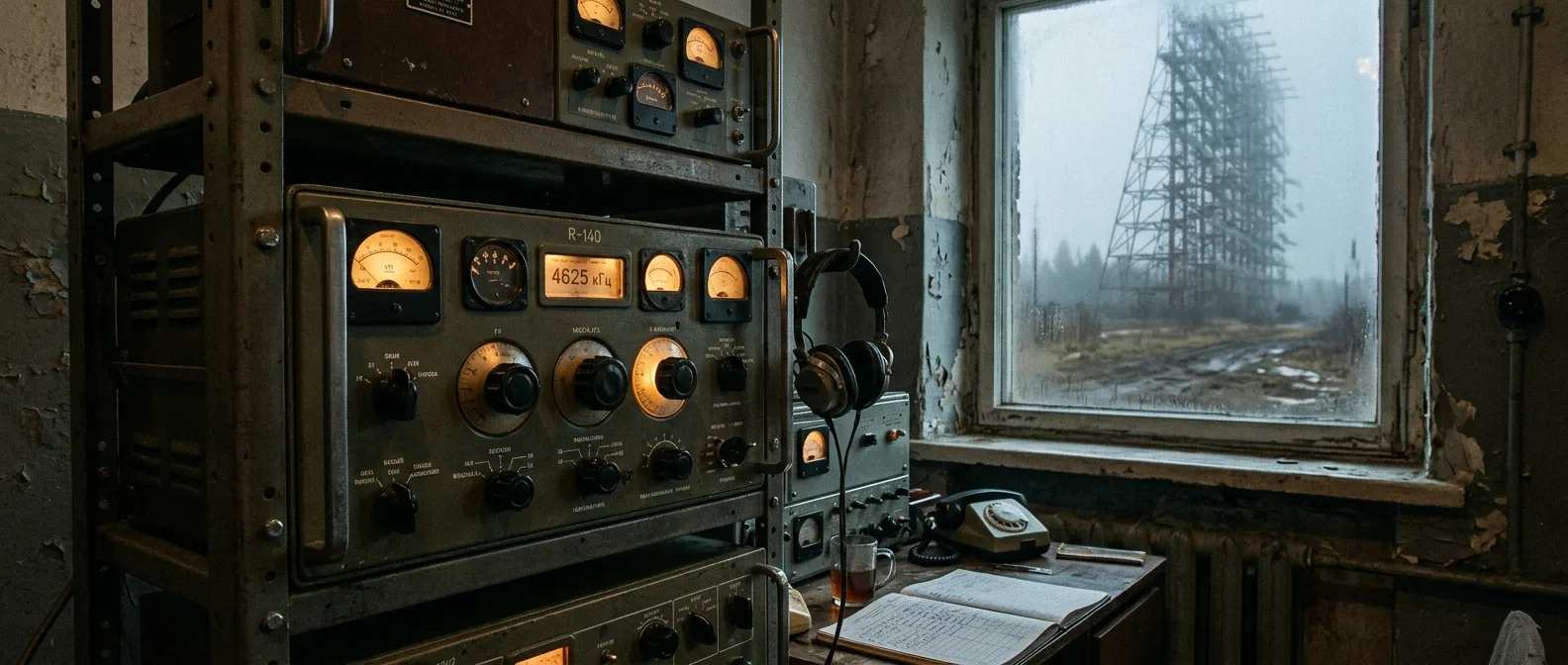
Somewhere in Russia, a radio station broadcasts on 4625 kHz without interruption, and has done so for over forty years.
📖 Read more: The Astronaut Who Was Stranded in Space
The sound that never stops
If you tune a shortwave radio to 4625 kHz, you will hear something unlike anything else on the radio spectrum. A deep, mechanical buzz — like the distant hum of a transformer — transmits approximately every two seconds. It does not vary. It does not change in intensity. It does not stop.
This is UVB-76, known to its listeners as “The Buzzer.” It is a Russian shortwave station that has been broadcasting continuously since at least 1982, although some researchers believe the transmission began earlier, possibly in the late 1970s. The station has never officially identified itself. There is no public document explaining its purpose.
The sound is distinctive: a short buzz lasting approximately 1.2 seconds, followed by a pause of 1–1.3 seconds, and again. This repeats roughly 25 times per minute. Sometimes, behind the buzz, faint sounds are audible — conversations, footsteps, noises from a room. As if someone left a microphone open somewhere.
History — From the depths of the Cold War
The earliest recorded references to UVB-76 come from amateur radio operators in the early 1980s. In records from 1982, a steady buzz already appears on the 4625 kHz frequency, attributed to a Soviet military transmission. The broadcast began during the Cold War — an era when radio espionage and secret communication networks were vital.
Initially, the station used a different type of sound — a short pip rather than a buzz. Sometime in the mid-1990s, the sound changed to the familiar buzz transmitted today. No one ever explained why.
The transmission facility was originally located near Povarovo, a small town northwest of Moscow. The building was an unremarkable military structure inside a fenced compound — nothing that would attract the attention of a passerby. The antennas, however, were enormous — large enough to transmit shortwave signals across the entire European continent and beyond. Documents later recovered from the abandoned building revealed a connection to Military Unit 74939 — an invisible communications unit that appears in no official Russian military registry.
📖 Read more: The Wrong Button That Nearly Started a Nuclear War
The voices inside the buzz
What makes UVB-76 truly unsettling is not the buzz — it is what happens when the buzz stops. At unpredictable intervals — sometimes once a month, sometimes once a year, sometimes several times in a single week — the drone cuts out and a Russian voice is heard.
The voice reads coded messages. Their structure is always the same: a call sign, followed by Russian names and sequences of numbers. A typical message sounds something like this: “MDZHB 69 64 BROMAL 74 27 99 14 IGLA.” The names — NAIMINA, ANNA, BORIS, ROMAN — are used as phonetic letter identifiers, following the Russian system.
No one outside the Russian military knows what these messages mean. No government has admitted to monitoring them — though it is certain that all of them do. The structure resembles classic number station messages — secret stations that transmit coded orders to spies or military units.
In August 2010, the messages suddenly intensified. Several were broadcast within a single week — something unprecedented. No one knows whether this was related to a military mobilization or simply a protocol change.
The mysterious relocation
In September 2010, something unprecedented happened. UVB-76 fell silent. For the first time in decades, the 4625 kHz frequency was empty. The silence lasted only a few hours — but it was enough to send shockwaves through the global listener community.
Shortly after, the broadcast resumed — but something had changed. The signal quality was slightly different. Amateur radio operators, using triangulation techniques, discovered that the transmission source had moved. It no longer came from Povarovo. The new location was identified near Pskov, in northwestern Russia — nearly 600 kilometers away.
📖 Read more: Wow Signal: A Message from Space with No Explanation
What the permanent drone had concealed for decades was the physical relocation of an entire military broadcasting installation. The move happened almost invisibly — only the brief silence betrayed it.
Russian urban explorers later visited the abandoned facilities at Povarovo. They found derelict buildings, rusted antennas, military documents scattered across the floor. In one room, they discovered a handwritten log bearing the title “UVB-76” — the only physical confirmation that this was indeed the station's name.
Theories — What lies behind the drone
The most dramatic theory links UVB-76 to the “Dead Hand” system (Мёртвая рука) — a Soviet automatic nuclear retaliation system. According to this theory, if the buzz stops — meaning the Russian leadership has been neutralized — it triggers the automatic launch of nuclear missiles in retaliation. UVB-76 functions, under this theory, as a “heartbeat signal” — as long as it buzzes, Russia still exists.
This theory has never been proven — but neither has it been refuted. The Dead Hand system (also known as “Perimeter”) is acknowledged to exist, but its operational details remain classified.
A second theory holds that the station serves as a channel marker — that is, the drone keeps the frequency occupied so it remains available at any moment for military communications. In a crisis, the buzz is interrupted and the frequency is used for actual communication. This would explain the sporadic coded messages.
A third theory suggests the station is used for ionospheric research — the steady shortwave transmission allows constant measurement of changes in the ionosphere, useful both for military communications and for predicting solar storms.
Most likely, the truth is a combination of all three.
📖 Read more: 1918 Flu: The Pandemic That Killed 50 Million
The listeners — A global community of obsession
Thousands of amateur radio operators worldwide monitor UVB-76 on a daily basis. Live streams exist on the internet — some have been running nonstop for years. Forums, subreddits, and Telegram groups dedicated exclusively to “The Buzzer” record every anomaly, every change in intensity, every voice transmission.
UVB-76 is not the only mysterious radio station. Britain's “Lincolnshire Poacher,” the “Swedish Rhapsody,” and dozens of other number stations operated during the Cold War. But nearly all of them have gone silent. UVB-76 is the last — and that is precisely what makes it so magnetic. It is a living fossil from an era that supposedly ended.
The listener community develops its own analytical tools. Some use spectrograms to detect hidden patterns within the buzz. Others analyze the voice messages, cross-referencing them with known Russian military protocols. Some believe there are secondary signals hidden behind the drone — data transmissions detectable only with specialized equipment.
The emergence of online WebSDR receivers — such as the well-known University of Twente receiver in the Netherlands — made UVB-76 accessible to anyone with an internet connection, without needing to own a shortwave radio. This catapulted the station's popularity among younger generations of listeners.
The silence you hope never comes
There is an irony in the story of UVB-76. Its listeners — thousands around the world — tune in to a monotonous buzz for hours on end, hoping to hear something. But at the same time, they dread the idea that they might one day hear nothing. Because if the Dead Hand theory is correct, silence would mean something unthinkable.
In over forty years of transmission, the station has never fallen silent long-term. Even during the 2010 relocation, the silence lasted only hours. The drone always returns — reliable, tireless, indifferent to its listeners.
Today, UVB-76 continues to broadcast. If you open a shortwave radio right now and tune to 4625 kHz, you will hear it. The same buzz. The same rhythm. Without explanation, without reason, without end.
EpilogueUVB-76 remains one of the strangest enigmas of the modern era. It does not hide — it broadcasts openly on a frequency anyone can receive. It does not speak — except for those rare moments when a voice breaks the monotony. It buzzes. Without pause. And we listen — because somewhere deep inside, we know that this sound means something. We just do not know what.