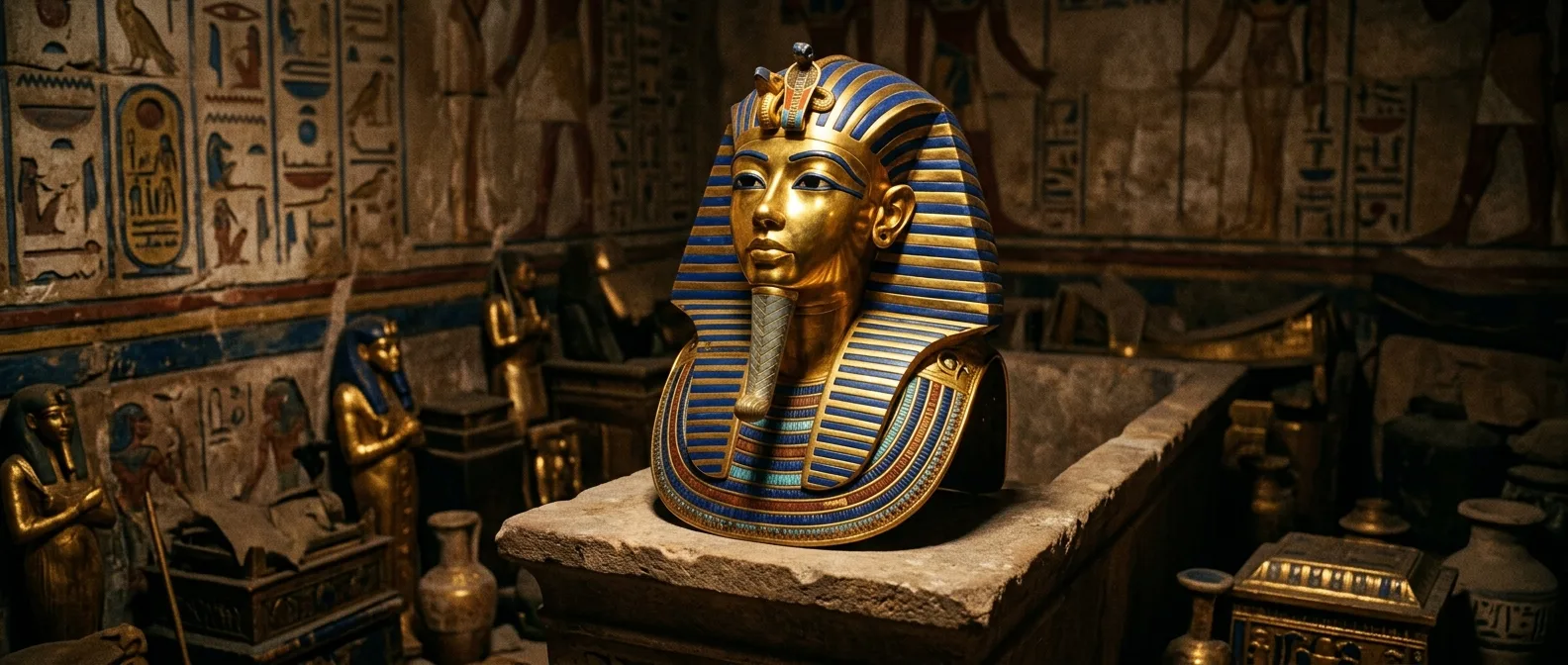
Tutankhamun's curse: coincidence or truth
A True Story
📖 Read more: Voynich Code: The Book Nobody Can Read
The lost tomb in the Valley of the Kings
In the early twentieth century, the Valley of the Kings near Luxor, Egypt, was considered exhausted. Dozens of archaeologists had dug through every corner of the desert, uncovering the tombs of great pharaohs — Ramesses, Seti, Thutmose. Yet one tomb remained undiscovered. The tomb of a young king who died at nineteen, around 1323 BCE: Tutankhamun.
Howard Carter, a British archaeologist with an obsessive devotion to Egyptology, was convinced the tomb was still out there, buried beneath tons of sand and rock. For years, his colleagues called him a dreamer. No one believed he would find anything significant in a site that had been so thoroughly excavated.
His patron, Lord Carnarvon, was a wealthy British aristocrat with a passion for archaeology. He had spent a small fortune supporting Carter's excavations, but after years without significant results, his patience was wearing thin. By late 1922, he gave Carter an ultimatum: one more season of digging, then it was over.
The discovery that changed history
Carter's workers began the new excavation season. They systematically removed layers of dirt and stone near the entrance to the tomb of Ramesses VI. The heat was unbearable, the dust tore through their lungs, but Carter persisted. Every morning he arrived first at the site and left last.
The first deaths: a myth is born
The euphoria did not last long. Less than five months after the tomb was opened, Lord Carnarvon died in Cairo. His death triggered a wave of panic that would persist for decades.
April 5, 1923Lord Carnarvon died at the Continental-Savoy Hotel in Cairo. The cause of death was septicemia, originating from a mosquito bite that became infected when he cut it while shaving. However, the details surrounding his death fueled the legend. According to witnesses, at the exact moment he died, the lights across Cairo went out — a blackout that was never fully explained. In England, his dog Susie reportedly howled at that precise moment and then died herself.
📖 Read more: Pompeii: The City Frozen in Time
The newspaper, the mystic, and the hysteria
The curse myth was not born in Egypt. It was born in the offices of the Daily Mail in London. Arthur Conan Doyle, the creator of Sherlock Holmes, publicly declared that Carnarvon's death was caused by “elemental forces” guarding the tomb. The fact that such a respected author believed in the supernatural gave enormous momentum to the rumors.
The Daily Mail held exclusive coverage rights to the excavation — something that infuriated rival newspapers. Those rivals, lacking access to real news from the tomb, turned to the most commercially appealing narrative: the curse. Every death, even those completely unrelated to Tutankhamun, was attributed to the “ancient curse.” The victim count ballooned uncontrollably.
Marie Corelli, a popular British novelist, had already warned — before Carnarvon even died — that “terrible dangers await anyone who opens a sealed tomb.” Her statement, widely shared in the press, amplified the fear. Meanwhile, a mystic named Velma claimed to “communicate” with Tutankhamun's spirit and said the pharaoh was enraged.
What science says: fungi, bacteria, and statistics
By the mid-twentieth century, several scientists decided to examine the “curse” with cold rationality. Their findings were revealing — and far less dramatic than the newspaper headlines.
The Aspergillus fungusIn 1999, German microbiologist Gotthard Kramer examined 40 mummies and discovered they harbored potentially dangerous fungi, primarily Aspergillus niger and Aspergillus flavus. These fungi can survive for millennia in sealed environments. When someone inhales their spores, they can develop aspergillosis — a severe lung infection that is particularly lethal for individuals with weakened immune systems. Carnarvon, who had suffered from chronic respiratory problems after a car accident years earlier, was exactly the type of vulnerable victim.
Carter: the man the curse “forgot”
If anyone should have been struck first by the curse, it was Howard Carter. He was the one who opened the tomb, removed the golden mask, and spent ten years cataloguing every object inside the burial chamber. If Tutankhamun wanted revenge, Carter was first on the list.
📖 Read more: Tunguska Explosion: The Day Siberia Exploded
And yet Carter died peacefully at sixty-four, seventeen years after the discovery, of lymphoma. Lady Evelyn Herbert, Carnarvon's daughter, who was present at the tomb's opening, lived to seventy-nine. Photographer Harry Burton, who documented every stage of the excavation, died of natural causes at an advanced age. The curse, it seems, had very poor aim.
The real story of Tutankhamun
Behind the legends, Tutankhamun himself was a tragic figure. He ascended to the throne at the age of nine or ten, around 1332 BCE. He was the son of the heretic pharaoh Akhenaten, who had overthrown the entire Egyptian religious system by introducing the monotheistic worship of the god Aten. Tutankhamun — originally named Tutankhaten — was tasked with restoring the old religious customs and regaining the trust of the powerful priesthood of Amun.
Modern CT scans of his mummy revealed that he suffered from multiple genetic abnormalities, most likely the result of inbreeding — his parents were siblings. He had a broken leg, spinal deformity, malaria, and probable bone necrosis. He died young and alone, in a court full of intrigue. The vizier Ay succeeded him immediately, and perhaps not by coincidence.
His tomb was small compared to those of the great pharaohs — inferior even to those built for officials of the era. Many archaeologists believe it was not originally constructed for him but was hastily adapted after his premature death. This explains why, although small, it was overloaded with objects — everything had to fit into a limited space.
The legacy: between myth and museum
Today, Tutankhamun's golden mask is displayed at the Grand Egyptian Museum in Giza. It is the most visited archaeological artifact in the world, with millions of people traveling every year to see it in person. The Valley of the Kings remains an active archaeological site, though Tutankhamun's tomb remains vulnerable to humidity, human perspiration, and the wear of mass tourism.
The “curse” never truly died. Films, books, documentaries, and conspiracy theories continue to revive it. Every time something unusual happens to someone involved with Tutankhamun, the press resurrects the legend. In 2005, a team of researchers performing a CT scan on the mummy reported “technical problems” with their equipment — enough for dozens of websites to publish new articles about the “curse.”
The truth, of course, is less mysterious but ultimately more interesting. Tutankhamun did not need magic to become immortal. Human imagination was sufficient — and one small mosquito bite.
EpilogueAmong those who worked most closely in the tomb, the average age at death was seventy — well above the average for their era. Carter, the man who should have been the “first victim,” spent his final years quietly writing his memoirs in London. Tutankhamun's curse was never ancient: it was modern. It was manufactured by newspapers, fueled by the fear of the unknown, and selectively confirmed by people who noticed only the deaths that fit the narrative. The real curse was always the same: the human tendency to see patterns where there is only noise.