Tunguska Explosion: The Day Siberia Exploded
A True Story
📖 Read more: The Lykov Family: Hidden in Siberia for 40 Years
The moment
That morning, the few inhabitants of the Tunguska region — mostly Evenki herders and hunters — saw a bluish light streak across the sky, brighter than the sun. It was followed by a blinding flash and a wave of heat so intense that a man 40 miles away felt his clothes catching fire.
Then came the sound — a thunderous hammering heard up to 600 miles away. Buildings shook in cities hundreds of miles distant. Seismographs across Europe recorded tremors. Barometric pressure waves circled the Earth twice. Microbarographs in London, Jakarta and Washington recorded the disturbances. The energy released was so immense that even magnetometers in Irkutsk — 560 miles away — registered geomagnetic field disruptions similar to those caused by a nuclear detonation.
The sky split in two. High above the forest, the entire northern sky appeared to be covered with fire. I felt great heat, as if my shirt had caught fire.
The nights that became day
Over the next several nights, something strange happened across northern Europe and Russia. The sky wouldn't darken. In London, people could read newspapers at midnight without artificial light. In Sweden, photographers took pictures at 2 a.m.
No one immediately connected the bright nights to an explosion deep in Siberia. The cause was microscopic dust particles — likely remnants of an object that vaporized in the atmosphere — scattering sunlight in the upper layers. The phenomenon lasted approximately two weeks and was documented in newspapers across Europe, though no one understood the real cause at the time.
Why no one went
The Tunguska region is in the most remote part of central Siberia — hundreds of miles from the nearest railway. In 1908, Russia was an empire in crisis. Then came World War I, the Russian Revolution, and civil war. No one had the time or resources to investigate an explosion in the middle of nowhere.
📖 Read more: The Woman Who Survived Alone on an Arctic Island
The local Evenki people believed the god Agdy had sent fire to punish the earth. They avoided the area with religious reverence, considering the destruction zone “cursed ground.” The few reports that reached urban centers were dismissed as exaggerations.
For 19 full years, the largest explosion in modern history remained uninvestigated. Not a single scientist had visited the site.
The Kulik expedition
It took almost two decades before anyone went there. Leonid Kulik, a mineralogist at the Soviet Academy of Sciences, was convinced a large meteorite had fallen. He believed he would find a massive crater full of iron — valuable for industry.
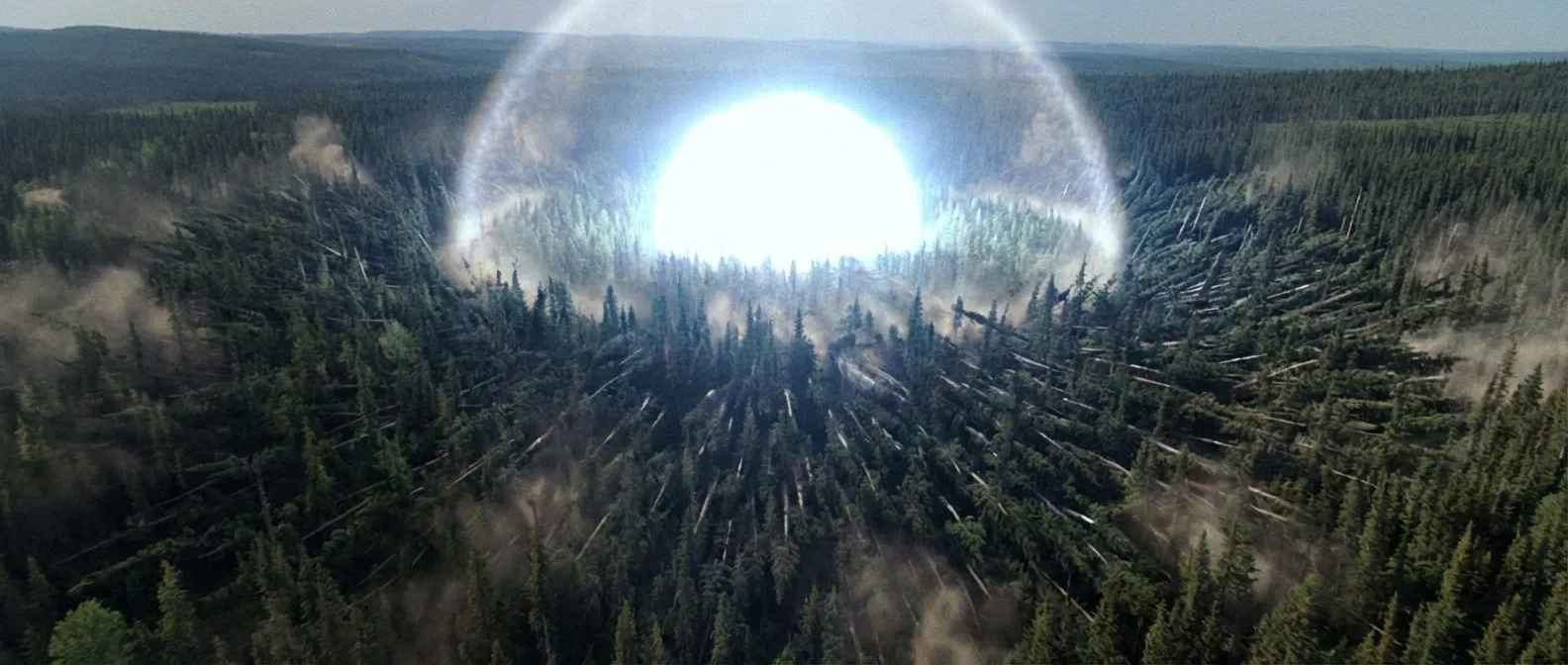
What he found shocked him. At the center of the destruction zone, trees were still standing — dead, stripped of branches, like giant matchsticks. Around them, 80 million trees lay fallen in concentric circles, with their tops pointing outward, as if something had pushed them from above.
But there was no crater. None at all. This was the greatest mystery: how could an explosion of such power leave no hole in the ground?
Kulik returned three more times — in 1928, 1929-30, and 1939. He drained marshes, excavated craters, and took soil samples. He never found a meteorite. He died in a Soviet prisoner-of-war camp in 1942 after being captured by the Germans, never having solved the mystery that had haunted him for fifteen years.
The results were astonishing. From the hill, the “dead zone” stretched to the horizon — millions of fallen trunks, straight as if a reaper had cut them down.
The theories multiply
Without a crater and without fragments, theories multiplied. Kulik believed in a meteorite that “sank” into marshes. Soviet science fiction writers proposed an alien spacecraft. Some physicists suggested a small black hole or antimatter.
📖 Read more: The Woman Who Was Declared Dead and Woke Up in the Morgue
After the development of nuclear weapons, a new theory emerged: a natural nuclear explosion. Radiation measured at the site was slightly elevated — but within normal limits. The theory was later discredited.
The most exotic proposal came from American theoretical physicists Albert Jackson and Michael Ryan, who suggested that a miniature black hole — weighing tens of thousands of tons but atom-sized — may have passed through the Earth. This theory was later rejected, as it did not explain the pattern of fallen trees. In 1973, Soviet author Alexander Kazantsev wrote a novel in which the explosion was caused by an alien spacecraft that detonated during landing — the idea became extraordinarily popular in the Soviet Union.
The airburst — the modern explanation
By the late 20th century, science converged on one explanation: an object — most likely an asteroid or comet fragment — entered the atmosphere at 10-20 miles per second. At an altitude of 3-6 miles, the pressure and temperature became so extreme that the body exploded in mid-air — an “airburst.”
It never hit the ground. That's why there's no crater. The energy dispersed as a downward shockwave, flattening everything. Directly below the explosion, trees received vertical pressure — that's why they remained standing but stripped bare.
Modern calculations indicate that the core of the explosion reached temperatures comparable to the surface of the sun — over 10,000 degrees Celsius. The shockwave traveled at many times the speed of sound, sweeping everything in a radius of dozens of miles.
The object is estimated to have been 160-260 feet in diameter. Had its arrival been delayed by just 4 hours and 47 minutes, the Earth would have rotated enough for St. Petersburg — with a population of over one million — to be directly below the epicenter.
The little Tunguska
On February 15, 2013, a 65-foot object exploded above Chelyabinsk, Russia. The blast was 30 times smaller than Tunguska, but it injured 1,500 people — mainly from glass shattered by the shockwave. This time, there were dashcams everywhere in the city. The videos that flooded YouTube showed a blazing streak across the sky, followed by a blinding flash and — seconds later — a shockwave that shattered thousands of windows. It was the first time an airburst had been captured on video from so many angles simultaneously.
📖 Read more: UVB-76: Russian Radio Buzzing for Decades
Chelyabinsk proved two things: first, that airbursts can still happen — and they do. Second, that we had zero warning. The object was not detected before it entered the atmosphere. No telescope, no radar, nothing. And the Chelyabinsk object was only 65 feet across — a third the size of Tunguska. Had it been larger, the devastation would have been nightmarish.
What we know — and what we don't
Modern studies (2019-2024) use supercomputer simulations to recreate the event. The latest explanation points to an iron asteroid 160-260 feet in diameter that entered the atmosphere at a 35-55 degree angle. It vaporized completely. It left nothing behind but flattened trees. However, a 2020 study in the Monthly Notices of the Royal Astronomical Society proposed an alternative explanation: that the body passed through the atmosphere without being fully destroyed, generating a shockwave while continuing on its trajectory back into space.
Yet some questions remain: slightly elevated iridium levels in peat layers. The exact composition of the body. Whether peat craters in the area (Lake Cheko) are related to the explosion. Tunguska has not been fully decoded yet.
The day we almost changed history
Tunguska exploded above an empty forest. If it had detonated over a city, the death toll would have been in the hundreds of thousands. Today, NASA tracks 34,000 near-Earth asteroids through its Planetary Defense Coordination Office. But it is estimated that millions of Tunguska-sized bodies remain undetected.
Every year on June 30, “International Asteroid Day” is observed in memory of Tunguska. In 2022, NASA's DART mission proved that we can deflect an asteroid by striking it with a spacecraft — a technology that could one day prevent a new Tunguska. The sky is not always quiet. And Tunguska reminds us that the only difference between an event and a catastrophe may be a few hours of the Earth's rotation. That is the truth that summarizes this entire story: we are vulnerable — and our only defense is knowledge.