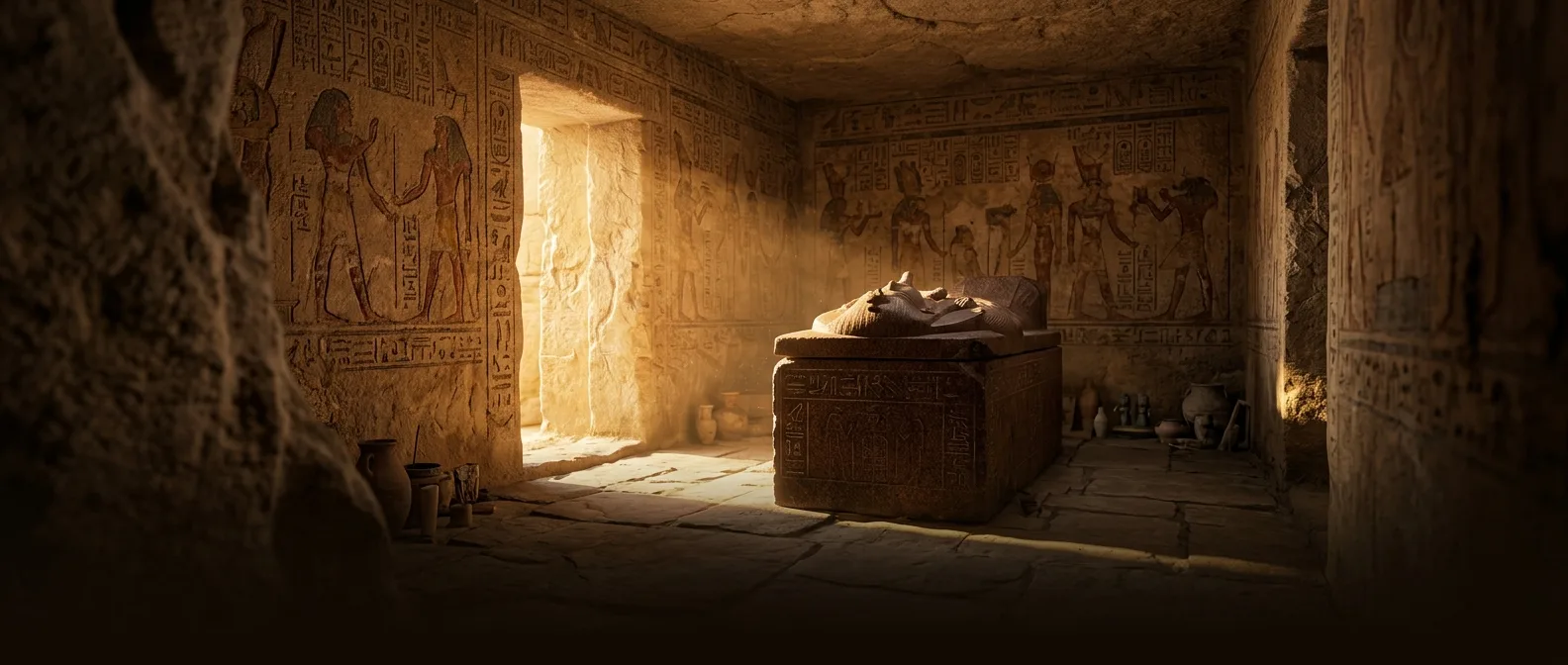
A scoop of sand here, an alabaster jar there — and suddenly you're holding a treasure thousands of years old. Valley of the Kings archaeologists lived exactly this moment in February 2025: Pharaoh Thutmose II's tomb surfaced after more than a century of searching. The first pharaonic discovery since Tutankhamun in 1922.
📖 Read more: Unknown Pharaoh's Tomb: 3,600-Year Mystery in Egypt
🏺 A Death That Left Behind Mysteries
Thutmose II ruled roughly from 1513 to 1500 BCE — a decade spent in his wife's shadow. Hatshepsut, both his sister and spouse as pharaohs customarily arranged, held real power even while he lived. After his death, she claimed the pharaoh title officially and erased his name from several monuments. But if Thutmose II was weak in life, he became invisible in death. In 2022, when an Egyptian-British team spotted the entrance at Wadi Gabbanat el-Qurud — 2.4 kilometers west of the Valley of the Kings — they thought they'd found a queen's tomb. Proximity to the burial sites of Thutmose III's wives and Hatshepsut led them to suspect it belonged to one of the royal consorts. The truth lay hidden in alabaster fragments.One Inscription That Changed Everything
The alabaster vessels spoke clearly. "The dead king" read the hieroglyphic characters beside Thutmose II's name. Another name accompanied the phrase: Hatshepsut. The wife who oversaw his burial. "The first time we've found burial furniture of Thutmose II," declared Dr. Mohamed Ismail Khaled from Egypt's Supreme Council of Antiquities. "No such material exists in any museum worldwide."Why Was He Missing So Long?
Thutmose II was the last "lost" pharaoh of the 18th Dynasty (1550-1292 BCE), ancient Egypt's most powerful period. Every other ruler from this era had been located — except him.
🌊 When Nature Destroys Eternity
Thutmose II's tomb didn't survive like Tutankhamun's. Floods that struck immediately after the king's death destroyed much of the structure. Waters invaded the interior, peeled sections from wall paintings, and left behind chaos. This explains why the pharaoh's mummy isn't in his tomb. Already in antiquity, priests moved his body to Deir el-Bahari, to a secret "storage" of royal mummies called the Royal Cache (TT320). There, in the 19th century, his mummy was discovered alongside other great pharaohs like Ramesses II and Seti I. The mummy now rests in the National Museum of Egyptian Civilization in Cairo.A Tomb That Shaped the Future
Despite the damage, Thutmose II's tomb holds unique architectural significance. Dr. Piers Litherland from Cambridge University, who co-directs the research, explains: "The simple architectural design served as a template for later royal tombs of the 18th Dynasty — including Tutankhamun's." A plastered corridor leads to the burial chamber, which sits 1.4 meters higher than the corridor floor. This height difference facilitated moving burial objects after the flood.📜 Messages from the World of the Dead
Surviving fragments in the tomb tell stories. Pieces of lime plaster with blue inscriptions and yellow stars. Excerpts from the "Book of Amduat" — a text that guided dead pharaohs on their journey to the underworld.3,500 years old
1922 last pharaoh discovery
2.4 km from Valley of Kings
The Woman Who Erased History
After his death, Hatshepsut was proclaimed pharaoh — a title rare for women in ancient Egypt. Her power was so absolute that she replaced her husband's name on several monuments, leaving minimal traces of his reign. This explains why Thutmose II remained "invisible" to archaeologists. Without clear archaeological evidence, his tomb was confused with those of female royal family members.🔬 A Discovery 100 Years in the Making
The 2025 discovery marks exactly 103 years since Howard Carter found Tutankhamun's tomb. But there's a crucial difference: while Tutankhamun's tomb was found intact, Thutmose II's had already been looted and partially destroyed by natural causes. Despite this, the scientific value remains enormous. Dr. Mohamed Abdel-Badi, head of the Egyptian team, emphasizes: "The material we're discovering adds significant knowledge to the region's history and Thutmose II's reign."This is one of the most important archaeological discoveries of recent years
Dr. Mohamed Ismail Khaled, Secretary-General of Egypt's Supreme Council of Antiquities