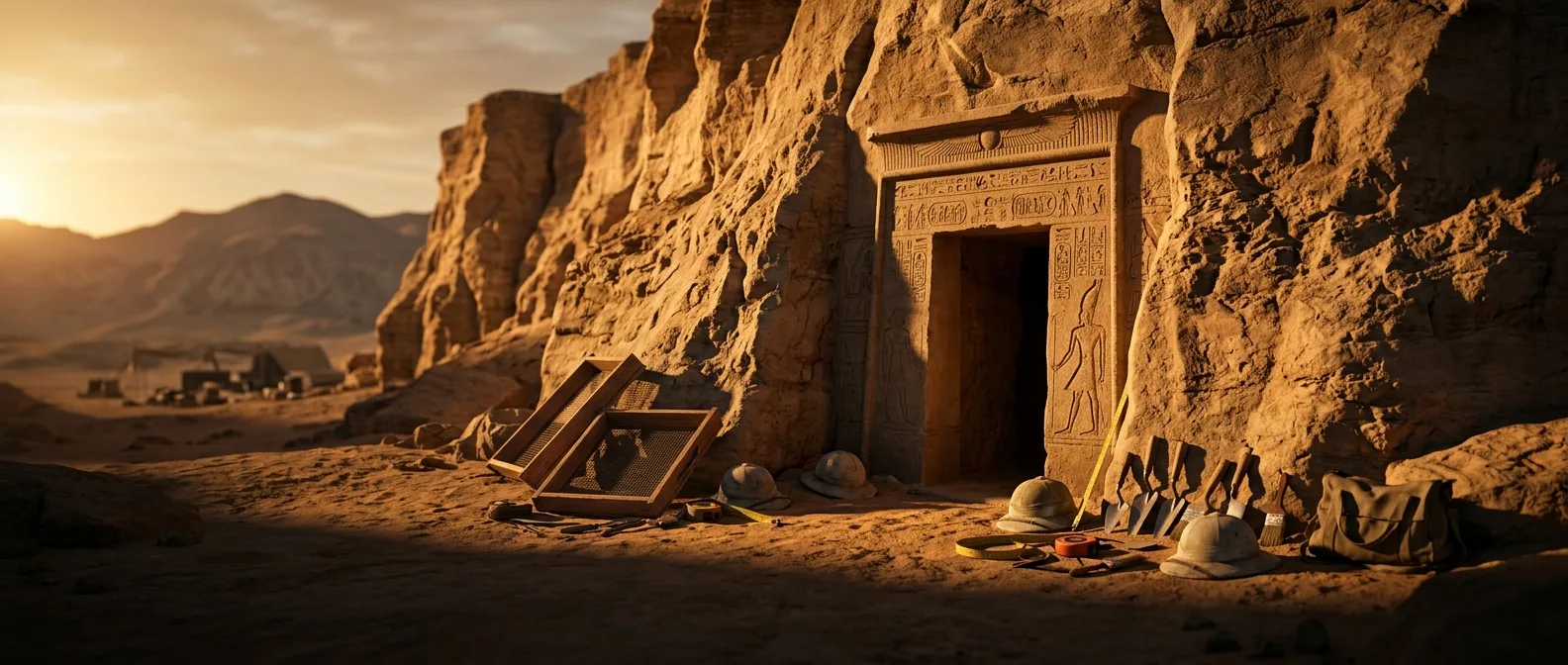
Six meters beneath the desert cliffs of Theban mountain in Luxor, a British-Egyptian research team crawls through an opening barely 40 square centimeters wide. The scene feels like an adventure movie — except this time the legend is real. After a century of searching, Pharaoh Thutmose II's tomb has finally been found. The discovery, announced in February 2025, closed the last chapter of missing royal tombs from the 18th Dynasty. It also revealed details about the era that preceded ancient Egypt's golden age — the period when Hatshepsut, Thutmose II's wife, would become one of history's most powerful female pharaohs.
📖 Read more: Thutmose II Tomb Found After 100-Year Hunt in Valley of Kings
🏺 The Hidden King of the 18th Dynasty
Thutmose II ruled Egypt from 1493 to 1479 BCE, roughly 14 years that often lived in the shadow of his great predecessors and successors. Fourth pharaoh of the eighteenth dynasty, he died at just 30 years old — which explains why historians considered his reign relatively brief and "unofficial." But his historical significance doesn't lie in the length of his rule. Thutmose II was married to Hatshepsut — who was also his half-sister, as was customary in pharaonic families. After his death, Hatshepsut initially became regent for the young heir Thutmose III, but later seized full power, becoming one of the rare female pharaohs. This family drama adds weight to the tomb discovery. The burial site reveals clues about the transition period when Egypt's most famous female ruler consolidated her grip on power.Why Was the Tomb Lost?
For over a century, archaeologists searched for Thutmose II's tomb on the opposite end of the mountain, near the classic Valley of the Kings. The miscalculation was based on older theories about 18th Dynasty burial patterns. The actual tomb was found roughly 2.2 kilometers away, west of the famous Valley.🔍 The 12-Year Campaign That Changed Everything
Dr. Piers Litherland's team from Cambridge University wasn't specifically hunting for Thutmose II. For 12 years they'd been systematically excavating the western Theban mountain of Luxor, having already discovered 54 tombs — mostly royal wives and court members. In February 2025, however, when the team reached a large staircase and an imposing downward corridor, they realized they'd uncovered something different. "The wide staircase and large entrance suggested something more significant than a queen's tomb," Litherland explained to the BBC. Access to the burial chamber was an adventure in itself. The team had to crawl through a narrow 10-meter passage, squeezing through the tiny opening to reach the interior space. There they found the first clear evidence: a stunning blue ceiling decorated with yellow stars and scenes from the "Amduat" — a sacred text reserved exclusively for kings.The Moment of Recognition
Definitive proof of the tomb's identity came from fragments of alabaster vessels with carved names. "Thutmose II" and "Hatshepsut" emerged clearly in the ancient inscriptions — the first objects ever connected to the pharaoh's burial. When Litherland emerged from the tomb, his wife waiting outside found him crying. "When you encounter something you don't expect to find, it's emotionally extremely turbulent," he described.📖 Read more: 7,000-Year-Old Stone Wall Found Deep Underwater Off France
🌊 The Tomb That Flooded
The tomb's condition reveals a dramatic story. About six years after Thutmose II's burial, a severe flood hit the area. The waters dissolved large chunks of plaster from the walls and likely forced ancient priests to move the tomb's precious contents to a safer location. This explains why the king's remains had been found in the 19th century in another area, along with other mummies moved by ancient guardians of the dead. This protective action, aimed at preventing tomb robbers, left behind an empty tomb — but not without traces. The flood damage actually helped preserve some decorative elements. Water-damaged plaster sections revealed underlying artwork that might have been painted over in antiquity.100+ years of searching
54 other tombs excavated
12 years of research
🏛️ Architecture and Royal Decoration
Despite flood damage, the tomb retains impressive elements of its royal architecture. The corridor is covered with white plaster and leads to the burial chamber, where the floor sits about one meter higher than the main corridor — a feature indicating the construction's royal significance. Remnants of blue inscriptions and yellow stars still decorate sections of the ceiling. Most importantly, the decorations include passages from the "Amduat" — the sacred book ancient Egyptians used to guide a dead king's soul on its afterlife journey. The tomb's layout follows classic 18th Dynasty royal patterns, but with unique modifications that suggest Thutmose II's burial was planned during a transitional period in Egyptian royal tomb design.What This Means for Egyptology
The discovery ends a search that began with the first systematic archaeological campaigns in the Valley of the Kings. "This is the first royal tomb discovered since Tutankhamun in 1922," declared Egypt's Minister of Tourism and Antiquities, Sherif Fathy. But the significance isn't just historical. Thutmose II's tomb proves that even after a century of intensive archaeological activity, ancient Egypt still hides secrets. Perhaps most exciting is that the team believes they've identified a potential location for the "secondary tomb" — where the precious contents were moved after the flood.📖 Read more: 1,000-Year-Old Whale Trap Found on Norway's Seafloor
🔮 The Future of Excavations
Unlike Tutankhamun's tomb, which contained over 5,000 objects, Thutmose II's tomb didn't hide treasures. At least not anymore. But this doesn't make it less significant — though certainly less Instagram-friendly than the most famous pharaoh's golden mask. The discovery's real value lies in understanding 18th Dynasty organization and burial practices of the era. The tomb proves ancient Egyptians had developed complex systems for protecting royal burials — systems that worked so well they hid an entire pharaoh from us for more than a century. The find also challenges assumptions about royal tomb locations. If archaeologists were wrong about Thutmose II for 100 years, what other royal burials might be hiding in unexpected places?"This discovery solves a major mystery of ancient Egypt — the location of early 18th dynasty royal tombs. They always believed it was on the other end of the mountain."
Dr. Piers Litherland, lead researcher