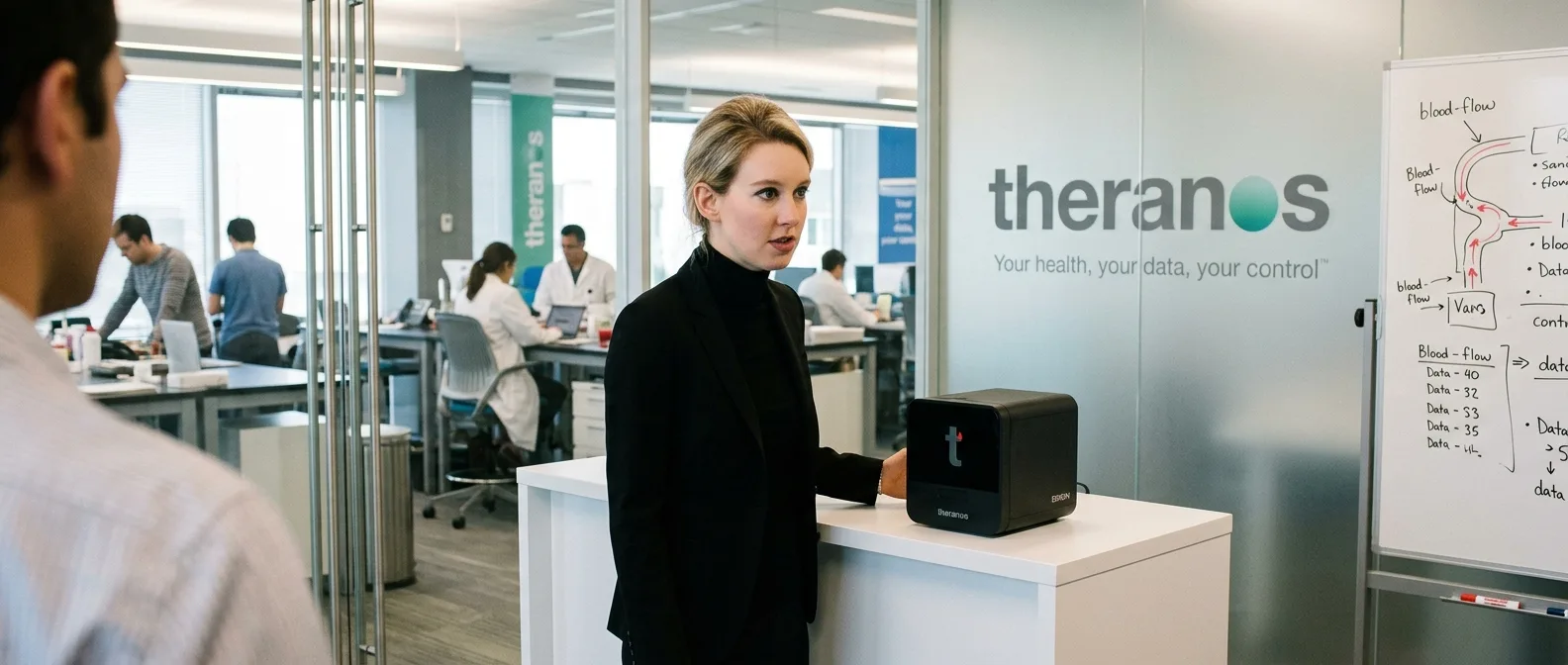
Bad Blood
How a single drop of blood created Silicon Valley's biggest fraud
📖 Read more: Flight MH370: Plane Vanished with 239 Passengers
The girl in the black turtleneck
She was nineteen when she dropped out of Stanford. Blonde, with large blue eyes and a voice unusually deep — so deep it later emerged she had been deliberately faking it. She always wore a black turtleneck, like Steve Jobs. Elizabeth Holmes didn't just want to build a company — she wanted to become the next Jobs. And for a few years, the world believed her.
Born on February 3, 1984, in Washington, D.C., Holmes grew up in a household steeped in political connections. Her father, William Holmes II, worked at Enron in government relations and later at USAID. Her mother, Noel, was a congressional staffer. From a young age, Elizabeth dreamed of becoming a billionaire. By the time she was nine, she had started learning Mandarin Chinese — at an age when most children still struggled with arithmetic.
At Stanford, she took chemical engineering courses under Professor Channing Robertson. Robertson was so impressed that he became the first advisor of the company she would go on to found. The original concept was an adhesive patch that could simultaneously deliver medication and analyze blood. The idea evolved into something far more ambitious.
In 2003, she founded Theranos — a blend of “therapy” and “diagnosis.” The promise? A tiny device called Edison that could run over 200 blood tests from a single finger prick. No needles. No vials. No waiting. Cheap, fast, everywhere.
The idea was perfect. The technology? Non-existent.
The court of power
What made Theranos so convincing wasn't the technology — it was the names. The company's board of directors didn't include scientists or doctors. It included former Secretaries of State: Henry Kissinger and George Shultz. Generals: Jim Mattis (later Secretary of Defense). Senators: Sam Nunn. Tycoons: Rupert Murdoch (who invested $125 million).
📖 Read more: The History of the Mobile Phone: From Luxury to Dependency
It was a roster no ordinary startup could have assembled. The legendary venture capitalist Don Lucas was among the earliest backers. Larry Ellison, founder of Oracle, invested early. In total, Theranos raised roughly $700 million from investors. Not one of them ever requested an independent evaluation of the technology. Holmes blocked it, using a dual-class share structure that gave her absolute control.
These people knew nothing about biochemistry or medical technology. But their presence sent a message: if such serious people trust this company, it must be legitimate. It was the same psychology Victor Lustig used: credibility isn't based on evidence — it's based on appearance.
“This technology will save tens of millions of lives. That's enough for me.” — Elizabeth Holmes in an interview (2014)
Holmes never let anyone see inside the Edison device. Not investors. Not partners. Not doctors. The excuse? “Trade secret protection.” The truth? Inside the machine, nothing worked as promised. Meanwhile, the company sealed major deals: with Walgreens (40 in-store testing centres) and Safeway (supermarkets), bringing Theranos closer to real patients — with fake technology.
Behind the curtain
Inside Theranos's laboratories, reality was nightmarish. The Edison device could perform only about twelve types of tests — immunoassays — and even those with questionable accuracy. Results were inconsistent, inaccurate, dangerous. For the majority of analyses, the company secretly used commercial Siemens machines — the same machines found in every regular lab. They simply hid them behind walls, in an area employees called “Normandy.”
A second device, the miniLab, was supposed to replace Edison. It never worked properly. Each new iteration added problems rather than solving existing ones.
Employees lived in a climate of terror. Holmes and her partner, Ramesh “Sunny” Balwani (who also served as President), monitored emails, fired anyone who questioned results, and banned all internal criticism. The company enforced strict compartmentalization: teams were forbidden from talking to one another about their work, so that no single person could see the full picture.
In May 2013, Ian Gibbons — Theranos's chief scientist — took his own life. He had been subpoenaed in a patent lawsuit and was deeply troubled by what he knew. Holmes did not attend his funeral. Instead, the company contacted Gibbons's widow to request the return of corporate documents.
📖 Read more: The Child Who Grew Up in the Jungle: Marina Chapman Story
The journalist and the grandson
The truth came from two unlikely sources. The first was Tyler Shultz — grandson of George Shultz, the board member. Tyler worked at Theranos as a young engineer and saw the fake results with his own eyes. When he tried to warn his grandfather, the elder Shultz refused to listen — Holmes had convinced him the company was infallible. The family was torn apart.
Another whistleblower, Erika Cheung, a young laboratory worker, independently uncovered the same problems. Both used prepaid phones and clandestine meetings to speak with the press.
The second source was John Carreyrou, an investigative journalist at the Wall Street Journal. Over months of secret investigation, he spoke with former employees, gathered internal documents, and dismantled every one of Holmes's claims. Theranos tried to stop him: lawyers, threats, even Rupert Murdoch (owner of the WSJ) was pressured to kill the story. Holmes deployed the law firm Boies Schiller — run by David Boies, who happened to sit on the company's board while simultaneously serving as its attorney. A staggering conflict of interest.
Nobody succeeded. In October 2015, the Wall Street Journal published its first exposé. Theranos began to collapse.
The fall
Events unfolded rapidly. Walgreens — which had placed Theranos testing centres in 40 stores — cancelled the deal and sued Theranos for $140 million (the case was settled out of court). The FDA ordered operations halted. In 2016, the Centers for Medicare and Medicaid Services revoked the main laboratory's licence and banned Holmes from running a lab for two years. The $9 billion valuation dropped to zero.
In March 2018, the SEC formally charged Holmes with “massive fraud.” In June, criminal charges followed. In January 2022, the trial concluded: guilty on four counts of federal fraud. In November 2022, she was sentenced to eleven years and three months in prison. In May 2023, she entered a minimum-security federal prison camp in Bryan, Texas.
📖 Read more: The Lykov Family: Hidden in Siberia for 40 Years
Sunny Balwani was separately convicted on twelve counts and sentenced to twelve years and eleven months.
“I know I started this company. I know I am failing at this.” — Elizabeth Holmes in court (2022)
The collapse wasn't merely legal. John Carreyrou wrote the book “Bad Blood: Secrets and Lies in a Silicon Valley Startup” (2018), which became a bestseller. HBO produced the documentary “The Inventor” (2019). Hulu released the series “The Dropout” (2022) starring Amanda Seyfried as Holmes, which won an Emmy. The Theranos story became a cautionary tale taught in business schools worldwide.
Why everyone believed her
The story of Theranos isn't just a story of fraud. It's a story about what we want to believe. Silicon Valley loved Holmes because she fit the myth: the young, ambitious founder changing the world. The idea was so beautiful — blood tests without pain, cheap, available everywhere — that nobody wanted to ask whether it was real.
The “fake it till you make it” culture was already deeply ingrained. In the world of Silicon Valley, exaggeration is considered normal — almost expected. Holmes took that logic and pushed it to the extreme — she didn't merely overstate capabilities. She fabricated them entirely. And no one around her had the expertise or the courage to call her bluff.
Investors didn't carry out due diligence because their fear of missing out was greater. Media didn't question because the story was too good. The board didn't ask because they didn't know what to ask. And nobody did the one thing that should have been done: request independent verification from a qualified laboratory.
Theranos showed that the greatest danger isn't technology that doesn't work. It's technology that nobody dares to test.
Today, Elizabeth Holmes sits in prison. But the legacy of Theranos is not merely a warning for startups. It is a reminder that glamour, charm, and big names are no substitute for data. Ever. Tyler Shultz, who lost his relationship with his grandfather and spent hundreds of thousands of dollars on lawyers, later said: “If I hadn't spoken up, I couldn't have lived with myself.” George Shultz died in February 2021, at the age of one hundred, without ever publicly admitting that Holmes had deceived him.
— The End —