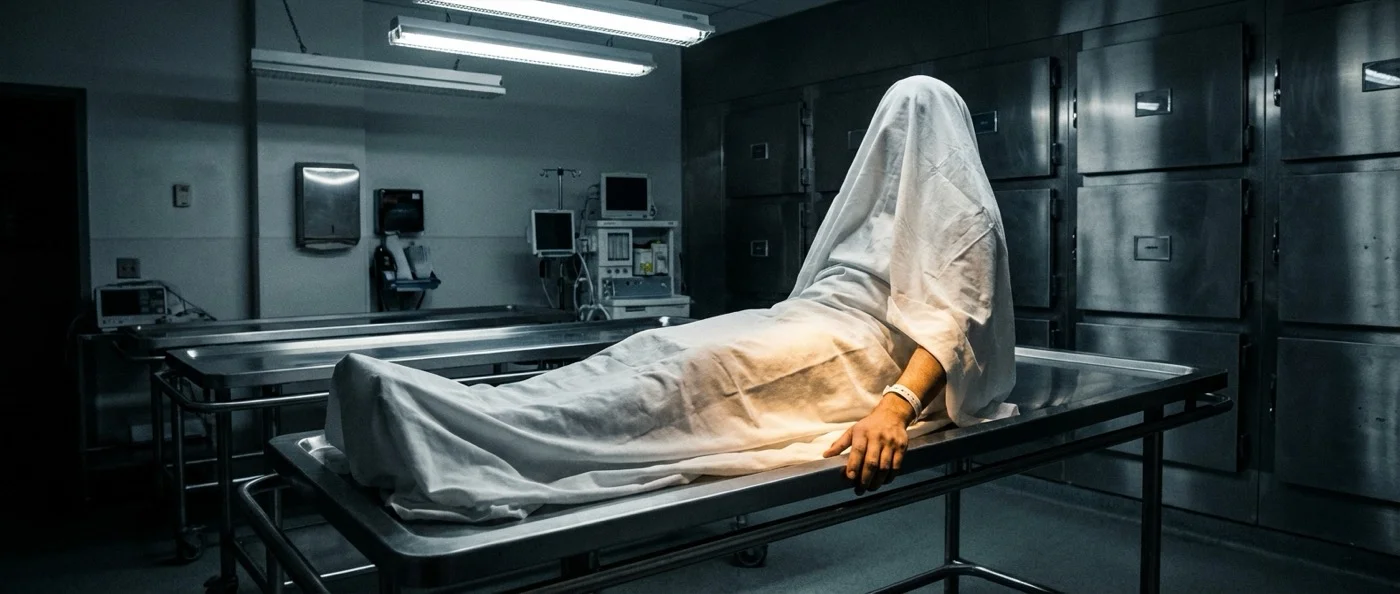
The Woman Who Woke Up in the Morgue
When medicine fails to tell the living from the dead
Prologue
The Silence of Death
Imagine waking up in total darkness. The air smells of formaldehyde and metal. Your hands touch something cold — stainless steel. Your body aches as if someone has been pounding on your chest over and over. You don't remember how you got here. You don't even know where you are. And then, slowly, consciousness informs you: you are in a morgue. Someone has declared you dead.
This is not the nightmare of some horror movie. It is the reality experienced by dozens of people around the world — people who were declared dead by doctors, wrapped in shrouds or placed in body bags, only to be discovered later still alive. Their story reveals something disturbing: that even in the 21st century, the line between life and death is not always as clear as we think.
This is not the nightmare of some horror movie. It is the reality experienced by dozens of people around the world — people who were declared dead by doctors, wrapped in shrouds or placed in body bags, only to be discovered later still alive. Their story reveals something disturbing: that even in the 21st century, the line between life and death is not always as clear as we think.
— i —
❧ ❧ ❧
Chapter One
Timesha Beauchamp
On August 23, 2020, the family of Timesha Beauchamp, a 20-year-old from Southfield, Michigan, called 911. Timesha, who had cerebral palsy since birth, was found unconscious in her home. She wasn't breathing.
Paramedics arrived within minutes. For 30 full minutes, they tried to revive her with CPR. Without success. An emergency room physician, informed by phone by the paramedics, declared her dead. The body bag was sealed. Timesha was transported to the James H. Cole funeral home in Detroit.
There, hours later, employees were preparing the embalming process. And then, a worker noticed something unthinkable: Timesha was breathing. Her eyes were open. She was alive.
Paramedics arrived within minutes. For 30 full minutes, they tried to revive her with CPR. Without success. An emergency room physician, informed by phone by the paramedics, declared her dead. The body bag was sealed. Timesha was transported to the James H. Cole funeral home in Detroit.
There, hours later, employees were preparing the embalming process. And then, a worker noticed something unthinkable: Timesha was breathing. Her eyes were open. She was alive.
"Her eyes were open and she was breathing. We couldn't believe what we were seeing. A little more and we would have started the embalming." — Funeral home employee, 2020
Timesha was rushed to Michigan Children's Hospital. Her family filed a $50 million lawsuit against the paramedics. Sadly, Timesha died on October 18, 2020, nearly two months after her “non-death.” In January 2026, the city of Southfield reached a settlement of $3.25 million.— 1 —
❧ ❧ ❧
Chapter Two
The Lazarus Syndrome
What happened to Timesha Beauchamp was not unique. Medical science has documented at least 38 verified cases of a phenomenon called “Lazarus Syndrome” — the spontaneous return of cardiac rhythm after failed resuscitation.
The phenomenon was named after Lazarus of Bethany, who according to the New Testament was raised from the dead by Jesus. It was first described in medical literature in 1982, and was officially named “Lazarus Syndrome” by physician Jack G. Bray in 1993.
How does it happen? The prevailing hypothesis involves the buildup of pressure in the thoracic cavity during CPR. When resuscitation efforts stop, the pressure is released, allowing the heart to expand again. This sudden change can trigger the heart's electrical signals, restoring the heartbeat.
The phenomenon was named after Lazarus of Bethany, who according to the New Testament was raised from the dead by Jesus. It was first described in medical literature in 1982, and was officially named “Lazarus Syndrome” by physician Jack G. Bray in 1993.
How does it happen? The prevailing hypothesis involves the buildup of pressure in the thoracic cavity during CPR. When resuscitation efforts stop, the pressure is released, allowing the heart to expand again. This sudden change can trigger the heart's electrical signals, restoring the heartbeat.
📋 Medical note: Experts recommend monitoring vital signs for 5–10 minutes after discontinuing resuscitation before certifying death. This recommendation arose precisely because of documented Lazarus cases.
Other possible factors include hyperkalemia — excessively high potassium levels in the blood — and the high doses of adrenaline administered during resuscitation. But the truth is that medical science does not fully understand the phenomenon. We know it happens. We don't always know why.— 2 —
❧ ❧ ❧
Chapter Three
Velma Thomas — 17 Hours Dead
In May 2008, Velma Thomas, 59, from Nitro, West Virginia, collapsed at her home after a cardiac arrest. Paramedics managed to restore a weak pulse after 8 minutes of CPR. But her heart stopped two more times after her arrival at the hospital.
Doctors connected her to life support and lowered her body temperature to prevent further brain damage. They recorded no brain activity. Velma was declared clinically dead. For 17 full hours.
Her son, Tim Thomas, remembers those hours: "Her skin had already started to harden. The fingers on her hands and feet had curled up. She already looked dead." The family began funeral preparations. She was disconnected from life support.
Ten minutes later, Velma Thomas woke up.
Doctors connected her to life support and lowered her body temperature to prevent further brain damage. They recorded no brain activity. Velma was declared clinically dead. For 17 full hours.
Her son, Tim Thomas, remembers those hours: "Her skin had already started to harden. The fingers on her hands and feet had curled up. She already looked dead." The family began funeral preparations. She was disconnected from life support.
Ten minutes later, Velma Thomas woke up.
"I don't know what happened. I only know that I woke up and my son was crying. And it wasn't grief crying — it was crying of joy." — Velma Thomas, 2008
Velma Thomas holds the world record for recovery from clinical death. 17 hours without measurable brain activity. 17 hours during which, by every medical criterion, she was dead. And yet, she came back.— 3 —
❧ ❧ ❧
Chapter Four
Buried Alive in Thessaloniki
These stories don't only concern distant countries. In 2014, in Peraia, Thessaloniki, police discovered that a 45-year-old woman had been buried alive after being declared clinically dead by a private hospital. She was discovered shortly after burial, when children playing near the cemetery heard screams from underground.
The woman had died — this time for real — from asphyxiation inside the coffin. Her family considered filing a lawsuit against the hospital.
But this was not an isolated incident. That same year, in the same area — Peraia, Thessaloniki — a second woman, 49 years old, was buried alive. The police investigation revealed that the woman, a cancer patient, had been declared dead due to medications administered as part of her treatment. These drugs induced a state that mimicked death — so convincingly that doctors were deceived.
The woman had died — this time for real — from asphyxiation inside the coffin. Her family considered filing a lawsuit against the hospital.
But this was not an isolated incident. That same year, in the same area — Peraia, Thessaloniki — a second woman, 49 years old, was buried alive. The police investigation revealed that the woman, a cancer patient, had been declared dead due to medications administered as part of her treatment. These drugs induced a state that mimicked death — so convincingly that doctors were deceived.
🇬🇷 Greek reality: The family of the 49-year-old reported that they could hear screams from underground at the cemetery shortly after the burial. The autopsy showed she died of cardiac arrest inside her coffin — not from cancer.
Two women, in the same city, in the same year. Buried alive in modern Greece. This tragedy proves that premature burial is not merely a medieval nightmare — it can happen anywhere, at any time.— 4 —
❧ ❧ ❧
Chapter Five
Essie Dunbar — The Woman Who Came Back in 1915
Long before modern medicine, erroneous death declarations were far more common. One of the most dramatic cases occurred in 1915 in South Carolina.
Essie Dunbar, 30 years old, an African American woman, suffered a severe epileptic seizure. Doctors declared her dead. The funeral was held quickly. Essie was buried.
But her sister, who had arrived late for the funeral, asked to see the body one last time. The attendees agreed. Just a few minutes later, they dug up the coffin, opened it — and Essie sat up.
The reaction? Three ministers fell into the grave in terror. Mourners ran away, convinced she was a zombie or a ghost. Essie Dunbar, however, was none of those things. She was simply alive.
Alive — and very confused.
Essie Dunbar, 30 years old, an African American woman, suffered a severe epileptic seizure. Doctors declared her dead. The funeral was held quickly. Essie was buried.
But her sister, who had arrived late for the funeral, asked to see the body one last time. The attendees agreed. Just a few minutes later, they dug up the coffin, opened it — and Essie sat up.
The reaction? Three ministers fell into the grave in terror. Mourners ran away, convinced she was a zombie or a ghost. Essie Dunbar, however, was none of those things. She was simply alive.
Alive — and very confused.
— 5 —
❧ ❧ ❧
Chapter Six
Safety Coffins and the Fear of Premature Burial
The fear of being buried alive — taphophobia — is cited as one of the most common phobias in the world. And it's not unjustified. In the 19th century, before medicine developed reliable methods of certifying death, premature burial was frighteningly possible.
In February 1885, the New York Times published a chilling report: a man in North Carolina was exhumed only to be found turned upside down inside the coffin. His hair was pulled out and scratch marks covered the inner walls. He had woken up. He had fought. He didn't make it.
These horror stories led to an entire industry of “safety coffins.” In 1882, J.G. Krichbaum patented a device in the USA that worked like a periscope — a tube provided air to the buried person, and if the “dead” person rotated or pushed it, it alerted passersby that someone was buried alive.
Edgar Allan Poe, obsessed with the subject, drew on these horrific accounts for some of his most famous stories: “The Premature Burial,” “The Fall of the House of Usher,” “Berenice,” and “The Cask of Amontillado.”
In February 1885, the New York Times published a chilling report: a man in North Carolina was exhumed only to be found turned upside down inside the coffin. His hair was pulled out and scratch marks covered the inner walls. He had woken up. He had fought. He didn't make it.
These horror stories led to an entire industry of “safety coffins.” In 1882, J.G. Krichbaum patented a device in the USA that worked like a periscope — a tube provided air to the buried person, and if the “dead” person rotated or pushed it, it alerted passersby that someone was buried alive.
"The invention belongs to that class of devices whose purpose is to indicate signs of life in buried persons." — Patent text US268693, 1882
In 1890, a family in Pennsylvania built a burial vault at Wildwood Cemetery with internal escape mechanisms, air supply, and felt lining to protect a panicked victim from self-injury. In 1896, the “Association for the Prevention of Premature Burial” was founded in London, proposing methods such as stethoscopy, application of electric current, and artificial ventilation before every burial.Edgar Allan Poe, obsessed with the subject, drew on these horrific accounts for some of his most famous stories: “The Premature Burial,” “The Fall of the House of Usher,” “Berenice,” and “The Cask of Amontillado.”
— 6 —
❧ ❧ ❧
Chapter Seven
Modern Cases — The List Continues
No one would expect that in the 21st century, with CT scanners, electroencephalographs, and pulse oximeters, we would still be writing such stories. And yet:
2001, Ashland, Massachusetts: A body bag was delivered to the Matarese funeral home. The owner, John Matarese, discovered that the “dead woman” was still breathing. Had he not been so careful, the woman would have been embalmed alive.
2010, Colombia: A 45-year-old woman was declared dead at a hospital. At the morgue, a worker noticed she was moving. The embalmer immediately alerted his colleague and the woman was transferred back to the hospital.
2014, Mississippi: Walter Williams, 78, was declared dead at his home by the coroner. He was transported to the funeral home. There, employees noticed he was moving inside the body bag. The most likely explanation? The implanted defibrillator in his chest had revived him. He died — for real this time — 15 days later.
2018, Brazil: Rosangela Almeida dos Santos, 37, was declared dead at the hospital and buried. Cemetery visitors heard noises from her grave. After 11 days, the grave was opened. The body was found destroyed — Rosangela had desperately tried to get out.
2022, Shanghai: During the COVID-19 pandemic, a body bag was delivered to a funeral home in Shanghai. Two employees detected signs of life in the woman inside the bag. They saved her in time, preventing premature burial.
2001, Ashland, Massachusetts: A body bag was delivered to the Matarese funeral home. The owner, John Matarese, discovered that the “dead woman” was still breathing. Had he not been so careful, the woman would have been embalmed alive.
2010, Colombia: A 45-year-old woman was declared dead at a hospital. At the morgue, a worker noticed she was moving. The embalmer immediately alerted his colleague and the woman was transferred back to the hospital.
2014, Mississippi: Walter Williams, 78, was declared dead at his home by the coroner. He was transported to the funeral home. There, employees noticed he was moving inside the body bag. The most likely explanation? The implanted defibrillator in his chest had revived him. He died — for real this time — 15 days later.
2018, Brazil: Rosangela Almeida dos Santos, 37, was declared dead at the hospital and buried. Cemetery visitors heard noises from her grave. After 11 days, the grave was opened. The body was found destroyed — Rosangela had desperately tried to get out.
2022, Shanghai: During the COVID-19 pandemic, a body bag was delivered to a funeral home in Shanghai. Two employees detected signs of life in the woman inside the bag. They saved her in time, preventing premature burial.
— 7 —
❧ ❧ ❧
Chapter Eight
The Thin Line
Why does it still happen? The answer lies in the very nature of death — or rather, in the difficulty of defining it.
Clinical death is not always the same as biological death. The heart may stop, breathing may cease, the brain may appear inactive — but that doesn't necessarily mean life has departed. Certain drugs, particularly barbiturates, narcotics, or chemotherapy medications, can create a state of lethal mimicry — a paralysis so deep that it deceives even experienced physicians.
Hypothermia can also mimic death. In medicine there is a saying: “No one is dead until they are warm and dead.” In cold conditions, metabolism can drop to such low levels that vital functions become detectable only with specialized equipment.
Clinical death is not always the same as biological death. The heart may stop, breathing may cease, the brain may appear inactive — but that doesn't necessarily mean life has departed. Certain drugs, particularly barbiturates, narcotics, or chemotherapy medications, can create a state of lethal mimicry — a paralysis so deep that it deceives even experienced physicians.
Hypothermia can also mimic death. In medicine there is a saying: “No one is dead until they are warm and dead.” In cold conditions, metabolism can drop to such low levels that vital functions become detectable only with specialized equipment.
⚕️ Medical protocol: Today, many hospitals require multiple criteria for certifying death: absence of pulse, absence of breathing, non-reactive pupils, absence of corneal reflexes, and — increasingly — a confirmatory electroencephalogram (EEG).
But these protocols are not always followed. In countries without adequate medical systems, in rural areas, in pandemic situations — death is sometimes certified hastily. And the mistakes are paid for in the most horrific way.— 8 —
❧ ❧ ❧
Epilogue
Waking Up in the Dark
The history of premature burial is not merely a collection of horrific anecdotes. It is a reminder that the line between life and death is never as clear as we want to believe.
From the safety coffins of the 19th century to the EEGs of the 21st, humanity continues to seek ways to be certain. Certain that when it declares someone dead, that person truly no longer exists. But Timesha Beauchamp, Velma Thomas, Essie Dunbar, the two women in Thessaloniki — they all remind us that certainty is a luxury.
Perhaps the greatest fear is not death. Perhaps it is the possibility — however small — that we wake up in a dark room, on a cold table, with someone next to us preparing the embalming tools.
And we wonder: how many never woke up?
From the safety coffins of the 19th century to the EEGs of the 21st, humanity continues to seek ways to be certain. Certain that when it declares someone dead, that person truly no longer exists. But Timesha Beauchamp, Velma Thomas, Essie Dunbar, the two women in Thessaloniki — they all remind us that certainty is a luxury.
Perhaps the greatest fear is not death. Perhaps it is the possibility — however small — that we wake up in a dark room, on a cold table, with someone next to us preparing the embalming tools.
And we wonder: how many never woke up?
— end —
· · · · ·
📖 Read more: Tarrare: The Man Who Ate Everything