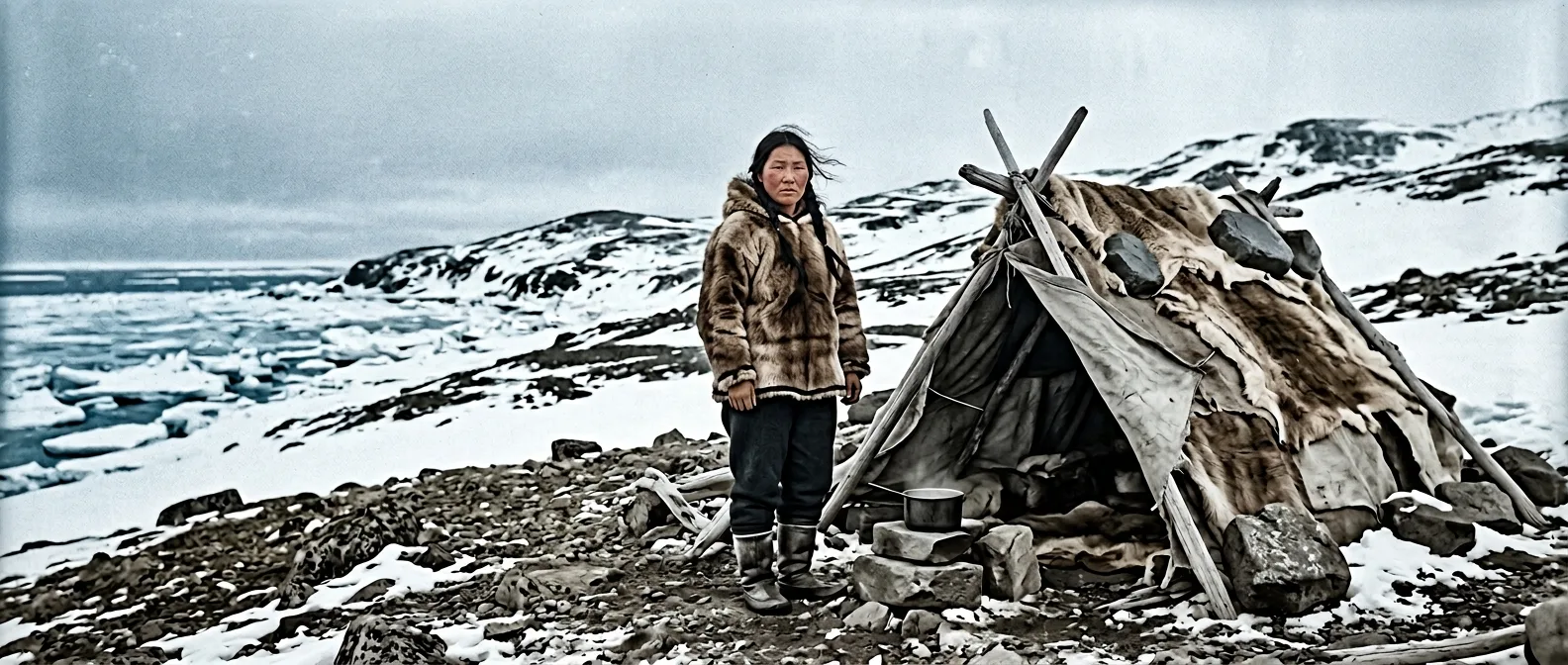
The Woman Who Survived Alone on an Arctic Island
In 1921, five people landed on Wrangel Island — a frozen, isolated piece of land in the Arctic Ocean, north of Siberia.
📖 Read more: Woman Survived 10km Fall Without Parachute: Vesna Vulović
Ada Blackjack
Ada Delutuk was born on May 10, 1898, in Spruce Creek — a remote settlement near Solomon, Alaska. Her father died of food poisoning when she was eight. Her mother sent Ada and her sister Rita to a Methodist mission school in Nome. There she learned to read English and, above all, to sew.
At sixteen she married Jack Blackjack, a hunter and dogsled driver. They had three children — only one survived infancy: Bennett. Jack abused her and eventually deserted the family. Ada took Bennett and walked 40 miles to Nome. There she cleaned houses and sewed clothes for miners, but the money was never enough. Bennett had tuberculosis and needed medical care she couldn't pay for. She had to place him in the Jesse Lee Home for Children — an institution that could care for him. But money was the only way to get him back.
Nome's police chief, E.R. Jordan, knew Ada's situation. He heard that some explorers were recruiting Alaska Natives for an Arctic expedition — and recommended her. They needed someone to sew fur clothing. Ada accepted. The only reason: the money for Bennett.
The Stefansson expedition
Vilhjalmur Stefansson was a Canadian explorer with grand ambitions. He believed the Arctic could be inhabited — and wanted to prove that Canada could claim territory there. He organized an expedition to Wrangel Island, roughly 90 miles north of Siberia. But he never went himself — he stayed behind “to fundraise.”
The team consisted of four young men: Canadian Allan Crawford (the leader), and Americans Lorne Knight, Fred Maurer, and Milton Galle. Maurer had already spent eight months on Wrangel Island in 1914, after the shipwreck of the Karluk — he knew what awaited them. The fifth member was Ada, hired as cook and seamstress. She'd been told many other Natives would be on the team. That was a lie. She was the only one.
Life on the island
On September 15, 1921, the team landed on Wrangel Island with food supplies for six months. Stefansson promised that a resupply ship would arrive the following summer. It never came.
📖 Read more: The Castaway Who Survived 133 Days Alone on a Raft
The first winter was hard but manageable. They hunted polar bears, seals, and birds. They had a cat — Victoria — as the expedition's companion. But after the first year, food ran out faster than expected. The ship never appeared. The second winter was unbearable. Knight fell gravely ill with scurvy. The situation turned critical.
The desperate march across the ice
On January 28, 1923, three of the four men — Crawford, Galle, and Maurer — decided to walk across the frozen ocean, crossing the Chukchi Sea to Siberia. The distance: roughly 90 miles of frozen sea. They took the few remaining supplies. They said goodbye one January morning — to Ada, to the sick Knight, and to Victoria the cat.
They were never seen again. Nobody knows exactly what happened. Most likely the ice broke beneath their feet, or they were lost in a blizzard. Their bodies were never found. Left on the island were Ada, the dying Knight — and Victoria.
Alone with death
Ada cared for Knight for five grueling months. She fed him, sheltered him, melted snow for water. Knight was suffering horribly — his teeth were falling out, his joints were swelling, he couldn't stand. Ada, with no medical knowledge, gave everything she had to keep him alive.
On June 23, 1923, Lorne Knight died. Ada was now utterly alone — with only Victoria the cat for company — on a frozen island, over 90 miles from Siberia. She was twenty-five years old. Two months before Knight's death, she had written something in her diary that freezes the blood:
"If anything happen to me and my death is known, there is black stirp for Bennett school book bag, for my only son. I wish if you please take everything to Bennett that is belong to me."
📖 Read more: The Fake Anastasia Romanov: Anna Anderson's 60-Year Deception
Learning to survive
Ada didn't know how to hunt. She didn't know how to trap. She didn't know how to set snares for birds or foxes. Until that point, she knew two things: sewing and cooking. But now she needed far more than that.
She learned alone, through trial and error. She built an observation platform on top of wooden crates to spot approaching polar bears. She taught herself to shoot — though at first she couldn't even lift the rifle. She trapped foxes, constructed boats, sewed parkas from reindeer skin. She kept a diary — a chronicle of every single day. The entries reveal a woman who refused to die.
Victoria, the expedition cat, was her only companion. Ada took care of the cat as she took care of herself — sharing fish, seal meat, whatever she managed to catch. One animal and one human, alone at the end of the world.
The polar bears
The greatest threat was not hunger or cold — it was the polar bears. Wrangel Island was full of them — today it's recognized as one of the largest polar bear denning areas in the world. Ada, who weighed less than 110 pounds, had to face them alone.
In one diary entry she writes: "A bear came close to the tent. I fired into the air. It left. My hands are still shaking." In another: "I woke up and a bear was 30 feet away. I didn't move. It looked at me and walked away." This was her daily reality: sleep, watch, hunt, fear — and the hope that a ship would appear on the horizon.
The observation platform she had built on wooden crates was her only advantage. From there she could spot bears approaching before they got too close. On nights when the wind blew hard and drowned out every sound, Ada slept with the rifle beside her — always loaded, always ready. She had no help. She had no backup plan. She had only herself.
The rescue
On August 19, 1923 — nearly two full years after landing — a ship appeared on the horizon. Harold Noice, a former colleague of Stefansson's, found Ada alive. She was thin, exhausted, but breathing. Victoria was with her.
📖 Read more: The Hindenburg Disaster: Live on Radio
The three men who had left for Siberia in January were never found. Knight was buried on the island. Ada was the sole survivor. Newspapers called her “the female Robinson Crusoe” — but Ada never saw herself that way. She simply wanted to go home.
When asked how she survived, Ada answered simply: “I had to get back to my son.”
The heroine they forgot
Ada returned to Nome, Alaska. Instead of becoming a hero, she faced criticism — some accused her of not caring enough for Knight. Her rescuer, Harold Noice, and Stefansson — who had never sent a resupply ship — tried to exploit her story. Books were written without her consent. Ada received almost nothing — only her expedition salary and a few hundred dollars from furs she had trapped on the island.
Ada hated the media circus. She took what money she had, reclaimed Bennett, and traveled to Seattle to treat his tuberculosis. She remarried later, had another son named Billy, and eventually returned to the Arctic — far from the spotlight.
She died on May 29, 1983, at the age of 85, in the Pioneer Home in Palmer, Alaska — a state retirement facility. She was buried in Anchorage. Her gravestone carries a plaque reading: “Heroine — Wrangel Island Expedition.”
Ada Blackjack today
In the early 21st century, Ada's story was revived. Author Jennifer Niven published “Ada Blackjack: A True Story of Survival in the Arctic” in 2003, restoring her memory. The New York Times included her in their “Overlooked No More” obituary column in December 2023 — a tribute to people whose lives were ignored while they lived.
Today, Ada is considered one of the most remarkable survival stories in history — a woman with no training, no equipment, and no hunting skills, who accomplished what trained male explorers could not. Stefansson was never held accountable. The three bodies were never found.
Wrangel Island still exists — isolated, frozen, inhabited only by polar bears and seabirds. But somewhere there, for nearly two years, a 110-pound woman with a rifle she could barely lift decided she would not die. Ada never sought recognition — she only wanted to return to her son. And she did.