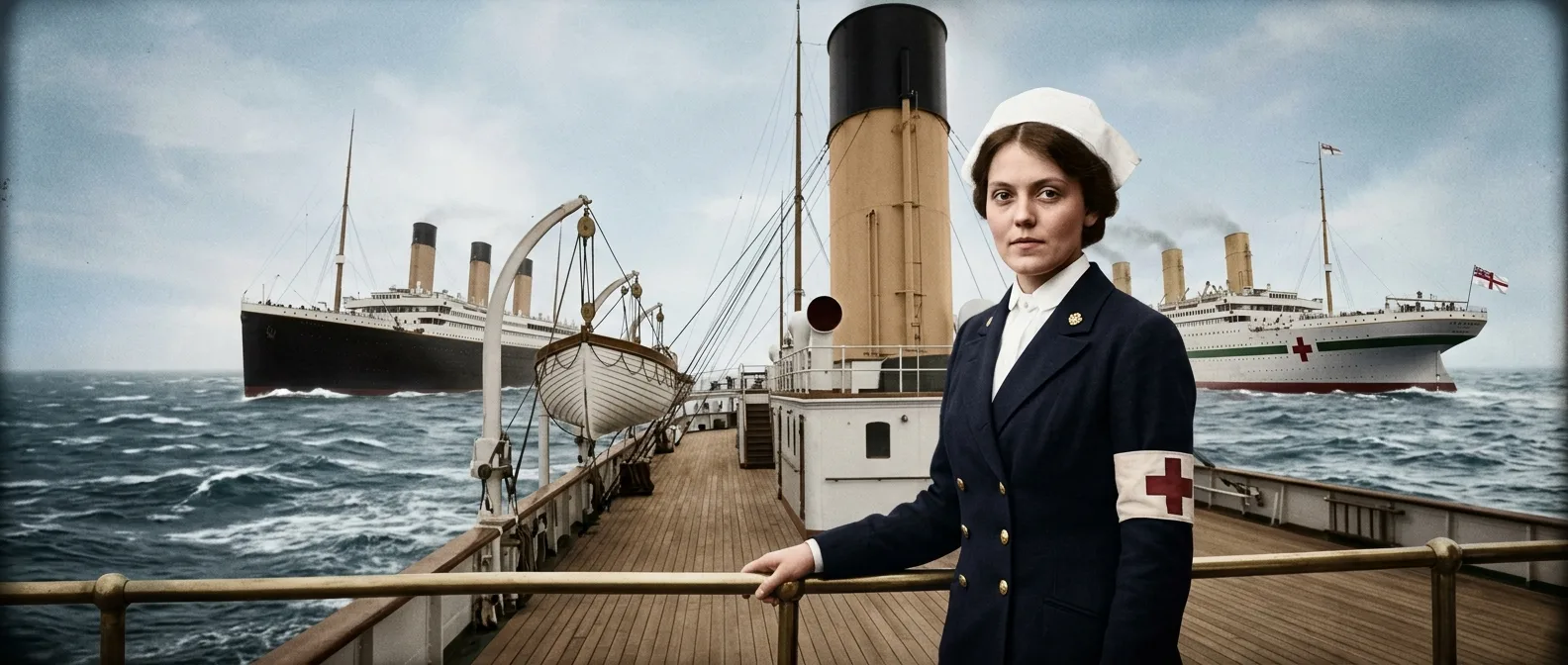
The Unsinkable
The woman who survived three disasters on three sister ships
📖 Read more: The Book That Predicted the Titanic 14 Years Before
There is a name that few remember, though it should be synonymous with survival itself. Violet Jessop boarded three sister ships of the White Star Line — the Olympic, the Titanic, and the Britannic. These were colossal ocean liners of the Olympic class, built at Harland & Wolff shipyard in Belfast. All three were wrecked or suffered grave accidents. She survived every single one.
They called her “Miss Unsinkable.” But behind the nickname lies a life that began with poverty and illness, and continued with a stubbornness that defied all reason. Hers is not simply a story of luck — it is the story of a woman who refused to let the sea decide her fate.
— 1 —Violet Constance Jessop was born on October 2, 1887, in Bahía Blanca, Argentina. Her father, William, was an Irish emigrant from Dublin who raised sheep on a farm in the pampas. Her mother, Katherine, kept the house and their nine children. Only six would survive infancy. Violet was the firstborn.
As a small child, Violet contracted tuberculosis. The doctors were categorical: the girl would not pull through. But Violet defied their prognosis — the first of many times she would push back against the inevitable. She recovered completely, something the doctors themselves called inexplicable.
When her father died — Violet was just sixteen — the family moved to England. Her mother found work as a stewardess on ocean liners to feed the children. Violet, seeing this path laid out before her, followed in her mother’s footsteps. At twenty-one, in 1908, she applied to the Royal Mail Line for a stewardess position aboard the SS Orinoco.
There was a problem: she was too young and too attractive. Shipping companies hesitated to hire good-looking women, fearing “complications” with passengers. Violet, determined to land the job, began dressing deliberately plain — no makeup, dark clothing, nothing that drew attention. She got the position. In 1910, she transferred to the White Star Line — the company that operated the largest ocean liners of the era. She had no way of knowing that this decision would bind her to three of the most famous ships in history.
All three ships — Olympic, Titanic, and Britannic — were sister ships of the Olympic class, built at the same shipyard. They weighed roughly 45,000 to 48,000 tons each and were considered engineering marvels of their age. Violet Jessop served aboard all three.
The first ship was the RMS Olympic — the largest ocean liner in the world at the time of its launch. Violet served as a stewardess, attending to first-class passengers. On September 20, 1911, as the ship was departing Southampton, it collided with the British warship HMS Hawke.
📖 Read more: The Man Who Was Struck by Lightning 7 Times
The collision was violent. Two watertight compartments flooded immediately, and the Hawke’s bow was crumpled beyond recognition. Yet the Olympic managed to limp back to port under its own power. No one was killed; no one was seriously injured. To Violet, the incident seemed unremarkable — a maritime mishap among many others.
She could not have imagined it was only the beginning. Seven months later, she would board the sister ship — the one that no one believed could ever sink.
— 3 —On April 10, 1912, Violet Jessop boarded the RMS Titanic at Southampton. She was twenty-four years old. As a stewardess, her job was to look after passengers — waking them, tidying their cabins, serving tea. There was no reason to be afraid. They called it unsinkable.
Four days later, on the night of April 14th, everything changed. An iceberg tore along the ship’s starboard side. Violet, initially, did not grasp the severity. But soon the order came: all hands to the boat deck.
Violet was ordered up on deck to demonstrate to non-English-speaking passengers how to wear their life jackets. She was to be a model of calm amid the chaos. She stood alongside the other stewardesses, witnessing scenes she would never forget.
“I was ordered up on deck. Calmly, passengers walked around. I stood at the bulkhead with the other stewardesses, watching women embrace their husbands before stepping into the lifeboats with their children.”
— Violet Jessop, memoirsSixth Officer James Paul Moody ordered her into lifeboat 16. “Get in,” he told her, “to show the other women it is safe.” She obeyed. As she climbed down into the boat, someone above thrust a baby into her arms. She had no idea whose child it was. She held it tightly through the entire night.
Moody would never see land again. He perished that night, along with 1,517 others. Violet spent the whole night on the freezing Atlantic, wrapped in a blanket, clutching the infant. In the morning, the RMS Carpathia plucked them from the water.
📖 Read more: Antikythera Mechanism: A 2,000-Year-Old Computer
Aboard the Carpathia, something strange happened. A woman approached Violet, snatched the baby from her arms, and disappeared without a word. Violet never learned who she was — nor whose child it had been.
Once she recovered, Violet did what no one expected: she went back to sea.
— 4 —In 1916, during the First World War, the White Star Line converted several of its ships into floating hospitals. Violet was now serving as a British Red Cross nurse aboard the HMHS Britannic — the third and final sister ship. It was the largest of the three, designed with improved safety systems following the Titanic disaster. Nobody believed it would meet a similar fate.
On the morning of November 21, 1916, as the ship passed through the Kea Channel in the Aegean Sea, a German naval mine detonated against the bow. The explosion rocked the entire vessel. Captain Charles Bartlett attempted to beach the ship on the island of Kea, but the flooding was too rapid — just fifty-five minutes from blast to sinking.
“The white pride of the medical world of the oceans tilted its head a little, then a little lower, and lower still. All the deck machinery tumbled into the sea like children’s toys. Then it made one terrible plunge. The stern rose hundreds of feet into the air, and with a final roar, it vanished into the deep.”
— Violet Jessop, memoirsThe situation was more perilous than the Titanic. As the captain tried to steer toward shore, the ship’s enormous propellers continued spinning — dragging lifeboats underwater and shredding anything that drifted near them.
Violet leaped from her lifeboat into the water to escape the propellers. But as she was pulled under, the ship’s keel struck her head.
“I jumped into the water but was sucked under the keel, which struck my head. I survived, but years later, when I visited a doctor for headaches, he discovered that I had once suffered a fractured skull!”
📖 Read more: Molly Brown: The Unsinkable Woman of the Titanic
— Violet JessopOf the 1,066 people on board, thirty were killed — several by the propellers themselves. Violet was not among them. For the third time, the sea had failed to claim her.
— 5 —After the sinking of the Britannic, Violet did not abandon the sea. In 1920, she re-joined a White Star Line vessel. She later transferred to the Red Star Line, and then to the Royal Mail Line. She completed two voyages around the world aboard the SS Belgenland — for a woman who had nearly drowned three times, the ocean remained her home.
At thirty-six, in 1923, she married John James Lewis, a fellow crew member. The marriage lasted barely a year. After the separation, Violet carried on alone — working at sea, living in cabins, traveling ceaselessly between Europe and the Americas.
It is worth noting that Violet was not the only person to survive all three ships. Arthur John Priest, a stoker (engine fireman) aboard all three vessels, shared the exact same fate — he boarded all three, and walked away from all three. They called him “the Unsinkable Stoker.”
— 6 —Miss Unsinkable
Violet retired from the sea in 1950. She settled in Great Ashfield, Suffolk, in the English countryside, where she tended her garden, raised chickens, and lived quietly. She wrote her memoirs, but they were never published in her lifetime — they would appear posthumously in 1997 under the title “Titanic Survivor.”
Years after her retirement, she received a phone call. A woman on the other end of the line claimed to be that baby — the baby from lifeboat 16 on the Titanic. Violet was moved. But the historical record tells a different story: the infant in question was most likely As’ad Tannous, a boy who died in 1931, decades before the call. Who actually rang her that evening, nobody knows.
Violet Jessop died on May 5, 1971, at the age of eighty-three, from congestive heart failure. She was buried in Hartest churchyard in Suffolk.
Three sister ships. Three disasters. One woman. Tuberculosis in childhood, a collision on the Olympic, a sinking on the Titanic, a mine on the Britannic, a fractured skull. And the sea — which tried three times to take her, and three times it failed.