The Town That Was Secretly Poisoned
A True Story
📖 Read more: The Village That Vanished Overnight Without Any Explanation
The Canal of Love
In the late 19th century, William T. Love had a vision: a canal connecting the upper and lower Niagara River, creating a model industrial city powered by hydroelectric energy. The canal began to be dug around 1894 in the northeastern part of Niagara Falls, New York State. Love named the project “Love Canal.” The idea was ambitious, even romantic. A utopian community built around clean energy.
But the money ran out before it was finished. Love abandoned the project, leaving behind a ditch roughly one kilometer long and 15 meters wide. For decades, the unfinished canal remained an open wound on the landscape — filled with water, weeds, and garbage. Nobody imagined what would happen inside it later.
The Factory and the Barrels
In the 1940s, the Hooker Chemical Company — a chemical industry giant based in Niagara Falls — was looking for a place to bury the toxic waste from its production. Chlorinated hydrocarbons, dioxins, hexachlorocyclopentadiene, lindane — substances recognized today as extremely hazardous. They needed somewhere deep, somewhere remote, somewhere cheap. The abandoned Love Canal was perfect.
📖 Read more: The 3 Lighthouse Keepers Who Vanished Mysteriously
1942Hooker Chemical acquires the rights to use Love Canal. The burial of toxic waste begins in 208-liter metal drums. The barrels are placed along the length of the canal, side by side, in layers.
One Dollar for a Disaster
In 1953, the Niagara Falls Board of Education was looking for a plot for a new elementary school. The neighborhood was growing rapidly — new families, baby boom children, a need for school seats. Hooker Chemical offered the entire Love Canal property to the school board — for one dollar.
One single dollar. But the sale included something suspicious: a liability disclaimer in the deed. The clause mentioned that the land had been used for “chemical waste disposal” and that the buyer assumed all risk. There were no details about exactly what had been buried, nor about the quantities. It was a systematic attempt to transfer responsibility — hidden behind legal language that nobody on the school board fully understood.
Construction begins on the 99th Street School directly on top of the center of the old canal. During excavation, workers find metal drums filled with liquid. Nobody stops the work.
📖 Read more: The Disappearance of Amelia Earhart in the Pacific
The Poisoning Nobody Could See
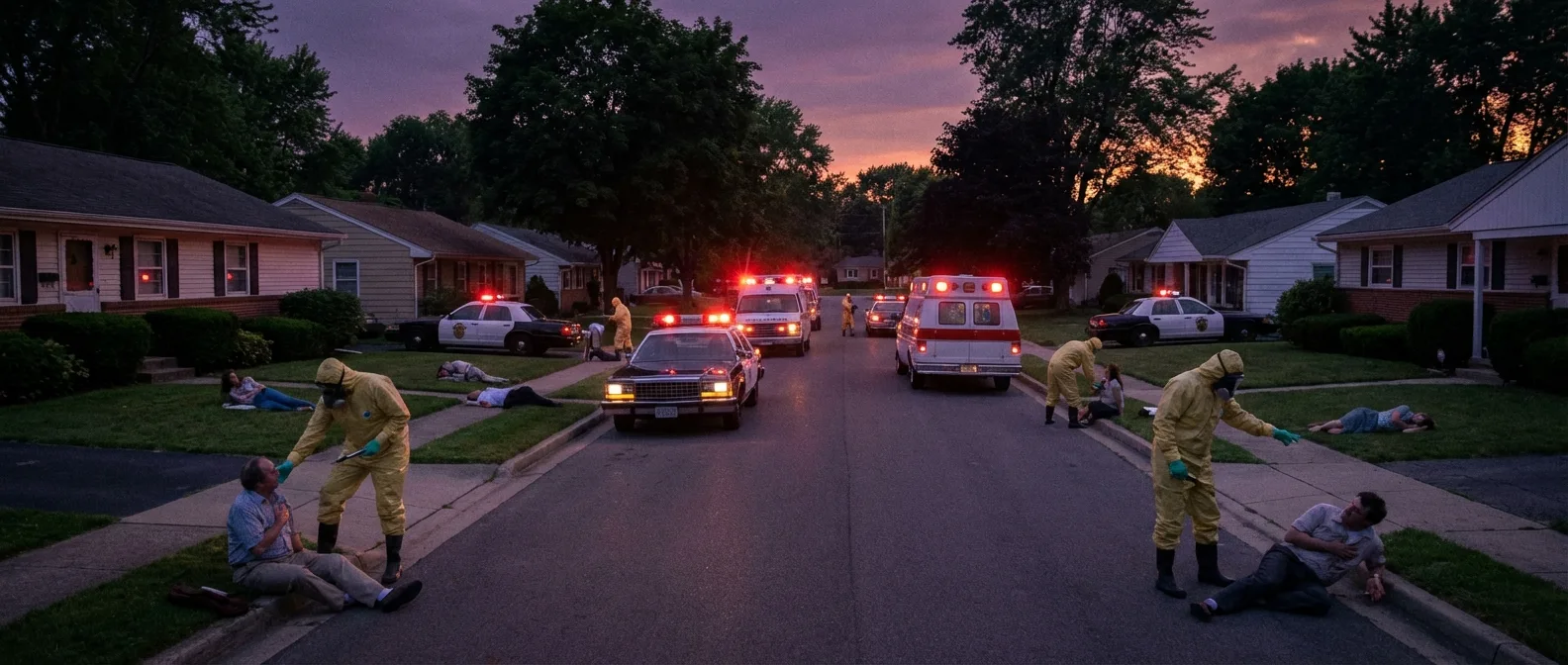
The first signs were invisible — or at least, nobody wanted to see them. In the 1970s, residents of the Love Canal neighborhood began noticing things they couldn't explain. A foul smell rising from the soil, especially on warm days. Children who played on the school grounds came home with rashes on their hands and feet. Dogs that dug in the yard fell ill. Trees withered for no reason.
In some basements, a black, oily liquid seeped up through cracks in the concrete. Some residents wiped the liquid with tissues — the smell lingered on their hands for days. Gardens stopped growing. Sewer drains clogged with a slimy black mass. Nobody spoke up — because nobody knew exactly what was happening. It was just “strange things in the neighborhood.”
The medical evidence accumulated silently. Women in the neighborhood had unusually high miscarriage rates — nearly triple the average. Babies were born with congenital abnormalities: heart defects, cleft palates, kidney problems, chromosomal damage. Childhood leukemia rates were extraordinarily high. The genetic harm was not theoretical — it was visible, measurable, tragic.
But local government, the state, even the federal government did not respond. Hooker Chemical — now a subsidiary of Occidental Petroleum — denied all responsibility. Public health agencies treated residents' complaints as exaggerations. It was something that would repeat again and again in such cases: inaction as a response, silence as policy.
📖 Read more: The Conman Who Sold the Eiffel Tower Twice
The Housewife Who Stood Up
Lois Gibbs was 27 years old, a housewife, mother of two. She was not an activist. She had no political experience. She had no degree and no connections. She lived in a small house on 101st Street, a few blocks from the school. Her son, Michael, was constantly sick — epileptic seizures, urinary infections, allergies. No doctor could explain why.
In June 1978, Lois read an article in the local Niagara Falls Gazette. Reporter Michael Brown revealed that thousands of tons of toxic chemicals lay beneath the neighborhood. Lois understood immediately: her son wasn't simply sick — he was poisoned.
June 1978Lois Gibbs begins knocking on doors. One by one, house by house, she asks her neighbors: “Are your children well? Has anyone been sick? Have you noticed anything strange?” The answers shock her. Everywhere — illness, miscarriages, genetic problems.
Lois Gibbs became a household name across America. She appeared on television news, spoke to newspapers, traveled to Washington. She carried folders filled with medical records, contamination maps, photographs of children with rashes. She had no political backing — only truth and determination.
The government stalled. The EPA conducted studies but didn't publish results. New York State handled relocation requests with bureaucratic inertia. The residents who stayed behind were living in homes they couldn't sell — who would buy a house on top of a toxic dump?
February 1979A new study reveals that dioxin levels in the Love Canal soil exceed acceptable levels by 250 times. Chemicals are found in residents' blood, in breast milk, in the placental fluid of pregnant women.
The Legacy of Poison
The disaster at Love Canal was not natural. It was not an earthquake, nor a flood, nor a hurricane. It was a disaster designed — step by step, decision by decision — by people who knew. Hooker Chemical knew what it buried. The school board ignored the warnings. The builders constructed homes without asking. The authorities stayed silent. Every link in the chain had the chance to stop it — and none of them did.
1980President Carter signs the CERCLA Act — known as Superfund. It creates a federal trust fund for cleaning up toxic sites across America. Love Canal becomes the first site on the Superfund list.