The Teacher Who Created a Dictatorship in a School
A True Story
📖 Read more: The Teacher Who Divided a Class by Eye Color
Discipline through posture
Ron Jones was a 25-year-old, charismatic history teacher at Cubberley High School in Palo Alto — a suburb of middle-class families, close to Stanford University. It was his second year of teaching, in an era when California was at the heart of the counterculture movement. He was teaching his students modern European history — sophomore students, aged 15 and 16 — and the unit on Nazi Germany had reached a critical question: how was it possible for an entire nation to blindly follow Hitler?
Jones decided to start simply. On Monday, he introduced strict posture rules: everyone had to sit precisely in their chair, feet flat on the floor, shoulders back, hands clasped behind their back. He required students to stand beside their desk before answering. Every response had to begin with “Mr. Jones.”
The results were immediate and astonishing. The class, which had previously been relaxed and noisy, suddenly became disciplined. Students stood up instantly, responding briefly and clearly. Jones noticed that even the most disengaged students appeared more focused. Structure and strictness didn't discourage them — it excited them. Jones later recalled being surprised at himself: the feeling of authority was intoxicating even for him, the educator.
Jones didn't explain why any of this was happening. He simply enforced rules. The absence of explanation was part of the experiment — authority doesn't need a reason.
Community over individualism
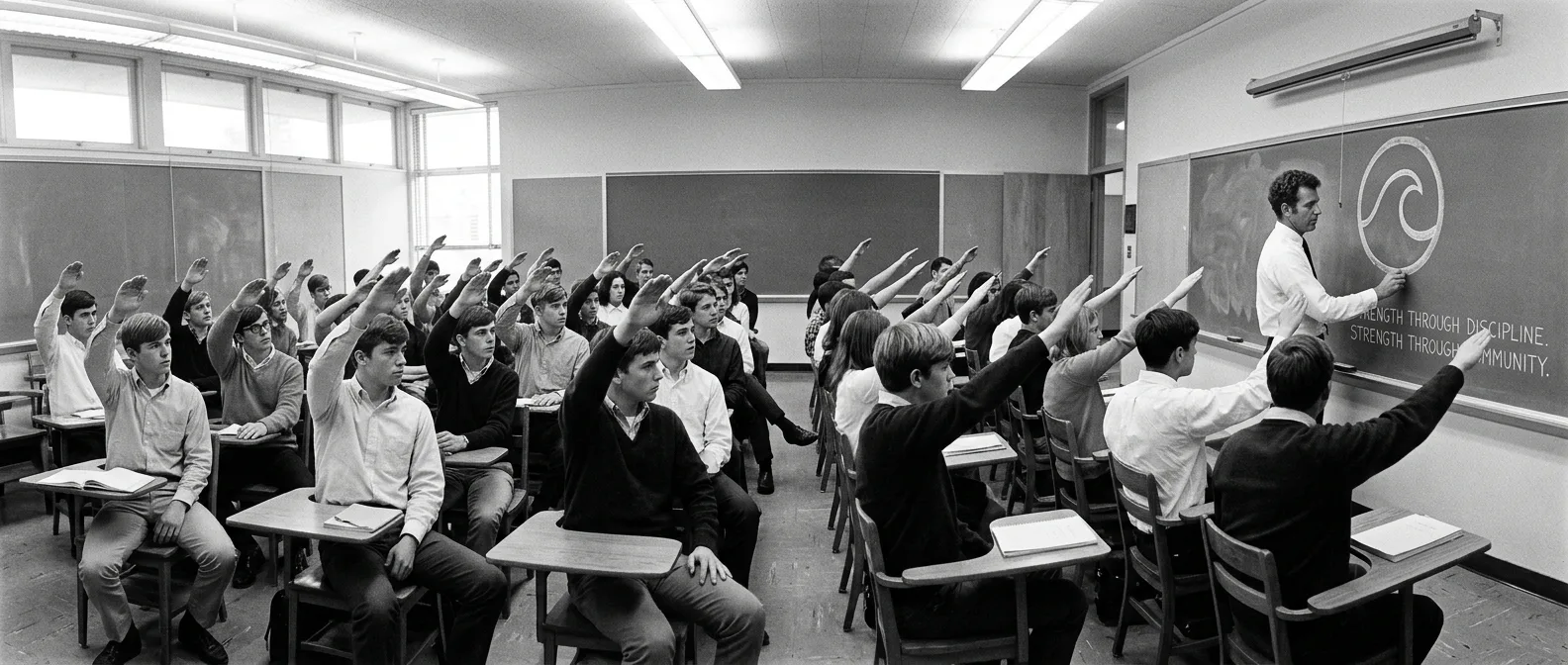
On Tuesday, Jones took the next step. He introduced a motto: “Strength through discipline. Strength through community.” The children chanted it together. He explained that individual success was secondary — what mattered was the group. Each person was responsible for everyone.
He created “membership cards” for the movement, which he named “The Third Wave” — referencing the myth that the third wave in a series of ocean waves is always the largest. Students arrived at class eager and enthusiastic. They began recruiting classmates — the class of 30 suddenly became a magnet. Students who had never cared about history now wanted to participate. Even students with low self-esteem and social isolation suddenly found identity — the Wave gave them a sense of worth they had never felt before.
I couldn't believe how quickly they accepted the rules. No one resisted. They wanted to belong to something — or rather, they wanted to belong.
Membership cards and a salute
On Wednesday, Jones introduced a special salute: right hand raised, with the forearm forming a curve like a wave. Students saluted each other in the hallways. Those who weren't members felt excluded. The pressure to join was immense and nearly impossible to resist.
Thirty students from the original class grew to over 80. Students independently created a surveillance network: if someone failed to salute properly or violated rules, they were reported to Jones. One student — without being asked — assumed the role of Jones's “bodyguard,” following him everywhere around the school. The student, a socially vulnerable teenager who had been a victim of bullying, felt powerful for the first time inside the movement.
Jones began to worry. What had started as a one-day experiment had taken on a life of its own. The children were no longer “playing along” — they genuinely believed. Some declared they felt for the first time that they belonged somewhere, that their lives had purpose. The feeling of belonging was so powerful it overrode any rational questioning.
Some students later confessed that the day they received their membership card was “the best day at school.” The need for group identity was deeper than any critical thinking.
Strength through action
On Thursday, Jones introduced the motto “Strength through action.” He announced that The Third Wave wasn't merely a school program — it was a national movement. There were, he said, corresponding Third Wave groups in schools in every state. The next day, the movement's leader would announce the creation of a new political party on national television.
📖 Read more: The Invisible Gorilla: Why We Don't See Everything
The children believed it. Membership now exceeded 200. Students disappeared from other classes to attend Third Wave rallies. Some threatened classmates who refused to join. One girl reported her own father to Jones because he “doesn't support the movement.”
Jones knew he had to end it immediately. The experiment had proven far more than he had imagined — but it was now dangerous. The school administration had no idea what was happening. Parents were calling to ask about this “Wave” their children kept talking about.
I felt I had started something I could no longer stop. The kids didn't want it to stop. They WANTED to be part of a movement. That was the terrifying part.
The revelation
On Friday, Jones summoned all members to a special assembly in the school auditorium. Over 200 students sat in silence, disciplined, in perfect posture. They were waiting for the movement's leader to appear on television.
Jones turned on a large television in front of the audience. The screen was blank. Silence prevailed. After several minutes of awkward waiting, Jones spoke. "There is no national movement. There is no leader. There is no Third Wave. What you have done over the past five days is exactly what the Germans did under Hitler."
On the screen appeared images from Nazi Germany — marching crowds, salutes, Nuremberg rallies. The students stared, frozen. Some burst into tears. Others sat speechless. One boy ran out of the auditorium. Some students initially refused to believe it was a lie — they wanted the Wave to be real. Jones spent nearly an hour talking with the students, explaining how discipline had transformed into submission and community into fanaticism.
Jones explained: "None of you are better than the German citizens. This week you followed blindly. You created hierarchy. You threatened those who didn't comply. That is fascism."
The legacy of The Third Wave
Jones didn't speak publicly about the experiment until the late 1970s, when he published an article in an educational journal. Jones was forced to leave the school a few years later — the administration was not pleased with his unconventional methods. He later devoted himself to working with people with disabilities in San Francisco. The story spread slowly but steadily. In 1981, the story was dramatized in an award-winning television special titled “The Wave” for the ABC Afterschool Special. That same year, Todd Strasser wrote a novel based on the events, which sold millions of copies and was translated into over 20 languages.
In 2008, German director Dennis Gansel released the film “Die Welle” (The Wave), transplanting the story to a contemporary German school. The film was a massive commercial success in Germany and across Europe, introducing the story to a new generation. In Germany, the film sparked a national debate: could something similar happen today in a German school? Many educators answered “yes, without a doubt.”
Jones's experiment entered social psychology textbooks alongside the Milgram experiments, the Stanford Prison Experiment, and Blue Eyes/Brown Eyes. Together, they paint a chilling picture: fascism doesn't require monsters to exist — it only needs structure, discipline, a charismatic leader, and a group of people who desperately want to belong.
Fascism is not something that only happens to “other people.” It can happen anywhere. It can happen here. And it can happen in five days.
Five days is all it takes
The Third Wave experiment wasn't just a history lesson. It was a living demonstration that the human brain is wired to seek hierarchy, group, leader. Five days were enough to transform typical American teenagers into fanatical followers of a nonexistent movement.
The truth Ron Jones revealed that Friday wasn't only for his students. It was for all of us: no one is immune. The line between democracy and authoritarianism is thinner than we think — and it can break within five days inside a school classroom. In an age of social media echo chambers and algorithmic radicalization, the lessons of The Third Wave may be more urgent today than they were in 1967.