📖 Read more: The History of Data: Why Our Personal Information Has Value
Before digital "free": an ancient idea
The idea of “free” didn't start with Silicon Valley. It's as old as strategy itself.
Roman “Panem et Circenses”
Bread and circuses — free. Juvenal (satirical poet, 1st century AD) denounced it: the Roman government distributed free grain and organized free gladiator games. The purpose? Social control. People who eat for free don't revolt. The earliest freemium model: free bread, paid for with obedience.
King Gillette: give away the razor, sell the blades
Gillette sold razors at cost (or below) — and made money from the blades. The “razor” was free. The “consumables” were gold. The “razor and blades” model — copied by: printers (ink), consoles (games), Nespresso (capsules). Nothing is truly cheap — the payment just shifts elsewhere.
Radio & television: “free” with ads
Television was “free” — but you paid with time. Every 10 minutes, 3 minutes of ads. Soap operas were called that because they were funded by Procter & Gamble. Entertainment was never “free” — it was funded by someone who wanted something.
"If you're not paying for the product, you are the product."
The digital era: “free” as a business model
Chris Anderson (Wired) published the book "Free: The Future of a Radical Price" in 2009. His thesis: in the digital world, the cost of copying tends toward zero. An email costs 0.000001 cents. A Google search: ~0.3 cents of electricity. If the cost is zero, the price becomes zero.
But Anderson didn't fully explain the catch: in exchange, you give up data — which is worth far more than a subscription.
Google: the empire of “free”
🔍 Search (1998)
8.5 billion searches/day. User cost: $0. Google's cost: ~$0.003/search. Google's revenue (2023): $307 billion — 80% from advertising. Every search tells Google what you're looking for, what you need, what you fear. That information is sold to advertisers in milliseconds (real-time bidding).
📧 Gmail (2004)
"1 GB free" — 100x more than Hotmail. The trade-off: Google scanned your emails (initially for targeted ads, stopped in 2017). But the metadata remains: who emails you, when, how often. Doctor? Lawyer? Pharmacy? Google knows.
🗺️ Maps (2005)
Before: GPS maps cost €200+. Google Maps: free. The trade-off: Google knows where you go, every moment. Google Timeline: a detailed record of every trip. Once, only intelligence agencies had this kind of information. Now, you give it away voluntarily.
Facebook/Meta: social life as a product
Zuckerberg (2004): create a profile, connect with friends, share photos — free. But every like, every share, every comment becomes a data point. 3+ billion users = the largest map of human behavior in history.
💰 How much are you worth to Meta (ARPU per quarter, 2023)
Your value depends on how wealthy you are — because advertisers pay more to reach Americans (purchasing power) than Indians. You're not a “user” — you're a commodity priced by weight (purchasing power).
Freemium: the psychology of “free”
Dan Ariely (behavioral economist, “Predictably Irrational”): the word "free" isn't just a price — it's an emotional trigger. Experiment: offer Lindt chocolate at $0.15 and a Hershey Kiss at $0.01 → 73% chose Lindt. Offer Lindt at $0.14 and a Hershey Kiss for free → 69% chose the Kiss. A 1-cent reduction “normally” wouldn't change anything. But the shift to “FREE” changes everything.
🎮 Free-to-Play Gaming
Fortnite: free. Revenue (2018): $5.4 billion — from skins, emotes, battle passes. Only 2.2% of players pay — but those who do pay a lot. The term "whale": players who spend $1,000-10,000+. The industry calls them “engaged users.” Psychologists call them “addicts.”
📱 Mobile apps: 96% free
Google Play: 96% of apps are free. Models: in-app purchases, subscriptions, ads. TikTok (free): $16 billion revenue/year. Candy Crush: $1.3 billion/year — solely from micro-transactions ($0.99-4.99 each).
📖 Read more: Social Media History: From Communication to Exposure
✉️ “Free” trial
"30 days free" = you enter your card, forget to cancel, and pay. Amazon estimates that 72% of Prime trial users become paying subscribers. Planet Fitness: "$1/month" → bait & switch, you pay a $49 annual fee. Dark patterns: design that makes it hard to leave.
Open Source: is anything truly free?
Not all “free” is a trap. There is a tradition of genuinely free creation — that began before the Internet.
Richard Stallman: GNU & free software
Stallman (MIT) rejected the idea that programs should be proprietary. “Free as in freedom, not free as in beer” — the freedom to view, modify, and share the code. The GPL license: if you use my code, yours must also be free. Viral freedom.
Linux: the free kernel that runs the world
Linus Torvalds (21 years old, Finnish): “I'm making a free operating system — just a hobby.” Today: 96.3% of web servers, Android (3+ billion devices), NASA, Tesla, SpaceX, all supercomputers. Value of the Linux ecosystem: $5+ trillion — but the kernel itself remains free.
Wikipedia: free knowledge
Jimmy Wales: an encyclopedia without profit, without ads, crowdsourced. 60+ million articles. Funded by donations ($170 million/year). Truly free knowledge needs someone to pay — the difference is that they don't ask for your data in return.
🆓 “Free as in freedom” vs “Free as in beer”
Stallman explains the difference: Free speech (freedom) vs Free beer (gratis). Gmail is “free beer” — you don't pay, but you're not free (you don't control your data). Linux is “free speech” — you can see the code, modify it, share it. The real question isn't “how much does it cost?” — but "who's in control?"
Surveillance capitalism: the true price of “free”
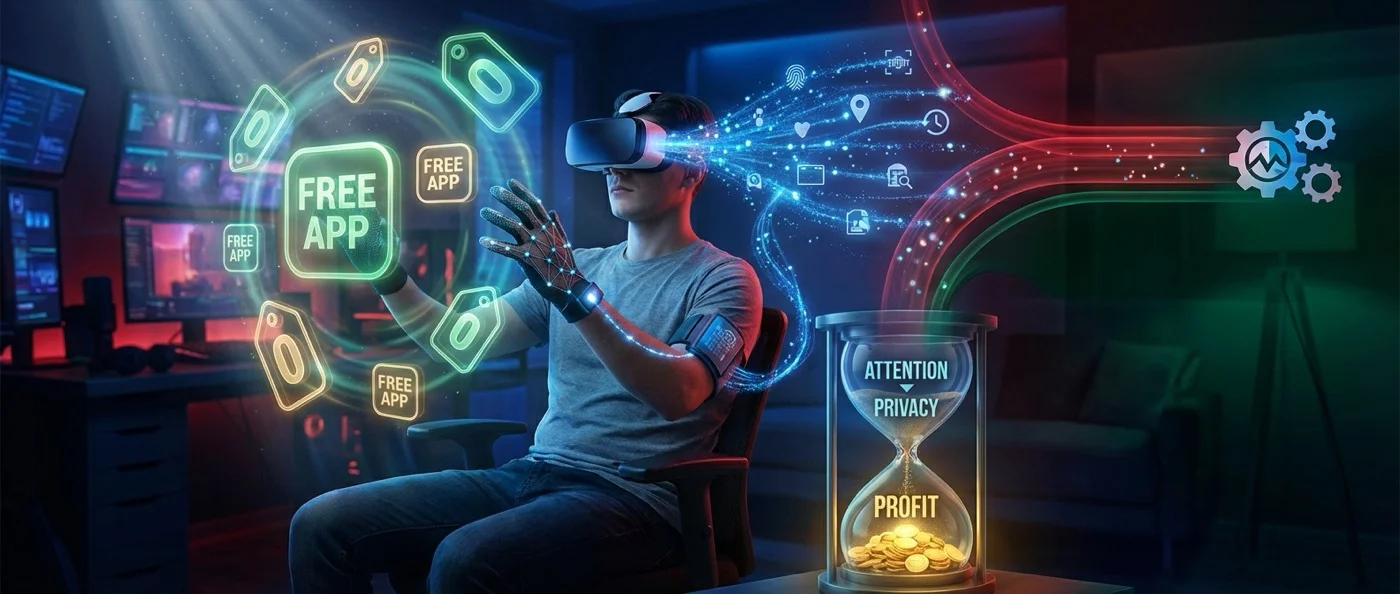
Shoshana Zuboff (Harvard, “The Age of Surveillance Capitalism”, 2019) named the model: surveillance as a business model. It's not that they “sell your data” — it's that they use it to predict and modify your behavior. Google doesn't sell data — it sells prediction: “this user will buy this, with 87% probability.”
🔄 What you actually pay
The resistance: I pay, therefore I control?
The pushback started slowly — but it exists.
🔒 Privacy-first services
Signal (free, non-profit, encryption), DuckDuckGo (search without tracking), ProtonMail (encrypted email, Switzerland). Model: you pay (or rely on donations) instead of “paying” with data. Problem: very few people use them (DuckDuckGo ~3% market share).
💶 Subscription fatigue
The “solution” to “free” was subscriptions. But now: Spotify, Netflix, Disney+, iCloud, Dropbox, NYT, Patreon, YouTube Premium... Average American household: $219/month on subscriptions. The “subscription economy” (Zuora): $275 billion (2024). We wanted to stop being the “product” — we became subscribers to everything.
⚖️ GDPR & regulations
The EU (GDPR, 2018): every user can request what data you hold (Right of Access) and deletion (Right to Erasure). Fines: Amazon €746 million, Meta €1.2 billion. But the reality: how many people have ever requested their data? Very few.
AI: The New “Free”
ChatGPT: free. Claude: free. Gemini: free. The most powerful AI tools are free — but they were trained on billions of data points without consent. Each conversation improves the model. Each prompt becomes training data. OpenAI is worth $80+ billion — built on texts, images, and code from people it never paid.
History repeats itself: new technology → “free” → mass adoption → monopoly → “actually, it costs.” ChatGPT Plus: $20/month. Copilot Pro: $30/month. The pattern is always the same: free until you're dependent — then, you pay.
"In Silicon Valley, the word 'free' has become a political tool. It means: 'I give you something so attractive that you'll never ask what the true cost is.'"
The history of “free” is the history of an illusion. Nothing was ever truly free — from Roman grain to Gmail. But the form of payment changes: money → time (ads) → data → attention → behavior. Each generation of “free” takes away something less visible — and therefore more valuable. The real question isn't “how much does it cost” — but what are you giving away without knowing it.