The Somerton Beach Dead Man with No Identity
A True Story
📖 Read more: Golden State Killer: DNA Caught Him 40 Years Later
"It Is Ended"
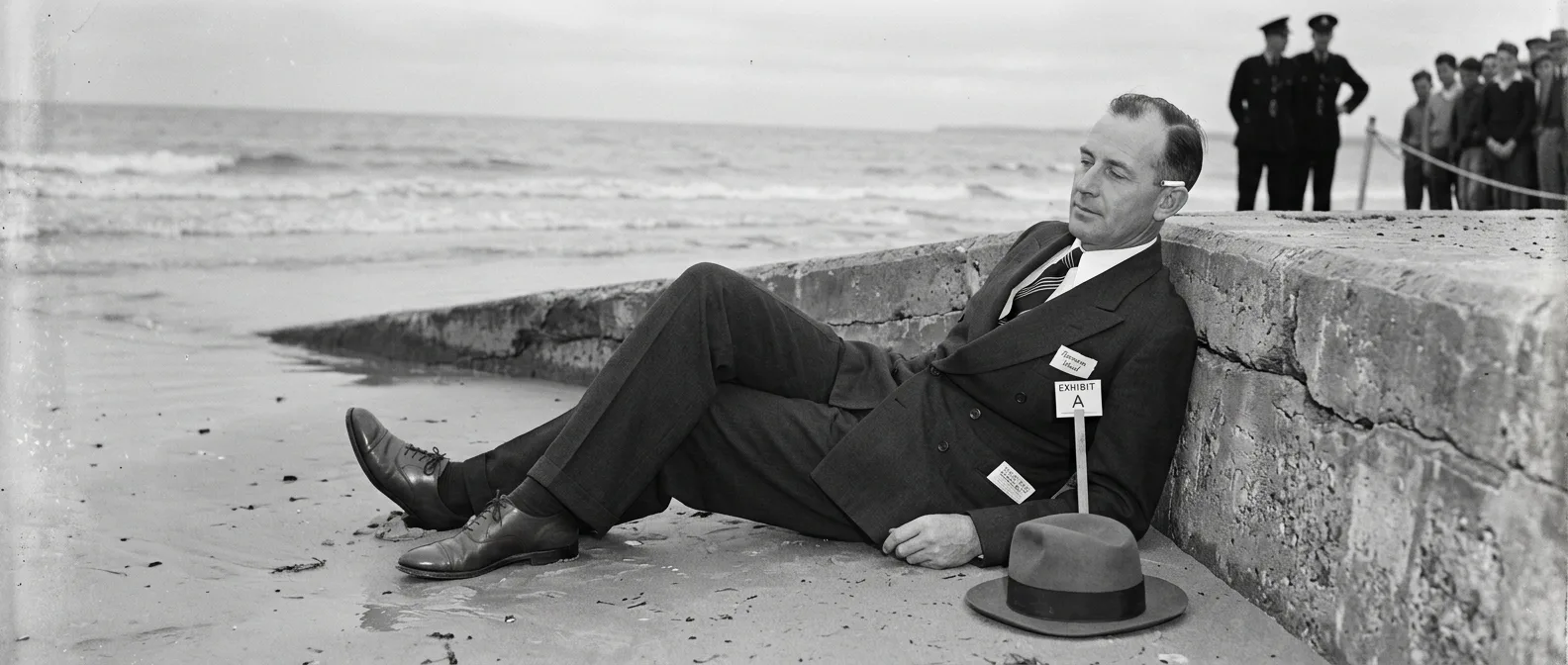
On the evening of November 30, 1948, just before dark, a couple sat on a bench at Somerton Beach in Adelaide, South Australia. The air was warm — it was the beginning of summer in the southern hemisphere. Looking toward the sea, they noticed a man lying on the sand, propped against a seawall, legs crossed, as if he were sleeping. He wore a suit and tie. He seemed to be gazing at the ocean, but something was wrong — he was completely motionless. The couple assumed he was drunk, or simply exhausted. They didn't approach him.
At 6:30 the next morning, December 1, two men on their morning walk found him in the exact same position. He wasn't breathing. Police arrived within minutes. The man was dead — had been for hours, probably. He was well-dressed, clean-shaven, roughly forty-five years old. He carried no identification documents. No wallet. In his pockets they found a packet of cigarettes, a box of matches, a comb, and an unused notebook. Nothing led anywhere.
This was the beginning of a case that would haunt Australia — and the rest of the world — for seventy-three years.
The Dead Man With No Name
The autopsy was conducted the following day at the Royal Adelaide Hospital mortuary. The pathologist, Dr. John Benet Cleland, could not determine a cause of death. The man's heart was in excellent condition. His lungs showed congestion and hemorrhaging, his spleen was three times its normal size, and his liver exhibited destruction at the center of its lobes — all indicators of poisoning, yet no known poison was detected in his blood.
The most disturbing finding wasn't medical. It was the clothing. Every label — every single one — had been carefully removed. Seams had been cut, tags unpicked, brand marks stripped away. Someone had taken the time to ensure these clothes could never lead to an identification. The dead man himself? Someone else? The police had no answer.
December 1, 1948The unidentified man is found dead on Somerton Beach, Adelaide. He wears a suit, white shirt, and tie. He carries no proof of identity. Estimated age: 40–45. Height: 5 feet 11 inches.
The Hidden Pocket
In January 1949, a naval commander named John Freeman Cleland re-examined the dead man's clothing. This time he searched more thoroughly — and after careful inspection, he discovered something that had been missed in the first examination. In a seam of the trousers, concealed inside a tiny pocket barely large enough for a finger, lay a tightly rolled scrap of paper. Printed on it were two words in Persian script: “Tamám Shud.”
📖 Read more: The Family That Vanished While Their Home Remained Untouched
The phrase comes from the Rubaiyat of Omar Khayyam, the celebrated collection of poems by the twelfth-century Persian mathematician and astronomer. It means “ended” or “finished” — the final words on the final page of the book. In Edward FitzGerald's famous English translation, the last verse speaks of the futility of existence, of the wind that erases everything.
The scrap had been torn from an actual copy of the book — the tear matched precisely with the page from a specific type of edition. Police now needed to find that book.
The Book and the Code
In July 1949, a businessman from Adelaide handed police a copy of the Rubaiyat. He said he had found it on the back seat of his car months earlier — around the time the body was discovered. His car had been parked near Somerton Beach, unlocked. The final page of the book was missing — torn out at exactly the point where the words “Tamám Shud” would have appeared.
But that wasn't all. On the back cover, someone had written in pencil five lines of capital letters — an incomprehensible code:
MLIAOI
WTBIMPANETP
MLIABOAIAQC
ITTMTSAMSTGAB
The second line had been written, then crossed out, then rewritten — as if someone had hesitated, reconsidered, corrected. Australian military cryptographers, mathematicians, intelligence agencies — no one ever managed to decipher those five lines. Decades later, researchers would devote thousands of hours to this code without result.
On the back cover there was something else: a telephone number. It belonged to a woman.
The Nurse Who Denied Everything
The number belonged to Jessica “Jo” Thomson, née Harkness — a young nurse who lived in Glenelg, just a few hundred meters from Somerton Beach. When detectives visited her, her reaction was remarkable. According to the detective present, Jessica paused, turned pale, and “appeared as though she was about to faint” when shown the plaster bust of the dead man.
Yet she categorically denied knowing him. She said she had no idea how her telephone number had ended up in that book. She mentioned she had once given a copy of the Rubaiyat to a soldier named Alfred Boxall during the war — but Boxall was found alive, and his copy was intact, its final page untouched.
📖 Read more: The Ship Found Sailing Alone with the Table Still Set
July 1949Police trace Jessica Thomson. She denies knowing the dead man, but her reaction raises suspicion. She explicitly requests that her identity not be publicly revealed — a request that is honored for decades.
The Suitcase at the Station
In January 1949, police discovered an unclaimed suitcase at Adelaide Railway Station. It had been deposited there on November 30 — the day before the body was found. Inside were clothes, grooming tools, a small pair of scissors — and again, every label had been removed. Almost every label. One thread slipped through: on a shirt, the name “T. Keane” or “T. Kean” had been sewn into the collar, nearly invisible. Police searched for every T. Keane in Australia, New Zealand, and Britain. No one matched.
Inside the suitcase was also a stiletto knife, thin as a needle. Some investigators believed it was a spy's tool — suitable for administering poison via injection without leaving a visible mark. Adelaide in the 1940s was a center of espionage activity — the Australian government maintained secret nuclear installations in South Australia, and the Woomera Rocket Range was only a few hundred kilometers away. The theory that the dead man was a spy was not as outlandish as it sounded.
Seventy-Three Years of Silence
For more than seventy years, the Somerton Man case remained open — Australia's greatest unsolved mystery. Every decade, new investigators picked up the file. New theories were born: Was he a Cold War spy? A fugitive sailor? Simply a desperate man who chose to end his life on a beach, clutching a poem?
1960s–1970sEspionage theories intensify. It is revealed that Australia hosted secret nuclear testing programs in South Australia. The connection to the dead man is never proven — but never ruled out either.
A Name, at Last
In July 2022, Professor Derek Abbott announced what millions had been waiting decades to hear: the Somerton Man had been identified through genealogical DNA analysis. His name was Carl “Charles” Webb. He was an electrical engineer, born on November 16, 1905, in Melbourne.
Webb had married a woman named Dorothy Robertson in 1941. They separated a few years later. During the war, he worked as a technician in electrical installations. He did not appear to have been a spy. He did not appear to have belonged to any intelligence service. He was an ordinary Australian who, for reasons still unknown, ended up on that beach on that evening.
July 2022The identification is publicly announced. Carl “Charles” Webb was forty-three years old at the time of his death. The genealogical analysis was based on DNA extracted from hairs embedded in the plaster death mask and compared with descendants of his family.