No Surrender
The soldier who refused to end his war
📖 Read more: Hachiko: The Dog Who Waited 10 Years
In December 1944, a 22-year-old Japanese officer stepped off a military vessel onto Lubang Island, in the Philippines. He knew things most soldiers didn't: how to build improvised explosives, how to survive behind enemy lines, how to sabotage airstrips and bridges. He had trained at the Futamata branch of the Nakano School — a secret facility run by the Imperial Japanese Army for guerrilla warfare, sabotage, espionage, and psychological operations.
His orders were specific: destroy the island's airstrip and the pier at its harbor ahead of the Allied invasion, then continue guerrilla operations indefinitely. One directive stood above the rest: "Under no circumstances are you to surrender. Under no circumstances are you to take your own life."
His name was Hiroo Onoda. He would obey that order for nearly three decades after World War II ended — 10,416 days, to be precise.
— 1 —Hiroo Onoda was born on March 19, 1922, in the village of Kamekawa, Wakayama prefecture. He came from a samurai lineage — a detail he considered definitive of his character. His father served as a cavalry sergeant and was killed in the Second Sino-Japanese War. His mother raised him with strict discipline and unwavering standards.
"I was always defiant and stubborn in everything I did. There was nothing I ever left unfinished."
— Hiroo Onoda, in an interviewIn 1939, at seventeen, he went to work at a branch of the Tajima Yoko trading company in Wuhan, China. Three years later, in 1942, he was conscripted into the Imperial Japanese Army. He wasn't assigned to a regular infantry unit. Instead, he was selected for the Nakano School — the army's intelligence academy — where he trained in guerrilla warfare, sabotage, propaganda, and counterintelligence. He was the perfect soldier for operations behind enemy lines.
On December 26, 1944, he was dispatched to Lubang. His mission: sabotage and guerrilla resistance. But senior officers already on the island blocked him from carrying out his initial orders, which helped American and Philippine Commonwealth forces capture the island easily on February 28, 1945. Soon, from a unit of dozens, only four men remained: Second Lieutenant Onoda, Private Yuichi Akatsu, Corporal Shōichi Shimada, and Private First Class Kinshichi Kozuka. They retreated into the island's mountains.
📖 Read more: The Man Who Lived in an Airport for 18 Years
— 2 —In August 1945, World War II ended. Japan signed the instrument of surrender. On tiny Lubang Island, the fighting had gone silent — but Onoda read the silence as a tactical trap. Every lull, he reasoned, was just the calm before the next attack.
In October 1945, a separate group of Japanese holdouts on the island showed them a note left by locals: “The war ended on August 15. Come down from the mountains!” Onoda dismissed it immediately as propaganda. After all, this was exactly what the Nakano School had taught him: the enemy will use every trick in the book.
Toward the end of 1945, leaflets bearing a surrender order from General Tomoyuki Yamashita of the Fourteenth Area Army were airdropped over Lubang. Onoda and his companions examined them meticulously, one by one. They spotted inconsistencies in phrasing — phrases they believed no authentic Japanese military order would contain. They concluded the leaflets were forgeries.
"The leaflets were filled with mistakes, so I decided they were a trick by the Americans. I could not conceive of Japan's defeat."
— Hiroo Onoda, ABC Lateline, 2010In Onoda's mind, the empire still lived — and he was its soldier, standing guard in a war without end.
— 3 —The four men developed their own survival routine. They ate bananas, coconuts, rice stolen from villagers' fields, and meat from cattle they slaughtered during night raids. Onoda treated every inhabitant of Lubang as an enemy guerrilla — he killed local farmers and clashed repeatedly with police patrols. He and his companions are alleged to have killed up to thirty civilians across the decades they spent hiding on the island.
In September 1949, Akatsu deserted. He slipped away under cover of darkness. He wandered alone for six months before surrendering to Philippine authorities in March 1950. The remaining three considered it a betrayal — and grew even more distrustful.
📖 Read more: Nicholas Winton: Saved 669 Children in Secret
In February 1952, aircraft dropped photographs and letters from the soldiers' families, urging surrender. Onoda recognized the handwriting. He didn't budge: "I assumed our families were living under occupation and were being forced to write those things."
In June 1953, Shimada took a bullet to the leg during a clash with local fishermen. Onoda nursed him through the wound, keeping him alive. A year later, on May 7, 1954, Shimada was shot dead in a firefight with a Philippine Army mountain unit that accidentally stumbled upon the two soldiers during a training exercise. Onoda buried his companion alone.
Only two remained: Onoda and Kozuka. Together, they kept their private war going for another eighteen years. On October 19, 1972, Kozuka was shot dead by police during a recurring raid — the two had been burning piles of harvested rice, a signal they intended for fellow Japanese forces to show their unit was still operational. Onoda was left utterly alone. Alone in a war that had ended a generation ago.
— 4 —On February 20, 1974, a 23-year-old Japanese adventurer named Norio Suzuki landed on Lubang. He was an unconventional explorer with long hair and a backpack — or as Onoda would later describe him, “this hippie boy.” Suzuki had told friends he was searching for “Lieutenant Onoda, a panda, and the Abominable Snowman, in that order.”
Suzuki found Onoda after just four days of trekking through the jungle — a feat that dozens of military search parties, police squads, and rescue teams had failed to accomplish in three decades. The aging soldier was wary. Suzuki spoke calmly: “Onoda-san, the Emperor and the people of Japan are worried about you.” Onoda brushed the words aside. He was adamant: he would not abandon his post unless he received a formal military order from his commanding officer.
Suzuki returned to Japan carrying photographs of Onoda as proof of their encounter. The government tracked down Onoda's former commanding officer, Major Yoshimi Taniguchi — Commander of the Special Intelligence Squadron of the Fourteenth Area Army, who had since become a bookseller. They flew him to Lubang alongside Suzuki.
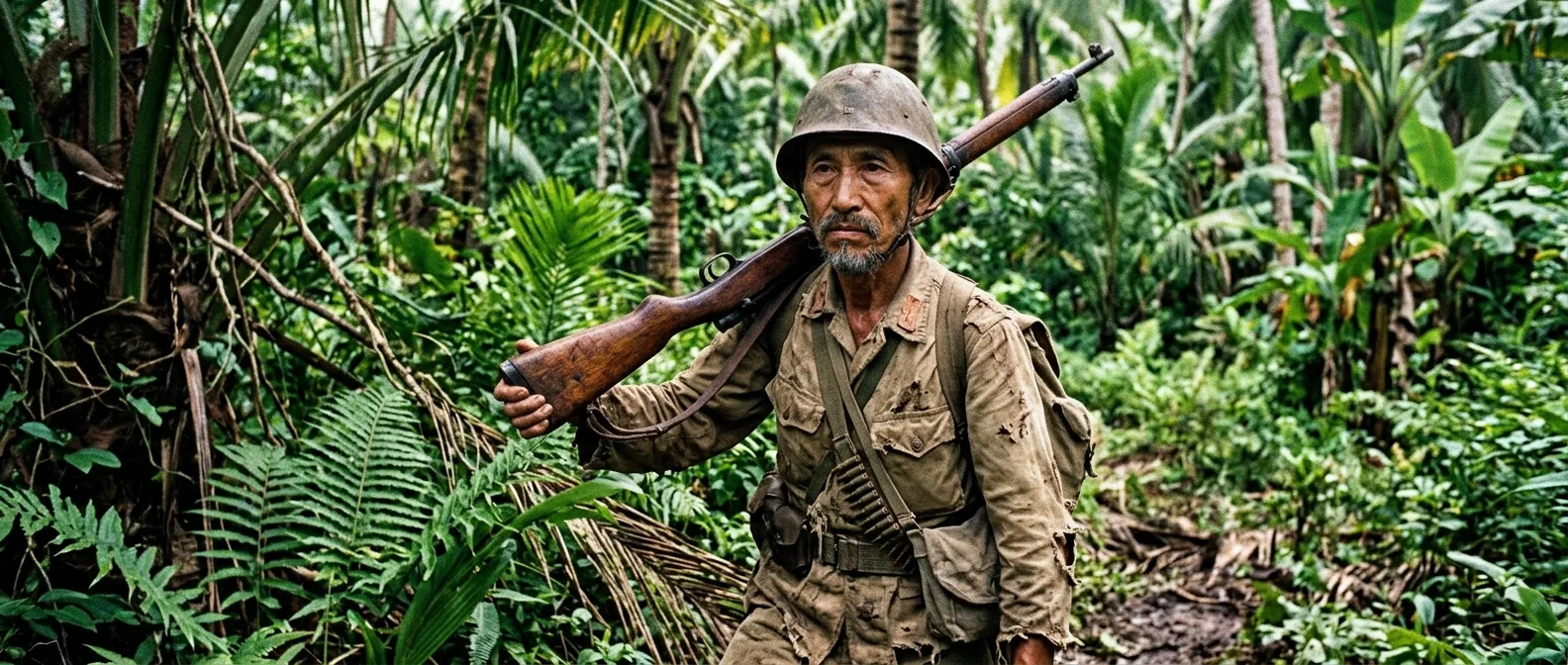
On March 9, 1974, deep in Lubang's overgrown jungle, Hiroo Onoda stood face to face with his former commander. At 52, he still wore what remained of his military uniform. He carried a functioning Arisaka Type 99 rifle — immaculately maintained, polished with obsessive care — 500 rounds of ammunition, hand grenades, his samurai sword, and a dagger in a white sheath. The dagger was a gift from his mother, given before his departure in 1944, meant for seppuku if captured by the enemy.
📖 Read more: The Child Who Grew Up in the Jungle: Marina Chapman Story
Taniguchi read three orders. First: in accordance with the Imperial Command, the Fourteenth Area Army has ceased all combat activity. Second: the Special Intelligence Squadron is relieved of all military duties. Third: units and individuals are to cease military operations immediately and place themselves under the command of the nearest American or Philippine forces.
Onoda listened, raised his hand in salute, and laid down his weapons. Twenty-eight years, six months, and eight days had passed since Japan's surrender.
The following day, March 10, he formally surrendered to Philippine forces at Lubang's radar station. On March 11, in a ceremony at Malacañang Palace in Manila that drew international media attention, he presented his sword to President Ferdinand Marcos. Marcos granted him a full pardon. The islanders of Lubang — families of those Onoda had killed — never forgave him. Decades later, when he visited in 1996, fifty relatives of victims staged a protest against his return.
— 6 —A Japan he didn't recognize
The Japanese government had declared him dead in 1959. When he returned alive in March 1974, he was greeted as a hero in a homeland that barely remembered him. He was offered a substantial sum in back pay. He refused it. Money pressed upon him by admirers he donated to the Yasukuni Shrine.
But Onoda felt like a stranger. The imperial Japan he had fought for no longer existed. The military had been dismantled. The country had accepted responsibility for the war. Onoda disagreed with all of it. He wrote his autobiography that year — “No Surrender: My Thirty-Year War” — and it became a bestseller.
📖 Read more: The Man Who Survived Two Atomic Bombs
In April 1975, following the footsteps of his older brother Tadao, he left for Brazil. He settled in the Jamic Colony, a Japanese-Brazilian community in Terenos, Mato Grosso do Sul. He married in 1976 and became a cattle rancher. The land suited him — a man who had survived in the jungle knew how to live close to the earth.
But Japan pulled him back. In 1980, after reading about a Japanese teenager who murdered his parents, he decided to return. In 1984, he founded the Onoda Shizen Juku nature school in Fukushima prefecture — an outdoor education program for young people. He firmly believed that contact with nature builds character and discipline in children.
Hiroo Onoda died on January 16, 2014, at the age of 91, from heart failure due to pneumonia, at St. Luke's International Hospital in Tokyo. Chief Cabinet Secretary Yoshihide Suga remarked: "I vividly remember that I was reassured of the end of the war only when Mr. Onoda returned to Japan."
His story remains a question without a simple answer: where does loyalty end and madness begin? Devotion, discipline, and unshakable obedience to an order — these kept him alive in the jungle for nearly three decades. But they also turned him into a killer of innocents.
"I became an officer and I received an order. If I could not carry it out, I would feel shame. I would be unworthy."
— Hiroo Onoda, 2010Sources:
- All That's Interesting — Meet Hiroo Onoda, The Soldier Who Kept Fighting WWII For 29 Years
- BBC News — Japan WW2 soldier who refused to surrender Hiroo Onoda dies
- The Guardian — Hiroo Onoda: Japanese soldier who took three decades to surrender, dies
- The New York Times — Hiroo Onoda, Soldier Who Hid in Jungle for Decades, Dies at 91