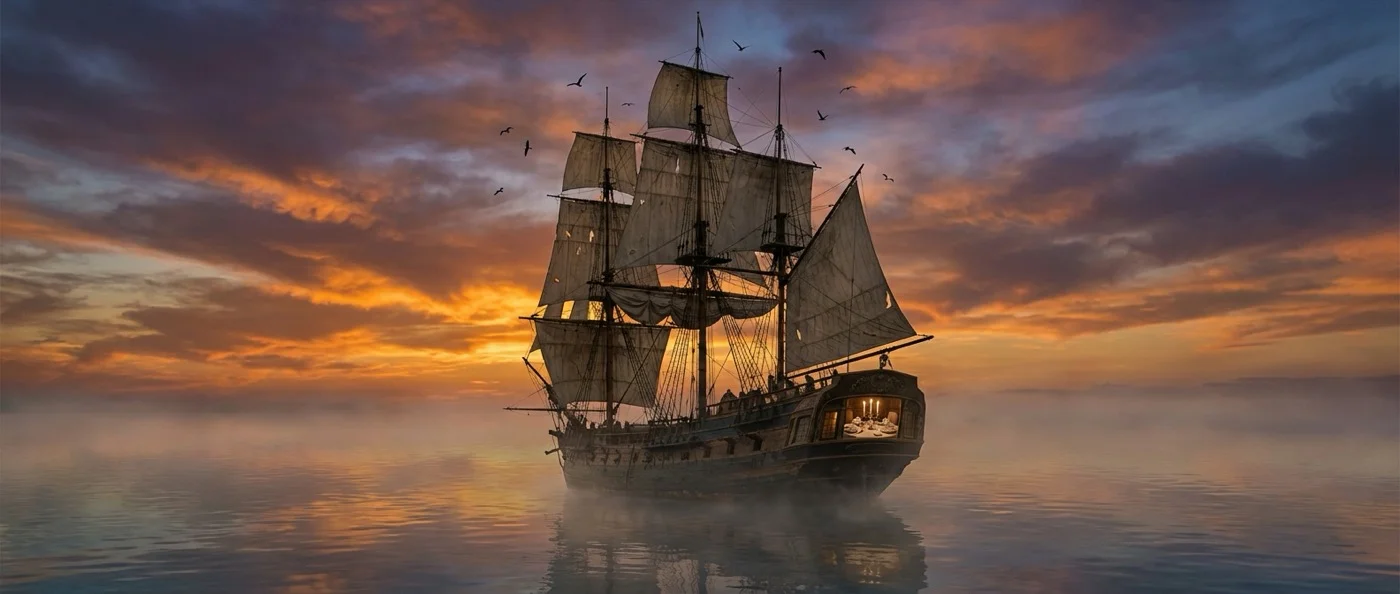
On December 4, 1872, somewhere in the middle of the Atlantic between the Azores and Portugal, Captain David Morehouse of the Canadian vessel Dei Gratia noticed something strange on the horizon. A ship was approaching unsteadily, its sails at odd angles, with no one visible on deck. It responded to no signal.
📖 Read more: Dyatlov Pass: 9 Hikers Dead with No Explanation
Morehouse sent first mate Oliver Deveau and second mate John Wright to investigate. What they found aboard the Mary Celeste would become the greatest maritime mystery of all time: a fully operational ship, with food in the galley, personal belongings in their place, the cargo untouched — but with no one on board. Ten souls had vanished as if they had never existed.
The story begins in New York, in October 1872. Benjamin Spooner Briggs, age 37, was an experienced and respected captain. Born in Wareham, Massachusetts, he came from a seafaring family — his father was a captain and four of his five siblings went to sea. He was a deeply devout Christian, regularly read the Bible, and attended prayer meetings.
In 1862, he married his cousin Sarah Elizabeth Cobb, and they spent their honeymoon on a ship — the schooner Forest King in the Mediterranean. They had two children: Arthur, born in 1865, and Sophia Matilda, born in October 1870.
For this voyage to Genoa, Briggs decided to bring his wife and little Sophia, just two years old. Arthur, now school-age, would stay home with his grandmother. In a letter to his mother shortly before departure, Briggs wrote enthusiastically: “Our ship is in splendid condition and I hope we shall have a fine passage.”
The crew included first mate Albert Richardson (married to a niece of the ship's owner Winchester), second mate Andrew Gilling, steward Edward William Head — also a newlywed — and four German sailors from the Frisian Islands: brothers Volkert and Boz Lorenzen, Arian Martens, and Gottlieb Goudschaal. A later certificate described them as “peaceable and first-class sailors.”
On October 20, 1872, Briggs arrived at Pier 50 on the East River in New York to oversee the loading: 1,701 barrels of alcohol, destined for Genoa. His wife and daughter joined him a week later.
On the morning of Tuesday, November 5, the Mary Celeste weighed anchor and headed for New York Harbor. The weather wasn't ideal, so Briggs decided to wait at anchor near Staten Island. Sarah used the delay for one last letter to her mother-in-law: "Tell Arthur I depend very much on the letters I shall get from him, and will try and remember anything that happens on the voyage that will please him to hear."
Two days later the weather improved, and the Mary Celeste set out into the Atlantic. It was the last time anyone saw a living soul aboard that ship.
It was around 1 p.m. on December 4, 1872, when Captain Morehouse came up on deck of the Dei Gratia. They were approximately halfway between the Azores and Portugal. The helmsman reported a ship approaching about six miles away — but it was moving... strangely. Erratically. Its sails were in the wrong position.
No one was visible on deck. No signal was answered. Morehouse sent Deveau and Wright in a boat. They recognized the name on the stern — Mary Celeste — and climbed aboard. What they saw froze them in their tracks.
The ship was deserted. The sails were partly set but in poor condition; some had disappeared entirely. Ropes hung loosely over the sides. The main hatch was secured, but the fore and lazarette hatches were open, their covers resting beside the deck. The only lifeboat — a small yawl-type craft — had apparently been stowed on top of the main hatch, but was gone.
The compass in the binnacle had been displaced and its glass housing was broken. There were approximately three and a half feet of water in the hold — significant but not alarming for a vessel of this size. An improvised sounding rod was found abandoned on deck.
Deveau explored the cabins. They were damp and untidy from water that had entered through doors and skylights — but otherwise in reasonable order. In the captain's cabin, he found personal belongings scattered about, including a sword in its scabbard under the bed. The galley equipment was neatly in place. There was no food cooked or being cooked, but the food supplies were adequate.
The most enigmatic clues were what was missing. The captain's navigation instruments — chronometer, sextant — were not found. Most of the ship's papers were also gone. This meant Briggs had taken his navigation instruments with him into the lifeboat — he had planned, in other words, to navigate somewhere. It wasn't blind panic. It was a deliberate decision.
There were no signs of fire or violence. No blood, no signs of struggle. The picture was that of an organized abandonment — a crew decision to leave a ship that was perfectly capable of sailing. Perhaps the most chilling detail: a small bottle of sewing machine oil was found still upright in its place — a sign that the ship had not passed through heavy seas.
Morehouse decided to tow the Mary Celeste to Gibraltar, 600 nautical miles away. Under maritime law, the salvager of a vessel was entitled to a share of the ship's and cargo's value. He split his eight-man crew between the two ships — three on the Mary Celeste, five on the Dei Gratia — and after a slow voyage through bad weather, they arrived in Gibraltar on December 12–13.
There, hearings began on December 17, presided over by Chief Justice Sir James Cochrane. Attorney General Frederick Solly-Flood — a man who “once he made up his mind, would not be moved,” as one historian described him — was immediately convinced that a crime had been committed.
He ordered an examination of the ship. Surveyor John Austin found cuts on both sides of the bow — as if from a sharp object — and possible bloodstains on the captain's sword. A team of Royal Navy officers reinforced the suspicions, reporting stains on a railing and a deep mark resembling an axe blow.
📖 Read more: Flight 19: 5 Planes Lost in the Bermuda Triangle
Flood developed his theory: the crew — “foreigners” mostly — had drunk from the alcohol cargo and in a state of intoxication murdered Briggs, his wife, the child, and the officers. They had cut the bow to make it look like a collision and escaped in the lifeboat.
The theory collapsed. Laboratory analysis proved the stains on the sword were not blood. An American naval officer stated that the cuts on the bow were natural wear from the sea. The trial ended on February 25, 1873, without a satisfactory answer. Morehouse received just 1,700 pounds — roughly one-fifth of the ship's and cargo's value. Far less than he had expected.
The mystery spawned dozens of theories, from the logical to the outlandish. Let's look at the most important ones:
The vapor explosion theory. This is considered today the most likely explanation. The cargo was 1,701 barrels of alcohol, which releases explosive fumes. Foul sounds and small explosions from the hold were a common phenomenon. According to this theory, a more intense explosion — enough to blow the hatch covers off — frightened Briggs enough to order immediate abandonment. In the panic, they got into the lifeboat but didn't manage to tie it properly — or the wind caught the sails and the ship drifted away, leaving them behind in the sea.
In 2006, chemist Andrea Sella of University College London conducted an experiment for a television program. He built a model of the hold and created an explosion with butane gas. The result: an impressive fireball but with no damage whatsoever — no burns, no soot. “We created a pressure wave,” he stated. “The air behind the flame was relatively cool.” This explained why there were no traces of fire on the Mary Celeste.
The waterspout theory. A powerful waterspout could explain the water in the hold and the poor condition of the sails. Low barometric pressure could have pushed water up through the bilges, creating false readings — making Briggs believe the ship was sinking.
Piracy? Although Riffian pirates were active off the coast of Morocco at the time, pirates would have plundered the ship. But the valuable personal belongings were untouched.
Conspiracy? Some theorized that Briggs and Morehouse were accomplices — they had planned the alleged abandonment together to share the salvage money. Historian Brian Hicks responds: "If they had planned something like that, they wouldn't have created such a spectacular mystery." And why would Briggs have abandoned his son Arthur if he intended to disappear?
After the trial, the Mary Celeste returned to sea — but its reputation as a “cursed” ship followed it. “It rotted at wharves where no one wanted it,” writes Macdonald Hastings. It was sold at a loss in February 1874. In the years that followed, it sailed mainly in the Caribbean and the Indian Ocean, systematically losing money.
In February 1879, on the island of Saint Helena, Captain Edgar Tuthill fell ill and died — the third captain of the ship to die prematurely, fueling the myth of the curse.
The end came in January 1885. The last captain, Gilman C. Parker, had devised a classic insurance fraud. He loaded the ship with nearly worthless cargo, falsely declared as valuable goods and insured for $30,000. On January 3, he deliberately ran the Mary Celeste onto the Rochelois Reef near Haiti, tearing open the keel. And his fate: he was tried but acquitted. He died penniless three months later. One co-defendant went insane. Another committed suicide.
If the truth was mysterious, fiction made it terrifying. The Los Angeles Times rewrote the story in 1883 with invented details: "Every sail was set, the helm was lashed, not a rope was out of place... The fire was burning in the galley. Dinner was set, still warm." None of this was true — but this version lodged itself in the popular imagination.
Arthur Conan Doyle — then a 25-year-old ship's surgeon, long before Sherlock Holmes — published a short story based on the case in 1884. It was he who renamed the ship “Marie Celeste” (instead of Mary), a mistake that has persisted in everyday language to this day. His story described a fanatical murder conspiracy — pure fiction, but the American consul in Gibraltar sent an official inquiry asking whether any part of it was true.
Chambers's Journal suggested in 1904 that a giant octopus had snatched the passengers one by one. An astrology publication linked the case to the Great Pyramid of Giza, the lost Atlantis, and the Bermuda Triangle — even though the ship was abandoned in an entirely different part of the Atlantic. Others spoke of aliens.
Over 150 years later, no one knows what truly happened on the Mary Celeste during those nine days between November 25 and December 4, 1872. Benjamin Briggs, Sarah, little Sophia, and the seven crew members were never found. The lifeboat was never found. No corner of the sea, no island, no archive ever betrayed their fate.
The most likely explanation remains the most tragic: a momentary crisis — perhaps alcohol fumes, perhaps an ominous sound from the hold — drove an experienced captain to make a decision from which there was no return. In their haste, they didn't tie the lifeboat to the ship properly. The wind caught the sails. The Mary Celeste slipped away. And ten people — along with a baby — were left in a small boat in the middle of the Atlantic, watching their ship sail into the distance.
The Mary Celeste was not the first ghost ship in history. But it was the one that left the most indelible mark. In 1955, the MV Joyita disappeared in the South Pacific with 25 people — it was found a month later, deserted. Historian David Wright called it “a maritime mystery of Mary Celeste proportions.” Because that is what it has become: a yardstick. Every abandoned ship, every unexplained disappearance, is measured against the shadow of a 282-ton brigantine that once passed like a phantom through the Atlantic, with its sails askew and no one at the helm.