The Postman Who Hoarded 40,000 Letters at Home
In September 2010, in the small northern Italian city of Vicenza, police made a discovery that would haunt them for years.
📖 Read more: Kitty Genovese: Murder in Front of 38 Bystanders
The discovery
The case began with a complaint. Residents of Vicenza had been reporting for months that their mail wasn't arriving — bills gone missing, notifications never received, letters from loved ones seemingly vanished into thin air. Italian police opened an investigation, tracing the problem back to one specific postal worker. The complaints centered on the Monte Berico and Bertesinella neighborhoods — precisely the areas on his route.
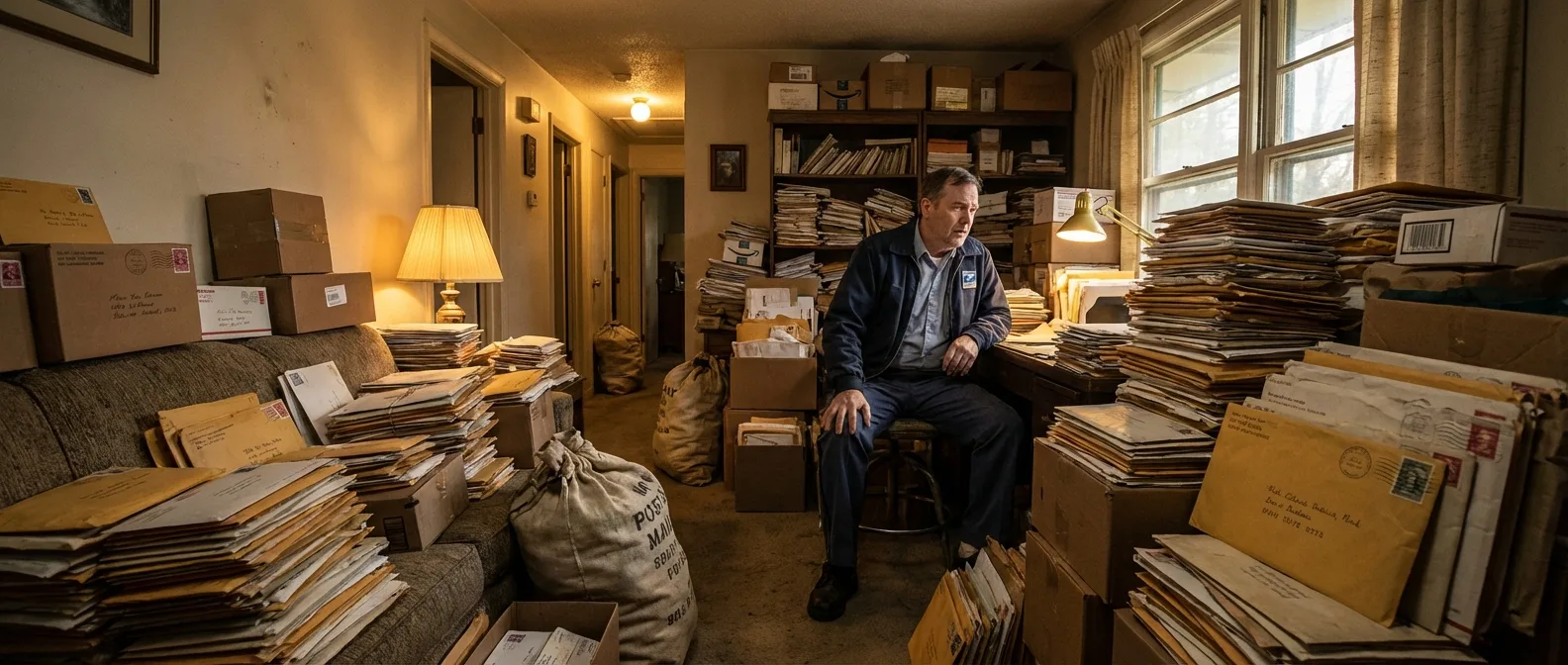
Police obtained a search warrant after weeks of surveillance. They had already noticed the postman returning to base each evening with half-empty bags — yet his delivery statistics were the lowest in the department. What they found exceeded all imagination. In the postman's home, in every room, there were stacks of letters. In hallways, under beds, inside wardrobes. The garage was packed floor to ceiling. Even along a nearby riverbank, hidden among bushes, lay bags stuffed with mail.
The final count? Over 40,000 letters, parcels, notices, and postal items. Some were only weeks old. Others dated back to the early 2000s. Among the findings were birthday cards with handwritten wishes, uncashed pension checks, and even a letter from a soldier on a peacekeeping mission to his wife back home. The postman hadn't thrown anything away — he had stored it all, as though he could neither deliver it nor let it go.
Every letter held back was a piece of someone's life. Among the 40,000 items, investigators found love letters never read, medical test results never delivered to patients, bills that went overdue through no fault of the recipients, court summons unknowingly ignored, and invitations to weddings and funerals that never arrived.
In Italy at the time, postal mail wasn't merely a communication channel — it was the backbone of bureaucracy. Tax notices, court orders, medical results, permit approvals: everything traveled by post. The failure to deliver wasn't a minor inconvenience — it was a hidden, slow, silent catastrophe.
"I couldn't just throw them away. I knew they were important. But I couldn't deliver them either."
Residents discovered months later that they had missed court deadlines, medical appointments, and financial opportunities. Some had paid fines for bills they never knew existed. Others learned that loved ones had written to them — but never received a reply, because the letter never arrived. At least twelve citizens filed lawsuits against Poste Italiane seeking compensation. One elderly man discovered that his home had been placed under foreclosure due to a tax notice he never received.
Inside the postman's mind
Why? That was the question repeated in every news report. The postman wasn't a thief — he never opened a single letter, never stole money, never exploited any information. There was no profit motive. There was something deeper.
📖 Read more: Golden State Killer: DNA Caught Him 40 Years Later
Psychologists who studied similar cases describe the "avoidance spiral": a worker begins with a small delay — perhaps a difficult day, an illness, bad weather. One day's mail goes undelivered. The next day, there's two days' worth of work. The pressure doubles. Instead of asking for help or admitting the backlog, he hides it. And every day, the problem grows.
After weeks, confession becomes impossible. After months, unthinkable. After years, the postman lives in a parallel universe where storing letters is his “normal” routine. The shame, the fear of dismissal, the inability to face the scale of it — all combine to create a psychological cage.
"Cumulative avoidance is a form of psychological trap. Each passing day, the cost of confession increases, while the cost of continuation appears constant." — Psychological analysis, University of Bologna
In some cases, experts recognize signs of hoarding disorder. The postman couldn't throw the letters away, but couldn't deliver them either. He kept them — the way hoarders keep worthless objects — because the very act of letting go was unbearable. His colleagues had suspected nothing — he arrived on time every morning, wore his uniform, greeted everyone. The facade of a functioning person was flawless.
He wasn't the only one
The Italian case is not unique. Around the world, dozens of postal workers have been discovered hiding thousands of letters. Each case looks remarkably like the others — as though they follow the same script.
📖 Read more: Hinterkaifeck Farm: 6 Dead and the Killer Lived There
In Germany, a postman in Baden-Württemberg was discovered in 2015 to have stored approximately 30,000 letters in his home. He had gradually stopped deliveries for months, hiding entire mailbags in basements and storage rooms. Some letters contained court documents that led to default convictions against innocent citizens. When asked, he simply answered: “I couldn't keep up.”
In Japan, a postal worker in Osaka hid more than 24,000 pieces of mail over a five-year period. He was discovered by accident when his landlord entered the garage for repairs. Japan Post issued a public apology, and the worker faced criminal charges under postal law.
In New York, a mail carrier was caught in 2014 storing thousands of letters — including tax documents and checks — in his Brooklyn apartment. In Sweden, in Britain, in France — similar cases surface every few years, with numbers ranging from a few thousand to tens of thousands of items.
"This is a phenomenon that appears globally, in every postal system, regardless of country or culture. That tells us the problem is not individual — it is structural." — EU Postal Services Study, 2019
The weight of a letter
For most people, a letter weighs a few grams. For a postman, it weighs responsibility. Each envelope is a promise — that the message will arrive, that the sender will be heard, that the connection will be completed. When that promise breaks, the consequences are invisible but profound.
📖 Read more: How an Italian Stole the Mona Lisa
A woman in Vicenza discovered that her mother in southern Italy had sent a letter asking her to come — she was ill. The letter was found in the postman's garage, months after the mother's death. A businessman lost a contract worth thousands of euros because the written acceptance was never delivered. A couple never received their friends' wedding invitation and only learned why years later.
The postal system, as an institution, relies on a fundamental trust: that every letter you drop in the mailbox will reach its destination. That trust — so simple, so taken for granted — proves fragile. One person, in a moment of weakness, can sever thousands of connections. In the age of email and instant messaging, we may believe that postal mail is losing relevance — but for millions of people across Europe, it remains the only way to receive official documents.
A system without a safety net
After every such scandal, the same question emerges: how can no one notice that 40,000 letters are missing? The answer reveals a system that relies almost entirely on individual conscientiousness.
In many countries, oversight of postal carriers is minimal. Mailbags are handed to the postman at the start of a shift, but there isn't always a verification mechanism to confirm delivery. There are no digital trails, no tracking systems, no random audits. The postman, essentially, operates on an honor code.
After the Vicenza case, Italy's Poste Italiane introduced stricter controls: digital scanning of mail, random route audits, and psychological support for workers. But in a system that handles millions of items daily, the human factor remains the weakest link — and simultaneously the most essential one. Today, many postal services use GPS route tracking and electronic barcodes on every envelope — but full digitization remains a distant goal for several European countries.
EpilogueThe postman of Vicenza was not a bad man. He was not a thief or a saboteur. He was a worker who one day couldn't keep up with the load, and the next day arrived before he could recover. Each new mailbag was a new failure stacked on top of the last. And at some point, the hill became a mountain. The postman was given a suspended sentence and dismissed — but he never served time in prison. His defense cited depression and burnout, and the court accepted mitigating circumstances. In the end, those 40,000 letters weren't just undelivered mail. They were the silent cry of a man nobody asked if he was okay — and of 40,000 people who never learned what they had missed.