The Message in a Bottle That Was Answered a Century Later
Stories of messages that traveled through time
📖 Read more: Titanic: What Really Happened That Night
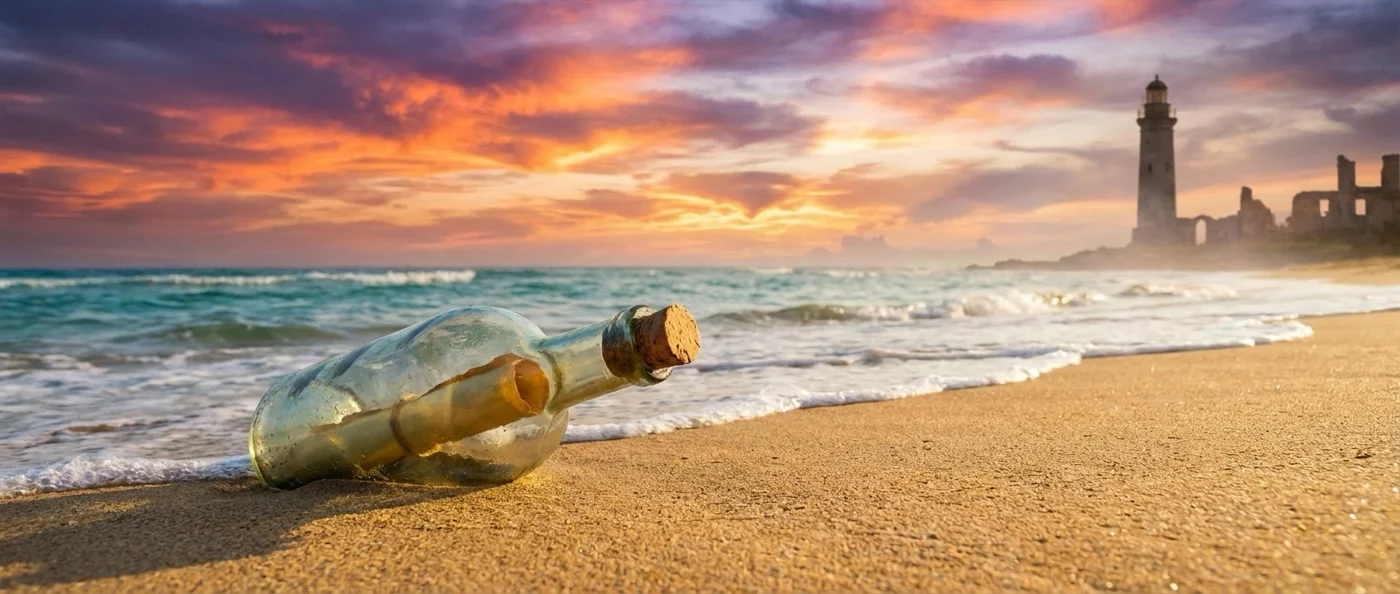
You toss a bottle into the sea. Inside, a slip of paper — a few words scribbled in haste, perhaps a name, a date, a plea. You seal the cap, hurl it into the waves, and turn your back. You don't know if anyone will ever find it. You don't know if the waves will crush it, if time will erase the ink, if the sea will swallow it forever.
And yet, sometimes, decades later — or even a full century after — unfamiliar hands open that bottle. They read words written by someone who no longer exists. And in that moment, for one fleeting second, time collapses. The sender comes back to life.
This is the story of those messages. Not just one — but many. Bottles that crossed oceans, decades, and entire lifetimes to reach their recipient. Some carry love confessions. Others, soldiers' farewells. A few, scientific experiments. And one of them traveled 131 years before washing up on a beach on the other side of the world.
The idea has been around for 2,300 years. Around 310 BC, Theophrastus — a student of Aristotle — reportedly cast sealed bottles into the Mediterranean. He wasn't writing love notes. He was trying to prove that the Mediterranean Sea was formed by Atlantic waters. It was, in essence, the first oceanographic experiment in history.
In 1177 AD, an exiled Japanese poet carved poems onto wooden planks and entrusted them to the waves. In the 16th century, Queen Elizabeth I of England took messages in bottles so seriously that she actually created the position of “Official Uncorker of Ocean Bottles.” Anyone else who dared to open a bottle found at sea faced the death penalty — she feared they might contain secret spy messages.
By the 18th century, Benjamin Franklin used bottles to map the Gulf Stream. Millions of bottles have been cast into the sea since then — it's estimated that by 2009, over six million messages had been released, 500,000 by oceanographers alone.
But the most extraordinary ones aren't the scientific ones. They're the human ones.
On May 17, 1913, a twenty-year-old baker named Richard Platz stood on a pier somewhere along the Baltic Sea. He held a postcard — Danish, with a brief message — asking whoever found it to send it to his address in Berlin. He sealed it in a bottle, tossed it into the sea, probably smiled, and went back to his bakery.
Richard Platz lived through two World Wars. He watched Germany conquer and be conquered. He raised children. He grew old. He died in 1946 — one year after the end of the Second World War, in a Berlin reduced to rubble.
His postcard was still drifting somewhere in the Baltic.
In March 2014 — 101 years later — a fisherman near Kiel pulled in his nets and found a bottle among the fish. Inside, the postcard was still legible. Researchers tracked down Platz's granddaughter, now 62 years old. They delivered her grandfather's message — a message written before she was born, before her mother was born, before the First World War had even begun.
"Please send this card to my address in Berlin."
— Richard Platz, 1913It took 101 years. But the message was delivered.
On September 9, 1914, Private Thomas Hughes crossed the English Channel by ship, heading for the trenches of France. A few days before reaching the front lines, he wrote a letter to his wife. He didn't trust the post — he sealed it in a green ginger beer bottle and dropped it into the water.
Thomas Hughes was killed just days later in the battles of France. He was among the first British casualties of the First World War.
In March 1999 — 84 years later — a fisherman in Essex, near the Thames estuary, pulled a bottle from his nets. Inside he found a love letter, written in ink that had faded but remained legible. Hughes's wife had died in 1979. But their daughter was still alive — 86 years old, living in New Zealand.
The fisherman and his wife flew all the way to New Zealand at the expense of the country's postal service, to personally deliver the letter to the daughter of a soldier who never came home. A letter her father had written before she was born.
Thomas Hughes was killed just days after dropping the bottle. His love letter drifted in the English Channel for more years than he himself had lived.
On the night of March 28, 1941, in the middle of the Mediterranean, the Battle of Cape Matapan was unfolding — one of the bloodiest naval engagements of World War II. The Italian cruiser Fiume was sinking slowly. On the deck, among the dying, sailor Francesco Chirico hastily scribbled a note on a piece of paper. He sealed it in a bottle. He threw it into the sea.
"Please notify my mother that I am dying for my country..."
— Francesco Chirico, last words, 1941The bottle was found 11 years later, in 1952, on a beach near Villasimius in Sardinia. Chirico's mother was still alive. She read her son's last words — words written in the dark, on a sinking ship, while dozens of sailors died around him.
The sea kept its promise. The mother was notified.
On Christmas Day 1945, 21-year-old American military nurse Frank Hayostek tossed an aspirin bottle from his ship as they approached New York. Inside, he had written a short note. Eight months later, a young Irish milkmaid named Breda O'Sullivan found the bottle on a beach near Dingle, in the Irish countryside.
Breda wrote back. A correspondence began that lasted years. Frank saved up for a plane ticket and flew to Ireland in 1952 to meet her. The story sparked a media frenzy — Time magazine wrote about the two of them, calling it “an impossibly romantic story.” They spent two weeks together but ultimately didn't marry each other — they married other people, around 1958-59. Yet they continued writing to each other until their deaths.
Ten years later, a Swedish sailor named Ake Viking — we're not joking, that was his real name — tossed a bottle into the sea in 1955 with a note reading: “To Some Beautiful and Faraway.” The bottle reached Sicily, where a 15-year-old girl named Paolina found it. They began writing to each other. Three years later, in 1958, they married in a ceremony attended by 4,000 people. They stayed together until Ake's death in 2001.
One bottle. One message. A marriage that lasted 43 years.
On June 12, 1886, the German sailing barque Paula was navigating the Indian Ocean, 950 kilometers off the coast of Western Australia. The captain, following instructions from the German Naval Observatory, filled out a standardized form with the ship's position, date, and conditions, sealed it in a thick glass bottle with a narrow neck, and threw it into the ocean. It was part of a scientific experiment on ocean currents.
In January 2018 — 131 years and 7 months later — a couple was walking along a beach near Wedge Island in Western Australia. Among the seaweed and shells, they noticed a bottle. Inside, they found a rolled-up piece of paper — damp but still legible. The thick glass and narrow neck had protected it from the elements for over a century.
Its authenticity was confirmed through the captain's meteorological logbook, still preserved in German archives. The 131 years far surpassed the previous record (108 years), making it the oldest message in a bottle ever found in the world.
During the time this bottle drifted across the ocean, the world witnessed two World Wars, the invention of the airplane, the automobile, the telephone, the internet, and the smartphone. The bottle began its journey before Hitler was born. It was found in an era when humanity was planning colonies on Mars.
Not all messages traveled by sea. Some were hidden on dry land — beneath floorboards, inside walls, in church rooftops.
On March 26, 1930, four craftsmen were working on the roof of the Goslar Cathedral in Germany. Times were hard — the Weimar Republic was collapsing, unemployment was hitting record highs — and one of the four, an 18-year-old apprentice named Willi Brandt, had an idea. They typed out a message: “Hard times of war are behind us... We hope better days will come soon.”
They sealed the note in a bottle and placed it on the roof, between the tiles. They didn't yet know that the war they feared wouldn't be the last — Hitler would rise to power three years later.
In the summer of 2018 — 88 years later — a craftsman was working on that very same roof. He found the bottle. And then he realized something: one of the four signatories — the 18-year-old apprentice Willi Brandt — was his grandfather.
The mayor of Goslar replaced the bottle with a copy of the message, adding his own confidential note for future craftsmen.
Not all messages are romantic or nostalgic. Some save lives.
In June 2019, three hikers were trapped above a waterfall in California, along the Arroyo Seco tributary. With no cell signal, no way to communicate, they did what sailors would have done centuries ago: they put an SOS in a Nalgene bottle and tossed it into the water. Someone found it 400 meters downstream. The next day, a helicopter rescued them.
In October 2011, off the coast of Somalia, the cargo ship Montecristo had been seized by pirates. The crew took refuge in an armored room but couldn't communicate with the NATO ships approaching. The solution? A bottle with a flashing light, thrown into the sea. The warships spotted it, realized the crew was safe and not being held hostage, and carried out a successful rescue operation.
The oldest form of communication still works.
Journalist Ryan Bort, writing in Newsweek, described messages in bottles as "cries for help, final poetic words of resignation before an indifferent sea, or lonely souls searching for their fate." He concluded with a line worth pausing for:
"Every message in a bottle is a romantic act... a surrender of yourself to something greater. Every message in a bottle is a prayer."
— Ryan Bort, NewsweekIn an age when we send dozens of messages a day via phones, email, social media — messages that arrive in fractions of a second and are forgotten in minutes — there is something deeply human about the idea of a message with no guarantee of delivery. A message that might arrive in ten days or in a hundred years. Or never.
Perhaps that's why they move us so deeply. It's not just the story of the sender or the recipient. It's the act itself — entrusting a piece of yourself to the unknown, without any control, without any certainty, with nothing more than a faint hope that someone, somewhere, someday, will bend down to pick up a bottle from the sand, unscrew the cap, unfold the paper — and read.
And then, for one second, time will no longer matter.