The Man Who Lived in an Airport for 18 Years
The true story of Mehran Karimi Nasseri — the man
who became a symbol of modern statelessness
📖 Read more: Hachiko: The Dog Who Waited 10 Years
Imagine an airport. Thousands of people pass through every day — running toward departure gates, embracing loved ones at arrivals, dragging suitcases across the polished floor. An airport is the definition of transient existence — a place you always leave. Nobody stays. Except at one airport in Paris, where a man never left. For eighteen whole years.
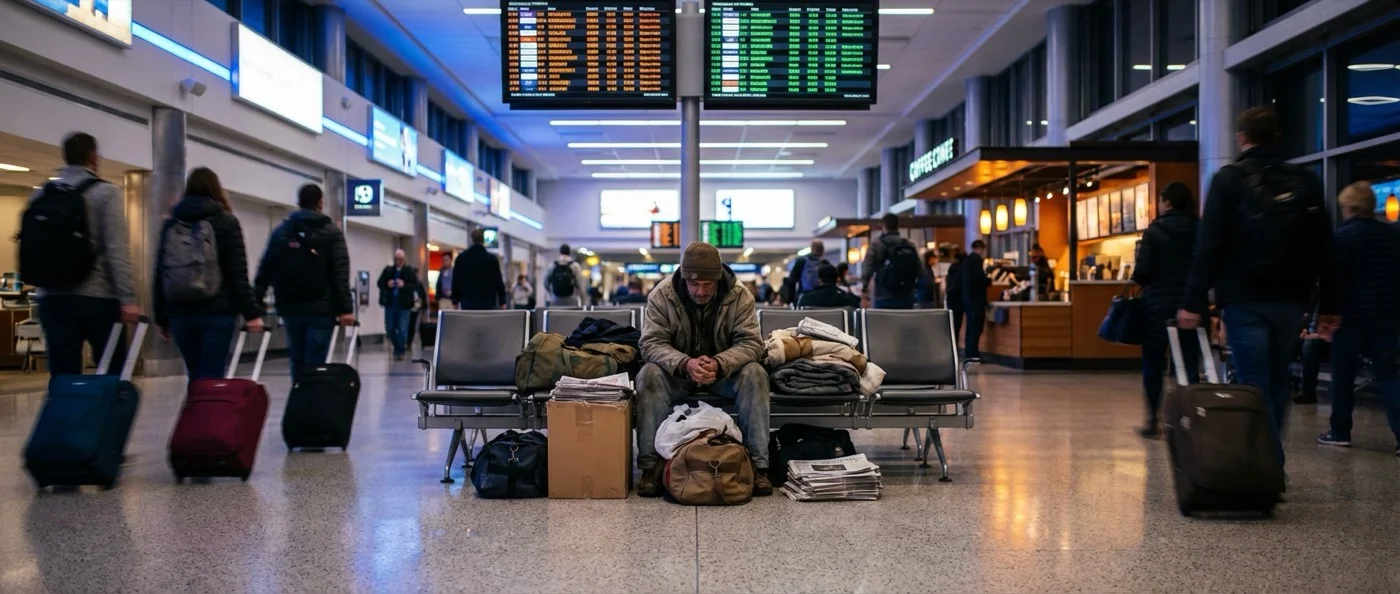
Mehran Karimi Nasseri — or “Sir Alfred Mehran,” as he called himself — lived in Terminal 1 of Charles de Gaulle Airport, sleeping on a red bench, eating at McDonald's, writing in his diary, smoking his golden pipe. From August 26, 1988, until July 2006. Without a passport, without an ID, without a homeland — a man stuck in the dead zone between two worlds.
His story inspired Steven Spielberg to make the film “The Terminal” with Tom Hanks. But the true story was no Hollywood comedy. It was something much darker, much more complex, and much more human.
Mehran Karimi Nasseri was born in 1945 in the Anglo-Persian Oil Company settlement in Masjed Soleyman, a city in southwestern Iran built around the first oil wells in the Middle East. His father, Abdelkarim, was an Iranian doctor who worked for the oil company, which ensured the young Mehran a relatively affluent childhood, amid the dust and flames of the petroleum industry.
Mehran later claimed his mother was a Scottish nurse — a caregiver who worked in the same settlement. In other versions, he spoke of a Swedish mother. None of these claims were ever confirmed, and most likely his mother was an Iranian housewife. But this obsession with “foreign” origins would gain meaning later — it was the first sign of a life that would be defined by the rejection of his identity.
At the age of 28, in September 1973, Mehran departed Iran for the United Kingdom. He enrolled at the University of Bradford for a three-year program in Yugoslav studies — a choice as eccentric as the man himself. Britain welcomed the young Iranian student, and for a few years his life followed a relatively normal trajectory.
That changed in 1977. According to his own account, he was expelled from Iran for protesting against the Shah. He began a long battle with bureaucracy, submitting asylum applications in multiple countries. Eventually, the UN granted him refugee status through Belgium — a status that theoretically allowed him to live in several European countries. However, later investigations challenged this narrative, suggesting that Mehran was never actually expelled from Iran.
The truth, as almost always in Mehran's story, was blurry — deliberately blurry, perhaps. Because his life was built on narratives that contradicted each other, on identities that didn't withstand scrutiny, on pasts that were rewritten again and again.
In 1988, Mehran was traveling between Britain and France — something his refugee papers theoretically allowed. But a critical event that would determine his future occurred on the ferry. According to his own account, his briefcase was stolen — and inside it was everything: his refugee certificate, his travel documents, his proven identity. Without them, Mehran was no longer anyone.
Other sources, however, tell a different version. According to them, Mehran himself mailed his documents to Brussels while on the ferry to Britain — and then falsely claimed they were stolen. If this version were true, then Mehran deliberately self-destructed — he destroyed the very papers that protected him.
Regardless of how the documents were lost, the result was irreversible. Arriving in London without a passport, British immigration authorities immediately returned him to France. At the French airport — Charles de Gaulle — he could prove neither his identity nor his refugee status. He was detained in the waiting zone for travelers without papers.
It was August 26, 1988. Mehran would not leave this airport for the next eighteen years.
📖 Read more: The Soldier Who Hid in the Jungle 30 Years After the War
Mehran's case was assigned to French human rights lawyer Christian Bourget. Bourget launched a years-long battle with French and Belgian bureaucracy, trying to secure new documents for his client. A solution seemed close many times — but each time something fell apart, and that “something” was usually Mehran himself.
Belgian authorities eventually agreed to issue new documents, but only if Mehran appeared in person in Brussels. Mehran refused. In 1995, the same authorities granted him permission to travel to Belgium, on the condition that he would live there under the supervision of a social worker. Mehran refused again — his reason was that he wanted to go to Britain, as had been his original intention.
But that wasn't all. Both France and Belgium offered him legal residency. Mehran refused to sign the papers. The reason? They listed him as “Iranian” instead of “British,” and didn't use the name he had chosen for himself: “Sir, Alfred Mehran” — including the erroneous comma after “Sir.”
"My frustration was immense. They offered him a solution several times. He refused every time. He didn't want a solution — he wanted a specific solution on his own terms, which no state could accept."
— Christian Bourget, Nasseri's lawyerHis lawyer, furious but unable to convince his client, publicly admitted that Mehran refused every realistic solution. His family in Iran, when asked to comment, said something equally harsh: “We believe he is living the life he wants.”
And perhaps that was the most unsettling truth: Mehran was not locked in the airport. He was free to leave. He simply refused.
How do you live in an airport for eighteen years? The answer is: routine. A routine so steady, so unchanging, that it could be considered urban mythology if there weren't hundreds of witnesses — airport employees, police officers, travelers, journalists — who saw him day after day, year after year.
The departure hall of Terminal 1 became his home. He slept on a red bench or on a seat near the “Paris Bye Bye” bar. Day and night, he could be found there — writing in his diary, listening to the radio, smoking his golden pipe. His meals were bought by strangers — travelers who recognized the “famous resident” of the airport. In some accounts, his luggage was always beside him, while he studied economics.
The world around him changed relentlessly — new airlines, new aircraft, new technologies, new generations of travelers. Europe united, the Soviet Union collapsed, the world entered the Internet age. Mehran remained in the same seat. Time moved around him — he was the only constant in a universe of perpetual motion.
Airport employees knew him by his first name. They greeted him every morning. Some considered him eccentric, some crazy, some sacred. No one bothered him. No one forced him out. In the busiest airport in France, a man lived unseen — visible to everyone but invisible to the system.
Wake up: uncertain hour (airports never go dark). Wash in the terminal restrooms. Breakfast from McDonald's or from strangers. Hours of writing in his diary. Studying economics. Pipe smoking. Listening to the radio. Second meal. More writing. Sleep on the red bench. Repeat. For 6,570 days.
What made Mehran's story so unsettling was not that he lived in an airport — it was that he chose to live in an airport. His obsession with the “correct” identity was so powerful that he preferred eighteen years of homelessness in a terminal, rather than accepting papers that called him “Iranian.”
Mehran refused to be Iranian. He refused to be called “Mehran Nasseri.” He wanted to be “Sir Alfred Mehran” — a name that was British, noble, pseudonymous. He wasn't simply rejecting papers. He was rejecting biology, history, blood. He wanted to be reborn as someone else — and if that wasn't possible in the real world, then he would live in a place that belonged to no world: the transit zone.
📖 Read more: The Fisherman Who Survived 438 Days Alone in the Pacific
Psychologists and journalists who visited him wondered if he suffered from some form of mental illness. No official diagnosis was ever given. But his behavior — the obsession with a pseudonym, the rejection of every practical solution, the disconnection from the past, the creation of alternative origin narratives — suggested something deeper than a simple bureaucratic entanglement.
Mehran was not a victim of the system. He was a victim of himself. The identity he rejected — his Iranian, real one — was the only exit door. But he locked that door from the inside, threw away the key, and sat in his red seat, waiting for a flight that would never come.
Gradually, Mehran's story escaped the walls of the terminal. Journalists from around the world began making “pilgrimages” to Charles de Gaulle to see the mythical airport resident. The first film inspired by his life came early: the French film “Lost in Transit” (Tombés du Ciel) was released in 1993 starring Jean Rochefort.
A documentary followed titled “Waiting for Godot at De Gaulle” (2000) — an apt title, since Mehran's life indeed resembled Beckett's characters: two people (or one, in this case) waiting for something that never arrives. Another documentary, “Sir Alfred of Charles De Gaulle Airport” (2001) by Hamid Rahmanian, recorded his daily life in exceptional detail.
His story even inspired contemporary opera. British composer Jonathan Dove created the opera “Flight,” which premiered at the Glyndebourne Opera House in 1998 and won the Helpmann Awards. From a red seat in a terminal, Mehran's story had reached the opera stage.
But the big moment came in 2003, when Steven Spielberg's DreamWorks reportedly paid $275,000 for the rights to his story. Mehran — a man without an identity, without a home, without a bank account — now had an enormous sum in his name. At least one piece of paper recognized him: a bank deposit.
In June 2004, the film “The Terminal” was released in theaters. Tom Hanks plays Viktor Navorski, a traveler from a fictional Eastern European country who gets stuck at New York's JFK Airport after a coup in his homeland. Spielberg transformed Mehran's dark story into a charming romantic comedy — with humor, love, and a happy ending.
Reality, of course, had none of that. There was no romantic relationship with a beautiful flight attendant. There was no clever improvisation. There was no redemptive departure. There was only a middle-aged man on a red bench, with luggage full of newspapers and diaries.
Remarkably, neither the film's promotional materials, nor the DVD's “special features,” nor the film's website ever mentioned Mehran as a source of inspiration. DreamWorks bought the rights but used only the central idea — a man stuck in an airport — almost completely ignoring the real events.
"Mehran was thrilled about the film. He carried a poster of it, wrapped around his suitcase next to his bench. But it was unlikely he would ever see it in a cinema."
— The Guardian, 2004Mehran also published his autobiography, “The Terminal Man,” in 2004, in collaboration with British author Andrew Donkin. The Sunday Times review called it “deeply disturbing and brilliant.” A book written inside an airport, by a man the world knew existed but nobody knew who he really was.
In July 2006, after eighteen years of continuous residence, Mehran's story in Terminal 1 ended — not because he decided to leave, but because he fell ill and was taken to a hospital. While he was hospitalized, his characteristic “corner” at the airport was dismantled. The red bench, the boxes of diaries, the pipe ashes — everything disappeared. Eighteen years evaporated as if they had never existed.
In late January 2007, after leaving the hospital, he was cared for by the French Red Cross at the airport — placed in a hotel near Charles de Gaulle for a few weeks. On March 6, 2007, he was transferred to a reception center run by the charity organization Emmaus, in the 20th arrondissement of Paris. From 2008, he lived in a homeless shelter in Paris.
📖 Read more: The Girl Who Walked 11 Days Alone Through the Jungle
The world forgot him almost immediately. Mehran outside the airport was no longer a story — he was simply another homeless man in Paris. The magic of the narrative depended entirely on the location: a homeless man in a park is not news. A homeless man in an airport is a legend.
But Mehran did not forget. Outside the airport, the world was a place no one had prepared him for. Eighteen years of photogenic solitude in an airport had completely disconnected him from the real world — a world of rents, bills, schedules, relationships. Mehran knew how to live in the feng shui of a dead zone. He didn't know how to live in life.
Mehran's story was not only personal. It was a metaphor — a crystalline example of a phenomenon affecting millions of people: statelessness. According to the United Nations, tens of millions of people worldwide have no nationality — stuck in legal voids, between countries that don't recognize them and borders that don't accept them.
Mehran was the personification of this phenomenon — though in a version far more staged than most people believed. His own statelessness was, to a large extent, self-imposed. He was not someone the system abandoned — he was someone who refused every help the system offered him. And yet, his story illuminated a truth: that identity — a piece of paper, a passport, a stamp — can be the difference between existence and non-existence.
An airport's transit zone belongs to no country. It is a legal void — a place where the traveler has not yet arrived but is no longer at the point of departure. Mehran exploited this void. He literally lived nowhere — in a place without jurisdiction, without rules, without a clock. An eternal limbo between departure and arrival.
The final act of Mehran's story was perhaps the most tragic. In September 2022 — sixteen years after his forced departure — Mehran returned to Charles de Gaulle. According to an airport spokesperson, he was now homeless and had returned to live in a public area within the airport. The circle was closing. A man who had been forced to leave his “home” had come back to it.
On November 12, 2022, Mehran Karimi Nasseri died of a cardiac arrest. He departed in the same place he had lived — Charles de Gaulle Airport. He was 77 years old. He was not found in the red bench of Terminal 1 — that had been replaced long ago. But he died inside that building, among travelers who didn't know him and planes that would never take him anywhere.
News agencies around the world reported his death. Le Monde, BBC, CNN, the Associated Press — all reported the death of “the man who inspired the film The Terminal.” The film had become more famous than the real man himself. Mehran, in the end, was a footnote in his own story.
The flight that never was
Mehran Karimi Nasseri's story is not a story about an airport. It is a story about papers. About the power of a document to determine whether a person exists or doesn't exist. About the power of a name — the right name, the one we decide represents us — to keep us captive in a place that belongs nowhere.
Mehran refused to be who he was. He refused to accept the papers that called him Iranian. He refused a life in Belgium, a life in France — any life that wasn't exactly the one he had imagined. And that refusal condemned him to eighteen years of stillness inside a building designed exclusively for movement.
There is something deeply paradoxical about his existence. A resident without a home. A traveler without a journey. A man who lived in the most public place imaginable, yet was perhaps the loneliest person in France. Thousands of travelers spoke to him every day, but nobody knew him. They looked at him with curiosity, photographed him like a tourist attraction, bought him meals — but nobody took him home.
Mehran died at the airport, where he had lived. The final boarding call had arrived. The departure gate was open. But the flight had no destination — only departure. A departure that lasted eighteen years, three films, an opera, a book, and an entire human life spent waiting.
In memory of Mehran Karimi Nasseri (1945–2022)
Charles de Gaulle Airport, Terminal 1
August 26, 1988 — November 12, 2022