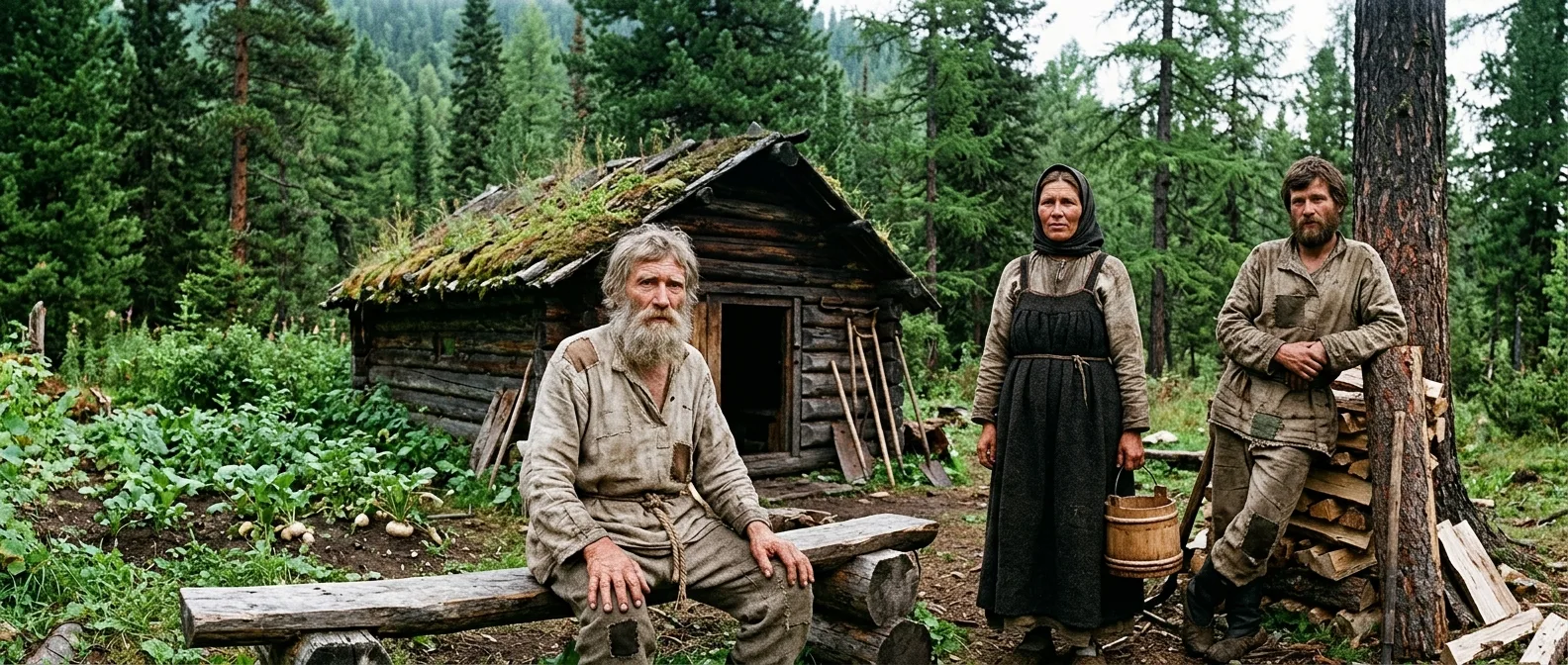
Lost in the Taiga
The true story of a family that vanished from the world for 42 years
📖 Read more: The Wrong Button That Nearly Started a Nuclear War
The helicopter dropped low over the pines. It was the summer of 1978 — a team of Soviet geologists was searching for iron ore deposits somewhere deep in southern Siberia, more than 150 miles from the nearest settlement. The pilot was scanning the ground for a landing spot when he saw something impossible. A clearing on a mountainside, scored with long, dark furrows. Something like a garden.
They made several passes over the site. There was no doubt — someone was cultivating the land up there. Soviet authorities had no records of anyone living in the district. It was a patch of earth that had never been explored.
Galina Pismenskaya, head of the geological team, decided they would investigate. “We loaded gifts into our packs for our potential friends,” she recalled later. “But I didn't forget to check the pistol that hung at my side.”
What they found on that mountain was not a hunter or a forest ranger. It was an entire family — five people trapped in a past that the rest of the world had forgotten decades ago.
— 1 —Karp Osipovich Lykov was an Old Believer — a member of a fundamentalist Russian Orthodox sect that worshipped in a manner unchanged since the 17th century. The Old Believers had endured persecution since the time of Peter the Great. Karp spoke of him as if he were still alive — calling him “the Antichrist in human form.”
Things got worse after the Russian Revolution. The Bolsheviks tolerated nothing — least of all religion. During the purges of the 1930s, a Communist patrol shot Karp's brother on the outskirts of their village while Karp knelt working beside him in the field.
Karp decided that very moment. He would not wait for the next bullet.
He gathered his wife, Akulina, their nine-year-old son Savin, and two-year-old daughter Natalia. They packed seeds, a spinning wheel broken into pieces, two kettles. And they vanished into the taiga.
"In the taiga, it's less dangerous to run across a wild animal than a stranger"
— Vasily Peskov, journalistThat was 1936. They pushed deeper and deeper into the forest, building crude shelters, always moving on. They finally settled in a spot so remote that, as journalist Vasily Peskov noted years later, “we traversed 250 kilometers without seeing a single human dwelling.” Meanwhile, two more children were born in the wilderness: Dmitry in 1940 and Agafia in 1944. Neither of them would ever see another human being outside their own family — for the next 34 years.
— 2 —Their home was a single-room cabin — dark, filthy, with a floor made of potato peel and pine-nut shells. A single window, small as a backpack pocket, was the only source of light. Five people lived inside.
Akulina taught the children to read and write. Their “pens” were sharpened birch sticks dipped in honeysuckle juice. Their only reading material: prayer books and a family Bible. The children knew that cities existed — places where people lived crammed together in tall buildings. They knew there were other countries besides Russia. But these were abstract concepts, like fairy tales.
Their main entertainment? Every evening, they gathered to tell each other their dreams.
They replaced their clothing with hemp cloth they grew themselves. Their shoes became galoshes made from birch bark. When both kettles rusted after years of use, the only vessels they could fashion were birch-bark containers — which couldn't be placed in fire. Cooking was no longer simple.
The Lykov family had no salt for 40 years. Karp later described this deprivation as “true torture.”
By the late 1950s, Dmitry — then a grown man — learned to hunt. Without guns or bows, the only method was to dig traps or chase animals on foot until they collapsed from exhaustion. He hunted barefoot even in winter, returning after days with a young elk across his shoulders. But most days there was no meat. Their diet was mainly potato patties mixed with ground rye and hemp seeds.
— 3 —Agafia remembered the 1950s as “the hungry years.” They ate rowanberry leaves, roots, grass, mushrooms, potato tops, tree bark. “Every year we held a council,” she recounted later, “to decide whether to eat everything up or leave some for seed.”
Hunger was always there, like a shadow. And in 1960, the final test came. It snowed in June. The hard frost killed everything in their garden. Through the winter, they had nothing. They ate leather shoes, bark, straw. Akulina chose not to eat — so her children could.
She died in February 1961. Of starvation.
"We ate the rowanberry leaf, roots, grass, mushrooms, potato tops, and bark. We were hungry all the time"
— Agafia LykovaAnd then something happened that the family considered a miracle. A single grain of rye sprouted among their peas. One solitary shoot. They guarded it day and night, built a fence around it, chased off mice and squirrels that came near. At harvest, that single spike yielded 18 grains. From those 18 grains, they painstakingly rebuilt their rye crop. Over years of patience.
— 4 —The geologists climbed the mountain carrying gifts. They found signs first — a path, a staff, a log laid across a stream, a small shed filled with dried potatoes in birch-bark containers. And then, the cabin.
The low door creaked. A very old man appeared in the light. Barefoot. Wearing a patched sacking shirt. His trousers were the same material — patches upon patches. His hair was disheveled. He looked terrified.
"Greetings, grandfather! We've come to visit," Pismenskaya began.
The old man did not reply immediately. After a long silence, a soft, uncertain voice: “Well, since you have traveled this far, you might as well come in.”
Inside the cabin, two women began to cry and pray. “This is for our sins, our sins,” one wailed. The other, hidden behind a post, sank slowly to the floor, her eyes wide with terror.
"Well, since you have traveled this far, you might as well come in"
— Karp Lykov, to the geologistsThe scientists backed out quickly. They sat a few yards away to eat. After half an hour, the door opened again. The old man and his two daughters came out — no longer panicking, but “frankly curious.” They approached the strangers. They refused everything offered — jam, tea, bread — with a murmur: “We are not allowed that.”
📖 Read more: The Astronaut Who Was Stranded in Space
"Have you ever eaten bread?" Pismenskaya asked.
"I have," the old man answered. “But they have not. They have never seen it.”
The daughters spoke a language distorted by a lifetime of isolation. “When the sisters talked to each other,” Peskov noted, “it sounded like a slow, blurred cooing.”
— 5 —Slowly, over many visits, the story unraveled. And then the geologists sat down to explain to Karp what he had missed in 42 years. The Second World War. The atomic bomb. Satellites. The moon landing.
Karp shook his head when he heard about the war: "What is this, a second time? And always the Germans. A curse on Peter. He flirted with them."
He stubbornly refused to believe that man had walked on the moon. But the satellites — he had already noticed those. Since the 1950s, the family had seen lights racing across the sky. Karp had developed his own theory: "People have thought up something and are sending out fires that are very like stars."
"Lord, what have they thought up — it is glass, but it crumples!"
— Karp Lykov, seeing cellophane for the first timeWhat amazed him most was not the rockets or the airplanes. It was a transparent cellophane package. “Lord, what have they thought up — it is glass, but it crumples!” he said, mesmerized.
Television proved to be an “irresistible sin.” On their rare visits to the geologists' camp, Karp sat directly in front of the screen. Agafia watched from behind a door, sticking her head in and out. She tried to pray away the transgression immediately — whispering, crossing herself — and stuck her head back out again. When she saw a horse on the screen, she recognized it from her mother's stories. “Papa, a steed!” she cried.
Dmitry was the most curious. He spent hours at the camp's sawmill, fascinated by the circular saw. “The log that took Dmitry a day or two to plane,” Peskov wrote, “was transformed into handsome boards before his very eyes.”
Initially, the family accepted only one gift: salt. Over time they accepted blankets, woolen socks, seeds, a battery-powered flashlight. When asked why she accepted a flashlight but not matches, Agafia “didn't know how to respond” — she only confirmed that matches were indeed sinful.
— 6 —Perhaps the saddest part of this story is this: contact with the outside world killed them. In the fall of 1981, within days of each other, three of the four children died. Savin and Natalia from kidney failure — likely the result of decades of harsh diet. Dmitry from pneumonia — an infection that may have come from their new friends.
Dmitry's death devastated the geologists. They tried desperately to save him. They offered to call a helicopter, to evacuate him to a hospital. But Dmitry, dying, would abandon neither his family nor the faith he had practiced his entire life.
"We are not allowed that. A man lives for howsoever God grants"
— Dmitry Lykov, his final wordsIn a single autumn, Karp buried three of his children on the mountain slope. Now only two remained — the old father and the youngest daughter, Agafia.
The geologists begged them to leave. To return to civilization, to find relatives who had survived the purges and still lived in the old villages. Neither of them would hear of it.
— 7 —The Woman Who Won't Leave
After her siblings' death, the Soviet government offered Agafia a tour across the country. She accepted. Her father stayed behind. She spent a month on the road, absorbing the world she had never known. And she came back to the taiga.
"It's scary out there. You can't breathe. There are cars everywhere. Each car that passes by leaves so many toxins in the air. You have no other option but to stay at home"
— Agafia Lykova, 2013Karp Lykov died in his sleep on February 16, 1988 — exactly 27 years after his wife Akulina, down to the very date. Agafia buried him on the mountain with the help of the geologists. Then she turned and walked back home.
"The Lord will provide," she said. And she stayed.
Geologist Yerofei Sedov, the family's closest friend among the scientists, eventually returned to the taiga after losing a leg to gangrene. He lived down the slope from Agafia. They listened to the radio together until his death in 2015.
Today, Agafia Lykova still lives there. Alone in the taiga. Over 80 years old. She accepted a new wooden cottage, funded by Russian billionaire Oleg Deripaska. She has a satellite phone. Volunteers travel regularly to bring her supplies.
But she won't leave. She has never left.
Sedov, at Karp's funeral, looked back one last time:
"I looked back to wave to Agafia. She was standing by the river, like a motionless statue. She wasn't crying. She nodded: 'Go on, go on.' We walked another kilometer and I looked back. She was still standing there"
— Yerofei Sedov, geologist