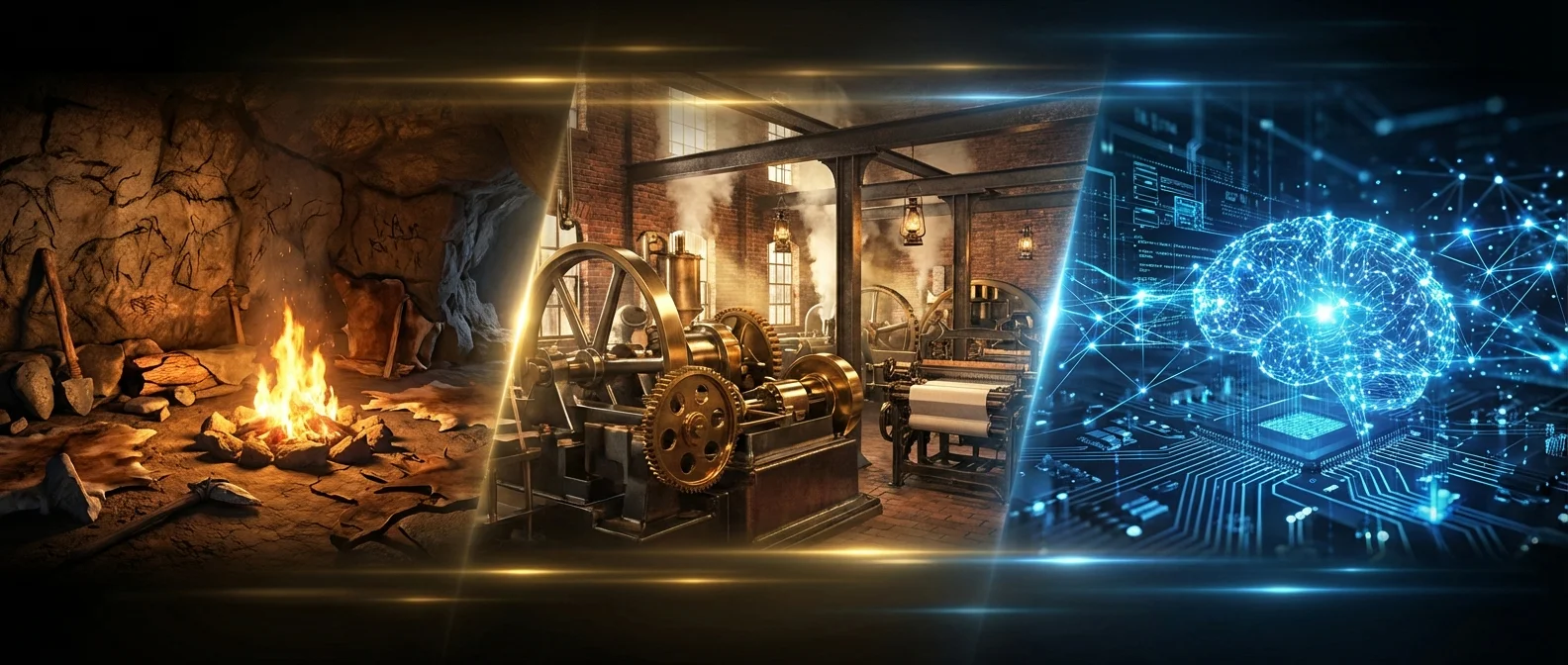
🔥 Prehistory — The foundations of everything
300,000 BC — 3,500 BC
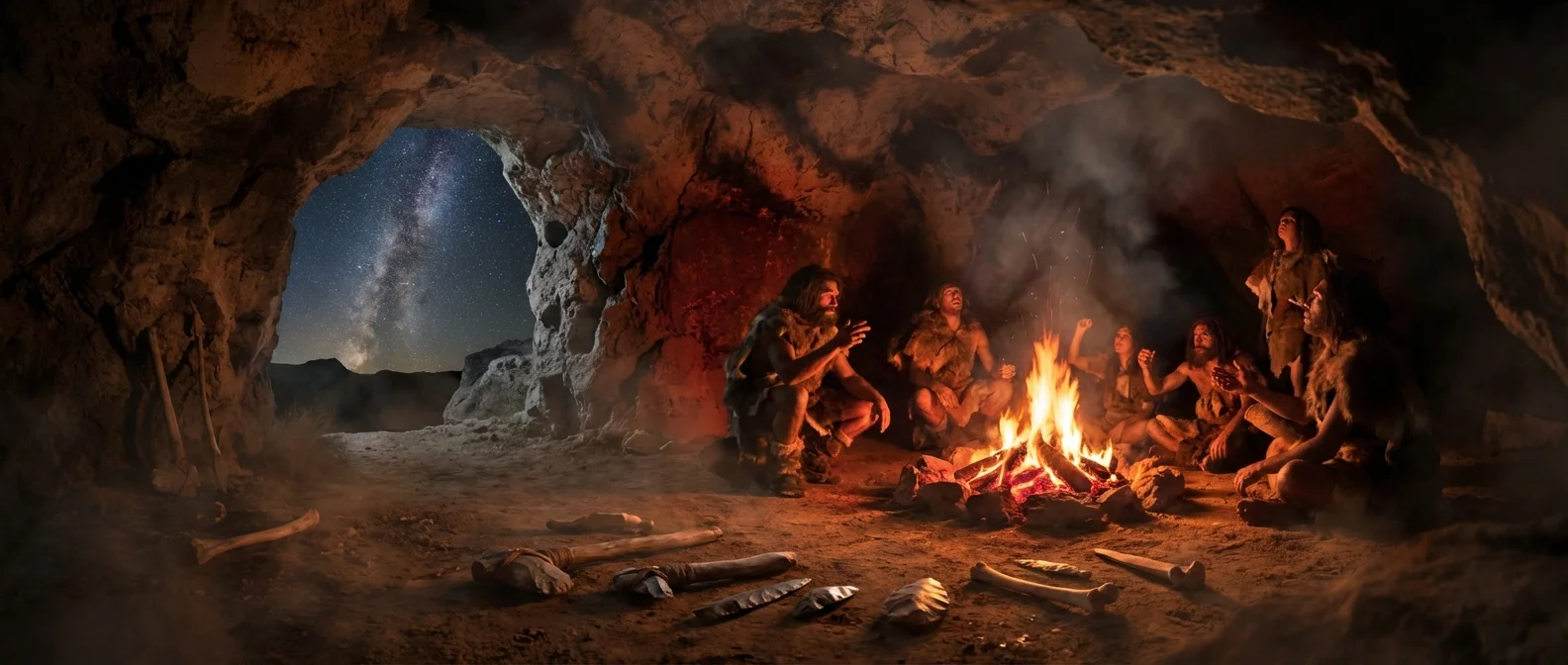
The dawn of technology — from the first tools to fire
🪨 Stone tools and the taming of fire
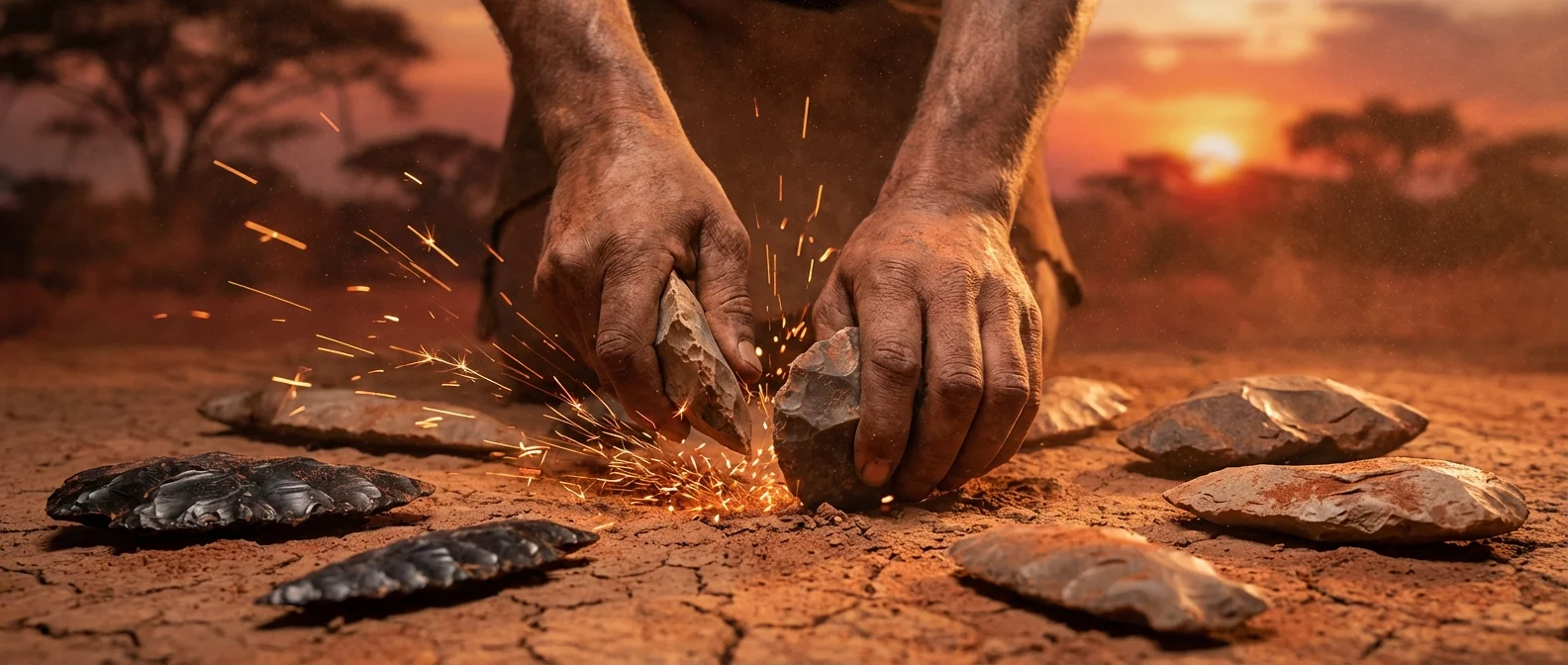
Stone tools and the taming of fire — the first inventions
The first technology was not digital, nor mechanical — it was a stone struck in just the right way. Around 2.6 million years ago, our earliest relatives, Homo habilis, crafted what are known as Oldowan tools in East Africa. Specifically, they struck pebbles to create sharp edges. This may sound trivial, but without this invention, Homo sapiens would never have come to dominate.
Fire came later, around 400,000 years ago, based on evidence from the Qesem Cave in Israel. Initially, fire was only used when found naturally, from lightning or wildfires. Controlled use came later, and that was literally a technological revolution. Fire gave us cooking, which increased the nutritional value of food and minimized parasites. Fire gave us warmth, which opened up new climates. Fire gave us safety, because no predator would approach the flame.
💡 Did you know?
Anthropologist Richard Wrangham argues that cooking, not hunting, was the reason the human brain grew larger. Cooked food requires less energy to digest, leaving more energy for the brain.
Around 70,000 years ago, the first composite tools appeared: points bound to wooden shafts, spears with stone tips, bows with arrows. This period, known as the Upper Paleolithic revolution, also brought jewelry, cave art, figurines, and perhaps the first clothes made from animal hides.
Cave art deserves special mention. At Lascaux in France, around 17,000 years ago, they painted bison, deer, and horses with stunning accuracy. They used natural pigments — ochre, hematite, charcoal — mixed with animal fat. These painters were not “primitive.” They were artists with keen observation, technical skill, and perhaps religious faith. Art was the first technology for communicating ideas without words.
Language, of course, was perhaps the most important “technology” of this era. Linguists believe that fully developed language appeared around 100,000 years ago. Without language, there would be no transfer of knowledge between generations. Each generation would start from scratch. Language made cumulative progress possible — what anthropologists call the "ratchet effect": each generation builds on the knowledge of the previous one, like a snowball.
🌾 The Neolithic Revolution — The greatest turning point in history
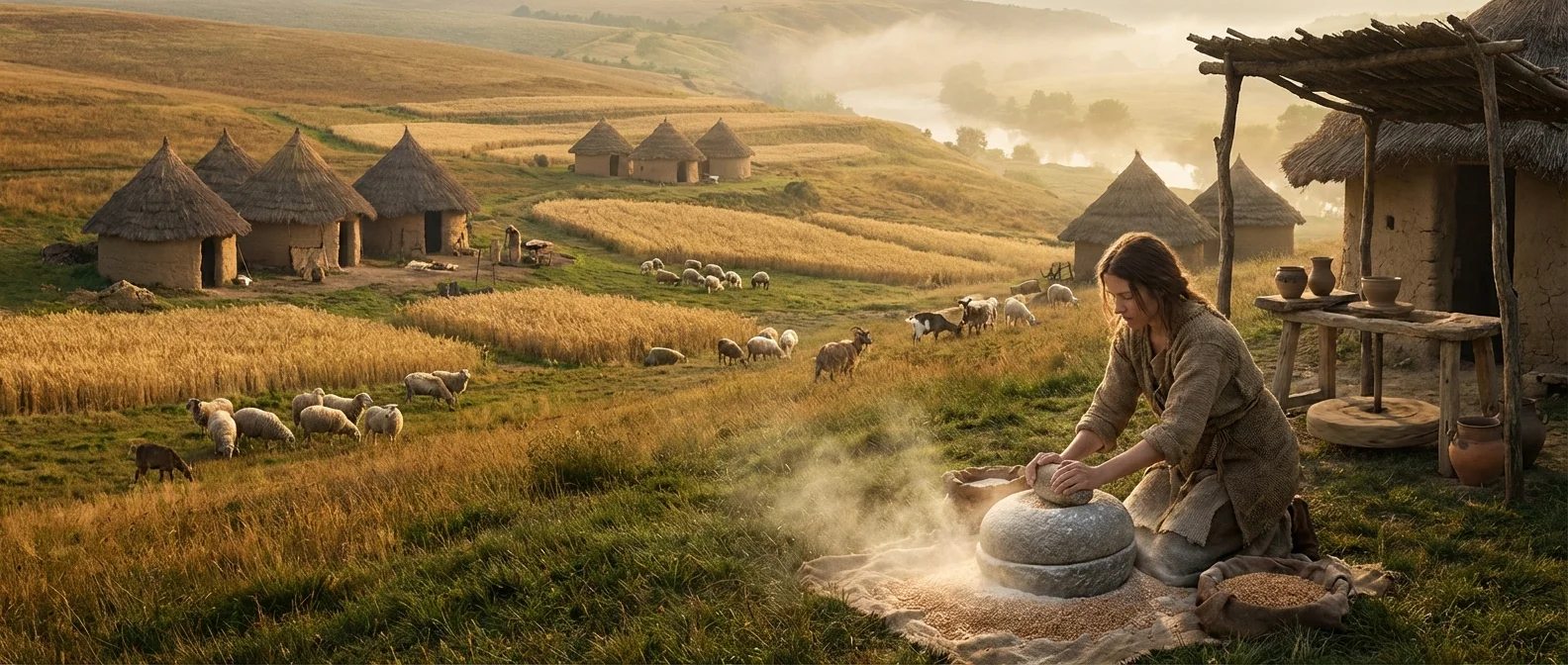
The Neolithic Revolution — the birth of agriculture and civilization
Around 10,000 BC, something happened in the Fertile Crescent — the strip of land from modern Turkey to Iraq — that changed everything. People stopped hunting and gathering, and began to farm. Wheat, barley, lentils. They domesticated sheep, goats, cattle. For the first time, they didn't follow food — food came to them.
This meant permanent settlements. Permanent settlements meant food storage. Storage meant surplus. Surplus meant not everyone needed to search for food, so some could become artisans, priests, warriors, leaders. The technology of agriculture gave birth to civilization.
The Agricultural Revolution was history's biggest fraud. Wheat domesticated Homo sapiens, rather than the other way around.
Along came ceramics, around 7,000 BC. Vessels for storing grain, water, oil. Weaving for clothes instead of animal hides. The wheel appeared around 3,500 BC in Mesopotamia, initially as a potter's wheel and then, crucially, as a transport wheel for carts. But the most important invention of this era was not physical — it was abstract: writing, around 3,400 BC, in Sumer.
Writing began as accounting. Seals on clay tablets, inventory records, counts of goats and sacks of grain. Gradually, cuneiform script evolved to record stories, laws, poems. The Epic of Gilgamesh, written around 2,100 BC, is the oldest known literature — older than Homer by a thousand years. Writing gave humanity something entirely new: memory external to the brain, memory that did not die with its owner. Knowledge could now travel through time.
It is worth noting that writing was invented independently at least three times: in Mesopotamia, in China around 1,200 BC, and in Mesoamerica by the Maya around 300 BC. This shows that writing was not an accidental discovery but an inevitable evolution: every complex society eventually needed it. Along with writing came arithmetic, the first mathematical system. The Babylonians used a base-60 system, which is why we still divide the day into 24 hours, the hour into 60 minutes, and the circle into 360 degrees.
🏛️ Antiquity — Machines, metals and mathematics
3,500 BC — 500 AD
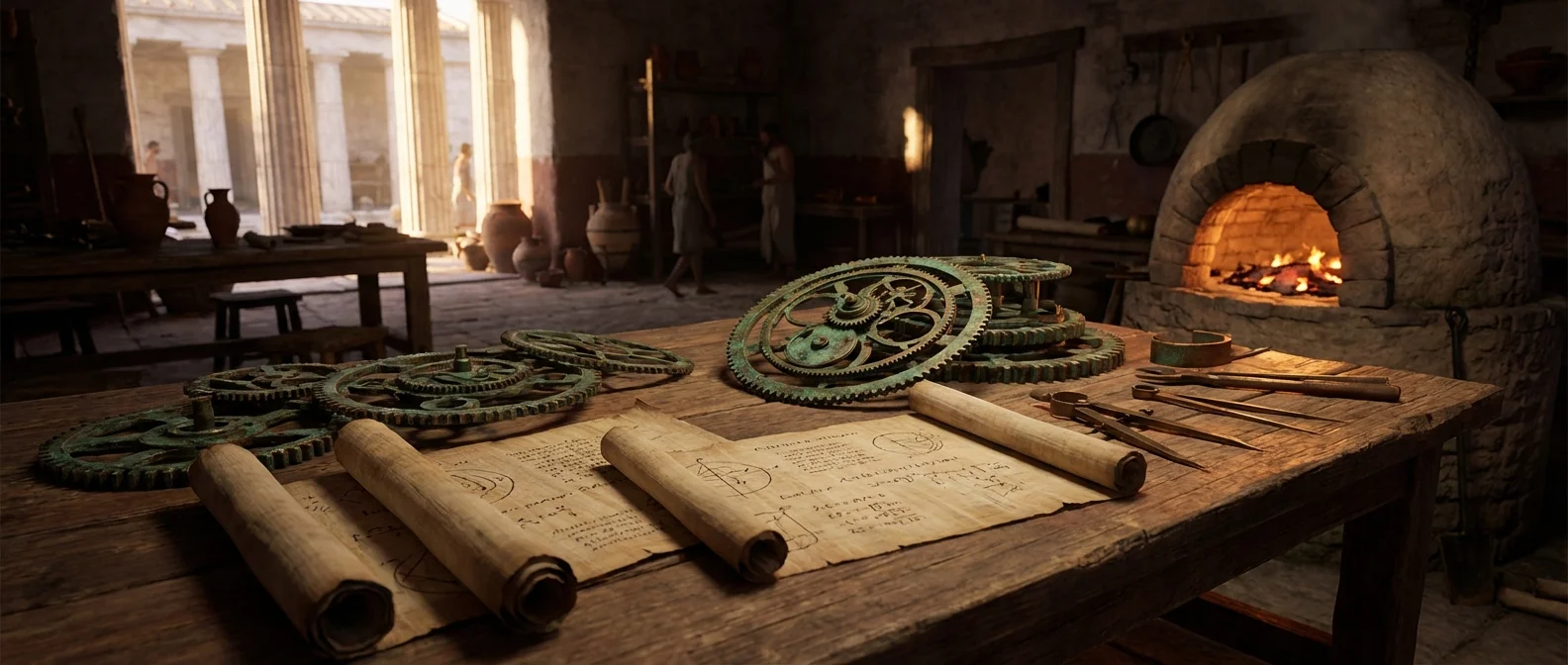
Antiquity — metals, machines and the birth of mathematics
⚒️ The Bronze Age and the Iron Age
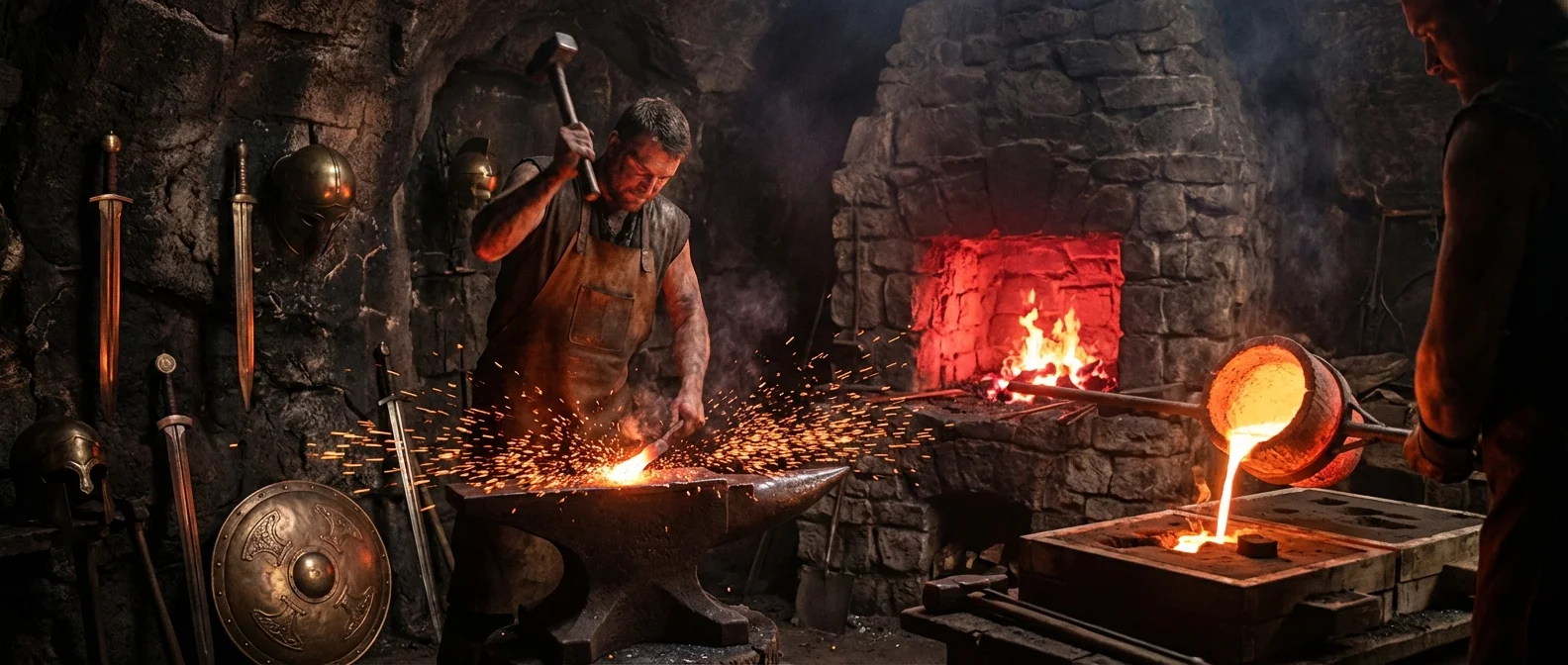
The age of metals — from bronze to iron
Copper was the first metal intentionally cast, around 4,500 BC. But copper alone was soft. Around 3,300 BC, someone discovered that mixing copper with tin produces bronze — harder, more durable, deadly as a weapon. The Bronze Age created empires.
The Iron Age began around 1,200 BC, when the Hittites in modern Turkey developed iron smelting techniques. Iron was cheaper and more available than bronze, but required higher temperatures. Iron tools meant better plows, which meant more food, which meant larger populations, which meant larger armies.
🏗️ Ancient engineering marvels
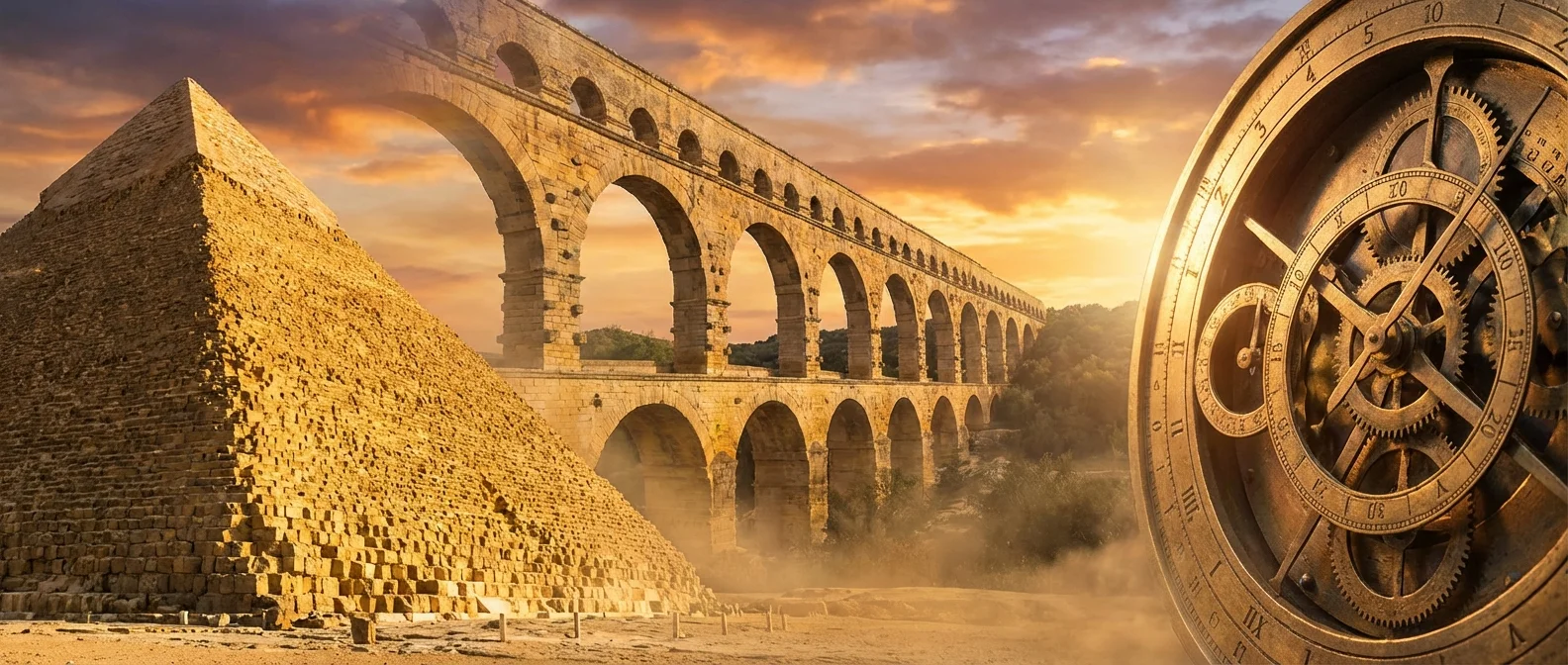
Ancient engineering marvels — from the pyramids to the Antikythera Mechanism
Antiquity was not just philosophy. The Egyptians built the Great Pyramid around 2,560 BC, with 2.3 million stone blocks averaging 2.5 tons each, without pulleys, without iron — only ramps, levers, and human strength. The precision of its alignment with true north is impressive even by today's standards.
🔧 Antikythera Mechanism
Around 100 BC, Greek engineers built the first analog computer. With over 30 gears, it predicted eclipses, planetary positions, and even the Olympic Games. The world would not create anything comparably complex until the 14th century.
🚰 Roman Aqueducts
The Romans built over 400 kilometers of aqueducts for Rome alone. They transported 1 million cubic meters of water daily. Some still function after 2,000 years.
⛵ Polyreme Warships
Triremes — warships with three rows of oars and 170 rowers — were the most advanced naval vessels for centuries. The Battle of Salamis in 480 BC was decided by these engineering marvels.
📜 Chinese Inventions
Paper around 100 BC, compass in the 2nd century AD, gunpowder in the 9th century, printing in the 11th century. China invented almost everything centuries earlier, but did not exploit them industrially.
⚔️ The Middle Ages — Darkness or silent progress?
500 AD — 1,400 AD
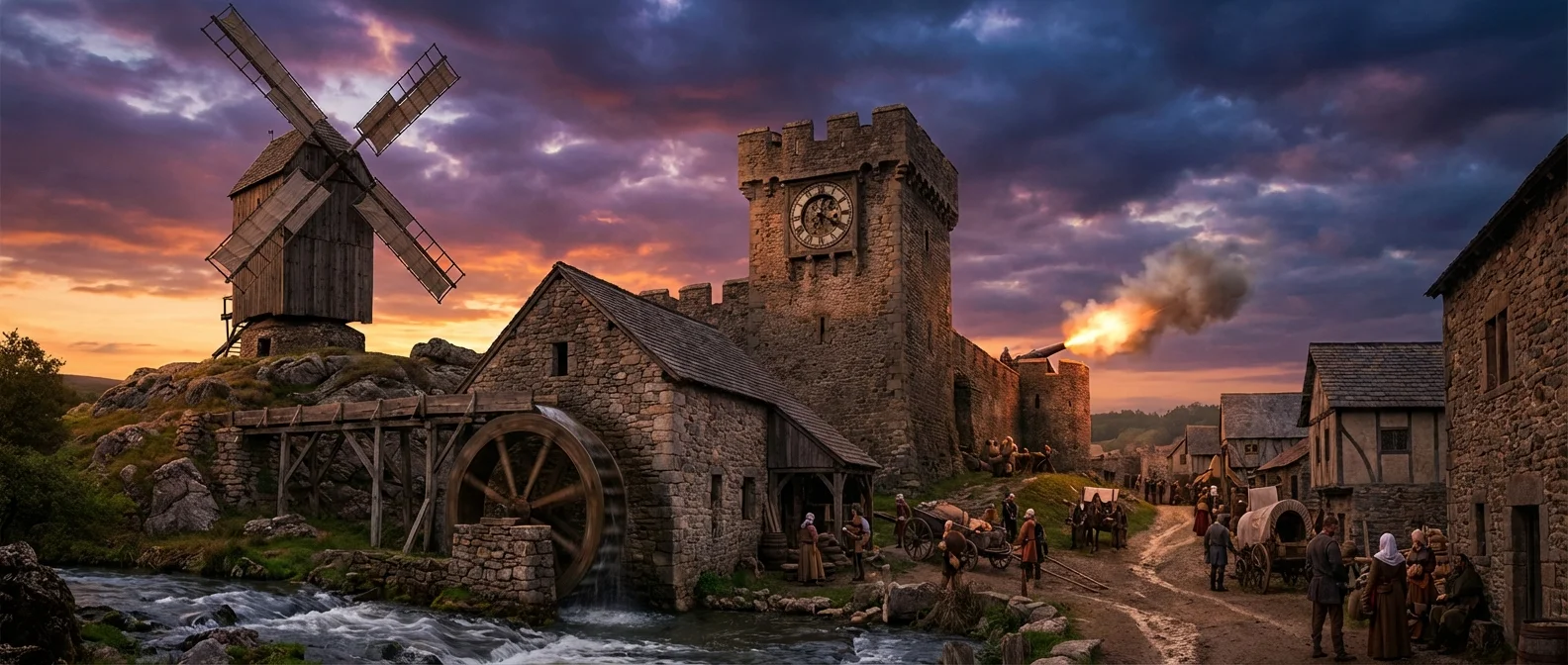
The Middle Ages — an era of silent but substantial progress
🌍 Technology never stopped
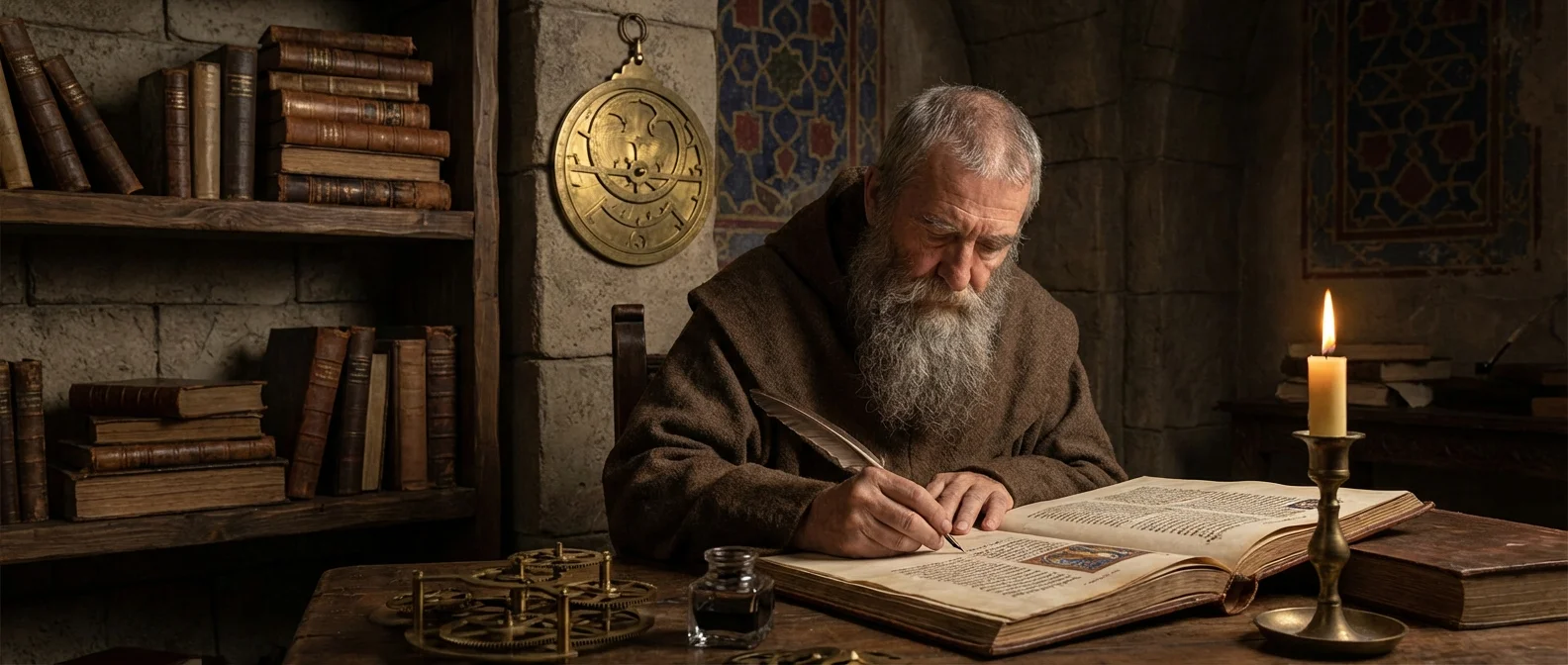
Watermills, clocks and the Silk Road — the quiet progress
The Middle Ages unfairly bears the reputation of being “dark.” In reality, technologically, it was a period of quiet but significant progress, especially in agriculture and engineering. The heavy iron plow, which appeared in the 6th century in Northern Europe, could dig through heavy soils that the light Roman plows could not. This transformed the forests of Northern Europe into farmland, changing the entire geography of power.
Windmills appeared in Persia in the 7th century and in Northern Europe in the 12th century. Watermills multiplied. In England, the Domesday Book of 1086 records over 6,000 watermills in a country of 1.5 million inhabitants — that's one mill per 250 people. It was industrialization before industry.
⏰ Mechanical Clocks
The first mechanical clocks appeared in European monasteries in the 13th century. Gradually, they spread to city towers. For the first time, time was not natural but mechanical, and people could coordinate work with precision. Lewis Mumford argued that the clock, not the steam engine, was the critical machine of the industrial age.
In the Islamic world, progress was even more impressive. Al-Jazari in the 12th century designed automated clocks, hydraulic pumps, robotic musicians. Ibn al-Haytham founded modern optics. Algebra, the decimal number system, chemistry, medicine — the Arab world kept knowledge alive and advanced it.
And of course, gunpowder. Invented in China in the 9th century, it reached Europe in the 13th via the Silk Road. The first cannons appeared in Europe in the 14th century. Castles, which had dominated the landscape for centuries, suddenly became vulnerable. The entire feudal system was shaken.
The Silk Road deserves special mention as a technological conduit. It didn't just carry goods, but know-how: paper passed from China to Arabia to Europe, number systems passed from India to Arabia to Western Europe. The medieval world was not isolated — it was networked, just slowly. Globalization didn't start with the internet. It started on the Silk Road.
Gunpowder, the compass, printing: these three inventions changed the entire face and state of things worldwide.
📖 Renaissance and Discoveries
1,400 — 1,760
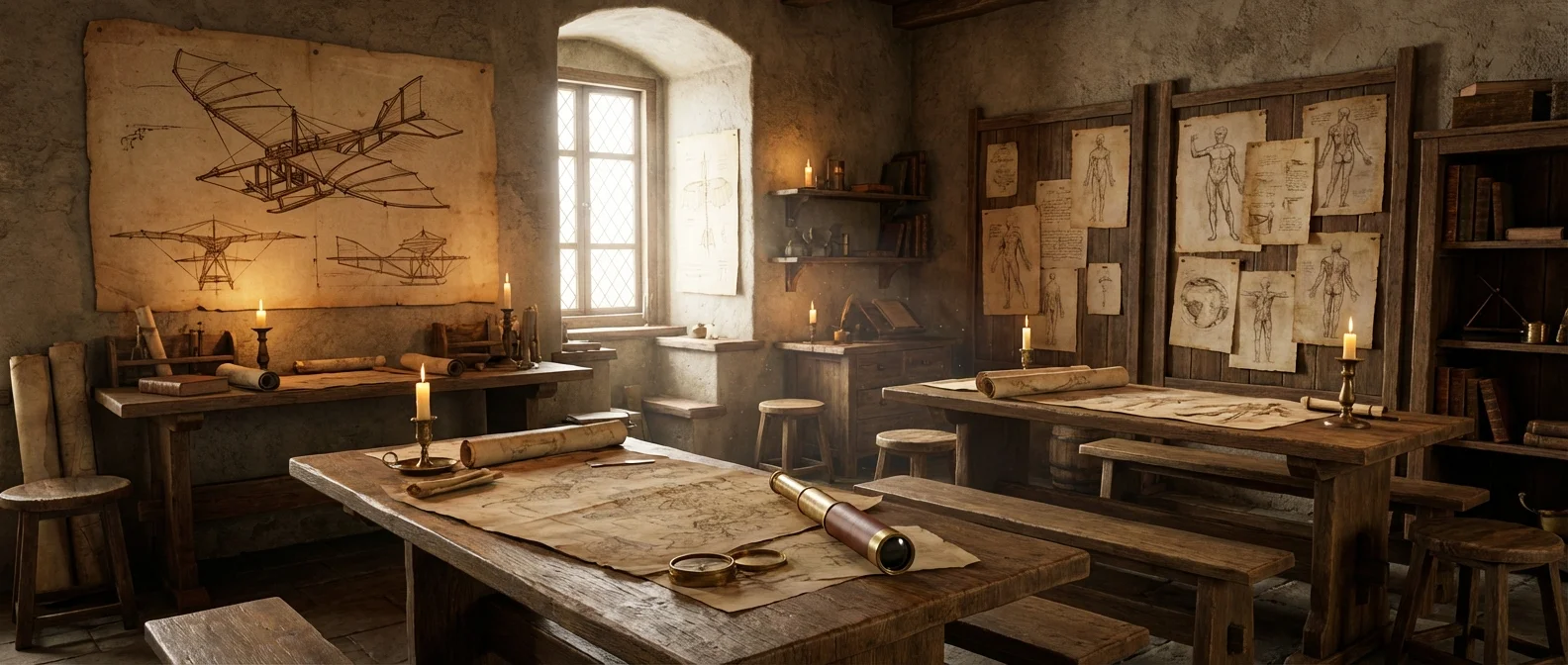
Renaissance and Discoveries — a new era of knowledge
🖨️ Gutenberg and the information revolution
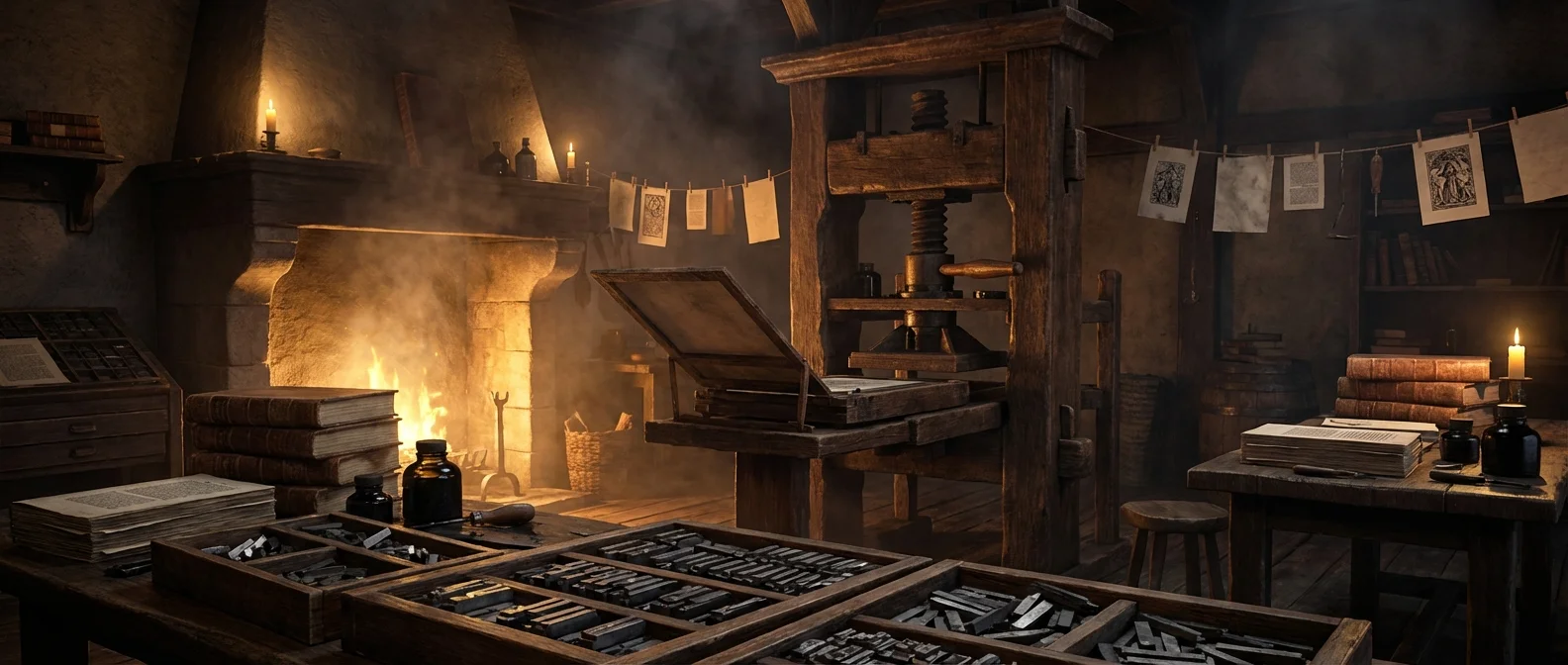
Gutenberg's printing press — the information revolution
In 1440, Johannes Gutenberg invented movable type printing in Mainz. Printing was not new — the Chinese and Koreans had movable type much earlier. But Gutenberg combined oil-based ink, a wine press converted into a printing press, and metal type into a system for mass-producing text. In 1455, the Gutenberg Bible was printed in 180 copies.
The results were seismic. Before Gutenberg, a book cost six months' wages. Afterward, a week's wages. By 1500, over 20 million books had been printed in Europe. Luther's Reformation, the Scientific Revolution, the Enlightenment — none of these would have been possible without cheap books.
🧭 The Age of Exploration
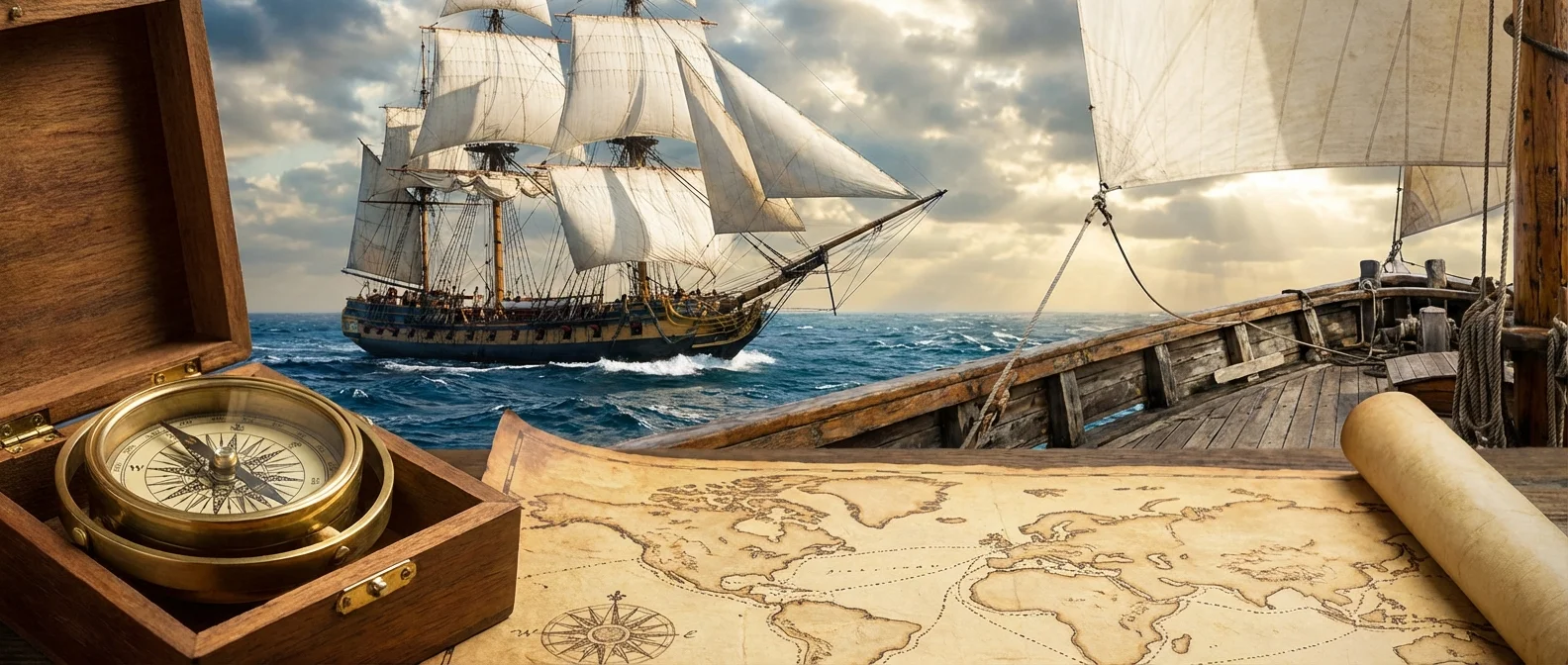
The Age of Exploration — when the oceans opened
The compass, the astrolabe, and progressively better ships — carracks, caravels, galleons — opened the oceans. Columbus in 1492. Vasco da Gama in 1498. Magellan, the first circumnavigation of the world, 1519-1522. Navigation technology was not just an invention — it was geopolitical power. Portugal, a small country, became an empire thanks to its ships.
Of course, the age of exploration also had a dark side. Technological superiority allowed Europeans to colonize continents. Firearms, steel armor and ocean-going ships were not just tools of exploration — they were tools of conquest. The Aztec and Inca civilizations collapsed, destroyed more by diseases brought by the Europeans than by their weapons. Smallpox killed more people in the Americas than any battle. The history of technology is not always heroic.
🔬 The Scientific Revolution
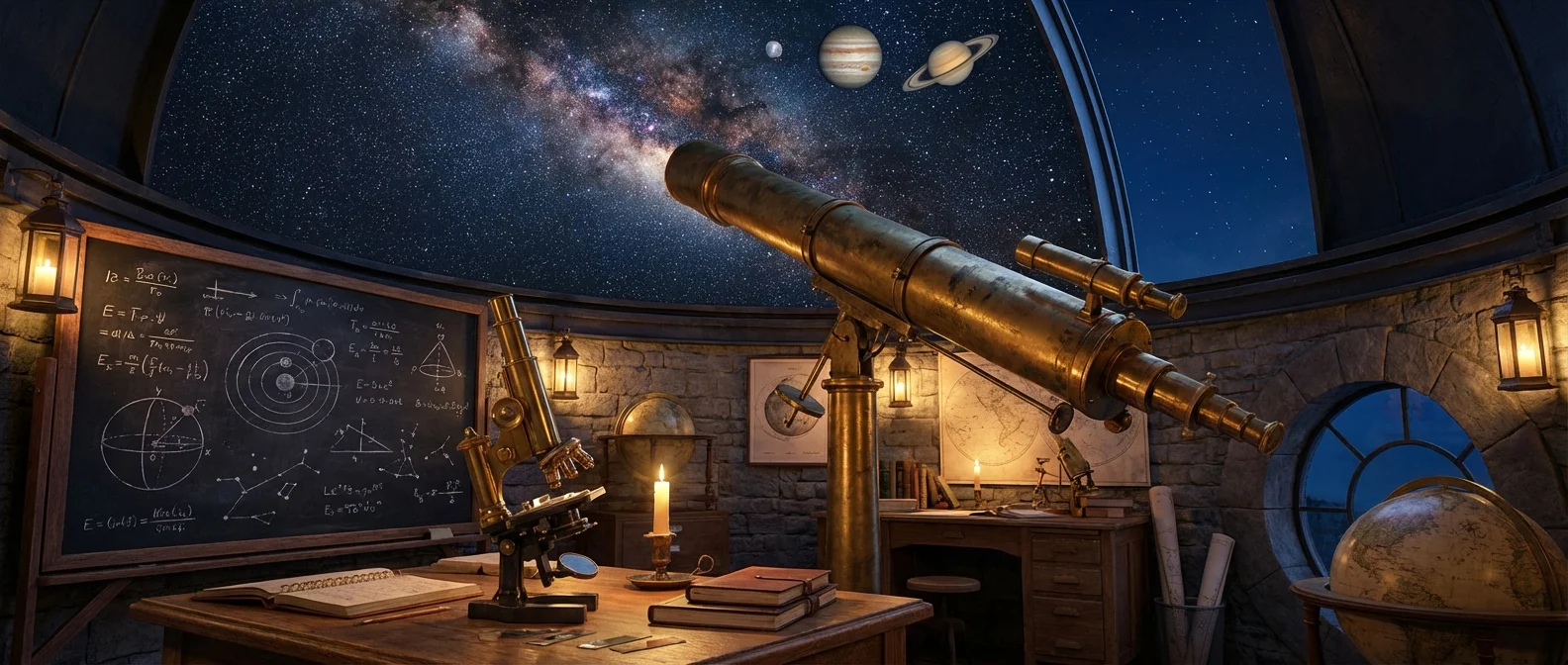
The Scientific Revolution — telescopes, microscopes and the scientific method
In the 16th and 17th centuries, technology and science became allies. Galileo built a telescope in 1609 and looked at Jupiter. He saw its moons and realized that not everything revolves around the Earth. Kepler calculated the elliptical orbits of the planets. Newton published the Principia Mathematica in 1687 and explained gravity with mathematics so elegant they still hold today. Leeuwenhoek built microscopes with a single lens and discovered bacteria, protozoa, spermatozoa — an entire invisible world.
But the most important invention was not any tool. It was the method: observation, hypothesis, experiment, proof. Francis Bacon formalized the inductive method. Descartes established rationalism. For the first time, knowledge was not based on the authority of ancient texts, but on what could be proven experimentally. The scientific method was the greatest technology of thought ever created, because it produced knowledge that was self-correcting.
🏭 The Industrial Revolution
1760 — 1900
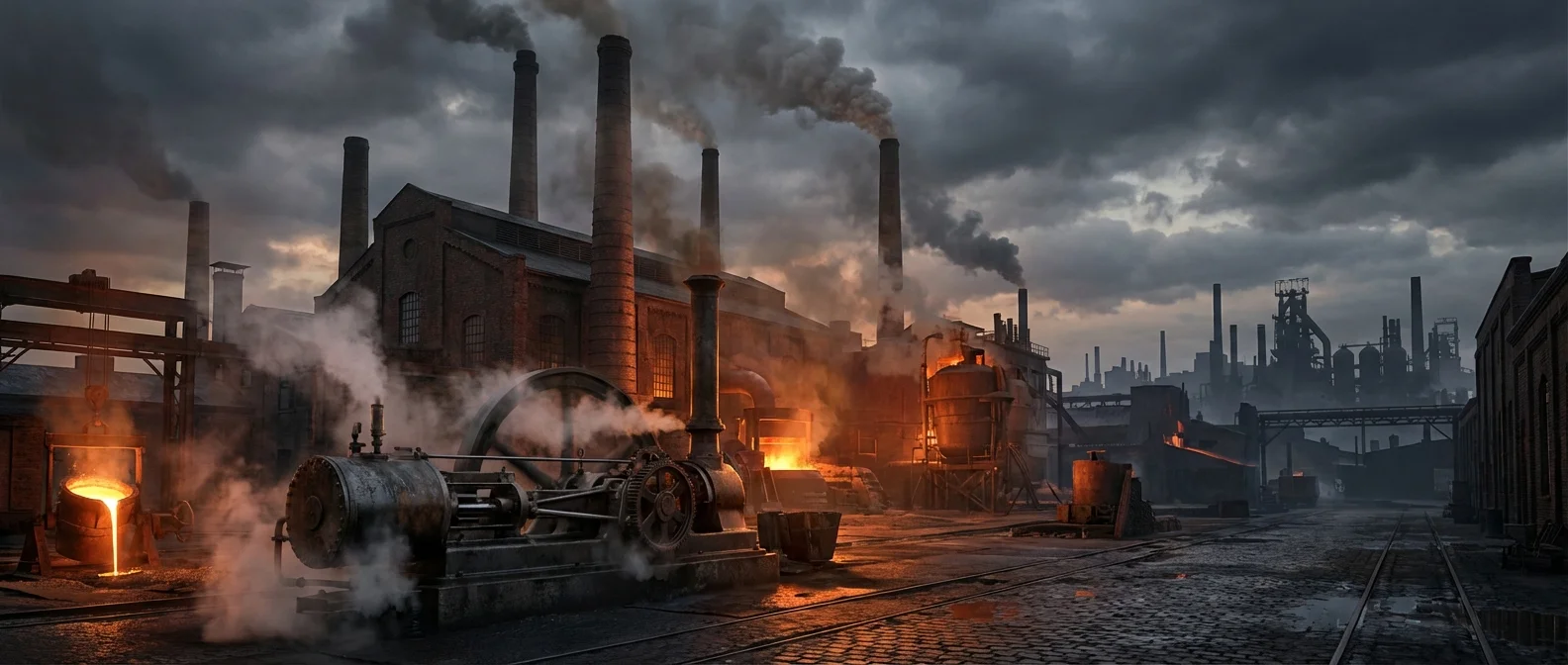
The Industrial Revolution — when machines replaced hands
💨 The steam engine changes everything
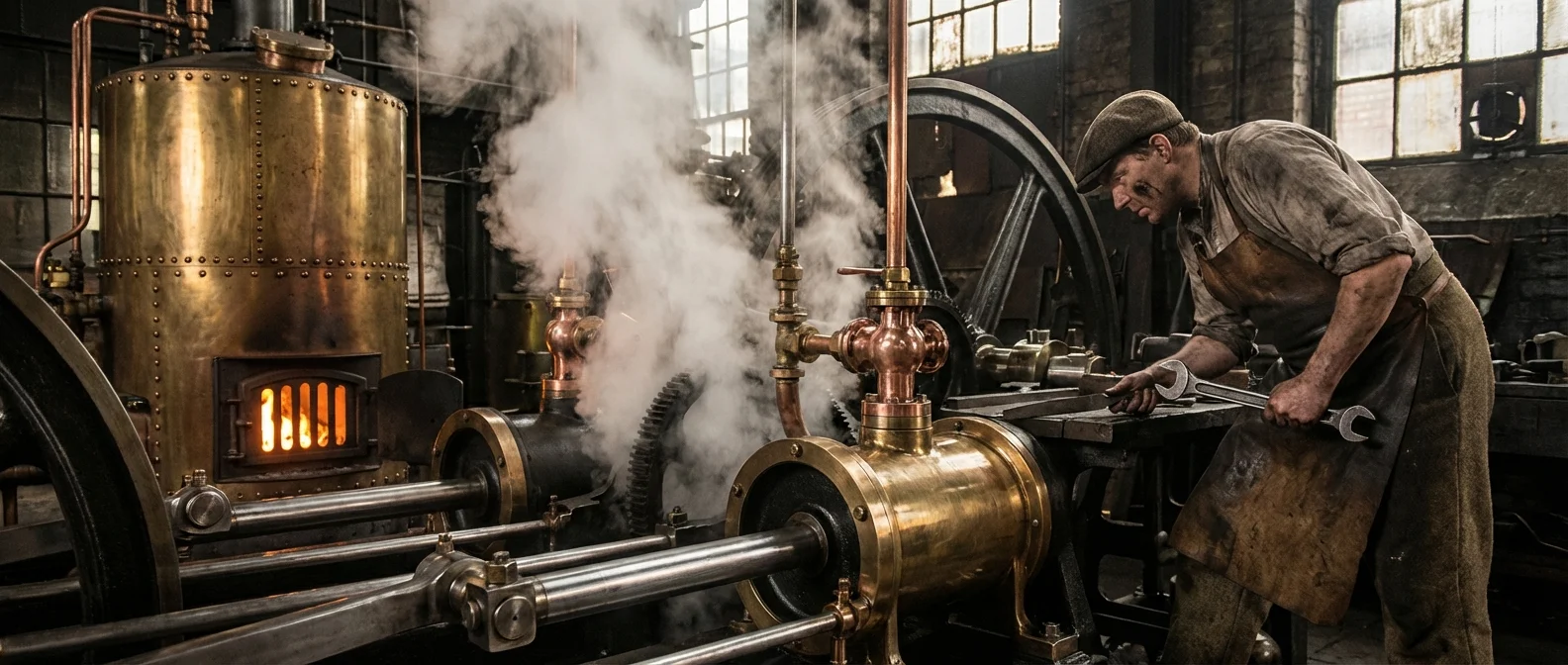
The steam engine — the machine that changed the world
In 1712, Thomas Newcomen built the first practical steam engine for draining water from mines. It was slow, inefficient, but it worked. In 1769, James Watt improved it dramatically by adding a separate condenser. The Watt steam engine wasn't just a bit better — it was four times more efficient. Suddenly, machines could do the work of humans, animals, wind, and water.
📊 Before vs. After the Industrial Revolution
England started first, thanks to coal, iron, colonies, a stable political system, rivers, ports, and a “tinkerer” culture — practical engineers who experimented. James Hargreaves' spinning jenny (1764) multiplied yarn spinning. Samuel Crompton's mule (1779) improved it further. The cotton mills of Manchester transformed a rural town into a global industrial center.
🚂 Railway, steamship, telegraph
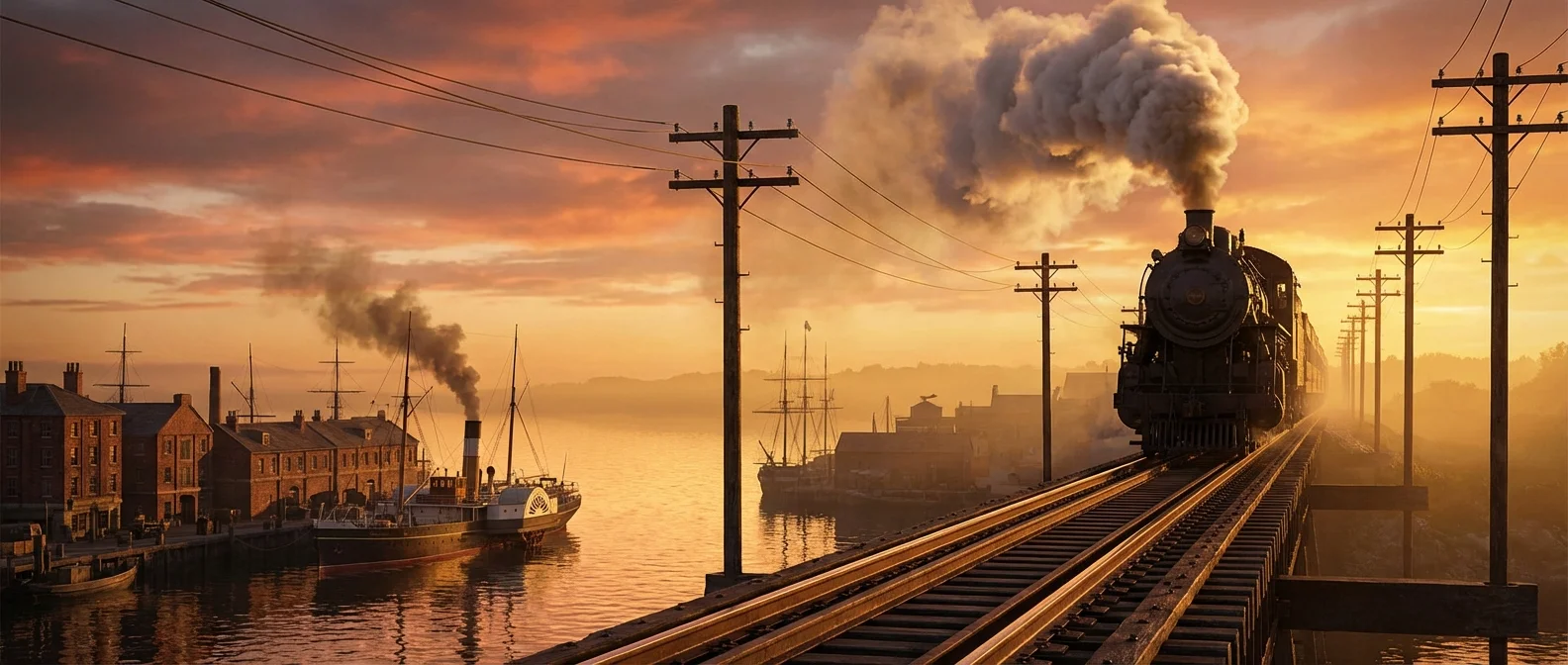
Railway, steamship and telegraph — distance shrank
In 1825, George Stephenson built the first passenger railway, Stockton to Darlington. In 1830, the Liverpool-Manchester line opened, and England was never the same again. The railway didn't just carry goods — it carried people, ideas, mail, newspapers. For the first time, distance shrank.
Steamships transformed the Atlantic from a month-long obstacle into a week-long journey. The telegraph, invented by Samuel Morse in 1844, did something even more radical: information traveled faster than people. Before the telegraph, a message from London to New York took weeks. After the transatlantic cable of 1866, it took minutes.
💡 Electricity: the second industrial revolution
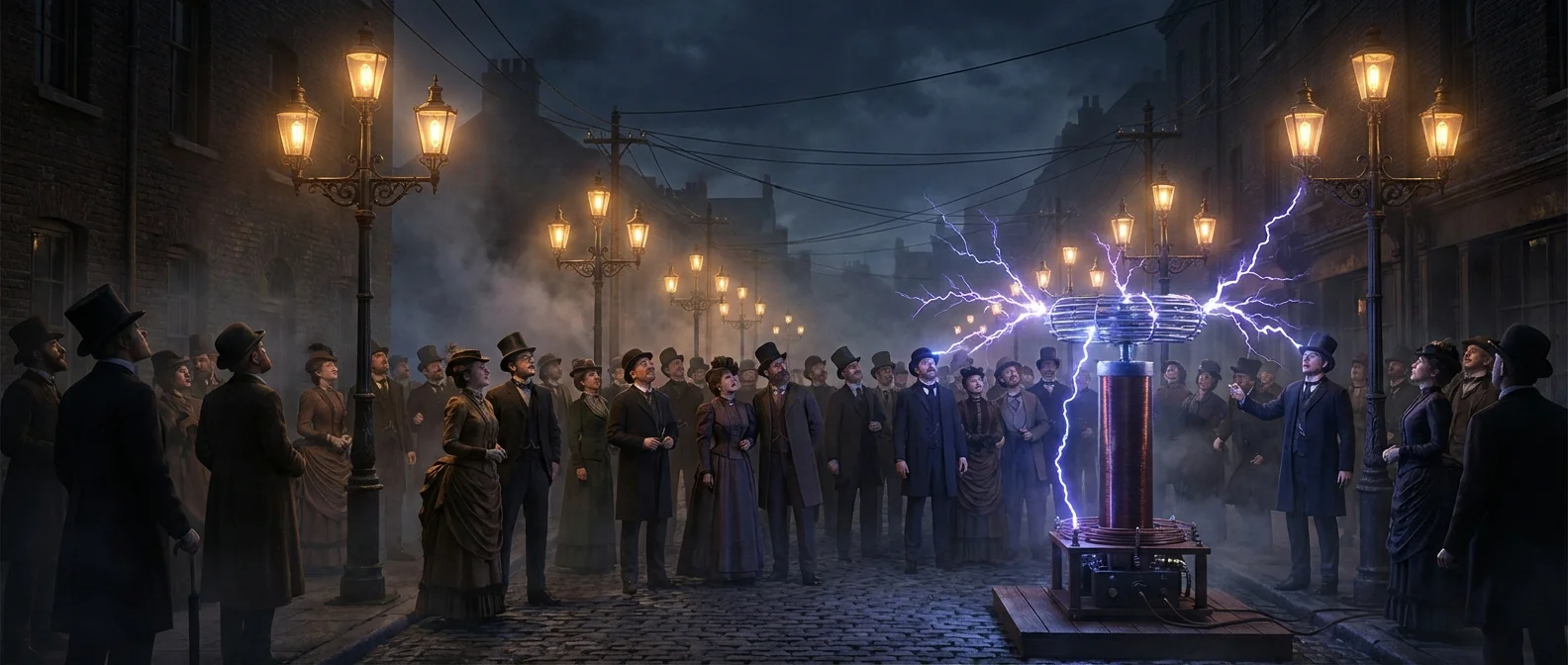
Electricity lights up the world — the second industrial revolution
Thomas Edison illuminated New York in 1882 with the first power station on Pearl Street. But the real hero was Nikola Tesla, who championed alternating current (AC) against Edison's direct current (DC). Tesla won, because AC could be transmitted over long distances. Without Tesla, every neighborhood would have needed its own power plant.
Electricity was not just a new source of energy. It gave birth to new industries: the telephone (Alexander Graham Bell, 1876), radio (Guglielmo Marconi, 1895), cinema (the Lumière brothers, 1895). By 1900, the pace of technological change was exponentially greater than in any previous era.
Medicine was also transformed. Louis Pasteur discovered that germs cause disease, overturning the “bad air” theory. Joseph Lister introduced antisepsis in surgery. Robert Koch identified the bacteria responsible for tuberculosis and cholera. Vaccines, starting with Edward Jenner's smallpox vaccine, evolved into mass vaccination programs. By the end of the 19th century, humanity was no longer helpless against disease. Medical technology was perhaps the most humane invention.
🏙️ Urbanization
The Industrial Revolution didn't just change factories — it transformed entire societies. In 1800, only 3% of the world's population lived in cities. By 1900, in England it was 77%. New cities sprang up around factories. New social problems emerged: poverty, child labor, pollution. But also new ideas: workers' rights, public education, democracy. Technology doesn't just change tools — it changes societies.
🚀 The 20th century — The century that exploded
1900 — 2000
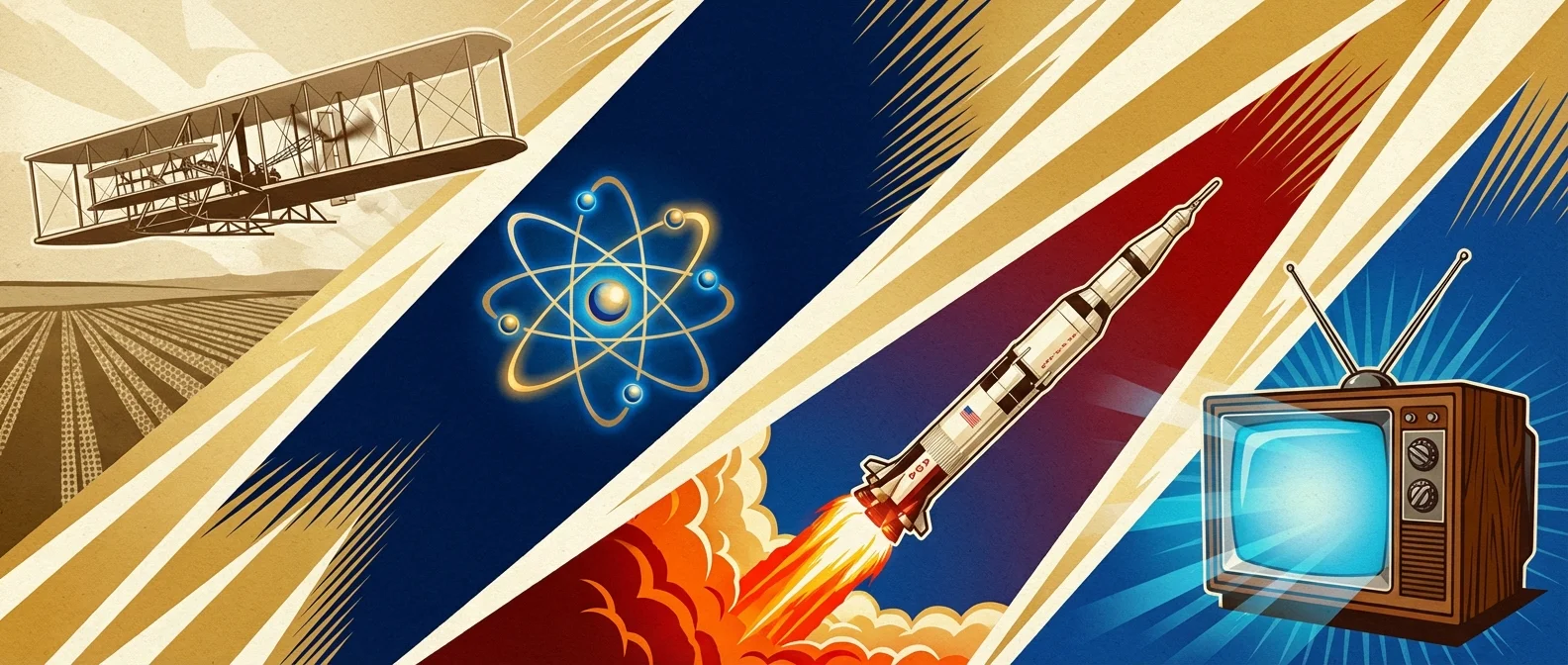
The century that exploded — from the car to outer space
✈️ 1900-1945: Cars, airplanes, nuclear weapons
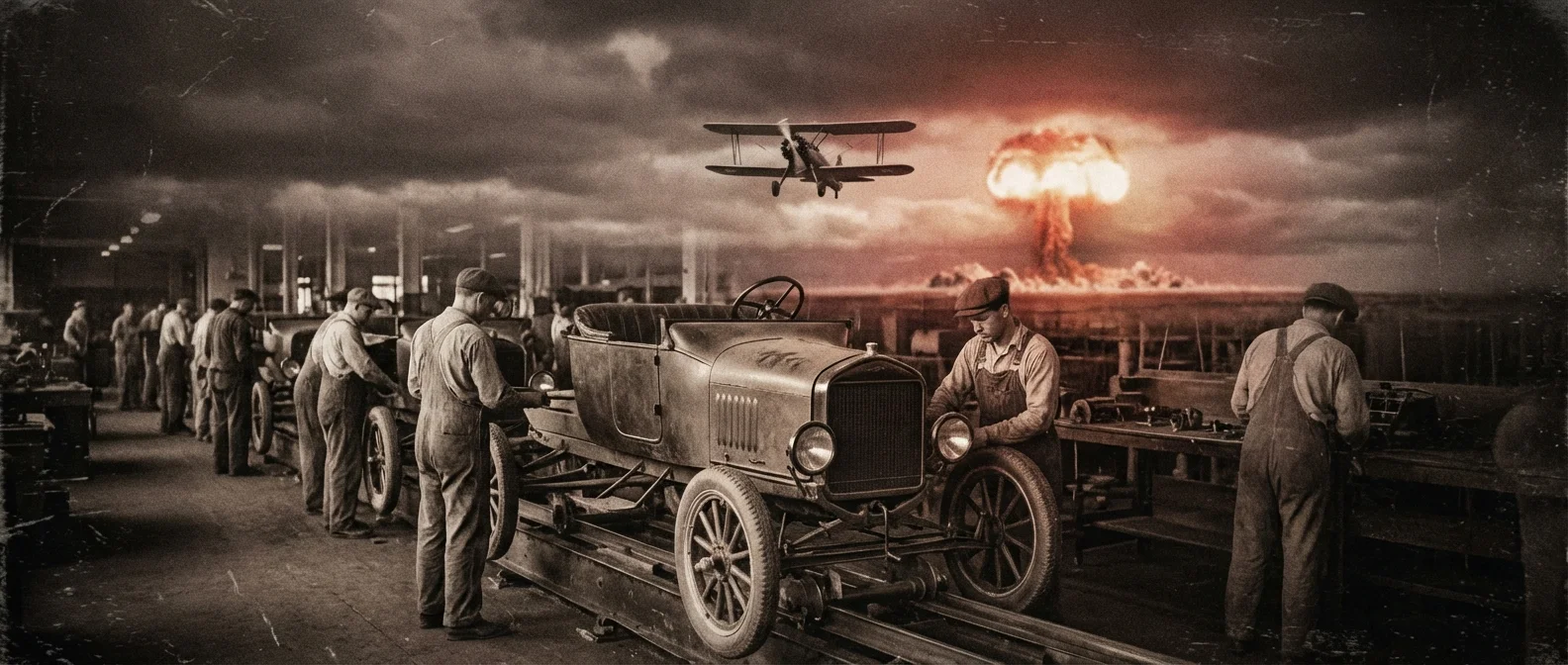
Cars, airplanes and the war of technology
Henry Ford didn't invent the car — that was Karl Benz, in 1886. But Ford invented the assembly line, in 1913. A Model T used to take 12 hours to build. After the assembly line, 93 minutes. The price dropped from $850 to $260. The car went from luxury to everyday transport.
The assembly line was not just a factory invention. It was a philosophical shift: standardization, repeatability, efficiency. Frederick Winslow Taylor published “Scientific Management” in 1911, studying every movement of a worker with a stopwatch. This logic — production as a machine — would dominate the entire 20th century. Today, the same logic applies to software, logistics, and even content creation.
The Wright brothers flew for 12 seconds at Kitty Hawk, North Carolina, on December 17, 1903. Sixty-six years later, Neil Armstrong was walking on the Moon. The speed of aviation's evolution is perhaps the most impressive technological sprint in history. To put it in perspective: if the wheel had evolved at the same pace, we would have reached Formula 1 within two generations.
First flight by the Wright brothers
12 seconds, 37 meters. Nobody considered it important.
Lindbergh: first transatlantic flight
New York — Paris, 33.5 hours, alone, without radio.
First jet aircraft
Heinkel He 178, Germany. The technology of war accelerated everything.
Breaking the sound barrier
Chuck Yeager in the Bell X-1. Mach 1.06, 1,127 km/h.
Apollo 11: Man on the Moon
Neil Armstrong, Buzz Aldrin. A 384,400 km journey in 4 days.
World War II was also a technological war: radar, penicillin, V-2 rockets, cryptography (Alan Turing and the Enigma machine), and of course the atomic bomb. On August 6, 1945, Little Boy was dropped on Hiroshima. For the first time in history, technology could obliterate an entire city in seconds.
Alan Turing deserves special mention. The Bombe machine, which cracked the Enigma code at Bletchley Park, is estimated to have shortened the war by two years, saving millions of lives. But Turing also left a theoretical legacy: as early as 1936, he had described the “Turing Machine,” a theoretical model that laid the foundation for all of computer science. Every computer we use today is based on the principles Turing outlined in that pivotal paper. Tragically, Britain prosecuted him for his homosexuality, and he took his own life in 1954, at the age of 41.
Penicillin, discovered accidentally by Alexander Fleming in 1928 but mass-produced during the war, was the first antibiotic. Before it, an infected wound was often fatal. Afterward, infections that killed millions could be cured in days. Antibiotics were the most life-saving invention of the 20th century.
💻 1945-1970: Computers, space, television
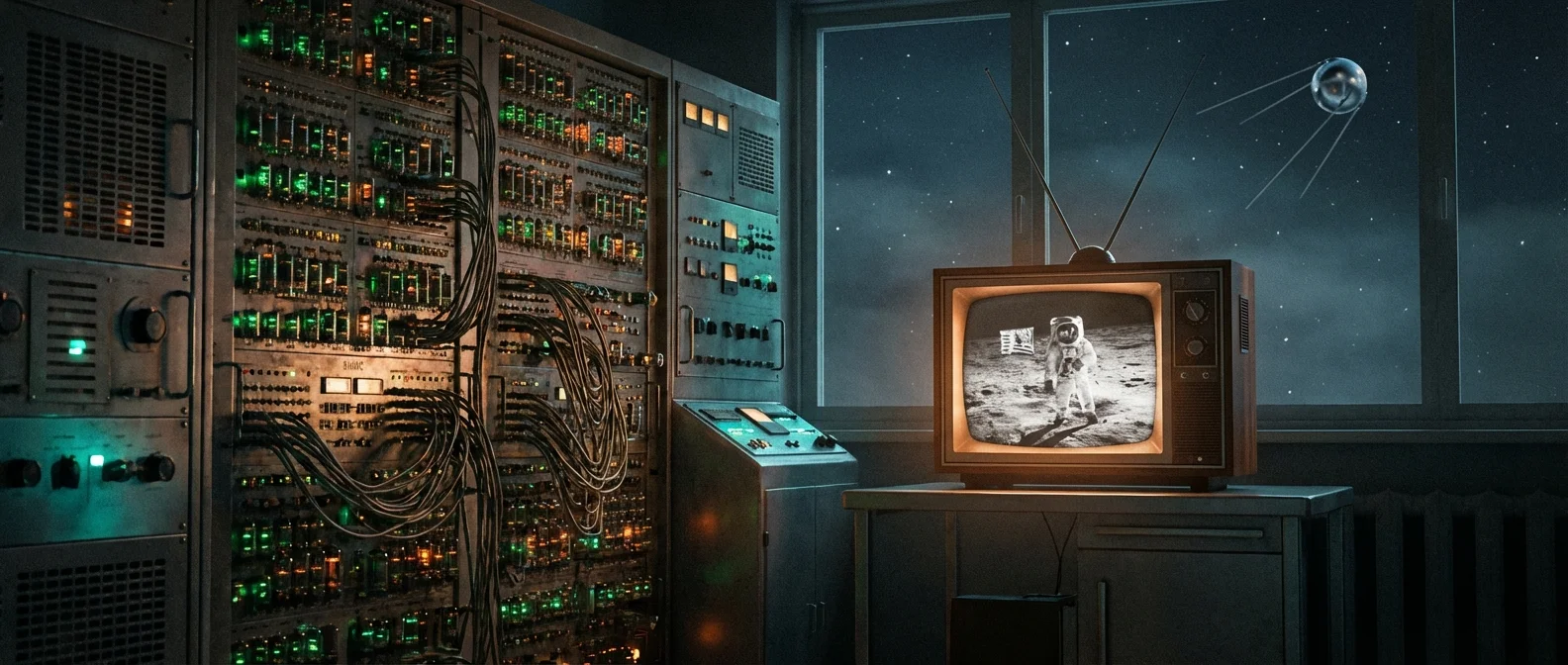
From ENIAC to Apollo 11 — computers and the space race
ENIAC, built in 1945, was the first general-purpose electronic computer. It weighed 27 tons, consumed 150 kilowatts, and used 18,000 vacuum tubes. It could perform 5,000 additions per second. Today, a smartphone performs trillions.
In 1947, Bardeen, Brattain, and Shockley at Bell Labs invented the transistor. Tiny, reliable, low-power. It replaced vacuum tubes and gave birth to modern electronics. Without the transistor, nothing we know today would exist.
If the auto industry had developed at the same pace as computers, a car today would cost one dollar and could travel 500,000 kilometers on a single liter of gasoline.
The Soviet Sputnik launched on October 4, 1957. A mechanical satellite weighing 84 kilograms that beeped every 0.3 seconds. The Cold War became the Space Race. Yuri Gagarin flew into space on April 12, 1961. Kennedy pledged to reach the Moon before the decade was out. And he did — with just 60 seconds of fuel remaining during the Apollo 11 lunar landing.
🖥️ 1970-2000: Microprocessors, internet, mobile phones
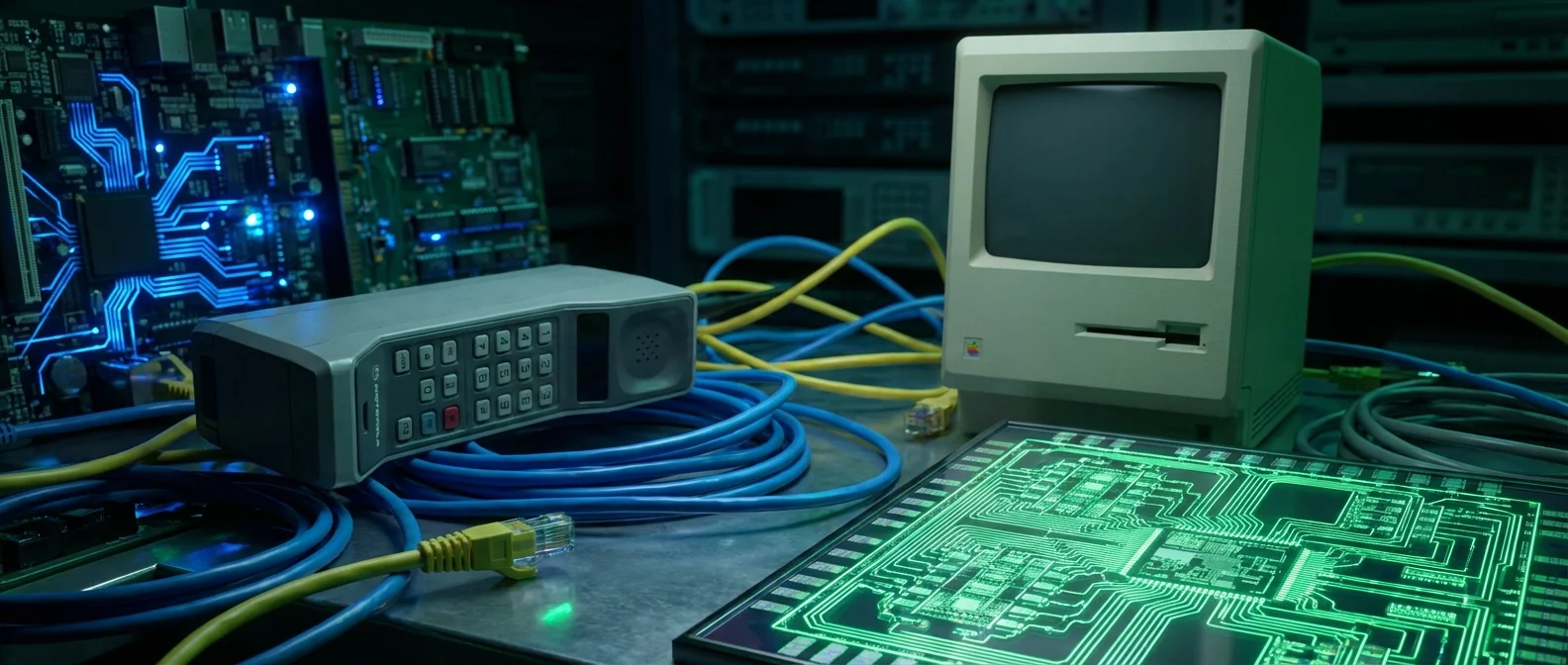
Microprocessors, internet and mobile phones — the digital revolution
In 1971, Intel released the 4004, the first commercial microprocessor. 2,300 transistors on a single chip. Today, Apple's M4 has 28 billion. Moore's Law — the observation that transistors per chip double every 2 years — held for nearly half a century, a remarkably steady exponential growth.
In 1975, the Altair 8800 launched the era of the personal computer. Bill Gates and Paul Allen wrote a BASIC interpreter for it, founding Microsoft. In 1976, Steve Wozniak and Steve Jobs built the Apple I in a garage. In 1981, IBM released the PC, running Microsoft DOS. By 2000, computers were everywhere.
📊 Evolution of computing power
In 1969, four computers at American universities were connected to each other — ARPANET. The first word was “LO,” because the computer crashed on LOGIN. Nobody at that moment imagined this would become the internet. In 1991, Tim Berners-Lee at CERN created the World Wide Web. He patented nothing — he gave it away for free. If Berners-Lee had patented the Web, he would probably be the richest person in history. Instead, he gave it to humanity. In 1993, one percent of the population used the internet. By 2000, 30 percent. Today, over 65 percent. Five billion people connected.
The internet's impact on knowledge was seismic. Wikipedia, launched in 2001, contains over 60 million articles in 300 languages — the largest encyclopedia in history, written for free by volunteers. Diderot needed 25 years to write the first encyclopedia. Wikipedia self-corrects in minutes. Knowledge went from a scarce commodity to atmosphere — you don't need to seek it, it surrounds you.
On April 3, 1973, Martin Cooper of Motorola made the first mobile phone call. The phone weighed 1.1 kilograms and had a 20-minute battery life. In 1999, the Nokia 3210 sold 160 million units. The world was now talking without wires.
Television, from another angle, transformed culture. The first commercial broadcast was in the 1930s, but television spread massively after the war. In the US in 1950, only 9% of households had a television. By 1960, it was 90%. Television was not just entertainment. It was a political tool: the Kennedy-Nixon debate in 1960, JFK's assassination broadcast live, the Moon landing, Vietnam. McLuhan called it the “global village.” Television made the world smaller decades before the internet.
📱 The 21st century — Our era
2000 — today

The 21st century — our era and the changes we're living through
📲 Smartphone: the world in your pocket
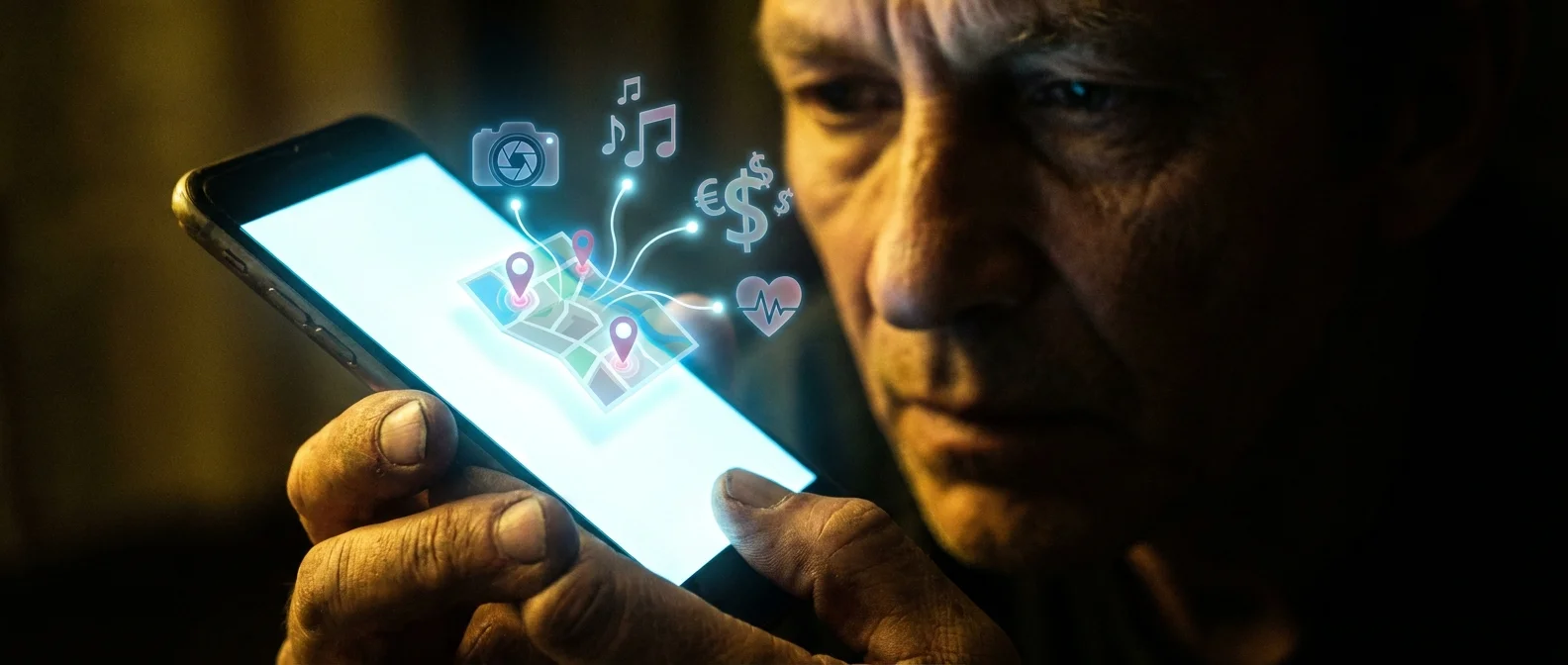
The smartphone — the entire world in 200 grams
On January 9, 2007, Steve Jobs walked onto the stage and said: “Apple is going to reinvent the phone.” An iPod, a phone, an internet device — one device. The iPhone wasn't the first smartphone, but it was the one that understood that interaction matters more than features. A touchscreen. No keyboard. Your fingers were the interface.
Today there are over 6.9 billion smartphone subscriptions worldwide. A modern smartphone has more computing power than the computer that sent humans to the Moon. And we're not just talking about phone calls: GPS, camera, music, news, banking, maps, flashlight, entertainment, education, health — all in 200 grams.
The smartphone's impact on developing countries was perhaps even more dramatic. In sub-Saharan Africa, millions of people who had never had a bank account gained access to financial services through mobile banking. M-Pesa in Kenya, launched in 2007, literally transformed a country's economy. Farmers in India check market prices before selling their crops. Students in remote villages around the world have access to Wikipedia and Khan Academy. Knowledge has never been more democratic.
🌐 Social Media, Cloud, and the digital age

Social networks, cloud and the digital age we live in
Facebook started in 2004 in a Harvard dorm room. Today, Meta has over 3 billion monthly active users. YouTube launched in 2005 and today over 500 hours of video are uploaded every minute. Twitter, later X, changed the way news is delivered.
Cloud computing allowed small companies to use infrastructure that once required millions. Amazon Web Services launched in 2006 and today hosts a large portion of the internet. Cryptocurrency and blockchain started with Satoshi Nakamoto's Bitcoin in 2009, promising a decentralized economy.
But social media also brought dark sides. Misinformation spreads faster than truth. An MIT study shows that false news travels on Twitter 6 times faster than true news. The addictiveness of platforms is designed deliberately: notifications, infinite scroll, likes — all calibrated to keep the user hooked. Mental health, especially among teenagers, has been affected. Technology is never just a solution — it always brings new problems.
🤖 Artificial Intelligence: the last invention?
Artificial Intelligence — the last invention?
The idea of artificial intelligence is not new. Alan Turing asked in 1950: “Can machines think?” John McCarthy coined the term “Artificial Intelligence” in 1956. But for decades, the results were disappointing — two “AI winters,” in the 1970s and 1990s, when funding dried up.
What changed? Big data — massive volumes of data. GPUs — graphics cards capable of parallel processing. And deep learning — neural networks with many layers. In 2012, a neural network dramatically won the ImageNet image recognition competition. From there, everything took off.
IBM Watson wins on Jeopardy!
AI beats humans in a natural language quiz show.
AlphaGo defeats Lee Sedol
DeepMind beat the world champion at Go, a game thought impossible for a machine.
GPT-3: language as AI
OpenAI released a model capable of writing text of near-human quality.
ChatGPT: AI for the masses
100 million users in 2 months. The fastest app growth in history.
Agentic AI and multimodal models
AI that sees, hears, writes, codes, decides. From tool to autonomous agent.
Artificial intelligence is already changing everything: medicine (cancer diagnosis, drug discovery), science (predicting protein structures with AlphaFold), creativity (images, music, video), education, work. The question is not whether AI will change the world — it's how fast.
AlphaFold deserves special mention. Predicting the three-dimensional structure of proteins was a problem biology couldn't solve for 50 years. X-ray crystallography took months or years for a single protein. AlphaFold predicted the structure of nearly all known proteins — over 200 million — in months. This is not just acceleration. It's a paradigm shift. Drugs that would have taken decades to design are now being developed in months. Biology is becoming computational science.
At the same time, AI raises serious ethical questions. Facial recognition can be used for security or for mass surveillance. Deepfakes can create fake videos so realistic that truth becomes indistinguishable. Autonomous weapons pose questions humanity has never faced before: should a machine decide who lives and who dies? Every technological era brings its own dilemmas, but the dilemmas of AI run deeper than ever.
🌱 Energy and climate: the most urgent technology
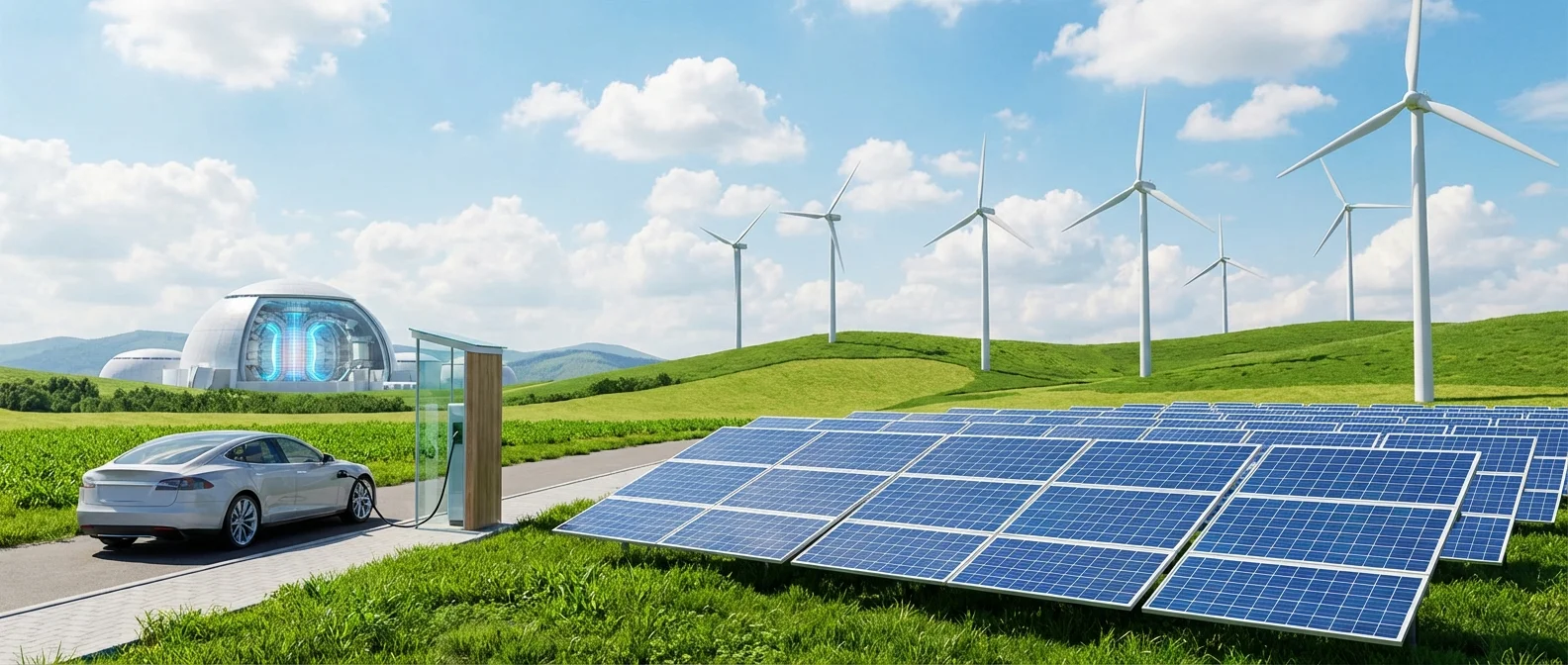
Energy and climate — the most urgent technological challenge
Climate change has made energy technology a matter of survival. Solar panels, which cost $77 per watt in 1977, now cost less than $0.20. The price of lithium-ion batteries dropped 97% between 1991 and 2024. Electric vehicles went from a niche curiosity to a dominant trend, with 14 million sold in 2023. Nuclear fusion, the holy grail of energy, is making gradual progress, with Lawrence Livermore's NIF achieving net energy gain in December 2022.
The energy transition is perhaps the greatest technological challenge in history. Our entire industrial base was built on fossil fuels. Changing it in a single generation, without economic collapse, requires simultaneous technological innovation, political will, and social change. But history shows that humanity rises to the occasion when pressured enough. World War II produced penicillin, radar, atomic energy, and computers — all in 6 years. The climate crisis may be the pressure that technology needs.
🔮 What's next?
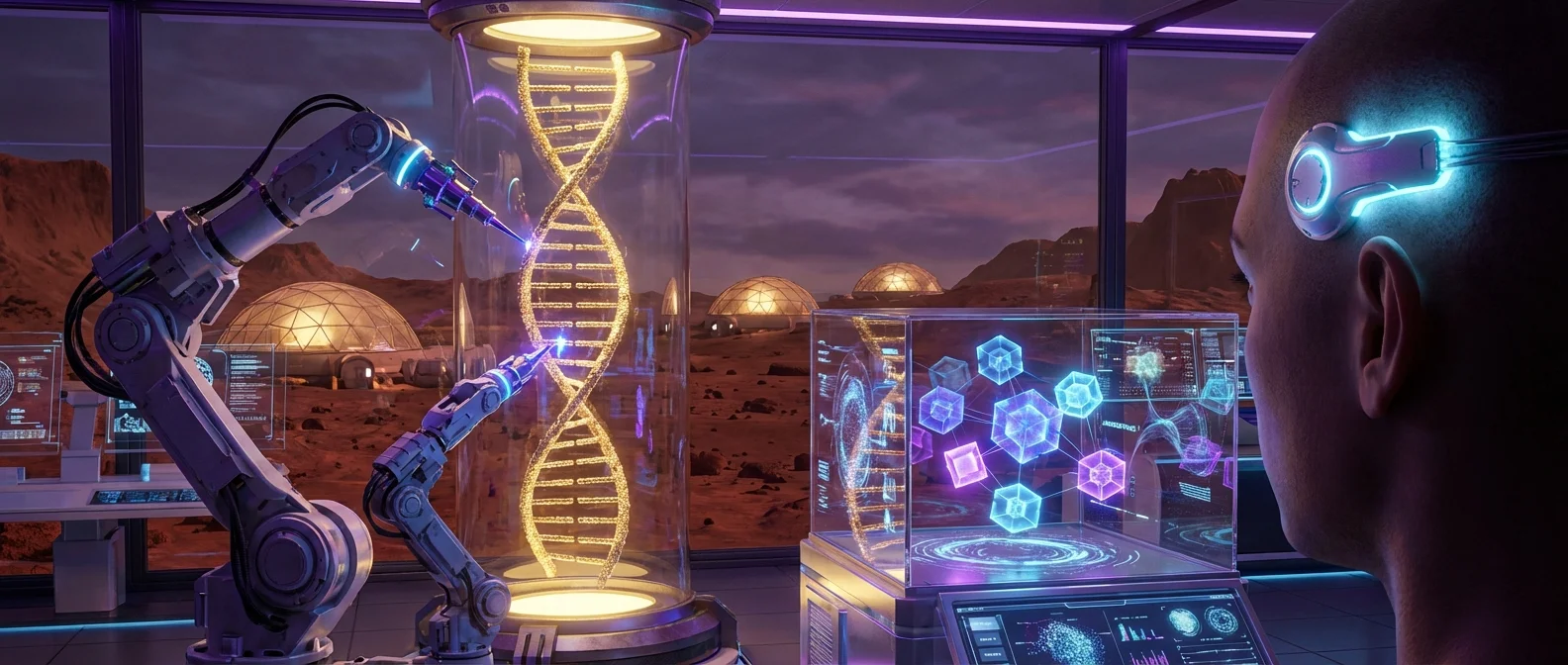
What's next — biotechnology, quantum computers and space
🧬 Biotechnology
CRISPR gene editing, synthetic biology, personalized medicine. The ability to edit our DNA is changing the very definition of “human.”
⚛️ Quantum computers
Google, IBM, and China are competing for “quantum supremacy.” Computers that can solve in minutes problems that would take thousands of years.
🧠 Brain-Computer Interfaces
Elon Musk's Neuralink implanted a chip in a human brain in January 2024. The idea: thought that becomes a command to a device.
🚀 Space colonization
SpaceX is targeting Mars. NASA's Artemis program aims for the Moon. Satellite internet (Starlink) is already transforming rural areas.
📜 What history tells us
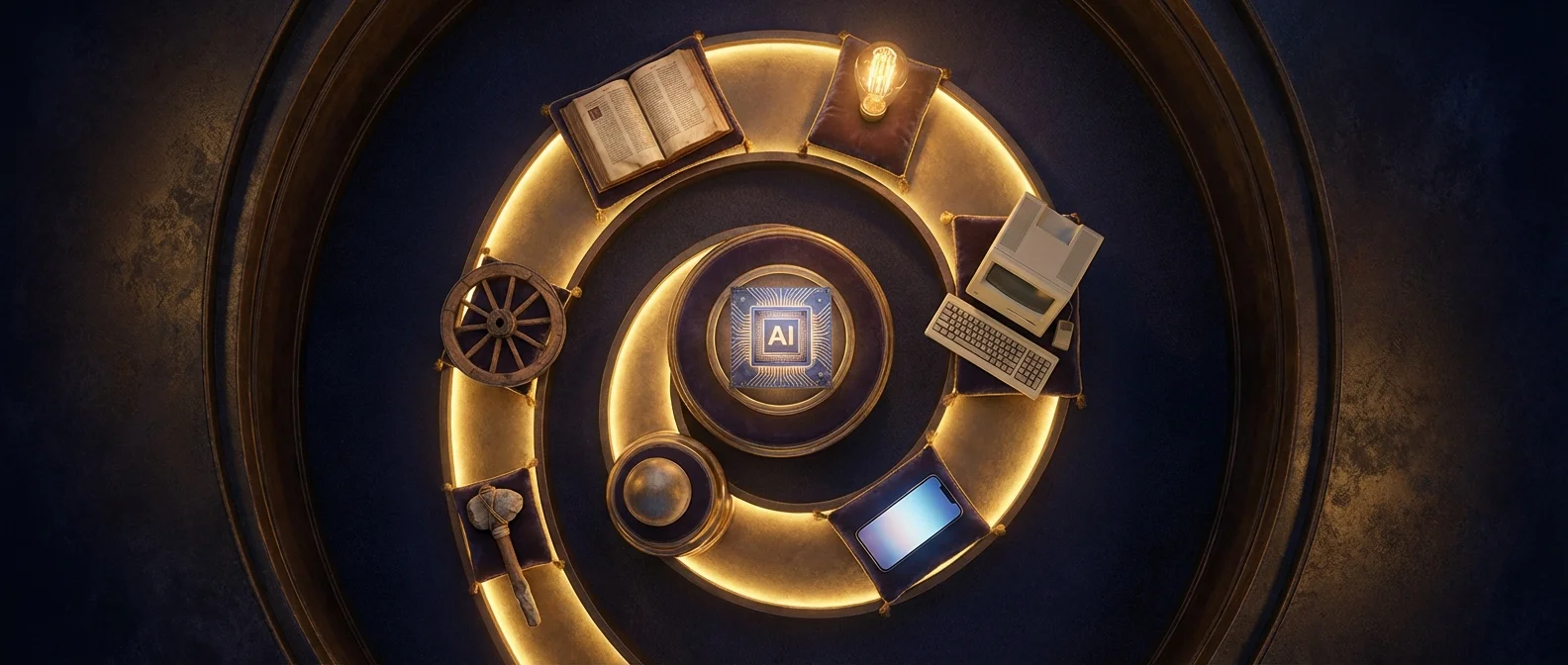
What history tells us — the patterns that keep repeating
Looking at this timeline, certain patterns are consistent:
- The pace increases exponentially. It took 200,000 years for agriculture, 5,000 for the wheel, 500 for printing, 100 for electricity, 50 for the computer, 15 for the smartphone, 2 for ChatGPT.
- Every technology creates fear. Socrates feared writing. Monks feared the printing press. Workers feared machines. Parents feared the internet. We fear AI.
- Technology is neutral. Gunpowder becomes a firework or a bomb. Nuclear energy becomes electricity or destruction. AI becomes a doctor or a surveillance tool.
- The leaders change. The technology leader was Mesopotamia, then Egypt, then Greece, Rome, the Islamic world, China, Europe, America. Nobody held the lead forever.
We shape our tools, and thereafter our tools shape us.
From a struck stone to a neural network, technology is not something we have — it is something we are. Every tool we made, remade us. Fire gave us brains. Agriculture gave us civilization. The printing press gave us democracy. The internet gave us everything, and with it, new questions. What will AI give us? That is still being written.
If one thing is certain, it is this: the pace will not slow down. The time between each great invention is relentlessly compressing. The next technological revolution may already be here — we just haven't recognized it yet. Just as Gutenberg couldn't have imagined Twitter, and Turing couldn't have imagined ChatGPT, we cannot imagine what we will build. But we will build it. That's what we do. That's what we've always done. Technology is the oldest human story — and it never ends.