📖 Read more: The History of Photography: When Time Learned to Freeze
Before social media: the first online communities
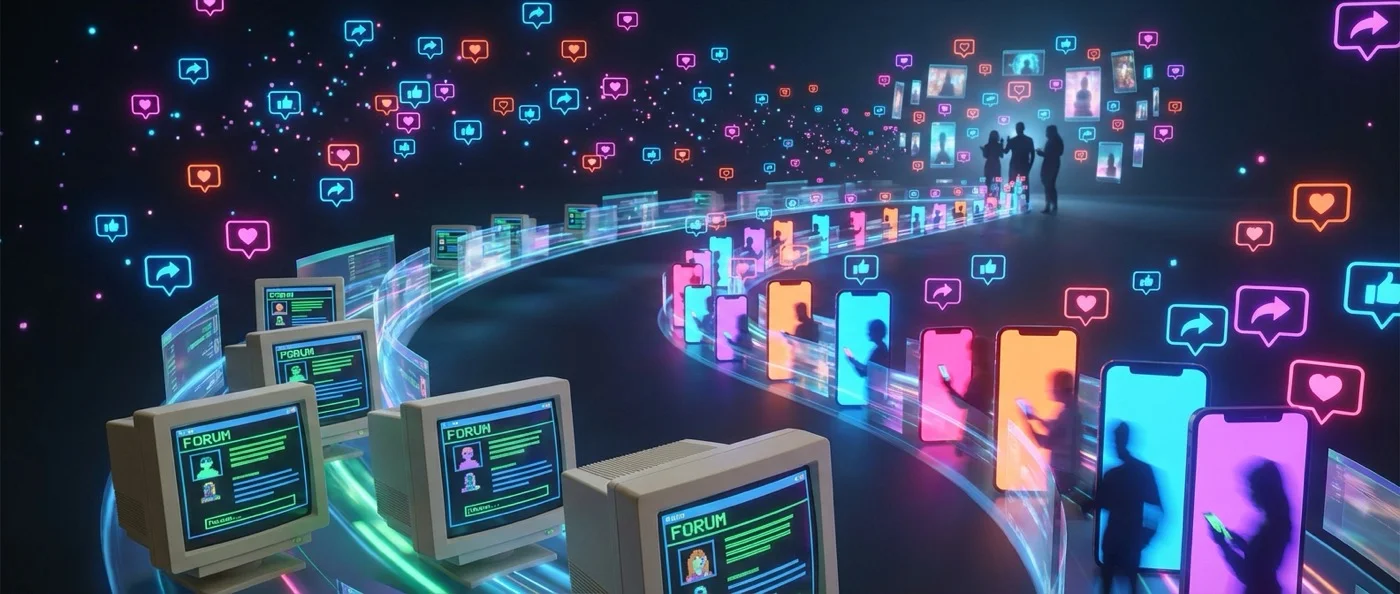
The need to “share” didn't start with Facebook. It existed from the earliest days of the Internet — and even before that, long before computers existed.
In 1978, two computer hobbyists in Chicago — Ward Christensen and Randy Suess — created CBBS (Computerized Bulletin Board System), the first electronic bulletin board. Users dialed in via modem, wrote messages, and others read them later. An asynchronous conversation — like a forum, but before the word even existed.
Usenet: the first “social media”
Usenet — a distributed system of “newsgroups” — was essentially Reddit 20 years before Reddit. Discussion groups: comp.sys.ibm.pc, rec.arts.movies, alt.fan.bill-gates. This is where flame wars, FAQs, and even the term “spam” (from a Monty Python sketch) were born.
The WELL: the first “community”
It had only 8,000 members, but among them were the future founders of Wired, EFF, and Craigslist. Stewart Brand, the founder: “They invented Internet culture before the Internet existed.”
IRC: real-time chat
Finnish programmer Jarkko Oikarinen created IRC (Internet Relay Chat). For the first time, synchronous communication via the Internet — “channels” with themed discussions. It was even used during the Soviet-Polish crisis to broadcast news amidst censorship.
GeoCities: “build your own corner”
GeoCities was a city on the Internet — divided into “neighborhoods” (Hollywood, SiliconValley, WestHollywood). Each user freely hosted their own page: GIFs, “under construction” signs, midi music, visitor counters. Chaotic, authentic, human.
1997–2003: the first generation of social networks
The term “social network” first appeared in academia, coined by British anthropologist John Barnes in 1954. But on the Internet, the story began later.
SixDegrees.com: the first “social network”
Based on the “Six Degrees of Separation” theory — anyone is connected to anyone else through 6 degrees of acquaintance. User profiles, friend lists, messages. 3.5 million sign-ups. It shut down in 2001 — too early for its time.
Blogger & LiveJournal
The emergence of blogs. Evan Williams (later co-founder of Twitter) created Blogger. The idea: anyone can be a publisher. The “democratization” of content began — but so did the collapse of traditional media.
Friendster
3 million users in 3 months. But the servers couldn't handle it — each page took 20–40 seconds to load. The technology wasn't ready for the demand. A classic case of “right idea, wrong time.”
MySpace: the “golden era”
MySpace was chaotic, full of glitter GIFs, auto-play music, and hand-coded HTML. But it was authentic. Bands uploaded songs; the Arctic Monkeys, Lily Allen, and Adele got their start there. 100 million users at its peak (2008).
"Social networking wasn't invented in Silicon Valley. It was invented when the first human sat beside a fire and told a story."
📖 Read more: The Story of 'Free': Why Nothing Is Truly Free
Facebook: the king
On February 4, 2004, Mark Zuckerberg launched “The Facebook” — exclusively for Harvard students. Within 24 hours, 1,200 students signed up. Within a month, half the undergraduates. Within a year, every Ivy League university.
What set Facebook apart? Authentic identity. Unlike MySpace, IRC, or forums — where pseudonyms were the norm — Facebook required a real name. Danah Boyd (Microsoft Research) observed: what made Facebook different was that it reflected existing social relationships rather than creating new ones.
News Feed: your “home page”
When Facebook introduced the News Feed — a stream of updates from your friends — the reaction was mass protests. “Creepy!” users shouted. 10% created protest groups. Within a few weeks, nobody remembered what it was like without it.
Facebook Platform & Like Button (2009)
The third-party app platform (FarmVille, Mafia Wars) skyrocketed user numbers. The “Like” button (2009) — designed in a single day — became the symbol of an entire era. Originally, the idea was for “Awesome” instead of “Like.”
Facebook IPO: $104B
The largest tech company IPO at the time. 1 billion users. But internal emails later revealed that management already knew the platform was creating addiction, especially among teenagers.
Twitter, YouTube, Instagram: the fragmentation
🐦 Twitter (2006)
140 characters. Jack Dorsey wanted “SMS for the Internet.” First tweet (Dorsey): “just setting up my twttr.” Twitter was never commercially successful — but it shaped public discourse: the Arab Spring (2011), Black Lives Matter (2013), Trump (2016–2021). Elon Musk bought Twitter for $44B (2022) and renamed it X — losing a brand worth decades.
📹 YouTube (2005)
Three former PayPal employees (Hurley, Chen, Karim) created YouTube. First video: “Me at the zoo” (18 sec., Jawed Karim in front of elephants). Google bought YouTube for $1.65B (2006) — expecting a loss. Today it's worth ~$200+B. Every minute, 500 hours of video are uploaded.
📸 Instagram (2010)
25,000 downloads on day one. The idea: photos + filters + sharing. Kevin Systrom wanted “Hipstamatic (filters) + Foursquare (social).” Facebook bought it for $1B (2012) — “crazy” then, the best acquisition ever today. Over 2 billion users (2024).
📌 Snapchat (2011)
The first platform with disappearing content — “Stories” that vanish in 24 hours. Evan Spiegel rejected a $3B offer from Zuckerberg (2013). Zuckerberg copied Stories to Instagram, Facebook, and WhatsApp — within months.
The algorithm: from chronological to “engagement”
The most important — and most invisible — change in social media was the shift from chronological feeds to algorithmic ones. Initially, your feed showed posts in the order they were published. Then, algorithms decided what was “worth” seeing — based on engagement (likes, comments, shares, time spent).
⚡ Why the algorithm prefers anger
A 2021 study (Yale/NYU) proved that posts expressing moral outrage receive 20% more shares per word. The algorithm doesn't “choose” anger deliberately — but it maximizes engagement, and anger creates engagement. Internal Facebook research (2018, leaked by Frances Haugen) revealed: if the algorithm were removed, political polarization would decrease by over 25%.
📖 Read more: Bhopal Tragedy: The Worst Industrial Disaster
TikTok: the Chinese revolution
In September 2016, Chinese company ByteDance launched Douyin in China (and as TikTok for the rest of the world in 2017). No social network had ever reached 1 billion users so quickly: 4 years (Facebook took 8).
The critical innovation? The “For You Page” algorithm. Unlike Facebook/Instagram, where the feed is based on who you follow, TikTok feeds you based on what you watch. You don't need to follow anyone — the algorithm “learns” your interests within 40 minutes of use.
📊 Time to 1 billion users
The dark side: addiction, mental health, misinformation
In September 2021, former Facebook employee Frances Haugen leaked thousands of internal documents to the Wall Street Journal — the “Facebook Papers.” The most shocking revelation: Facebook's own internal research showed that Instagram “makes body image issues worse for 1 in 3 teenage girls.”
🧠 Dopamine & addictive design
Aza Raskin (Mozilla's head of design) invented infinite scroll (2006) — and later publicly apologized. Along with notifications, streaks (Snapchat), auto-play videos, and “pull-to-refresh” — every element was designed to keep you there.
📉 Teen mental health
After 2012 (smartphone proliferation), rates of depression and self-harm among girls aged 10–14 increased by 151% in the US. Psychologist Jonathan Haidt published “The Anxious Generation” (2024), attributing a central role to social media.
🗞️ Misinformation
MIT study (2018): fake news spreads 6 times faster than real news on Twitter. The Russian Internet Research Agency created 80,000+ posts that reached 126 million Americans before the 2016 elections.
🔁 Filter bubbles
Eli Pariser (2011) described “filter bubbles” — algorithmically constructed worlds where you only see what you already believe. Two people googling “climate change” see completely different results.
"If you're not paying for the product, you're not the customer. You're what's being sold."
Is there hope?
The story doesn't end in despair. New movements, laws, and platforms are challenging the status quo.
The EU's Digital Services Act (2024) requires large platforms to be transparent about their algorithms. Countries are banning TikTok on government devices. Australia is considering a social media ban for anyone under 16. New platforms — Mastodon (decentralized), BlueSky (open protocol) — are experimenting with models free from algorithmic manipulation.
Social media weren't “bad” from the start. GeoCities, the early forums, even the original Facebook — were spaces for authentic connection. The destruction began when connection was replaced by engagement, and the purpose shifted from “sharing something” to “making someone scroll even more.”
If we can design technology that exploits our weaknesses, we can also design technology that respects our needs. The question is whether we will choose to.