📖 Read more: Deaf Beethoven: Masterpieces Without Sound
The silence before the machine
For thousands of years, music was live or nothing. If you wanted to hear a Mozart sonata, you had two options: go to a concert hall (if you were wealthy), or learn it yourself on the piano. Musical education was social status: in Victorian England, a “lady” had to play piano.
Even the greatest composers couldn't listen to their own works again. Beethoven, deaf in his final years, never truly heard his last symphonies. The musical score was the only way to “store” music — but a score is a recipe, not the meal.
"Music was always an art of the present moment. Recording transformed it into an art of the past — and that is both wondrous and tragic."
Edison vs Berliner: the talking machine
Thomas Edison: the phonograph
Edison shouted “Mary had a little lamb” into a sheet of tin foil wrapped around a cylinder. The needle etched the sound. When he turned the cylinder back, the sound was reproduced. Edison himself was shocked: “I didn't expect it to work.”
Emile Berliner: the disc
German-American Berliner invented the flat disc (gramophone record) — instead of a cylinder. Huge advantage: discs could be mass-copied (pressing), while each cylinder was unique. The disc beat the cylinder — and the mass music industry was born.
Victor Talking Machine & Caruso
Enrico Caruso — the most famous tenor in the world — recorded 10 songs for Victor. He sold 1 million copies. For the first time, a musician could “travel” without leaving home.
Victrola: music in the living room
Victor released the Victrola — a gramophone “hidden” inside an elegant wooden cabinet. Music was no longer a curiosity — it was home décor. Cost: $15–$200 (equivalent to $500–$6,000 today).
🎵 The fear of “mechanical sound”
John Philip Sousa — the “March King” — warned (1906): "These machines will destroy musical development. Children will never learn to play on their own." The American Federation of Musicians fought gramophones with the slogan: “Canned Music on Trial.” The same fear repeats with every technological shift — radio, cassette, MP3, streaming.
📖 Read more: Why We Stopped Downloading and Started Streaming Everything
Radio: free music for everyone
On November 2, 1920, station KDKA in Pittsburgh broadcast the presidential election results — and the era of commercial radio began. Within a few years, music belonged to everyone.
The music industry panicked. “Why would anyone buy a record if they can listen to music for free on the radio?” Record sales dropped 90% between 1927 and 1932 (the Great Depression helped). But in the long run, radio actually increased sales — because people discovered new songs and wanted to buy them.
📻 The DJ becomes a star
Alan Freed — a radio host in Cleveland — played R&B music by Black artists to white audiences in the early 1950s. He coined the term “Rock 'n' Roll.” The disc jockey (DJ) became more important than the musicians — because he decided what got played.
🎶 Payola: paid airtime
Record labels secretly paid DJs to play songs — “payola.” Scandal of 1959: Alan Freed was convicted. 65 years later, the same practice continues — it's just called “playlist placement” on Spotify/Apple Music now.
Vinyl, cassette, CD: music becomes an object
LP: 33⅓ RPM — the revolution
Columbia Records released the Long Play record — 23 minutes per side instead of 3–4. Suddenly, musicians could think in long form — not just singles. Without the LP, there would be no “Sgt. Pepper's,” “Dark Side of the Moon,” or “Kind of Blue.”
Compact Cassette (Philips)
Philips introduced the small cassette — portable, durable, recordable. The music industry panicked: “Home Taping Is Killing Music!” But the cassette created new cultures: mixtapes (romantic, friendly, political), underground hip-hop, punk DIY labels.
Sony Walkman: music goes mobile
Akio Morita (Sony) wanted to listen to music on airplanes. The Walkman TPS-L2 launched at $200. It sold 400 million units. For the first time, music was personal: your own soundtrack in public space.
Compact Disc: digital clarity
Philips + Sony created the CD. First CD: Billy Joel's “52nd Street.” The industry loved the CD: digital, “perfect” sound, more expensive than vinyl. 200 billion CDs sold between 1983–2023. Peak: 2.5 billion CDs in 2000.
📖 Read more: 1918 Flu: The Pandemic That Killed 50 Million
📀 Listening cost per format
Napster: the 18-year-old who destroyed an industry
In June 1999, Shawn Fanning — an 18-year-old student at Northeastern University — released Napster. The idea was simple: peer-to-peer MP3 file sharing. You could download any song you wanted for free. Within 18 months, 80 million registered users.
The music industry exploded. The RIAA sued Napster, Metallica (Lars Ulrich testified before Congress), and eventually thousands of individual users — including a 12-year-old, Brianna LaHara, who paid a $2,000 fine. Napster shut down in July 2001.
"The music industry didn't collapse because people didn't want music. It collapsed because they didn't want to pay $18 for a CD with 2 good songs."
iPod + iTunes: Jobs saves music (?)
iPod: “1,000 songs in your pocket”
Steve Jobs unveiled the iPod. 5GB, click wheel, $399. It wasn't the first MP3 player — but it was the first one that actually worked properly. Combined with the iTunes Store, it sold 450 million iPods.
iTunes Music Store: $0.99 per song
Jobs convinced the 5 major labels to sell songs at $0.99. “One million songs sold in 6 days.” The idea: instead of fighting piracy, offer something better than free. Easy, fast, legal.
The age of shuffle
With thousands of songs on the iPod, the “shuffle” function — random playback — changed the way we listen. The concept of the album as a “unified work” weakened. Music was becoming a playlist, not a record.
📖 Read more: 6 Months in a Cave with No Clock: The Siffre Experiment
Streaming: music as tap water
In October 2008, Daniel Ek — a 25-year-old Swede — launched Spotify. The idea: you don't buy music, you don't download it — you just listen. Like a faucet: turn it on, music flows.
🟢 Spotify
626 million users (2024), 246 million subscribers. 100+ million songs. Algorithmic playlists (Discover Weekly, Release Radar) decide what you hear — 30% of listening comes from algorithmic suggestions.
🍎 Apple Music
Launched in 2015, after Apple acquired Beats (Dr. Dre + Jimmy Iovine) for $3 billion. 100+ million subscribers. Human-curated playlists as a counterbalance to algorithms.
📹 YouTube Music
Technically the largest music platform: 2+ billion monthly users (YouTube overall). Music videos, live performances, covers — an ocean of free music with ads.
💰 How much do artists get paid?
Spotify: ~$0.003–0.005 per stream. A song needs 250,000+ streams to earn $1,000.
Apple Music: ~$0.007–0.01 per stream — nearly double.
YouTube: ~$0.001–0.002 per view.
Taylor Swift — the most-streamed female artist — earns millions. But the average musician on Spotify earns ~$12,860 per year. 90% of streams go to 1% of artists.
Vinyl 2.0: the paradoxical comeback
While streaming dominates, vinyl is experiencing an astonishing renaissance. In 2023, 43 million vinyl records were sold in the US — a record since 1988. Taylor Swift, Adele, and the Arctic Monkeys sell more vinyl than CDs.
Why? Psychologist Adam Alter (NYU) explains: in an era where everything is digital and ephemeral, people crave something tangible. Vinyl isn't bought just for the sound (which many can't even distinguish) — it's bought for the ritual: you take out the record, place it on the turntable, drop the needle, sit down and listen to an entire side without skipping.
🔊 Sound quality by medium
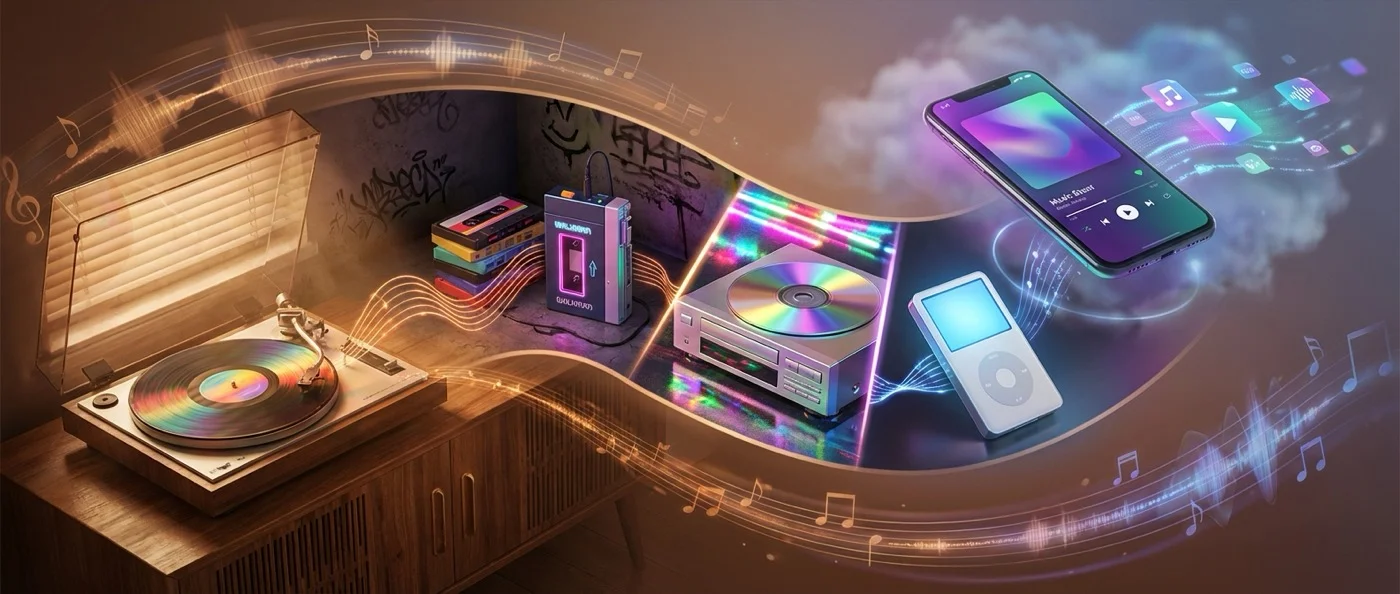
Music started as breath — something ephemeral, impossible to capture. Edison turned it into an object. Radio turned it into air. The cassette turned it into a gift. The CD turned it into data. Napster turned it into free. Streaming turned it into background noise.
At every stage, we gained something — access, convenience, quantity — and lost something: ritual, attention, value. Today we have 100 million songs in our pockets — but we may be listening less carefully than ever. Edison would be amazed. Or rather, he'd ask: “But are you really listening?”