📖 Read more: The History of Television: How a Box Became Power
Before writing: the oral tradition
For 200,000 years, Homo sapiens transmitted information without writing. Memory was the only storage medium — and storytellers were the “hard drives.” The Bards of Central Europe, the griots of West Africa, the rhapsodes of Ancient Greece: they all carried thousands of verses in their heads.
Homer did not “write” the Iliad — he sang it. 15,693 verses, memorized in musical patterns. Milman Parry proved in the 1930s that Homeric rhapsodes used “stock phrases” — formulas — that functioned as mnemonic compression: "rosy-fingered Dawn," "winged words." Memory was not weak — it was technology.
🧠 How much can a human remember?
The Serbian rhapsode Avdo Međedović (documented by Parry/Lord in the 1930s) memorized poems of 12,000+ verses. In West Africa, griots maintained genealogies spanning 700 years. The Iliad + Odyssey: 27,803 verses. No storage medium — just the brain.
Writing: the first great “revolution”
Sumerian cuneiform
Perhaps the first writing — but it was NOT “democratic.” Only scribes could write: 12+ years of training. They controlled the records, the laws, the taxes. Information was power — literally.
Egyptian hieroglyphics
The word “hieroglyphics” means “sacred writings.” That was no accident: writing in Egypt was a religious monopoly — the priests held the codes. Ordinary people did not read.
Greek alphabet
The crucial difference: vowels. The Phoenicians had only consonants — you needed knowledge of the language to “fill in the gaps.” The Greeks added vowels → complete, reproducible writing → democratization of information. Cause or effect of democracy? Perhaps both.
"This discovery [writing] will create forgetfulness in the souls of those who learn it, because they will neglect their memory."
Socrates (through Plato) believed that writing would destroy memory. Every new information medium gives birth to the same fear: books would destroy thinking, television the brain, the Internet truth. Socrates was indeed “right” — writing did replace part of memory. But what humanity gained was incomparably greater.
Libraries: the first “data centers”
📜 Alexandria (~300 BC)
The greatest library of antiquity: 400,000-700,000 scrolls. Collection strategy: every ship entering the harbor had ALL manuscripts copied. The first “data harvesting” policy. Its destruction (perhaps gradual, perhaps multiple) is considered the greatest information loss in history.
📕 Monastic Scriptoria (6th-12th c.)
After the fall of Rome, knowledge “hid” in monasteries. Monks copied texts by hand — roughly 1 page/day. But the selection was political: Christian texts were copied, “sinful” ancient texts were lost. Aristotle survived only because Arab translators kept him alive.
🕌 Bayt al-Hikma (9th c.)
The “House of Wisdom” in Baghdad: the Islamic world translated ALL Greek texts into Arabic (the Translation Movement). Without this “data transfer,” the Western Renaissance might never have happened.
Gutenberg: the first “information democracy”
In 1440, Johannes Gutenberg invented the movable type printing press. Printing was not new — the Chinese (Bi Sheng) had movable ceramic type since the 11th century, the Koreans had metal type (Jikji, 1377). But the “lightning bolt” was not the technology — it was the timing.
Gutenberg Bible
180 copies — dirt cheap compared to manuscripts. One manuscript: 2 years of a monk's labor. One printed copy: days. Cost of a book before Gutenberg: 6 months' wages. After: one week's wages.
Martin Luther: 95 Theses go viral
Luther nailed 95 theses to a church door — but the Reformation “took flight” thanks to the press. In 2 weeks, copies circulated throughout Germany. The first “viral” information. Without the press, Luther would have been just another heretic — with the press, he started a religious schism.
Relation: the first newspaper
Johann Carolus in Strasbourg printed the first weekly newspaper. Information shifted from “eternal” (books) to “current” (news). By the 18th century, hundreds of newspapers in every European capital.
📖 Speed of copying information
Censorship: the shadow of every information revolution
Every time information becomes more accessible, someone tries to control it. There is no “free flow of information” without someone wanting to stop it.
🔥 Index Librorum Prohibitorum (1559)
The Pope created the list of "forbidden books": Galileo, Copernicus, Kepler, Hume, Descartes, Sartre — even Plato. The list was abolished only in 1966. Result: banned books sold even more (the Streisand effect, 400 years early).
📰 Propaganda (20th century)
Goebbels, Pravda, Voice of America: “information” as a weapon. Goebbels stated: “Tell a lie big enough, repeat it often enough, and it will be believed.” Radio made propaganda possible on a massive scale.
🌐 Great Firewall of China (2003+)
China blocks: Google, Facebook, Twitter, YouTube, Wikipedia. 2+ million “cyber police” monitor content. VPN use: technically illegal. 1.4 billion people live on a different internet.
📖 Read more: The History of Trust: From People to Systems
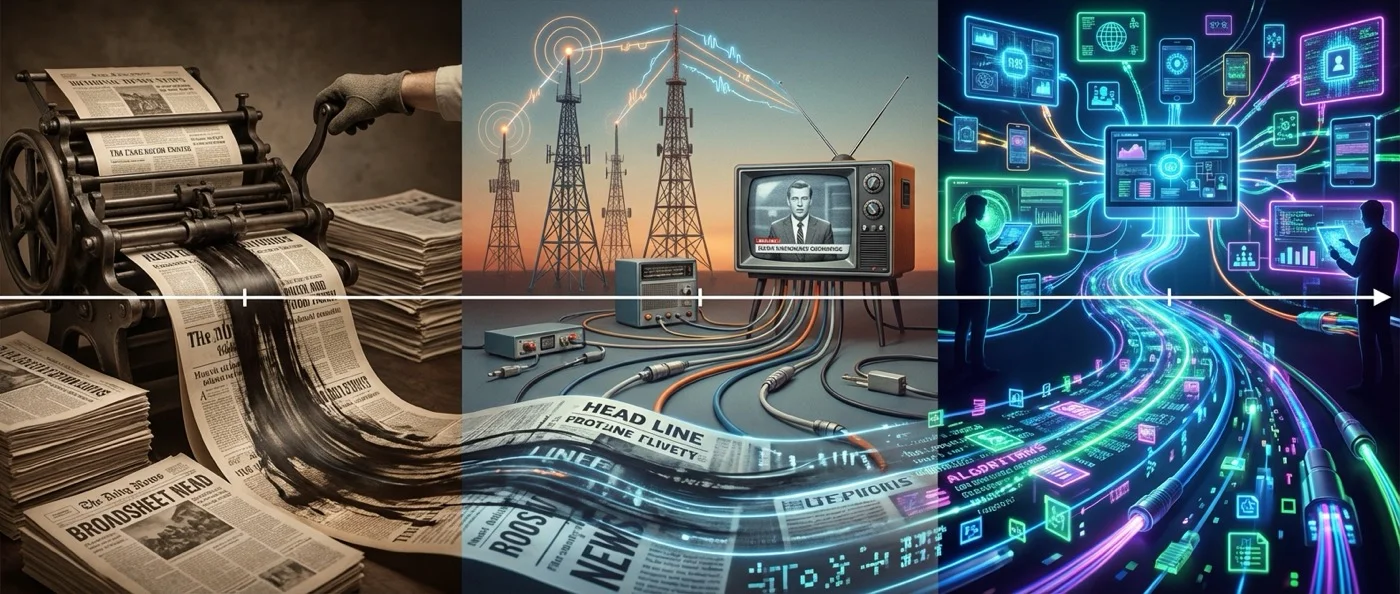
Telegraph, radio, television: the speed of information
Before the telegraph, information traveled at the speed of a horse. The fastest possible rate: ~150 km/day (the Roman cursus publicus). The victory at Waterloo (1815) reached London after 3 days — Rothschild, who had a private courier service, learned about it in 24 hours and made a fortune on the stock exchange.
Samuel Morse: “What hath God wrought”
First telegram: Washington → Baltimore. For the first time, information traveled faster than the messenger. The beginning of “real time.” Stock markets, wars, newspapers: everything changed.
Radio: mass information
For the first time, a message reached thousands simultaneously without paper. Roosevelt used “fireside chats” — 90 million listeners. Hitler used radio for propaganda. Same tool — completely different outcome.
Television: “the medium is the message”
Marshall McLuhan understood: it's not just about WHAT we say — but HOW. Television didn't just transmit information — it transformed it. The Kennedy-Nixon debate (1960): radio listeners thought Nixon won. TV viewers: Kennedy. The image beat the argument.
The Internet: the ultimate revolution (?)
In 1969, four computers at American universities (UCLA, SRI, UCSB, Utah) were connected to each other. ARPANET — funded by the Pentagon, designed to survive a nuclear strike. In the first test, they typed “LOGIN” — the computer crashed at “LO.” The first word on the internet was incomplete.
🌐 World Wide Web (1991)
Tim Berners-Lee at CERN didn't “invent” the Internet — he invented the Web: hyperlinks, URLs, HTML. The radical idea: information is not hierarchical (library) — it's a network. And Berners-Lee himself? He didn't patent anything — he gave it away for free.
🔍 Google (1998)
Larry Page & Sergey Brin: PageRank — the value of a page is judged by how many point to it. Democratic? It seems so. But Google determines what you find — first page = exists, second page = invisible. “The best place to hide a body is page 2 of Google.”
📚 Wikipedia (2001)
60+ million articles in 300+ languages. Crowdsourced knowledge. But: only 10% of editors are women. Only English (6.8 million) — the rest? Far fewer. “Edit wars” — who decides what is “neutral”?
Fake news: the oldest technology
"Fake news" is not a 21st-century invention. Octavian (Augustus) spread false information about Antony — that he was a drunkard, that Cleopatra controlled him. In the 18th century, the “Yellow Press” (Hearst, Pulitzer) manufactured news to sell papers. The Spanish-American War (1898) started partly because of fabricated stories.
The difference today? Speed and scale. An MIT study (2018) proved: fake news spreads 6 times faster than true news on Twitter. Reason: it triggers stronger emotions — anger, disgust, fear. The human brain was not designed for fact-checking — it was designed for survival. And survival means: watch for threats, ignore the boring stuff.
🤖 Deepfakes & AI-generated misinformation
In 2023, a deepfake photo of the Pope in a puffer jacket fooled millions. AI tools (Midjourney, DALL-E) can create “evidence” that never existed. In a world where creating information costs nothing, truth becomes a luxury.
Filter bubbles: you only see what you want to see
Eli Pariser (2011) coined the term "filter bubble": algorithms show you information that will keep you on the platform — not information that benefits you. Result: two people Google the same thing and see completely different results.
Technology is not neutral. YouTube's algorithm increased radicalization — a 2019 study (NYU/Becca Lewis): the recommendation algorithm pushed viewers toward flat earth, conspiracy, alt-right content. Why? Extreme videos kept viewers watching longer. More watch time = more ads = more profit.
"If the service is free, you are the product. But actually, you are not the product — the gradual, slight change in your behavior is the product."
Who controls what we know today?
The history of information reveals a consistent pattern: every new technology starts as a tool of “liberation” — and ends up as a tool of consolidation. The printing press toppled monarchies — but created publisher oligarchies. Radio “democratized” the news — but the station owner decides. The Internet “freed” information — but 5 companies (Google, Meta, Amazon, Apple, Microsoft) control what humanity sees.
🔄 The information power cycle
Information never “wanted to be free” — that is a myth. Information is a tool. It becomes free only if someone — a Berners-Lee, a Wikipedia editor, a whistleblower — actively decides to share it. History shows that this choice is never self-evident — and always comes at a cost.