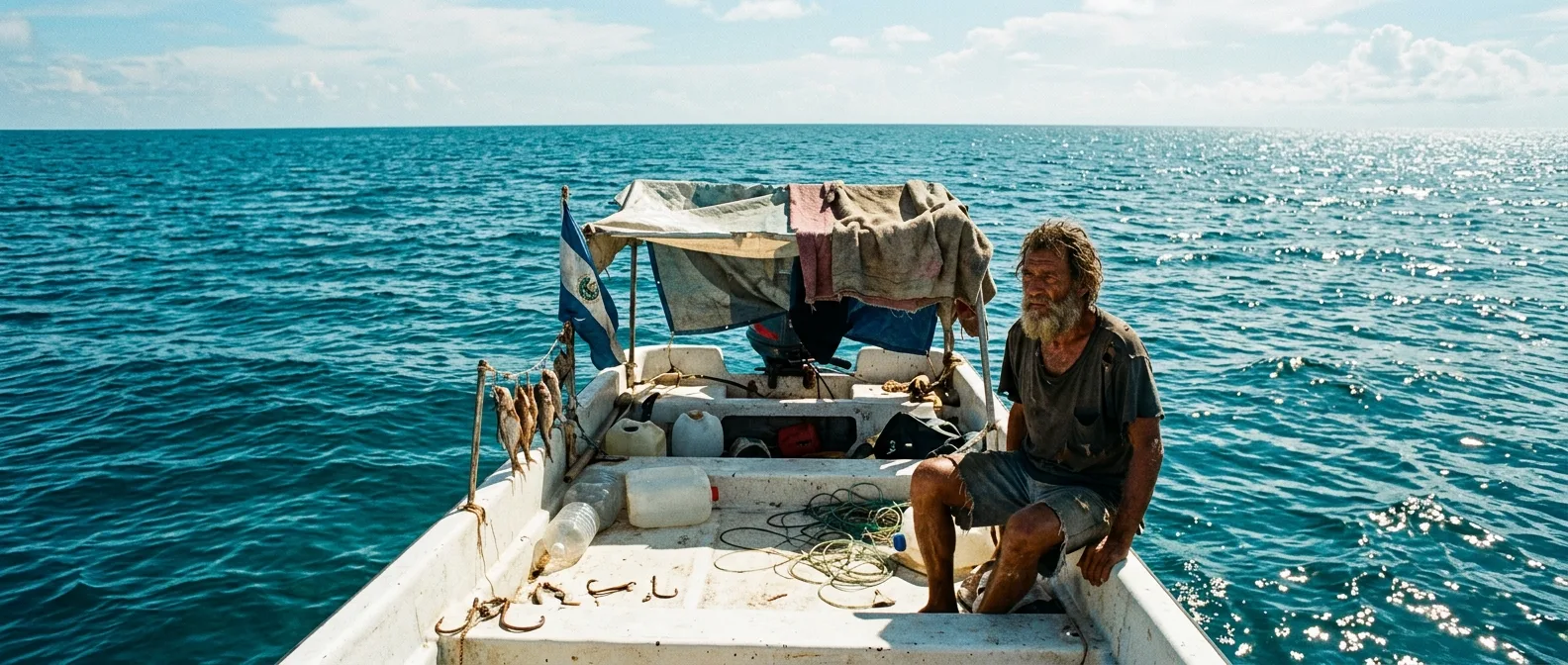
438 Days of Nothing
The true story of the fisherman who drifted 6,700 miles across the Pacific Ocean — and lived to tell it
📖 Read more: The Climber Who Cut Off His Own Arm to Survive
The police officers on the small patrol boat stared at the man lying on the deck. His hair shot upward like a shrub. His beard curled in wild disarray. His ankles were swollen, his wrists skeletal. He could barely stand. He refused all eye contact and kept hiding his face.
They were somewhere in the southern Marshall Islands, deep in the Pacific Ocean — one of the most remote places on the planet. Salvador Alvarenga, a 36-year-old fisherman from El Salvador, had left the coast of Mexico 14 months earlier. He was now 6,700 miles away. He had been drifting for 438 days.
— 1 —On November 17, 2012, Alvarenga prepared his boat — an open-hulled vessel roughly 25 feet long, with no cabin, no running lights, practically invisible at sea. On board: 70 gallons of gasoline, 16 gallons of water, 50 pounds of sardines for bait, 700 hooks, miles of fishing line, knives, bailing buckets, and a mobile phone sealed in a plastic bag.
His regular partner, Ray Pérez, cancelled at the last minute. His replacement was Ezequiel Córdoba, a 22-year-old nicknamed “Piñata” — known in the village mostly as a defensive star on the local soccer team. The two had never spoken before. They had never worked together.
They headed out to open water. Over two days, the fishing was excellent — tuna, mahimahi, sharks, nearly 1,100 pounds of fresh catch. Enough money for a week.
Then the storm came.
— 2 —Waves rose to the height of a three-storey building. Water crashed over the boat from every direction, flooding the hull. Córdoba, panicking, refused to bail. He clung to the rails, vomiting, crying.
Alvarenga ignored him. He gripped the tiller, drawing on every scrap of experience from years of deep-sea fishing in foreign waters. They were 50 miles from shore.
Around 9 a.m., he spotted a mountain on the horizon. Two hours from land. Then the engine started coughing. He grabbed the radio.
"Willy! Willy! Willy! The engine's dead!"
"Calm down, give me your coordinates."
"We have no GPS, it's not working."
"Drop anchor."
"We have no anchor."
"We're coming to get you."
"Come now — we're getting destroyed out here."
Those were his last words to anyone on land. Shortly after, the radio died. The engine was already gone. The GPS had failed earlier. It was the first day of a five-day storm.
In a fit of rage, Alvarenga grabbed a heavy club — the one he used for killing fish — and bashed the broken engine. Then the radio and GPS went overboard too. Desperate fury.
Their only hope was to dump the fish — all 1,100 pounds — to lighten the boat. One by one they hurled the carcasses into the water, while sharks circled below.
— 3 —Without bait, without hooks, Alvarenga invented a daring technique. He knelt at the edge of the boat, plunged his arms in up to the shoulders. He held his palms open, a few inches apart. When a fish swam between them, he slammed them shut, digging his fingernails into the scales.
Many escaped. Gradually, though, he mastered the art. He caught fish, turtles, flying fish that accidentally landed in the boat. Córdoba cleaned them, sliced them into strips, and laid them in the sun to dry.
For the first days-nights, they drank their own urine. Salty, but at least something liquid. Drink, urinate, drink again — a cycle he thought kept him alive, but in reality it was accelerating dehydration. Seawater they stubbornly refused to touch. Both of them knew what that meant.
"I was so hungry that I was eating my own fingernails, swallowing all the little pieces. I started grabbing jellyfish from the sea and swallowing them whole. It burned the top of my throat, but it wasn't so bad."
— Salvador AlvarengaAfter roughly 14 days, while curled up inside the overturned icebox that served as their shelter, he heard a sound. Raindrops on plastic. He burst out screaming: “Piñata! Piñata! Piñata!”
They set up a water collection system — a grey five-gallon bucket with its mouth pointed skyward. Within an hour, an inch of water. Then two. They laughed. They drank. They washed their bodies under the rain as if it were a baptism.
— 4 —Two months at sea. Alvarenga had learned to eat raw birds, turtles, anything he could catch. Córdoba took a different path. He fell violently ill after eating raw seabird and made a drastic decision: he stopped eating. Entirely.
He gripped a plastic water bottle with both hands but no longer had the strength to lift it to his mouth. Alvarenga offered tiny pieces of bird, bites of turtle. Córdoba clenched his jaw shut.
They made a pact. If Córdoba survived, he'd travel to El Salvador to find Alvarenga's parents. If Alvarenga made it, he'd go back to Mexico and find Córdoba's mother.
"Tell my mother I'm sorry I couldn't say goodbye. And that she shouldn't make any more tamales for me — let me go, I've gone with God."
— Ezequiel Córdoba, shortly before his death"I'm dying, I'm dying, I'm almost gone," he said one morning. His breathing was rough. Alvarenga took the water bottle and pressed it to his lips, but Córdoba didn't swallow. He stretched out. His body shook in short convulsions.
"Don't leave me alone! You have to fight for life! What am I going to do here alone?" Alvarenga screamed.
Córdoba didn't answer. He died with his eyes open.
— 5 —The next morning, Alvarenga looked at Córdoba in the bow. He spoke to him. “How do you feel? How did you sleep?” he asked. Then answered his own questions, changing his voice: “I slept fine, and you? Have you had breakfast?”
The easiest way to cope with losing his only companion was to pretend he hadn't died.
Six days after Córdoba's death, they sat together — the living and the dead — on a moonless night, in full conversation. At some point, as if waking from a trance, he realized what he was doing.
"First I washed his feet. His clothes were useful, so I stripped off a pair of shorts and a sweatshirt — it was red, with little skulls and crossbones. I put it on. And then I slid him into the water. And as I let him go, I fainted."
When he came to, minutes later, Alvarenga was terrified. "What could I do alone? Without anyone to talk to? Why had he died and not me? I had invited him to fish. I blamed myself for his death."
His will to live and his fear of suicide — his mother had convinced him that those who take their own lives never enter paradise — kept him searching for solutions. Sunrise and sunset were the hours he scanned the horizon. Container ships appeared as dark silhouettes. Massive. Slow. Indifferent.
Every sighting sent Alvarenga leaping — jumping, waving his arms, screaming. About 20 ships passed along the horizon over those months. Not one saw him. Not one stopped.
To keep from losing his mind, he let his imagination run free. Every morning he began with a walk — five steps forward, five steps back, up and down the boat — imagining he was strolling through cities, markets, streets. He conjured entire meals in his head. Food he hadn't tasted in years. He later said that alone at sea he experienced the finest meals of his life.
His grandfather had taught him to track time by the moon's phases. Now, alone on the open ocean, he counted lunar cycles. One. Two. Five. Ten. Fifteen full moons. His hair had become a shrub, his nails animal claws, his skin parchment.
He was certain his next destination was heaven.
— 7 —He was riding a fast current, calmly now, when suddenly the sky filled with seabirds. Alvarenga looked up. The muscles in his neck tightened. A tropical island emerged through the mist. Green. Turquoise waters all around. Small — no bigger than a football field.
Hallucinations didn't last this long. Was this real?
With his knife, he cut the lines of buoys he'd strung as a makeshift sea anchor. A bold move — without the buoys, a moderate wave could flip him. But speed mattered more now.
Within an hour, he was close to shore. Ten yards from the beach, he dove into the water. He paddled “like a turtle” until a large wave picked him up and hurled him onto the sand like driftwood. Face down on the beach, he clutched a fistful of sand like treasure.
"I held a handful of sand like it was treasure."
— Salvador AlvarengaHe didn't know it yet, but he had washed ashore on Tile Islet, part of the Ebon Atoll at the southern tip of the Marshall Islands. Had he missed that sliver of land, he would have continued north of Australia, likely all the way to the Philippines — another 3,000 miles.
— 8 —Dragging himself through palm fronds and coconut shells, he found himself across a small canal from a beach house. Emi Libokmeto and her husband Russel Laikidrik stared at him. “I see this white man over there. He's yelling. He looks weak and hungry,” Emi recalled.
They didn't share a language. Alvarenga drew a sketch — boat, person, shore — then gave up. How do you explain 7,000 miles of drift with stick figures on sand?
They cared for him, fed him, dressed him. Russel crossed the lagoon to the main settlement to get help. Within hours, police and a nurse were at his side. A visiting Norwegian anthropologist alerted the local Marshall Islands Journal.
The photo of the bearded fisherman shuffling ashore went viral. Briefly, Alvarenga became world news. Authorities confirmed the boat's registration number — the same vessel that had set out from Mexico on November 17, 2012. Oceanographers, the U.S. Coast Guard, former Navy SEALs — everyone confirmed that his drift path was consistent with known ocean currents.
— 9 —Paradise wasn't dry land
He was diagnosed with anaemia. Doctors suspected that his diet — years of raw turtles and raw birds — had infected his liver with parasites. He himself feared the parasites might crawl up to his brain.
After 11 days in hospital, he flew home to El Salvador. There he kept his promise: he travelled to Mexico to find Córdoba's mother, Ana Rosa. He sat with her for two hours. He told her everything.
Dry land wasn't the salvation he'd imagined. He had developed a deep fear of the ocean — but even the sight of water terrified him. He slept with the lights on. He needed someone next to him at all hours. Deep sleep was impossible.
It took a full year before the fog lifted. Before he looked at a map, saw the staggering line he'd drawn across the Pacific, and began to understand what exactly he'd done.
"I suffered hunger, thirst and an extreme loneliness — and didn't take my life. You only get one chance to live — so appreciate it."
— Salvador Alvarenga438 days. 6,700 miles. One ocean. One death. And one man who refused to die — not out of heroism, but because his mother had convinced him that suicide keeps you out of paradise.