The Family That Vanished While the House Remained Untouched
Bobby, Sherilynn and Madyson Jamison — Oklahoma, 2009
📖 Read more: The Somerton Beach Dead Man with No Identity
In the San Bois Mountains of southeastern Oklahoma, time moves differently. The hills, blanketed by dense forests of oak and pine, conceal trails that lead nowhere — or everywhere, depending on the mood of the terrain. It is a land that seems to resist civilization, a landscape so inhospitable that even GPS maps lose their bearings inside its ravines. Here, in October 2009, a family of three left behind an absolute enigma.
Bobby Jamison, 44, his wife Sherilynn, 40, and their six-year-old daughter Madyson lived in Eufaula, a small town on the shores of Lake Eufaula. An ordinary family, at least on the surface. On October 8, 2009, they set off in their pickup truck to look at a 40-acre plot of land near Red Oak, about 30 miles away. They never came back.
What followed defies every boundary of human logic. Their home in Eufaula remained exactly as they had left it — dishes in the sink, clothes in the closet, the television off. Their pickup was found abandoned on a dirt road, with their dog Maisie alive but dehydrated in the cab, their cell phones in the glove compartment, their wallets in place — and $32,000 in cash hidden beneath a seat. As if they had simply stood up and walked into the forest, leaving everything behind.
Eufaula, Oklahoma, is a town of roughly 2,800 residents, built on the edge of the state's largest man-made lake. Lake Eufaula, created in the 1960s when a dam was built across the Canadian River, transformed a region of dry hills into a tourist destination. But beyond the marinas and vacation homes, the wider area remained what it had always been: rural, isolated, poor.
Bobby Jamison was born on August 4, 1965, into a family that was indistinguishable from any other in the area. His father, Bob Dean Jamison, was a tough man with a reputation as someone you didn't want to cross. The father-son relationship was never easy, but no one imagined just how dark it would become later on.
Sherilynn was born on November 5, 1968. Bobby met her in the mid-1990s; they fell in love and married. On August 1, 2003, Madyson was born — a little girl with brown eyes and blonde hair who immediately charmed every neighbor. She was lively, cheerful, innocent. Exactly what a six-year-old child should be.
The family lived in a house in Eufaula, nothing special — a typical American home in a town that has little to offer besides peace and quiet. Bobby struggled financially; Sherilynn battled bouts of depression. It wasn't the ideal life, but it was their life. And within that life, certain dark seeds had already begun to take root.
In the months before the disappearance, the Jamison family's life had begun to spiral out of any semblance of normality. The most significant event was Bobby's falling out with his father. Bobby had filed a lawsuit against Bob Dean, accusing him of making threats, of running him over with his car in November 2008, and of being involved in methamphetamine trafficking.
These were not ordinary family disputes. They were grave, dark accusations that revealed a world behind closed doors that few neighbors could have imagined. The lawsuit described scenes of violence, intimidation, and criminal activity. Bob Dean, according to his son, was not merely a difficult father — he was dangerous.
Police later examined these allegations but found insufficient evidence to link Bob Dean to the disappearance. Nevertheless, the shadow of domestic violence lingered in the background of every theory that followed.
«My father threatened my life, the life of my wife, and my daughter. He hit me with his car. I fear for the safety of my family.»
— Bobby Jamison, from the court documents of the lawsuit against his father
Meanwhile, the couple's financial situation remained unstable. Bobby suffered from chronic back pain that prevented him from working normally. Sherilynn fought her own battles with mental health. Medications piled up — painkillers, antidepressants, anti-anxiety pills. A pharmaceutical fog that gradually clouded their thoughts and decisions.
And then there were the spirits.
At some point before their disappearance, Bobby and Sherilynn had separately visited the local pastor, Gary Brandon, to confide something troubling: they believed their house was haunted. They saw shadows on the walls, sensed presences in rooms that would suddenly turn cold, heard sounds they couldn't explain.
Pastor Brandon later recalled that Bobby had mentioned reading the Satanic Bible, Anton LaVey's book. It wasn't clear whether he was reading it out of curiosity, searching for answers, or whether there was deeper involvement. Brandon was concerned. Sherilynn, for her part, seemed genuinely terrified — she spoke of spirits in every corner of the house, of invisible eyes watching them.
The cynical interpretation would have these accounts be side effects of medication, symptoms of mental illness, or manifestations of extreme anxiety. The darker interpretation would suggest that something was truly happening in that house — something that doesn't fit within the categories of our rational understanding. Whatever explanation one accepts, one thing remains undeniable: Bobby and Sherilynn believed that something evil was living with them.
A Note on the Satanic Bible
Anton LaVey's “Satanic Bible,” published in 1969, is not a book of black magic — it is a philosophical text of individualism. However, in a small community of deeply religious people, merely possessing it was enough to generate negative impressions and conspiracy theories.
The truth is, we don't know what was really happening inside the Jamison house during those days. We know that Sherilynn had written a letter in which she admitted to thinking about “killing” — but the reference was vague, without a specific target. We know that Bobby had lost considerable weight in recent months, that he appeared weak, withdrawn. We know that something was eating this family from the inside, long before they vanished from the map.
On October 8, 2009, Bobby, Sherilynn, and little Madyson loaded up their Chevrolet pickup and headed for Red Oak. The purpose was, at least officially, to inspect a 40-acre plot of land they were considering buying. A homestead far from everything — from Bobby's father, from the spirits in the house, from the town that was suffocating them.
Their home surveillance system captured the last images of them. The video, which would later become one of the most chilling pieces of evidence in the case, shows Bobby and Sherilynn making repeated trips between the house and the truck. They move back and forth in silence, carrying objects. Their movements were later described as “trance-like” — slow, mechanical, without conversation, without interaction.
They don't speak to each other. They don't look at one another. They move like automatons in some inexplicable ritual. Sherilynn appears to place a brown briefcase inside the vehicle — this briefcase was never found. Sheriff Jesse Beauchamp later stated that he believed the briefcase may have been a critical piece of evidence. Along with it, Sherilynn's handgun also disappeared.
«They don't look like people getting ready for a drive in the country. They look like zombies. Like something has taken control of them.»
— Police investigator, referring to the surveillance video
What no one could ever explain: why, if they were preparing for a short trip to a field, would they bring $32,000 in cash? The family was not known for large sums of money. That amount represented a small fortune by their standards. And they had it hidden inside the car, as if they were preparing to travel much farther than a field 30 miles away.
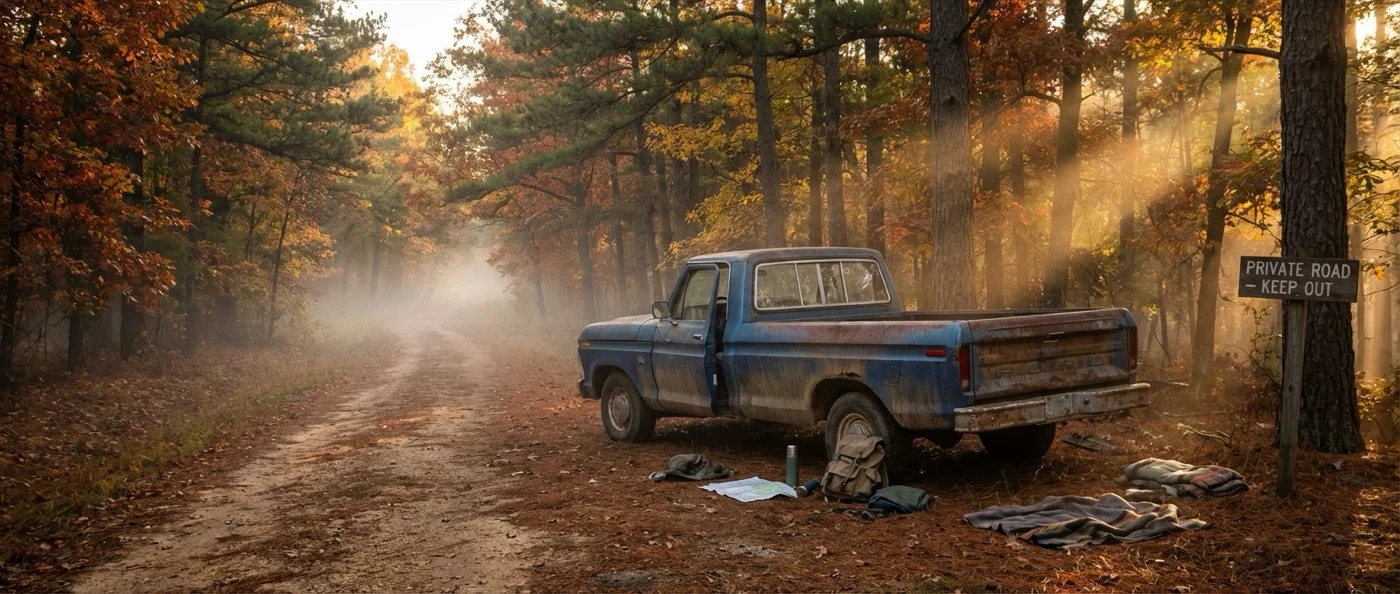
A few days later, a local resident spotted the Jamison family's Chevrolet pickup on a forest dirt road in Latimer County, just south of the tiny settlement of Kinta. The truck was locked. Inside, their dog Maisie was alive but hungry and dehydrated, already in poor condition after days of confinement.
Police broke the window and freed Maisie. What they found inside the vehicle defied every logical scenario of voluntary departure: both parents' cell phones were in the glove compartment. Their wallets — IDs, credit cards — were there. The car's GPS system was in place. And beneath a seat, in a bag, lay $32,000 in cash.
No sign of violence on the vehicle. No broken glass, no blood, no trace of a struggle. The Jamisons had stopped at this spot, stepped out of the car — and never came back. As if the earth had swallowed them whole.
The Findings
Found inside the truck: 2 cell phones, 2 wallets with IDs, a GPS system, house keys, $32,000 in cash, the dog Maisie alive. Not found: the brown briefcase, Sherilynn's handgun, any sign of violence.
The area around the vehicle was searched immediately, but initially without result. The terrain was rough, covered in dense vegetation, sharp rocks, and deep ravines. Tracking dogs searched the area but couldn't follow a scent beyond a few yards from the truck. Helicopters flew over the forests. Volunteers combed the hills. Nothing.
The Jamison family had simply vanished. Three people — a man, a woman, a six-year-old girl — had stepped out of a car in a forest and were now nowhere to be found. Neither alive nor dead. They simply no longer existed.
In the months that followed, investigators and the media developed at least five major theories about what had happened to the Jamison family. None could ever be proven — or fully disproven. Each one explained something, but none explained everything.
Theory 1 — Murder: The most obvious hypothesis. Someone killed the Jamisons in the mountains and hid the bodies. Bobby's rift with his father, the rumors of drug trade involvement, the $32,000 — all could point to a motive. But who? And how, without a single trace of violence on the car? Police examined Bob Dean Jamison but found no evidence linking him.
Theory 2 — Drugs: The $32,000 was suspicious. Investigators noted that the family had no reason to possess such an amount in cash. Some suggested the Jamisons were buyers or sellers of methamphetamine — a scourge in rural Oklahoma — and that a deal gone wrong led to their deaths. The area around Red Oak was known for illegal labs hidden in the woods.
Theory 3 — Suicide or murder-suicide: The mental state of both adults was not stable. Sherilynn had written about “dark thoughts.” Bobby had lost weight dramatically. Some suggested the couple took little Madyson and walked into the forest to end their lives. But this theory faced a major problem: why leave $32,000 behind? And why lock the dog inside the car?
Theory 4 — Staged disappearance: Perhaps the Jamisons planned everything. Perhaps they wanted to vanish, to start a new life elsewhere. But this didn't explain why they left the money, the phones, the IDs. How would they start a “new life” without identification, without money, with a six-year-old child?
Theory 5 — Spirits and satanism: The most exotic theory was based on the pastor's accounts of spirits and the Satanic Bible. Some believed the family got entangled in something supernatural or in an organized cult. It was the least credible theory, but in a deeply religious society like rural Oklahoma, it found fertile ground.
Among the evidence police uncovered was a photograph on Sherilynn's cell phone that stunned investigators. It was a picture of little Madyson, taken most likely very close to the moment of the disappearance. The girl stares straight into the lens, but her expression is not that of a child on an outing. Her eyes are vacant, the feeling unsettling. As if she's looking at something beyond the camera. As if she knows something we cannot see.
The photograph was later published and sparked a wave of discussion. Was it an ordinary photo of a tired child? Or was it the last image of a six-year-old who knows something terrible is about to happen? The interpretation depended entirely on the viewer — and that was precisely what made the entire case so psychologically draining.
The dog Maisie was perhaps the only witness to what truly happened that day. When she was found inside the locked truck, hungry but alive, her presence raised more questions than it answered. Why would anyone leave the dog locked inside? If they planned to leave for good, they would have freed her. If they were taken by force, why did the perpetrator ignore the animal?
Maisie was later adopted by family relatives. No one was ever able to “read” what she had seen that day in the San Bois Mountains. Dogs don't talk — but perhaps that was her only advantage: she didn't need to stay silent out of fear.
After the first weeks of intensive searches, the Jamison case sank into a dead-end silence. The Latimer County police, with minimal resources and manpower, couldn't investigate thousands of acres of impenetrable forest. Tracking dogs found nothing beyond a few yards around the truck. Helicopters swept the area without result.
The case was filed as “open” — it was never officially closed, but in practice it stopped being actively investigated. The media, having exhausted every possible angle, moved on to the next story. Only the true crime forums on the internet kept the memory alive.
In 2010, the series “Disappeared” on Investigation Discovery dedicated an episode to the case, titled “Paradise Lost.” The irony was lost on no one: little Madyson, the dog Maisie, the 40 acres that were supposed to become their new world — nothing ended up where it was supposed to go.
Sherilynn's and Bobby's relatives never gave up. They posted flyers at gas stations and supermarkets, called the sheriff's office every month, uploaded photos on social media for years. Wearing hope like armor, they waited for something that never came — a phone call, a tip, a revelation.
The San Bois Mountains continued to stay silent. The seasons changed, leaves fell and grew back, rain washed the soil, time covered the traces. For four long years, the earth kept its secrets locked in its depths.
In November 2013, four years and one month after the disappearance, two deer hunters were walking through a remote area of Latimer County. It was autumn, the vegetation had thinned, and sunlight could now reach spots that were impenetrable during summer. In a valley, less than three miles from where the abandoned truck had been found, they discovered human bones.
The hunters immediately notified authorities. The scene that greeted investigators was heartbreaking in its silent simplicity: skeletal remains of three people — two adults and a child — scattered across a small area. Their clothes, decomposed but still recognizable, were still on them. There was nothing around them — no objects, no tools, no sign of a campsite. Just three bodies, in a valley, beneath a canopy of oaks.
The bones were sent to the Oklahoma medical examiner for identification. The process took months — the decomposition was far too advanced. Anthropological and pathological examinations, DNA analyses, dental record comparisons. Finally, on July 3, 2014, confirmation came: the remains belonged to Bobby, Sherilynn, and Madyson Jamison.
«We now know they are no longer alive. But we don't know how they died, why they died, or who killed them — if anyone killed them at all.»
— Oklahoma Medical Examiner, at the announcement of the identification
The most chilling detail: the cause of death could not be determined. The bones showed no signs of trauma — no broken bones, no bullet marks, no traces of a sharp object. Decomposition had destroyed all tissue that might have revealed poison, asphyxiation, or anything else. Their death, like their disappearance, remained an enigma.
Three miles. That is the distance between the abandoned truck and the spot where the skeletons were found. Three miles in the San Bois Mountains is nothing like three miles on a road — it's hours of hiking through fallen trees, rocky inclines, and streams that turn into rivers after rain. Without a trail, without a compass, without visibility beyond a few yards.
What could have compelled three people — among them a six-year-old child — to cover that distance over that terrain? If someone was chasing them, why didn't they use the car? If they chose to walk on their own, what state of mind does it take to drag a six-year-old girl through impenetrable forest?
Some investigators suggested they got lost. That they stepped out of the car briefly — perhaps to explore the land they were thinking of buying — and became disoriented. In the San Bois Mountains, this can happen easily: the dense vegetation erases every landmark, the sun hides behind the trees, the trails all look alike. Three people, without water, without food, without a phone (which they had left in the car), walking in circles until dehydration, exhaustion, and hypothermia defeated them.
But even that scenario doesn't explain the $32,000. It doesn't explain the “trance-like” movements in the video. It doesn't explain why Bobby, a local resident who knew these woods, would become so thoroughly disoriented. Every explanation leaves holes. Every theory drowns in its own gaps.
The Jamison case gradually transformed into a cultural phenomenon. True crime communities on Reddit, YouTube, podcasts, and Websleuths pages delved extensively into every detail. Madyson's photograph, the $32,000, the surveillance video, the spirits, the Satanic Bible — every element became fuel for theories, analyses, and reports.
BuzzFeed Unsolved dedicated one of its most popular episodes to the case. Documentaries appeared on Netflix, Hulu, and Investigation Discovery. The story had all the elements the true crime industry demands: mystery, chilling evidence, an unresolved conclusion, and three victims — one of whom was a small child.
But behind the clicks and views, there were real people. Bob Dean Jamison, Bobby's father — regardless of whether he was involved or not — spent the last years of his life under public accusation. Sherilynn's relatives faced waves of questions from journalists looking for a “new angle.” The memory of a six-year-old girl now served algorithms and clickbait headlines.
«Madyson loved animals, she colored, she sang. She was a normal little girl. She wasn't a piece of a puzzle — she was a child.»
— A relative of the Jamison family, in a 2014 interview
The mystery industry operates with a relentless mechanism: it always needs to leave the questions open, because a mystery that gets solved stops selling. And so the Jamison case continued to be republished, rehashed, reshaped — each time with a slightly different filter, but always with the same unanswered questions.
Let's put what we know for certain in order. The Jamison family — Bobby, 44, Sherilynn, 40, and Madyson, 6 — disappeared on October 8, 2009, near Red Oak, Oklahoma. Their pickup was found abandoned, with their personal belongings, their dog, and $32,000. Their skeletal remains were found four years later, less than three miles away. The cause of death was never determined.
What we don't know could fill books. Why did they have $32,000 with them? What was in the briefcase that was never found? Where was Sherilynn's handgun? Why were their movements in the video so “mechanical”? Why did they walk three miles through impenetrable forest? Did they die of natural causes or were they murdered? If they were murdered, by whom?
Police never officially closed the case. They say it remains an “open case,” which in police language means: we know they died, we don't know how, we can't charge anyone, we have no evidence to move forward. A bureaucratic admission of helplessness wrapped in official terminology.
In reality, the Jamison case may never be solved. Nature destroyed every physical piece of evidence over the course of four years — rain, heat, cold, animals, microorganisms wiped out every bit of tissue that could have revealed toxins, soft tissue injuries, or signs of suffocation. What remained — bones, clothing, a few objects — is not enough to tell a story.
And now, let us return to where this story began: the house. The Jamison family's home in Eufaula didn't burn down, wasn't looted, wasn't demolished. It remained. A shell of a life, a museum of an ordinary day that never ended. Dishes in the sink. Madyson's toys in her room. Clothes in the closets. The television, the framed photographs, the bills on the table.
A house waiting for its owners to return functions like a clock that has stopped: it always shows the same time. The same hour, day after day, month after month. The flowers in the vase withered, dust covered the furniture, the sun faded the curtains. But the house didn't die — it simply stopped living.
There is something deeply unsettling about houses that are left behind. It is the inversion of every human narrative: usually, people survive and buildings are destroyed. Fires, earthquakes, floods — our civilization is full of stories of people rebuilding on ruins. But here, the ruin was the family. The building was intact. And that contrast — the silence of an untouched house set against the disappearance of three people — is what makes the Jamison case so psychologically devastating.
Because we can endure ruins. Ruins tell a story — of violence, decay, endings. Ruins give us something to weep for, something to mourn, something to comprehend. But a house that stands motionless while its inhabitants have vanished says nothing. It stays silent. And silence is always worse than ruins.
In the San Bois Mountains of Oklahoma, the wind blows differently on autumn evenings. It carries with it the scent of wet earth, decomposing leaves, stone soaked by rain. If you close your eyes up there, you can almost hear footsteps — three pairs of shoes on dry leaves, one large stride, one medium, one small. A family walking toward somewhere.
Or toward nowhere.
The story of the Jamison family has no ending — and that is precisely what haunts it. There is no resolution, no closure, no relief of “we finally learned what happened.” Three people walked into a forest in October 2009, their bones were found four years later, and the world kept spinning without caring much.
In an age when information travels at the speed of light, when satellites map every square meter of the Earth, when algorithms analyze our every move, there is something primitively chilling about the fact that three people can still vanish without explanation. That a 40-acre plot of land can swallow an entire family. That $32,000 can remain unclaimed. That a dog may know the truth but can never share it.
Madyson Jamison would be over twenty years old today. She would have finished school, perhaps college. She would have fallen in love, gotten her driver's license, dreamed of a future. Instead, she is a little girl forever six years old, frozen in time in a cell phone photograph, with eyes that gaze beyond the lens at something no one could ever identify.
In Eufaula, the lake continues to rise and fall with the seasons. The houses around it turn on their lights every evening. Cars pass on the road toward Red Oak. And somewhere out there, in a house where a family of three once lived, silence keeps striking the walls like an invisible clock.
Tick. Tock. Tick. Tock.
No one hears.