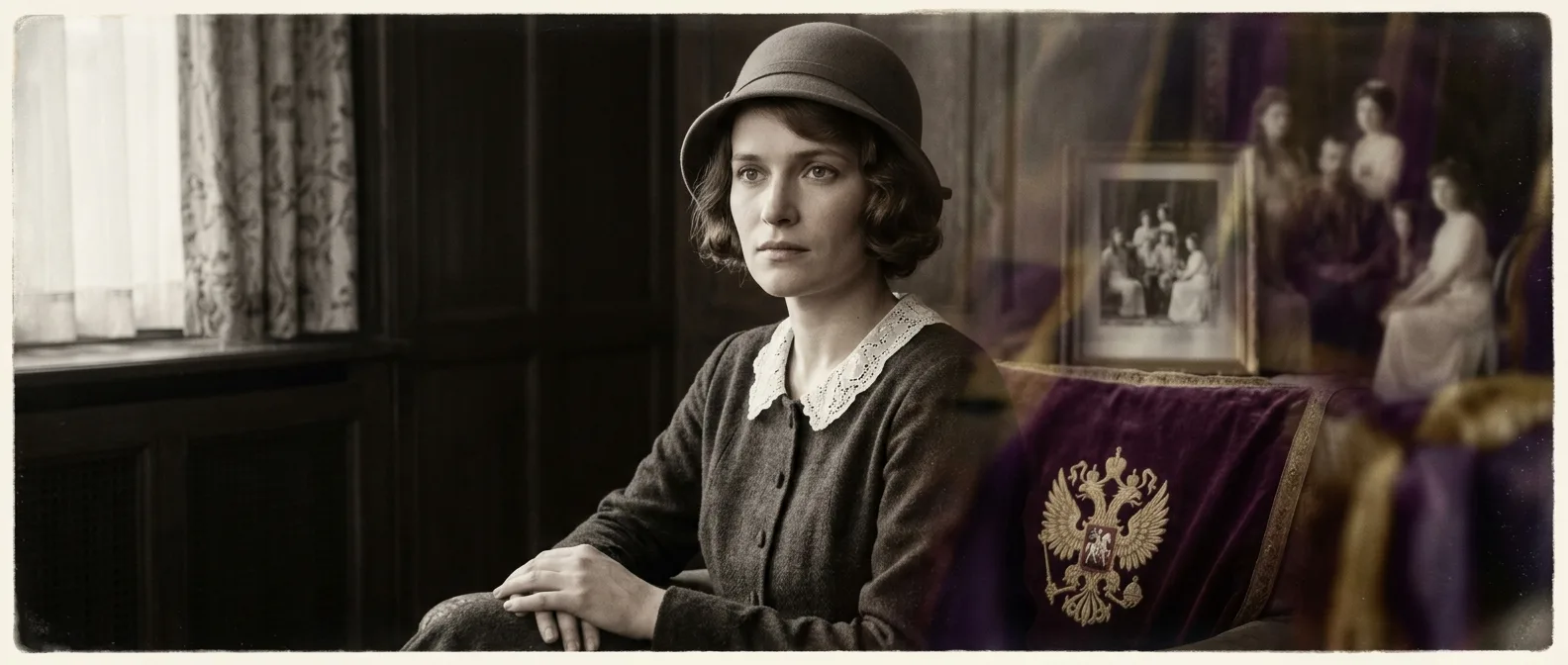
The last night of the Romanovs
On July 17, 1918, shortly after midnight, a guard woke Tsar Nicholas II and his family in the basement of the Ipatiev House in Yekaterinburg, Russia. He told them to get dressed and come downstairs — they would be transferred elsewhere, for their safety. The tsar, Tsarina Alexandra, their four daughters — Olga, Tatiana, Maria, Anastasia — and young Alexei, thirteen years old, descended the stairs together with their physician and three servants. None of them came back alive.
Yakov Yurovsky, head of the execution squad, read the death sentence aloud. Before the tsar could react, the gunfire had begun. Members of the imperial family fell on top of one another. Some bullets ricocheted off the girls' corsets — inside the layers of fabric they had sewn diamonds and precious stones, a last attempt to hide something of their wealth. Those who did not die immediately were finished off with bayonets. The execution took less than twenty minutes.
The Soviet government announced the tsar's death but said nothing about the rest of the family. That silence — deliberate or accidental — gave birth to the greatest identity theft of the twentieth century.
Rumors in the dark
Within months, rumors began circulating across every corner of Europe. Some claimed to have seen members of the imperial family alive — in Romania, in China, in southern France. The most persistent scenario involved the youngest daughter, Anastasia, who was seventeen on the night of the execution. It was said she had survived — that a bullet had not struck her fatally, that a soldier had taken pity on her, that hidden diamonds in her clothing had deflected the shots.
📖 Read more: The History of Trust: From People to Systems
None of it was true. But in the chaotic world after World War I and the Russian Revolution, truth was wet clay — anyone could shape it as they wished. Hundreds of Russian aristocrats had fled to Berlin, Paris, and Rome. They lived on memories and on a hope: that the old Russia had not died entirely. The idea that a princess had survived was medicine against despair.
The unknown woman of Berlin
A young woman jumps from the Bendler Bridge into the Landwehr Canal in Berlin. Police pull her out. She carries no identification and refuses to reveal her name. She is taken to a psychiatric clinic. In the records she is listed as “Fräulein Unbekannt” — Miss Unknown.
The battle for an identity
Over the following years, Anna Anderson moved dozens of times — to supporters' homes, to castles, to hotels, and eventually to courtrooms. Her case split the world of the Russian exile community in two. Some were convinced she was indeed Anastasia — among them Gleb Botkin, son of the physician executed alongside the Romanovs, and Princess Xenia Georgievna, a distant relative.
Others were equally certain she was an impostor. Grand Duchess Olga, the tsar's sister, visited her in the hospital. She initially seemed moved, but later stated unequivocally that this woman was not her niece. Princess Irene of Hesse, aunt of the real Anastasia, also visited — and rejected her.
📖 Read more: The History of Work: Why We Work More but Feel Less
1933Anderson files a lawsuit in a German court seeking recognition as Grand Duchess Anastasia and a share of the Romanov inheritance — bank accounts held in England and Germany.
Believers and doubters
The Anderson case turned into a cultural phenomenon. Books, films, and plays were all based on her story. The real question was not merely whether this woman was Anastasia — it was why so many people wanted to believe she was. Anastasia represented something larger: the possibility of a miracle, the hope that history could be reversed, that injustice could be undone.
Anderson's supporters were fervent, almost fanatical. Gleb Botkin devoted his entire life to defending her. Some aristocrats hosted her for months in their homes. Graphologists found similarities in her handwriting. Sculptors recognized “the hands of the Romanovs” in her fingers.
Her detractors were equally fierce. Former courtiers declared that this woman did not speak proper Russian — something the real Anastasia, despite the English and French she spoke at court, would surely have been able to do. Anderson replied that her injuries had affected her memory and speech. German detectives, as early as the 1920s, had found an alternative explanation: that Anna Anderson was in reality Franziska Schanzkowska, a Polish factory worker who had vanished from Berlin shortly before “Miss Unknown” appeared in the canal.
Franziska Schanzkowska was born on December 16, 1896, in a small village in Pomerania, then part of Prussia. She was a farmer's daughter, the fourth of five siblings. At sixteen she went to Berlin to work in a munitions factory. An industrial accident — a grenade exploded near her — left permanent scars on her body and possibly on her mind. Those scars were the same wounds she would later present as proof that she was Anastasia.
After the accident, Franziska disappeared. Her family searched for her. A year later, a woman was pulled from the Landwehr Canal. The coincidence in dates was striking: Schanzkowska vanished just weeks before “Miss Unknown” surfaced in the water. Franziska's sister, Gertrude, later identified the woman with certainty as her sibling — but Anderson denied any connection to them.
How did a Polish factory worker convince so many people she was a Russian princess? Some psychiatrists believe that Franziska, after the trauma and the suicide attempt, developed a psychotic identity disorder — that she genuinely believed what she claimed. She was not merely an impostor; she may have been history's first deeply convincing false self.
The final years
Anna Anderson marries Jack Manahan, a history professor in Virginia. She takes the new name Anna Manahan. Manahan firmly believes his wife is Anastasia — and he will maintain that belief until his own dying breath.
The truth in the DNA
In the early 1990s, DNA analysis technology had advanced enough to give definitive answers to questions that had remained open for decades. In 1991, the mass grave near Yekaterinburg was officially opened. Nine skeletons were found — the tsar, the tsarina, three of the daughters, the physician, and three servants. Two skeletons were missing: those of Alexei and one daughter.
1994Researchers at the British Forensic Science Service analyze Anderson's tissue sample and compare it with DNA from members of the Romanov family. The result is unequivocal: Anna Anderson had no genetic relationship to the Romanovs whatsoever. Her mitochondrial DNA matched perfectly with that of Karl Maucher, a nephew of Franziska Schanzkowska — the Polish factory worker detectives had pointed to for decades.