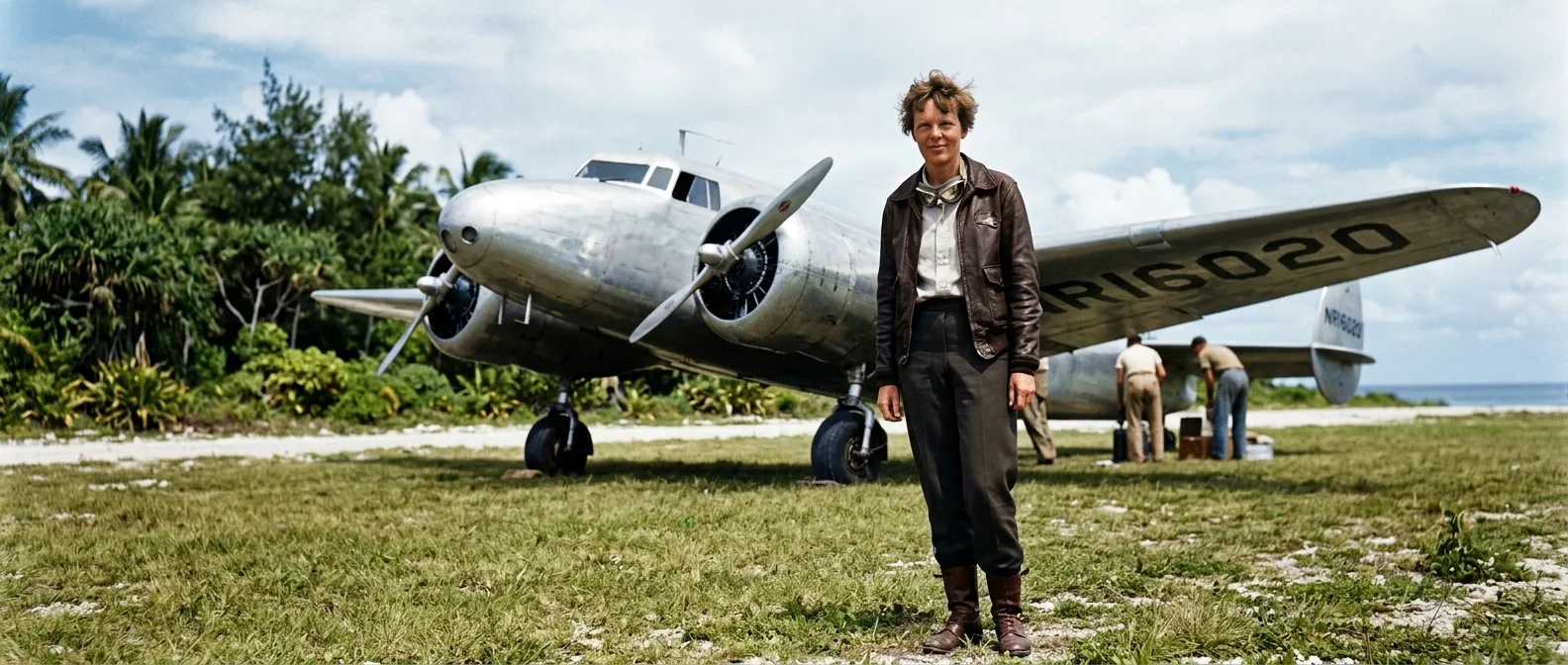
The Disappearance of Amelia Earhart in the Pacific
A True Story
📖 Read more: The 3 Lighthouse Keepers Who Vanished Mysteriously
A girl who wanted to fly
Amelia Mary Earhart was born on July 24, 1897, in Atchison, Kansas. She grew up in an era when women couldn't vote — let alone fly airplanes. Her father was an alcoholic and the family moved frequently. Amelia and her sister Muriel grew up amid instability — but Amelia turned every upheaval into freedom. As a child, she hunted rats, climbed trees, and was known in the neighborhood as “the girl who does what boys do.”
At age 10, she saw an airplane for the first time at an Iowa state fair. She wasn't impressed — “it was just a thing of wire and rust,” she recalled later. But at 23, at an air show in Long Beach, California, something changed. “As soon as we left the ground at 200 feet, I knew I had to learn to fly.”
She took her first flying lessons from Neta Snook — one of the few women pilots of that era. Within 6 months, she bought her own plane — a yellow Kinner Airster biplane she named “The Canary.” To afford it, she worked as a truck driver, photographer, and telephone company clerk.
The woman who broke every record
In June 1928, Earhart became the first woman to cross the Atlantic by air — though as a passenger, not as a pilot. The press called her “Lady Lindy” (after Charles Lindbergh). She hated the name.
I was just a sack of potatoes. Stultz flew, Gordon navigated. I sat in the back. That has to change.
Four years later, on May 20, 1932, Earhart took off alone from Newfoundland. 14 hours and 56 minutes later, she landed in a field in Northern Ireland. A farmer asked her: “Have you flown far?” She replied: “From America.”
She became the first woman — and only the second person after Lindbergh — to fly solo across the Atlantic. The flight was anything but easy: she battled freezing winds, a malfunctioning altimeter, and dense fog that forced her to fly nearly blind for the final hours. President Hoover awarded her the Distinguished Flying Cross — she was the first woman ever to receive it. The world adored her, and Earhart became a symbol of a new era.
The grand plan: Around the world
After the Atlantic, Earhart continued breaking records — first to fly solo from Hawaii to California (1935), first from Los Angeles to Mexico City (1935). But she wanted something bigger: a complete circumnavigation of the Earth along the equator — the longest possible route.
The route would be 29,000 miles. She would fly a brand-new Lockheed Electra 10E — a twin-engine plane equipped with extra fuel tanks. Her navigator would be Fred Noonan — exceptional at celestial navigation, a former Pan American Airways navigator, but known for a drinking problem that had cost him his job. Several people believed he was the wrong choice for a mission of such critical importance.
A first attempt in March 1937 (flying east to west) ended in a crash at Honolulu airport — the plane suffered serious damage during takeoff. Earhart refused to give up.
The final flight
On June 1, 1937, Earhart and Noonan departed from Miami — this time heading east. They passed through South America, Africa, India, and Southeast Asia. By June 29, they had covered 22,000 miles. Only 7,000 remained.
On July 2, they took off from Lae, New Guinea. Destination: Howland Island — a strip of land just 1 mile long and 0.3 miles wide, lost in the middle of the Pacific. The U.S. Coast Guard had stationed the ship USCGC Itasca next to Howland to serve as a radio beacon.
But communications were problematic from the start. Before departure, Earhart had left behind her long-range Morse antenna, considering it excessively heavy equipment — a decision many analysts now consider a fatal mistake. Without it, her ability to receive low-frequency signals was severely limited. Earhart appeared unable to receive the Itasca's signals. The Itasca crew tried desperately to communicate on various frequencies, but Earhart never responded to their transmissions. It was as if she was the only one talking and nobody could hear. At 7:42 a.m. (local time), she transmitted: “We must be on you but cannot see you... fuel is running low...”
Earhart's last message at 8:43 a.m.: "We are on the line 157-337. Will repeat this message. Will repeat this message on 6210 kilocycles." After that — silence. Forever.
The largest search in history
President Roosevelt immediately ordered the largest naval and aerial search ever conducted at that time. 9 ships and 66 aircraft swept 250,000 square miles of ocean — an area larger than France. At the height of the search, the aircraft carrier USS Lexington was deployed to the area with 62 reconnaissance planes.
Nothing. No wreckage, no oil slick, no life vests. After 16 days and a cost of $4 million (over $80 million in today's value), the search was called off. It was the most expensive search operation the U.S. government had ever ordered for a private individual. On January 5, 1939, Earhart was officially declared dead.
Theories, findings, and an endless search
Theory 1 — She sank in the Pacific: The simplest explanation. The fuel ran out, the plane crashed into the sea and sank to depths of 16,000+ feet. Modern sonar teams are still scanning the ocean floor around Howland.
Theory 2 — Nikumaroro (Gardner) Island: In 1940, bones were found on this uninhabited island, 350 miles southeast of Howland. A British doctor examined them and concluded they belonged to a man. The bones were lost. Modern studies (2018) believe they were female — and matched Earhart's physical characteristics. Furthermore, TIGHAR (The International Group for Historic Aircraft Recovery) found remnants of a campfire on the island, aluminum fragments consistent with the Electra, a jar of anti-freckle cream (the same brand Earhart used), and turtle bones — signs that someone had survived there for weeks.
If we analyze the data with modern statistical methods, the probability that the bones belong to Earhart is over 90%.
Theory 3 — Captured by the Japanese: Some believe Earhart landed in the Japanese-held Marshall Islands or Saipan, was captured as a spy, and died in captivity. There are local eyewitness accounts — Marshall Islands residents claimed they saw an American woman pilot being captured by Japanese soldiers — but no clear evidence.
Theory 4 — Secret spy mission: The most “conspiratorial” version. It claims Earhart was flying on behalf of the Roosevelt administration, surveilling Japanese military installations in the Pacific. There is no supporting evidence. However, the theory remains popular in popular culture and has inspired books and documentaries.
The search continues
In January 2024, the company Deep Sea Vision announced it had detected a suspicious shape on the Pacific Ocean floor — at a depth of 16,000 feet, near Howland Island — using underwater sonar. The shape resembles an airplane. Tony Romeo, founder of Deep Sea Vision, stated he plans an expedition with an ROV (remotely operated vehicle) to verify the finding. If it is indeed the Electra, it would solve an 87-year-old mystery.
But even if it is never found, Amelia Earhart has already defeated time. Her 39 years of life were enough to change the way the world sees women — in the air, on the ground, and everywhere in between.
Before Earhart, aviation belonged to men. After her, every girl who looked at the sky could say: “This can be done.”
Lost in the sky — but never forgotten
Amelia Earhart flew in an era without GPS, without radar, without satellites. She navigated with maps, a compass, and the stars. She broke records because she refused to accept that the sky belonged only to men.
Somewhere on the floor of the Pacific — or perhaps beneath the sand of a forgotten island — lies an airplane. And inside it, the story of a woman who decided that boundaries exist only to be crossed. Amelia Earhart wasn't just a pilot — she was proof that courage has no gender.