The Day the Sun Disappeared
From the Dark Day of New England to the Year Without a Summer — When the sky went dark and humanity panicked
Prologue
Noon Without Sun
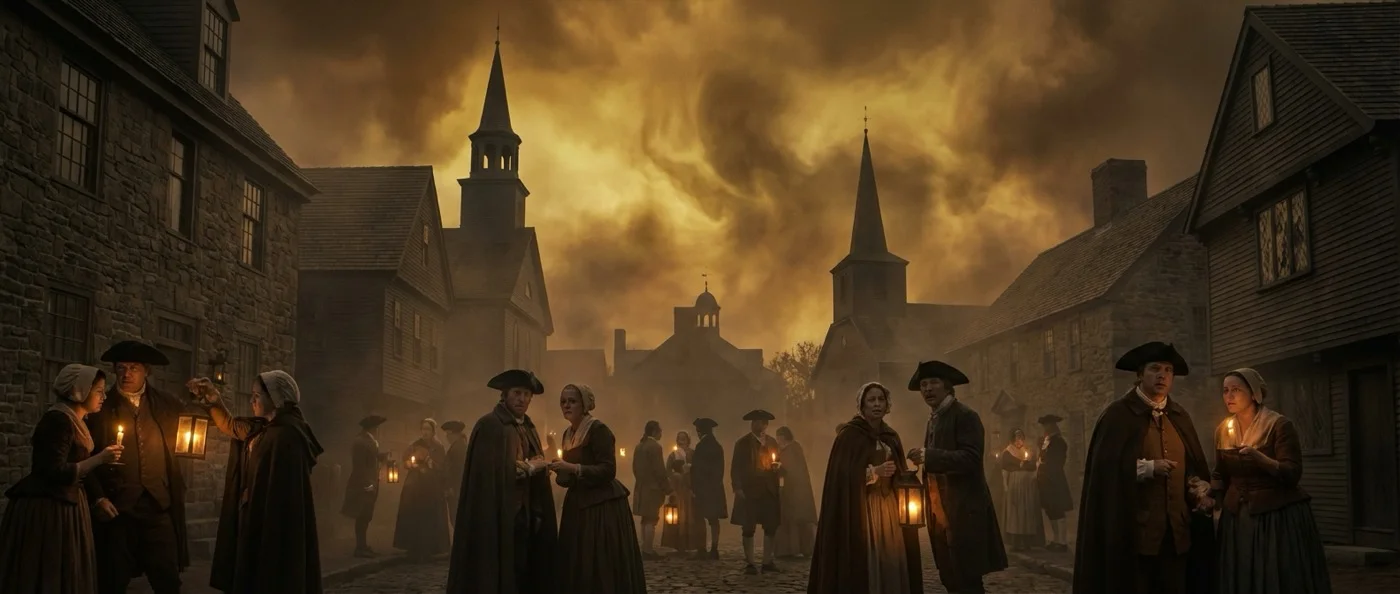
Imagine waking up to a perfectly normal morning. The sun rises, the birds sing, people head off to work. And then, without any warning, the sun goes out. Darkness. It's noon and you can't see your own hands. Roosters crow as if night has fallen, frogs begin to croak, candles are lit inside homes.
That is exactly what happened on May 19, 1780, across all of New England. But it wasn't the only time. A volcano in Indonesia managed, 35 years later, to erase an entire summer from the planet. And before all of that, in the 6th century, the world was plunged into darkness that lasted 18 months.
This is the story of the days the sun disappeared — and humanity came face to face with its most primal fear.
That is exactly what happened on May 19, 1780, across all of New England. But it wasn't the only time. A volcano in Indonesia managed, 35 years later, to erase an entire summer from the planet. And before all of that, in the 6th century, the world was plunged into darkness that lasted 18 months.
This is the story of the days the sun disappeared — and humanity came face to face with its most primal fear.
— i —
❧ ❧ ❧
Chapter One
May 19, 1780 — The Dark Day
A few days before May 19, 1780, something was wrong with the sky above New England. The sun appeared red. The sky was an eerie yellow. The air smelled of soot. But no one could have imagined what was to follow.
That morning, the first report of darkness came from Rupert, Vermont — the sun was already hidden at sunrise. In Cambridge, Massachusetts, Professor Samuel Williams of Harvard observed that "this extraordinary darkness came between 10 and 11 a.m. and continued until midnight." At Harvard College, the darkness peaked at 12:45 p.m.
The darkness was so thick that candles were needed from noon onward. Poultry returned to their roosts, roosters crowed, and whip-poor-wills — nocturnal birds — began their nighttime serenade. In Ipswich, at 2 p.m., people were living in total night.
That morning, the first report of darkness came from Rupert, Vermont — the sun was already hidden at sunrise. In Cambridge, Massachusetts, Professor Samuel Williams of Harvard observed that "this extraordinary darkness came between 10 and 11 a.m. and continued until midnight." At Harvard College, the darkness peaked at 12:45 p.m.
The darkness was so thick that candles were needed from noon onward. Poultry returned to their roosts, roosters crowed, and whip-poor-wills — nocturnal birds — began their nighttime serenade. In Ipswich, at 2 p.m., people were living in total night.
🌑 The extent: The darkness stretched at least from Portland, Maine in the north to New Jersey in the south. Soldier Joseph Plumb Martin recorded: "The poultry went to their roosts, the roosters crowed... people had to light candles in their homes to be able to carry on with their work."
— 1 —
❧ ❧ ❧
Chapter Two
"Judgment Day"
In a deeply religious era, the reaction was predictable: people believed the Apocalypse had come. Thousands of Americans, in the midst of the Revolutionary War, thought God was punishing them. Panic spread faster than the darkness.
In Connecticut, the state legislature was about to adjourn its session. Abraham Davenport, a member of the Governor's Council, stood up and spoke the words that would make him immortal:
And as if the day weren't enough, the night that followed was equally terrifying: the moon was blood red.
In Connecticut, the state legislature was about to adjourn its session. Abraham Davenport, a member of the Governor's Council, stood up and spoke the words that would make him immortal:
"I am against adjournment. The Day of Judgment is either approaching, or it is not. If it is not, there is no cause for an adjournment. If it is, I choose to be found doing my duty. I wish therefore that candles may be brought." — Abraham Davenport, Member of the Governor's Council of Connecticut, May 19, 1780
The poet John Greenleaf Whittier dedicated an entire poem to Davenport's courage. The Public Universal Friend, a religious leader, interpreted the phenomenon as the fulfillment of prophecies from the Book of Revelation. Ann Lee, founder of the Shakers, used the Dark Day as a springboard to publicly preach her religion.And as if the day weren't enough, the night that followed was equally terrifying: the moon was blood red.
— 2 —
❧ ❧ ❧
Chapter Three
What Really Happened
It wasn't the Apocalypse. It wasn't a solar eclipse. It wasn't a meteorite. It was fire — a massive, sprawling wildfire.
Researchers who examined tree rings and fire scars in the area now covered by Algonquin Provincial Park in Ontario, Canada, found clear evidence of a major fire in 1780. The smoke, combined with thick fog and cloud cover, created a suffocating layer over all of New England.
Eyewitnesses reported a strong smell of soot in the air. Rainwater had a thin film of burned leaf particles and ash. In some parts of New Hampshire, ash and charcoal covered the ground six inches deep. The gloomy sunset that followed — a terrifying red — was the result of light refracting through the smoke.
But the Dark Day of 1780, though terrifying, was relatively short-lived. Within 24 hours, the sun returned. History, however, had far worse examples in store.
Researchers who examined tree rings and fire scars in the area now covered by Algonquin Provincial Park in Ontario, Canada, found clear evidence of a major fire in 1780. The smoke, combined with thick fog and cloud cover, created a suffocating layer over all of New England.
Eyewitnesses reported a strong smell of soot in the air. Rainwater had a thin film of burned leaf particles and ash. In some parts of New Hampshire, ash and charcoal covered the ground six inches deep. The gloomy sunset that followed — a terrifying red — was the result of light refracting through the smoke.
But the Dark Day of 1780, though terrifying, was relatively short-lived. Within 24 hours, the sun returned. History, however, had far worse examples in store.
— 3 —
❧ ❧ ❧
Chapter Four
The Eruption That Killed Summer
On April 10, 1815, Mount Tambora on the island of Sumbawa in Indonesia erupted with a violence the planet hadn't witnessed in 1,300 years. With a Volcanic Explosivity Index of 7 (the scale goes up to 8), the eruption launched at least 37 cubic kilometers of material into the atmosphere.
Sulfate aerosol particles formed a veil in the stratosphere that blocked sunlight. The planet's average temperature dropped by 0.4 to 0.7 degrees Celsius. Sounds like little? It was enough to destroy entire harvests, starve millions of people, and alter the course of history.
The year 1816 became known as “The Year Without a Summer.” Snow fell in June in Albany, New York. Frost struck five consecutive nights in late June at Cape May, New Jersey. In Massachusetts, the physician Edward Holyoke recorded on June 7: "Exceedingly cold. The ground froze hard, and snowstorms throughout the day. Icicles twelve inches long in the shade at noon."
Sulfate aerosol particles formed a veil in the stratosphere that blocked sunlight. The planet's average temperature dropped by 0.4 to 0.7 degrees Celsius. Sounds like little? It was enough to destroy entire harvests, starve millions of people, and alter the course of history.
The year 1816 became known as “The Year Without a Summer.” Snow fell in June in Albany, New York. Frost struck five consecutive nights in late June at Cape May, New Jersey. In Massachusetts, the physician Edward Holyoke recorded on June 7: "Exceedingly cold. The ground froze hard, and snowstorms throughout the day. Icicles twelve inches long in the shade at noon."
🌡️ Numbers of terror: The price of oats skyrocketed from 12 cents to 92 cents per bushel. In Maryland, brown, blue, and yellow snow fell — stained by volcanic ash. In northern Italy, red snow fell throughout the year.
— 4 —
❧ ❧ ❧
Chapter Five
Famine, Plague, and Migration
Europe, still reeling from the Napoleonic Wars, was hit hardest. Failed harvests in Britain, Ireland, and France. Food riots in major cities — the worst since the French Revolution. Historian John D. Post called 1816 “the last great subsistence crisis of the Western world.”
Between 1816 and 1819, major typhus epidemics broke out in Ireland, Italy, Switzerland, and Scotland. More than 65,000 people died from the spread of the disease outside of Ireland alone. In Switzerland, an ice dam beneath the Giétro glacier in the Val de Bagnes collapsed in June 1818, killing 40 people.
In North America, thousands of families abandoned New England. Thomas Jefferson, already retired at Monticello in Virginia, suffered catastrophic crop losses that plunged him even deeper into debt. Vermont alone lost 10,000 to 15,000 residents, wiping out 7 years of population growth in just 2 years. Among those who left was the Smith family — their move to New York eventually led to the founding of the Church of Jesus Christ of Latter-day Saints.
Between 1816 and 1819, major typhus epidemics broke out in Ireland, Italy, Switzerland, and Scotland. More than 65,000 people died from the spread of the disease outside of Ireland alone. In Switzerland, an ice dam beneath the Giétro glacier in the Val de Bagnes collapsed in June 1818, killing 40 people.
In North America, thousands of families abandoned New England. Thomas Jefferson, already retired at Monticello in Virginia, suffered catastrophic crop losses that plunged him even deeper into debt. Vermont alone lost 10,000 to 15,000 residents, wiping out 7 years of population growth in just 2 years. Among those who left was the Smith family — their move to New York eventually led to the founding of the Church of Jesus Christ of Latter-day Saints.
— 5 —
❧ ❧ ❧
Chapter Six
Frankenstein, Vampires, and Bicycles
Every catastrophe gives birth to something. And the “Year Without a Summer” gave birth to some of the most iconic cultural creations in history.
In June 1816, “incessant rain” kept Mary Shelley, Percy Bysshe Shelley, Lord Byron, and John William Polidori confined inside the Villa Diodati near Geneva. Byron proposed a contest to write the most frightening story. Mary Shelley awoke one night with a vision of Victor Frankenstein kneeling over his monstrous creation — and so “Frankenstein” was born. Polidori, inspired by a fragment of Byron's writing, penned “The Vampyre” — the forerunner of Dracula.
Byron himself, on a day when "the poultry went to their roosts at noon and candles had to be lit as if it were midnight," wrote the poem "Darkness":
In June 1816, “incessant rain” kept Mary Shelley, Percy Bysshe Shelley, Lord Byron, and John William Polidori confined inside the Villa Diodati near Geneva. Byron proposed a contest to write the most frightening story. Mary Shelley awoke one night with a vision of Victor Frankenstein kneeling over his monstrous creation — and so “Frankenstein” was born. Polidori, inspired by a fragment of Byron's writing, penned “The Vampyre” — the forerunner of Dracula.
Byron himself, on a day when "the poultry went to their roosts at noon and candles had to be lit as if it were midnight," wrote the poem "Darkness":
"I had a dream, which was not all a dream. / The bright sun was extinguish'd, and the stars / Did wander darkling in the eternal space, / Rayless, and pathless, and the icy earth / Swung blind and blackening in the moonless air; / Morn came and went — and came, and brought no day." — Lord Byron, “Darkness”, 1816
And one more thing: the shortage of oats for horses pushed the German inventor Karl Drais to seek alternative means of transportation. The result? The draisine — the ancestor of the bicycle. A volcano in Indonesia gave the world Frankenstein, vampires, and the bicycle.— 6 —
❧ ❧ ❧
Chapter Seven
536 AD — The Worst Year in History
But if you think 1780 or 1816 were terrifying, you haven't heard about 536 AD. Medievalist Michael McCormick called it “the worst year to be alive” — and rightfully so.
A mysterious cloud blanketed the sky over all of Europe, the Middle East, and parts of Asia for 18 months. The Byzantine historian Procopius wrote: "The sun gave forth its light without brightness, like the moon, during this whole year." Temperatures dropped by 1.5–2.5°C. Snow fell in August in China. Drought, famine, and plague followed.
The cause? Most likely a volcanic eruption — possibly Krakatoa or Ilopango in El Salvador. Ice core analyses revealed massive amounts of sulfuric acid in the atmosphere that year. The dark sky of 536 did not come alone: a second eruption followed in 540, and then the Plague of Justinian in 541 — the first major plague pandemic in history, which killed 25 to 50 million people.
The decade of 536–546 was the darkest, coldest, and most lethal period in at least the last 2,000 years.
A mysterious cloud blanketed the sky over all of Europe, the Middle East, and parts of Asia for 18 months. The Byzantine historian Procopius wrote: "The sun gave forth its light without brightness, like the moon, during this whole year." Temperatures dropped by 1.5–2.5°C. Snow fell in August in China. Drought, famine, and plague followed.
The cause? Most likely a volcanic eruption — possibly Krakatoa or Ilopango in El Salvador. Ice core analyses revealed massive amounts of sulfuric acid in the atmosphere that year. The dark sky of 536 did not come alone: a second eruption followed in 540, and then the Plague of Justinian in 541 — the first major plague pandemic in history, which killed 25 to 50 million people.
The decade of 536–546 was the darkest, coldest, and most lethal period in at least the last 2,000 years.
— 7 —
❧ ❧ ❧
Chapter Eight
The Paintings and the Dawns
One of the most poetic secondary effects of these catastrophes was their impact on art. The high levels of ash in the atmosphere created sunsets unusually rich in red hues — and painters captured them.
A 2007 study that analyzed paintings from 1500 to 1900 found a clear correlation between volcanic activity and the use of red pigments. J.M.W. Turner, one of the most important British painters, captured the stunning sunsets that followed the eruptions — paintings such as “Chichester Canal” (1828) display a yellow light absent from his earlier works. Caspar David Friedrich, in his paintings before and after the Tambora eruption, shows a dramatic shift: darker, more melancholic scenes, even under sunlight.
Similar phenomena were observed after the eruption of Krakatoa in 1883 — the sunsets were so spectacular that Edvard Munch is believed to have drawn inspiration for the sky in “The Scream” from them. And after the eruption of Pinatubo in 1991 in the Philippines, the planet cooled by half a degree — this time with cameras recording everything.
A 2007 study that analyzed paintings from 1500 to 1900 found a clear correlation between volcanic activity and the use of red pigments. J.M.W. Turner, one of the most important British painters, captured the stunning sunsets that followed the eruptions — paintings such as “Chichester Canal” (1828) display a yellow light absent from his earlier works. Caspar David Friedrich, in his paintings before and after the Tambora eruption, shows a dramatic shift: darker, more melancholic scenes, even under sunlight.
Similar phenomena were observed after the eruption of Krakatoa in 1883 — the sunsets were so spectacular that Edvard Munch is believed to have drawn inspiration for the sky in “The Scream” from them. And after the eruption of Pinatubo in 1991 in the Philippines, the planet cooled by half a degree — this time with cameras recording everything.
— 8 —
❧ ❧ ❧
Epilogue
The Fragility of Light
We take the sun for granted. Every morning it rises, every evening it sets, and we never consider that it might not appear. But history tells us something different: the sun doesn't vanish only in Hollywood movies.
A wildfire in Canada darkened all of New England. A volcano in Indonesia erased an entire summer from the planet, even though it was 14,000 kilometers away. A mysterious eruption in the 6th century killed tens of millions through famine and plague.
Today, NASA monitors every active volcano on Earth. Satellites measure the composition of the atmosphere in real time. But if a Tambora-scale volcano erupted tomorrow, we would be able to do little more than what our ancestors did: light candles and wait for the sun.
And perhaps that is the real darkness — not the kind in the sky, but the reminder that our planet, for all the marvelous technology we have built, remains at the mercy of forces far greater than ourselves.
A wildfire in Canada darkened all of New England. A volcano in Indonesia erased an entire summer from the planet, even though it was 14,000 kilometers away. A mysterious eruption in the 6th century killed tens of millions through famine and plague.
Today, NASA monitors every active volcano on Earth. Satellites measure the composition of the atmosphere in real time. But if a Tambora-scale volcano erupted tomorrow, we would be able to do little more than what our ancestors did: light candles and wait for the sun.
And perhaps that is the real darkness — not the kind in the sky, but the reminder that our planet, for all the marvelous technology we have built, remains at the mercy of forces far greater than ourselves.
— the end —
· · · · ·
📖 Read more: Timothy Dexter: The Luckiest Fool in History