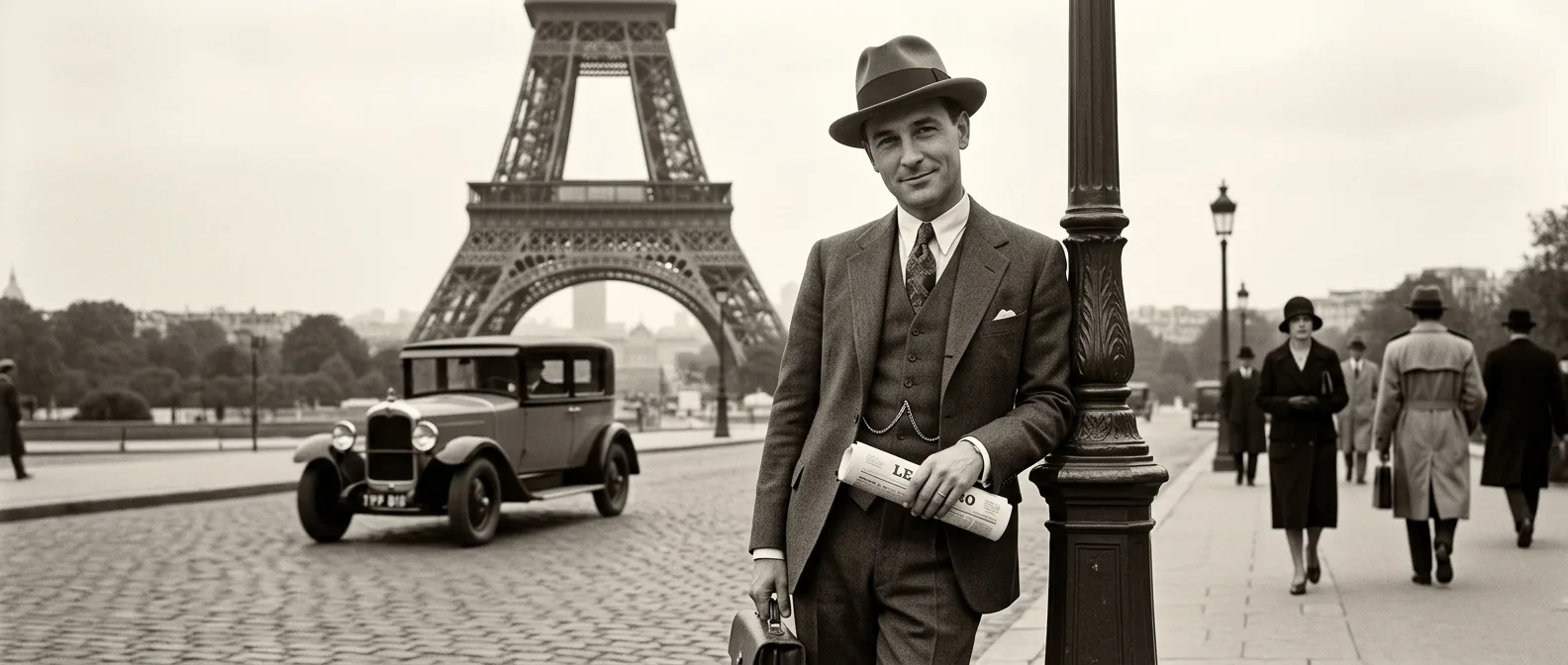
The Con Artist of the Century
How Victor Lustig sold the Eiffel Tower — twice
📖 Read more: How an Italian Stole the Mona Lisa
The count with five names
He was born Robert V. Miller in 1890 in Hostinné, Bohemia — then part of Austria-Hungary, now the Czech Republic. He spoke five languages fluently: Czech, German, English, French, and Italian. He studied design at a boarding school in Dresden before enrolling at the Sorbonne in Paris, where he discovered gambling — and acquired a distinctive scar on his left cheek, courtesy of the jealous boyfriend of a woman he had been seeing. By the age of 20, he had already assumed at least 47 different identities. The world knew him as “Count Victor Lustig” — a fabricated aristocratic name he wore like a Savile Row suit.
From a young age, Lustig understood something fundamental: people aren't deceived by lies — they're deceived by truths they want to believe. He started by swindling wealthy passengers on ocean liners, selling a machine that supposedly duplicated banknotes — the “Romanian Money Box.” He'd demonstrate it (using pre-loaded real bills), sell the box for thousands, and vanish before the buyer discovered it only produced blank paper. The “Romanian Box” was a mahogany chest the size of a steamer trunk, with fake levers and two slots — one for the original bill and one for the “copy.” The machine supposedly needed six hours per print — more than enough time for Lustig to disappear.
But these were modest beginnings. Lustig dreamed of something bigger. Something monumental. Something that would become legend.
A newspaper, an idea
In May 1925, Lustig sat in a Parisian café reading the newspapers, as he did every morning, scanning for opportunities. A small article caught his eye: the Eiffel Tower needed expensive repairs. The French government was struggling to fund its maintenance. There were still voices calling for its demolition — after all, the Tower had been built as a temporary structure for the 1889 World's Fair. Many Parisians considered it an architectural monstrosity. The writer Guy de Maupassant reportedly ate lunch at the Tower's restaurant every day — because it was the only place in Paris where he couldn't see it. The antipathy was real, and Lustig knew it well.
Lustig folded the newspaper. He smiled. He had just found the world's biggest "money box": 7,000 tons of iron standing in Paris that nobody particularly wanted. If the government was seriously considering selling it for scrap... why not sell it first?
“The best scam isn't one that nobody believes. It's one that nobody questions.” — Victor Lustig
📖 Read more: Theranos: The Billion-Dollar Company That Didn't Exist
Dinner at the Hôtel de Crillon
Lustig forged official government stationery and invited five of Paris's largest scrap metal dealers to a “confidential” meeting at the luxurious Hôtel de Crillon, right on the Place de la Concorde. The choice was deliberate — the Crillon was one of the city's most aristocratic hotels, the perfect setting for a “government official.”
He wasn't alone: he had brought along Dan Collins, known as “Dapper Dan,” a professional accomplice who played the role of secretary. Lustig introduced himself as the Deputy Director General of the Ministry of Posts and Telegraphs — the ministry that actually oversaw the Tower. He explained with a grave expression that the government had secretly decided to sell the Eiffel Tower for scrap. The announcement would come later — but first, they wanted bids from reputable dealers.
He even took them on an “inspection tour” of the Tower. In a government limousine. He showed them the rusty sections. Discussed maintenance costs. His speech included arguments that sounded perfectly logical: the Tower was a foreign body among the Gothic monuments, the cathedrals, and the Arc de Triomphe. The five dealers looked at 7,000 tons of iron and saw millions.
André Poisson pays up
Lustig identified his mark immediately: André Poisson, a relative newcomer to the industry who was struggling to establish himself among the bigger dealers. Poisson was anxious, insecure, eager. Perfect.
But Poisson hesitated. Something felt off — the secrecy, the pressure, the speed. This is where Lustig played his masterstroke: in a private meeting, he “confessed” to Poisson that a government official's salary was inadequate. That he was struggling financially. That a “gift of gratitude” would be... welcome.
This was brilliant. A real government official would never ask for a bribe — but a government official in 1920s France? Of course he would. The request for a bribe didn't increase Poisson's suspicions — it eliminated them. If he's asking for a kickback, Poisson thought, he must be real.
Poisson's wife, according to some accounts, expressed doubts. Something didn't feel right to her — the rush, the secrecy. But André ignored her. Ambition was stronger than reason.
📖 Read more: Frank Abagnale: Pilot, Doctor, None of the Above
Poisson paid approximately 70,000 francs (equivalent to millions today) for the “Eiffel Tower,” plus a generous “gift.” Lustig took the money and caught the first train to Vienna.
Act two: all over again
From Vienna, Lustig monitored the French newspapers. He waited for the headlines: “DEALER SWINDLED — EIFFEL TOWER SOLD BY FRAUD.” But they never came. Poisson was too embarrassed to go to the police. Revealing he'd been conned would destroy his reputation in the market. Silence.
And then Lustig decided something outrageous: he would do it again. He returned to Paris, prepared the same forged letters, found five new scrap dealers, and walked back into the Hôtel de Crillon with the same role: the “government official” selling the Tower.
The second time, however, his mark was more suspicious. He went to the police. Lustig, who always had an escape plan, vanished before they could arrest him and crossed into America.
“If you can't trust a con man, who can you trust?” — Victor Lustig
The man who conned Al Capone
In America, Lustig found new victims — and new dangers. The Great Depression had just begun, and even the most powerful were looking for “sure-fire” investments. His boldest move? He went straight to Al Capone, the most dangerous gangster in America, and asked for $50,000 for a “sure-fire investment.”
Capone, enthusiastic, handed over the money. Lustig locked it in a safe for two months. Then he returned to Capone, told him the “investment” had fallen through, and returned the entire sum. Capone, impressed by his honesty, gave him $5,000 as “compensation” for his trouble. That $5,000 had been the real target all along.
📖 Read more: The History of Information: Who Controls What We Know
Lustig didn't con Capone by stealing money. He conned him by making him feel he'd found the most honest man in the world. It was perhaps the most dangerous con he ever attempted — Capone killed people for far less. But Lustig understood that a gangster's weakness isn't money — it's trust.
The fall of the count
Lustig's luck ran out not because of some grand scam, but because of counterfeiting — the most pedestrian of his activities. Together with his partners William Watts and Tom Shaw, he had built a counterfeiting network that pumped thousands of fake dollars into the economy every month for five years. The Secret Service was closing in — but what ultimately brought him down wasn't a detective. It was his mistress, Billy May, who discovered he was cheating on her with a younger woman. She placed an anonymous call to federal authorities and led them straight to him.
He was arrested in 1935. Held at the Federal Detention Center in Manhattan. And then he did something that fit perfectly: he fashioned a rope from bed sheets and climbed down 27 stories — in the middle of the day, while a cleaning woman washed the windows. Nobody noticed.
He was recaptured 27 days later in Pittsburgh. In his locker at the Times Square subway station, agents found $51,000 in counterfeit bills and the printing plates used to make them. Sentenced to 20 years at Alcatraz — the same prison as Al Capone. He died of pneumonia in 1947 at Springfield, Missouri federal prison. He died on March 11, 1947, at the age of 57. On his death certificate, under “occupation,” it reads: “apprentice salesman.” Even in death, his true identity remained a lie.
— The End —