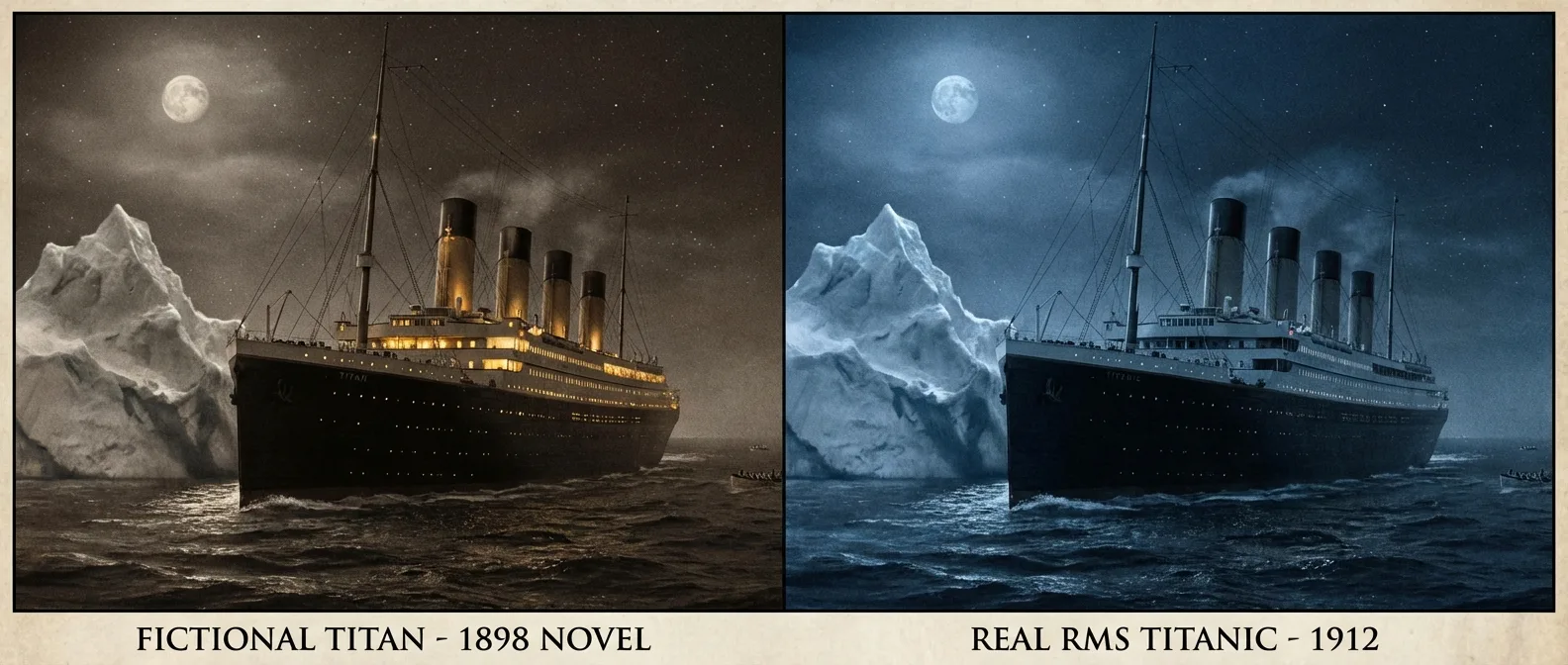
"Futility, or the Wreck of the Titan"
How an 1898 novella described with chilling accuracy the sinking of a ship that hadn't been built yet
📖 Read more: Molly Brown: The Unsinkable Woman of the Titanic
A book that shouldn't exist
In January 1898, a virtually unknown American author published a slim novella — a story that, on the surface, reads like just another maritime drama of the era. Morgan Robertson, the son of a ship captain from Oswego, New York, wrote “Futility” — a tale about the largest ship ever built. He called it the “Titan.” Fourteen years later, in April 1912, the real world would mirror his imagination in a way nobody could have predicted.
This isn't simply a case of matching names. Robertson didn't just “guess” a shipwreck. He described details so specific that when the Titanic sank fourteen years later, readers flipped through Robertson's pages with their mouths hanging open. The vessel's size, the manner of sinking, the season of the voyage, even the shortage of lifeboats — it was all there, written in ink long before the first steel plate of the Titanic was hammered into shape at the Belfast shipyard.
How can something like this be explained? Was Robertson a visionary? A lucky guesser? Or does the story of “Futility” reveal something deeper about the relationship between imagination, knowledge, and fate?
The writer who knew the sea
Morgan Andrew Robertson was born on September 30, 1861, in Oswego, New York, a port town on the shores of Lake Ontario. His father, Andrew Robertson, was a Great Lakes ship captain — a man who smelled of salt and engine oil. Growing up beside the docks, young Morgan didn't have many choices: by the age of 16, he had already shipped out as a common sailor.
For over a decade, Robertson traveled the oceans. He started as a deckhand and worked his way up to first mate. He understood how ships were constructed, how engines operated, how steel behaved in the frigid waters of the North Atlantic. Unlike many writers of sea adventures, Robertson didn't imagine the ocean from the comfort of a library — he had lived it in his very bones.
Around 1893, his eyesight began to deteriorate dramatically. Forced to abandon the sea, he turned to writing. He had already published a few short stories in magazines, but “Futility” would become his first significant work. He sat down in his small New York apartment and began writing a story based on what he knew best: ships, oceans, and hubris.
"I was no prophet. I was a sailor. I knew ships, I knew the sea. I simply wrote what I knew." — Morgan Robertson
Robertson later claimed that ideas “found him” — that some form of transcendent inspiration guided his hand. The reality, however, was more mundane and perhaps more impressive: he possessed an exceptional ability to combine technical knowledge of shipbuilding with the trends he observed in the maritime industry.
The plot of “Futility”
The novella tells the story of a vessel called the “Titan” — the largest and most luxurious ocean liner ever constructed. It is deemed unsinkable. It departs from America's eastern coast heading for Britain, carrying the wealthiest and most powerful people of the age. One evening in April, traveling at high speed through frozen North Atlantic waters, the Titan strikes an iceberg on its starboard side.
The ship sinks rapidly. And the lifeboats aren't enough — there were barely any, because who needs lifeboats on an unsinkable ship? Thousands of passengers are left behind. It is a disaster that is simultaneously a technological fiasco and a moral crisis — the arrogance of an era that believed mankind had conquered nature.
The protagonist, John Rowland, is a former naval officer who has fallen into alcoholism and now works as a lowly crew member aboard the Titan. During the sinking, he rescues a young girl — the daughter of a woman he once loved — and manages to survive clinging to a chunk of ice alongside a polar bear, in a scene that would be unbearably melodramatic if reality hadn't followed it in the most tragic way possible.
The breathtaking similarities
Place the details of the Titan (fiction) and the Titanic (reality) side by side, and the list of parallels sends a chill down your spine. These aren't vague correspondences. These are technical specifications, numbers, and details that shouldn't match so closely — and yet they do.
| Feature | Titan (1898) | Titanic (1912) |
|---|---|---|
| Ship name | Titan | Titanic |
| Description | "Unsinkable" | "Practically unsinkable" |
| Length | ~243 m (800 ft) | ~269 m (882 ft) |
| Displacement | ~45,000 tons | ~52,310 tons |
| Number of propellers | 3 | 3 |
| Speed at collision | 25 knots | 22.5 knots |
| Month of disaster | April | April |
| Cause of sinking | Iceberg (starboard) | Iceberg (starboard) |
| Lifeboats | 24 (insufficient) | 20 (insufficient) |
| Passengers | ~3,000 | ~2,224 |
| Ship's nationality | British | British |
Looking at this table, it's natural to feel awe. There are far too many details that line up — well beyond what you'd expect statistically. However, before rushing to embrace explanations of prophecy, it's worth digging deeper. Because the truth in this story isn't found in the supernatural — it's found somewhere far more interesting.
Coincidence, knowledge, or prophecy?
The answer to the first question everyone asks — “How did he know?” — lies hidden in Robertson's biography. This man wasn't a typical literary figure. He was a former sailor who tracked developments in shipbuilding with precision. In the late 19th century, the trend was clear: ships were growing ever larger, faster, and more luxurious.
The “race” between shipping companies — Cunard, White Star Line, Hamburg America Line — for the title of the world's biggest ship was no secret. Any well-informed sailor could extrapolate the specifications of an ocean liner that would be constructed within 10 to 15 years. The size, the speed, the number of propellers — these weren't magical guesses. They were logical conclusions.
"Robertson didn't predict the Titanic. He calculated the Titanic. That's far more unsettling." — Maritime history analyst
The iceberg collision? Icebergs were every captain's known nightmare in the North Atlantic. There was no radar, no sonar. A moonless night, calm seas with no waves — an iceberg could be invisible until it was too late. A sailor-turned-writer didn't need supernatural powers to imagine such a scenario. He only needed experience.
The shortage of lifeboats was even easier to foresee. In the late 19th century, safety regulations weren't updated to match larger vessels. A 10,000-ton ship required the same number of lifesaving equipment as a 50,000-ton one. Robertson, as a practical seaman, knew about this absurd gap — and exploited it dramatically in his novella.
📖 Read more: Antikythera Mechanism: A 2,000-Year-Old Computer
The night fiction became nightmare
On April 14, 1912, at 11:40 PM, the RMS Titanic — the largest ship in the world, called “practically unsinkable” — struck an iceberg in the North Atlantic. Everything matched what Robertson had written fourteen years earlier. A British vessel. Three propellers. Enormous size. An April crossing. A collision with an iceberg on the starboard side. Insufficient lifeboats.
In less than three hours, the Titanic sank. Of the 2,224 passengers and crew, only 710 survived. More than 1,500 people perished in the freezing Atlantic waters, where the sea temperature hovered around -2°C. Most didn't drown — they died of hypothermia within minutes.
The disaster shocked the world. And almost immediately, someone remembered “Futility.” Newspapers began referencing Robertson's book. The author himself, who had been living in relative obscurity, was suddenly thrust into the spotlight — but not in the way he would have wanted. They didn't call him a visionary. They called him “the man who knew.”
The weight of responsibility was enormous: how could the industry have ignored dangers that even a novelist could see? The White Star Line, the company that built the Titanic, wanted nothing to do with Robertson. The existence of a book that had “predicted” everything undermined the narrative that the catastrophe was “impossible to foresee.”
The differences nobody mentions
In our eagerness to find mystery, we forget the significant differences between reality and fiction — and those deserve just as much attention. First, the direction of travel: the Titan sailed from New York toward Britain, while the Titanic traveled the opposite way — from Southampton to New York, on its maiden voyage.
Second, in the novella, the collision with the iceberg was nearly head-on — the Titan struck it directly. The Titanic, however, scraped along the iceberg's side, opening a long gash in the hull — a far more insidious kind of damage. Third, Robertson imagined fewer deaths: in the novella there are survivors rescued through sensational adventures, while in reality the carnage was far worse.
Finally, a crucial detail: Robertson published a revised edition after the Titanic's sinking in 1912, changing certain technical specifications to match even more closely. In the original 1898 edition, the Titan's displacement was 45,000 tons and its length 800 feet. In the revised version, these increased to 70,000 tons and 880 feet — suspiciously close to the Titanic's 66,000 tons and 882 feet.
The forgotten prophet
If you're expecting a story of vindication — Robertson becoming famous, wealthy, recognized — prepare for disappointment. The Titanic's sinking brought him briefly into the light, but the glory passed quickly. Nobody truly wanted to deal with the man who had “seen” the catastrophe. It was more convenient to blame bad luck, the ice, or fate.
Robertson continued writing. He published stories of maritime adventure, but never managed to escape the shadow of “Futility.” He lived in difficult financial circumstances, battled declining health, and suffered ever-worsening eyesight. In an irony that would suit a novel, Robertson died on March 24, 1915, at the age of just 53 — alone, in a hotel room in Atlantic City.
He was found dead, standing upright beside his bed according to some accounts. The cause of death was cardiac arrest. There was no grand funeral, no newspaper headlines. The man who had written one of the most “prophetic” texts in literary history died in silence.
Yet his legacy lives on. “Futility” is regularly reprinted, discussed in documentaries and textbooks. Robertson's story reminds us of something important: sometimes, the people who see danger first are never heard in time — even if they shout it from every mountaintop.
The line between fiction and reality
The story of “Futility” isn't just a historical curiosity. It's a reminder that the boundary between imagination and reality is more fluid than we think. Robertson didn't have a crystal ball — he had knowledge, experience, and a restless imagination. And that was enough.
Perhaps the real lesson isn't that literature can “predict” the future. Perhaps the lesson is that, sometimes, fiction shows us truths we don't want to face — and we dismiss them as “fantasy” until it's too late. The 1,500 victims of the Titanic didn't need to read “Futility” to be saved. All it took was for someone to have listened to Robertson — and that never happened.
"Fiction doesn't predict the future. It illuminates the paths we're already walking."
Morgan Robertson was many things: a sailor, a writer, a visionary, a failure. But above all, he was a man who looked at the sea and saw what everyone else refused to see. And that, in the end, isn't prophecy. It's courage.
— The End —
📚 Sources: Biography.com — Morgan Robertson · Britannica — RMS Titanic